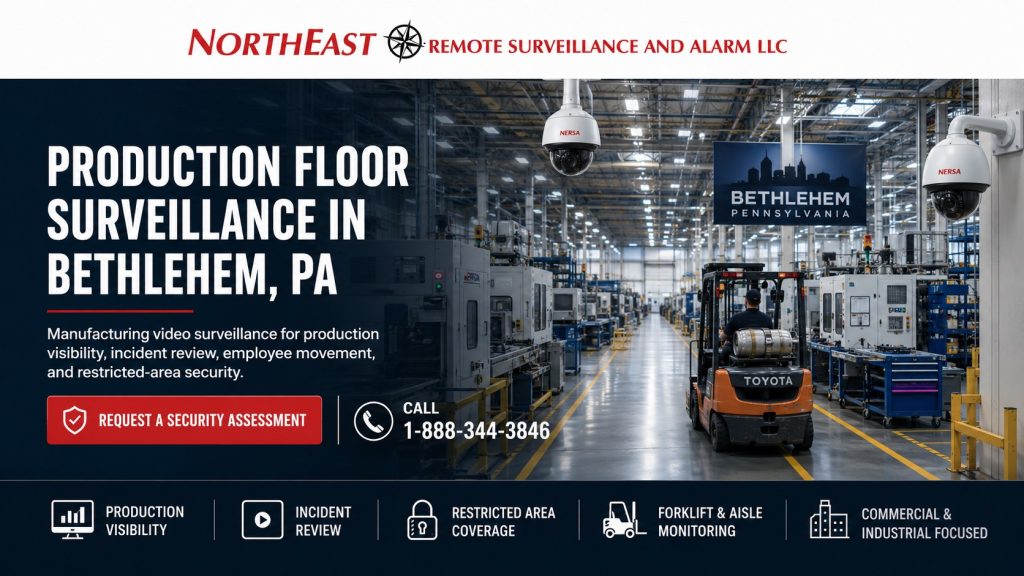
Production floor surveillance in Bethlehem, PA should be planned around manufacturing activity, machinery zones, employee movement, forklift routes, quality-control areas, restricted spaces, and incident review. Northeast Remote Surveillance and Alarm, LLC designs commercial and industrial video surveillance systems for Bethlehem manufacturing plants, production facilities, warehouse-connected operations, industrial buildings, and multi-building sites. For broader plant-wide security planning, start with Manufacturing & Industrial Security Systems in Bethlehem, PA.

Production Floor Surveillance for Bethlehem Manufacturing Facilities
Production floor surveillance is not the same as placing a few generic cameras inside a building. A manufacturing floor has movement, noise, equipment, material flow, shift changes, restricted areas, production schedules, and safety-sensitive activity that must be considered before cameras are installed.
A strong production floor camera layout should help managers see important activity, review incidents, support safety documentation, understand how people and materials move through the space, and protect critical areas without interfering with daily operations.
Northeast Remote Surveillance and Alarm, LLC does not install residential systems. Our focus is commercial, industrial, municipal, institutional, warehouse, manufacturing, logistics, healthcare, and enterprise environments where system design, infrastructure, reliability, documentation, and long-term support matter.
Why Production Floor Surveillance Needs a Different Design
Production floors are active environments. Employees may move between machines, supervisors may oversee multiple work areas, forklifts may cross pedestrian paths, raw materials may move into production, finished goods may move toward packaging, and contractors may enter controlled areas for maintenance or service.
A production floor surveillance system should account for:
Production lines
Machinery zones
Operator stations
Forklift routes
Pedestrian walkways
Material staging areas
Tool and maintenance areas
Quality-control areas
Shipping and production transition points
Restricted production rooms
Utility and equipment spaces
Employee entrances into the floor
Office-to-production doors
After-hours production exposure
Incident review needs
A properly designed system gives the facility better visibility without creating unnecessary blind spots, poor angles, unusable footage, or cameras that fail to capture the activity that matters.
Camera Placement Around Machinery and Production Lines
Camera placement matters more than camera count. A manufacturing facility may have large open areas, machinery obstructions, overhead utilities, lighting glare, moving equipment, high ceilings, dust, vibration, and changing production layouts.
Production floor cameras should be placed to capture useful views of activity, not just wide images of the room. Depending on the facility, this may include line overview cameras, focused views of key process areas, cameras near operator stations, views of material movement, and coverage of important transition points.
A proper layout should consider:
Camera height
Viewing angle
Lighting conditions
Lens selection
Equipment obstructions
Maintenance access
Cable pathways
Network location
Recording needs
Future line changes
Serviceability
The goal is footage that can actually be used after an incident, not a camera system that only looks complete on paper.
Forklift, Aisle, and Material Movement Visibility
Many production floor incidents involve movement. Forklifts, pallet jacks, carts, raw materials, packaging, finished goods, tools, maintenance equipment, and employees may all move through the same general areas during a shift.
Surveillance can help document movement around:
- Forklift intersections
- Blind corners
- Production aisles
- Staging areas
- Raw material movement
- Finished goods transfer
- Packaging zones
- Warehouse-to-production openings
- Shipping and receiving transition areas
- Maintenance routes
- Pedestrian walkways
Good camera coverage can help a facility review what happened before, during, and after an event. That can be useful for safety review, damage review, operational questions, training discussions, and management documentation.
Employee Entrances and Production Floor Access
Production floors often need controlled movement. Not every employee, vendor, visitor, driver, contractor, or office worker should have unrestricted access to every production area.
Cameras should be considered around production-floor entrances, employee entry points, office-to-floor doors, tool rooms, maintenance rooms, restricted production areas, utility rooms, chemical or material storage spaces, and other sensitive areas.
When production floor cameras are coordinated with access control, a facility can better understand who entered an area, when they entered, and what activity occurred around that time. For broader controlled-door planning, use Commercial & Industrial Access Control Systems.
Safety Review and Incident Documentation
Production floor surveillance can support workplace safety review by helping managers understand the sequence of events around an incident. Cameras can help document forklift contact, slips, trips, falls, struck-object events, machine-area activity, near misses, unauthorized access, and other operational concerns.
Surveillance does not replace a safety program, employee training, supervision, written policies, or regulatory responsibility. It provides visual documentation that can help responsible teams review what occurred and make better decisions.
A strong system should make incident review easier by providing:
- Clear camera naming
- Logical camera groups
- Reliable recording
- Proper retention
- Secure user access
- Searchable footage
- Export capability
- Time accuracy
- Documented system layout
When an incident occurs, facility leaders should not have to guess which camera matters or whether the footage was recorded.
Quality-Control and Process Review Visibility
Production floor cameras may also help facilities review process-related questions. This can include product movement, packaging activity, material staging, workflow bottlenecks, equipment-area activity, or whether a process step occurred at a specific time.
The goal is not to replace supervisors or production systems. The goal is to provide visual context when questions arise.
Production floor surveillance may support review around:
- Line activity
- Batch movement
- Packaging areas
- Quality-control stations
- Material handling
- Finished goods movement
- Tool usage
- Maintenance access
- Shift-change activity
- Equipment-area traffic
For broader camera planning across commercial and industrial facilities, use Industrial Video Surveillance Systems.
AI Video Analytics on Production Floors
AI video analytics can help some production environments review activity faster, but it should be planned carefully. A manufacturing floor is not the same as a quiet office hallway or an exterior parking lot. Motion, machinery, forklifts, lighting changes, people, materials, and reflections can create unnecessary alerts if analytics are not planned correctly.
Useful analytics may include people detection, vehicle detection, line crossing, restricted-area alerts, object search, motion filtering, after-hours activity review, and faster event search.
AI should be used where it improves review and response. It should not be treated as a magic replacement for proper camera placement, lighting, recording, user training, or operational planning.
After-Hours Production Area Awareness
Some Bethlehem facilities need visibility after the production floor is closed, lightly staffed, or operating with limited supervision. After-hours production-floor surveillance may help review movement around equipment areas, restricted rooms, employee entrances, maintenance spaces, utility areas, and warehouse-connected openings.
If live review or active response is needed, production floor cameras can be planned as part of a broader monitoring strategy. Not every interior camera needs live monitoring, and not every production area is appropriate for the same response workflow.
The correct design depends on the facility’s operating hours, staffing, security policy, restricted areas, alarm system, camera locations, and response expectations.
Integration With Alarms, Access Control, and Unified Security
Production floor surveillance becomes more valuable when it is planned with the rest of the facility’s security systems. Cameras can support access control events, intrusion alarms, restricted-area activity, after-hours movement, intercom use, and incident review.
A facility may need cameras tied to:
- Employee entrance activity
- Restricted-area access
- Held-open doors
- Forced-door events
- After-hours alarms
- Maintenance room access
- Utility room access
- Production-floor intrusion zones
- Warehouse transition points
- Multi-building activity
For facilities that need cameras, access control, alarms, intercoms, monitoring, analytics, and management platforms working together, use Commercial & Enterprise Unified Integrated Security Systems.
Low-Voltage Infrastructure and Camera Reliability
Production floor surveillance depends on reliable infrastructure. Cameras, recording equipment, switches, fiber, wireless bridges, power supplies, UPS systems, racks, cable pathways, and network design all affect long-term performance.
Industrial facilities may require careful planning around long cable runs, high ceilings, conduit, lift access, network closets, equipment rooms, production shutdown windows, dust, heat, vibration, and service access.
A good installation should leave the system organized, labeled, documented, and serviceable. Poor infrastructure can turn a camera system into a long-term maintenance problem, even when the cameras themselves are high quality.
Secure Remote Access and User Permissions
Production floor video should be managed carefully. Facility owners and managers should know who has access to live video, recorded footage, exports, administrative settings, and mobile viewing.
A proper system should support user permissions based on role and responsibility. Production managers, safety managers, facility leaders, ownership, HR, IT, and security teams may not all need the same level of access.
Good planning may include:
- Role-based user access
- Limited administrative permissions
- Secure remote viewing
- Password control
- Multi-user accountability
- Export rules
- Footage retention planning
- Camera naming standards
- Documentation for future service
The system should help the business maintain control over sensitive operational footage.
Responsible Camera Placement and Privacy Awareness
Production floor surveillance should be planned responsibly. Cameras should focus on operationally important areas, safety-sensitive movement, access points, restricted spaces, material flow, and incident review needs.
Cameras should not be placed in private areas such as restrooms, locker rooms, changing areas, or other locations where privacy expectations make surveillance inappropriate.
Businesses should also consider employee policies, signage, labor rules, privacy obligations, and legal requirements that may apply to their specific operation. Northeast Remote Surveillance and Alarm, LLC designs and installs commercial security systems, but legal, employment, and privacy policy decisions should be reviewed by the facility’s qualified advisors.
Production Floor Surveillance for Multi-Building Facilities
Some Bethlehem manufacturing properties include more than one building, separated production areas, warehouse-connected spaces, detached utility rooms, outside equipment areas, or multiple tenant or department zones.
In those environments, production floor surveillance should be planned as part of a larger site layout. The design may need to account for separate recording locations, network paths, fiber connections, user permissions, building-to-building visibility, and future expansion.
Multi-building planning should make the system easier to manage over time, not harder. A facility should be able to identify cameras, review footage, add coverage, and service equipment without confusion.
What This Page Does Not Cover
This page is focused only on production floor surveillance in Bethlehem, PA. It is intended for manufacturing plants, production facilities, industrial buildings, warehouse-connected operations, machinery areas, process areas, employee movement zones, and incident review points.
It is not the full Bethlehem manufacturing security page. It is not the full commercial video surveillance page. It is not the full access control page. It is not the full intrusion alarm page. It is not the full fire alarm page. It is not the full remote monitoring page. It is not a general warehouse security page or a full industrial park security page.
Facilities that need broader Bethlehem industrial security planning should return to the Manufacturing & Industrial Security Systems in Bethlehem, PA page.
Request a Production Floor Surveillance Assessment in Bethlehem, PA
If your Bethlehem manufacturing facility needs better production-floor visibility, machinery-area cameras, forklift-route review, restricted-area coverage, employee entrance documentation, process-area visibility, after-hours awareness, secure footage access, or integration with access control and alarms, Northeast Remote Surveillance and Alarm, LLC can help evaluate the property and recommend the right system design.
A proper assessment should review production activity, camera views, lighting, ceiling height, machine layout, forklift movement, employee routes, restricted areas, storage requirements, network infrastructure, recording needs, and long-term service expectations.
Request a Security Assessment or call 1-888-344-3846 to discuss production floor surveillance in Bethlehem, PA.
Frequently Asked Questions About Production Floor Surveillance in Bethlehem, PA
What is production floor surveillance?
Production floor surveillance is a camera system designed to improve visibility around manufacturing areas, machinery zones, production lines, employee movement, forklift routes, material handling, restricted areas, and incident review points.
Why do Bethlehem manufacturing facilities need production floor cameras?
Bethlehem manufacturing facilities may need production floor cameras to document incidents, improve operational visibility, review forklift movement, protect restricted areas, support safety review, and provide better visibility across active production spaces.
Where should cameras be placed on a production floor?
Common camera locations include production lines, machinery areas, forklift intersections, employee entrances, material staging zones, quality-control areas, maintenance spaces, tool rooms, warehouse transition points, and restricted production areas.
Can cameras help review forklift activity?
Yes. Cameras can help document forklift routes, aisle activity, intersections, material handling, loading transitions, and incidents involving equipment or product movement.
Can production floor surveillance support safety review?
Yes. Production floor cameras can provide visual documentation for slips, trips, falls, struck-object events, forklift contact, near misses, equipment-area activity, and other incidents that require review.
Should production floor surveillance include AI analytics?
AI analytics can help some facilities search footage faster, detect people or vehicles, identify restricted-area movement, or filter after-hours events. Analytics should be planned carefully around the real production environment to avoid unnecessary alerts.
Can production floor cameras integrate with access control?
Yes. Cameras can be coordinated with access control at employee entrances, restricted rooms, production-floor doors, office-to-floor openings, utility rooms, and other controlled areas.
How long should production floor video be retained?
Retention depends on the facility’s risk, policy, insurance expectations, incident review needs, storage design, and budget. Some facilities need short retention for basic review, while others need longer retention for investigations, compliance, or operational documentation.
Can production floor cameras be viewed remotely?
Yes. Many commercial and industrial camera systems can support secure remote viewing, but access should be controlled with proper permissions, strong credentials, and user management.
Does NERSA install residential camera systems?
No. Northeast Remote Surveillance and Alarm, LLC focuses on commercial, industrial, municipal, institutional, healthcare, warehouse, logistics, manufacturing, and enterprise security systems.
How do we start a production floor surveillance project in Bethlehem?
Start with a site assessment. Northeast Remote Surveillance and Alarm, LLC can review the production floor layout, machinery areas, lighting, forklift routes, employee movement, camera needs, recording requirements, infrastructure, and long-term security goals before recommending a system.