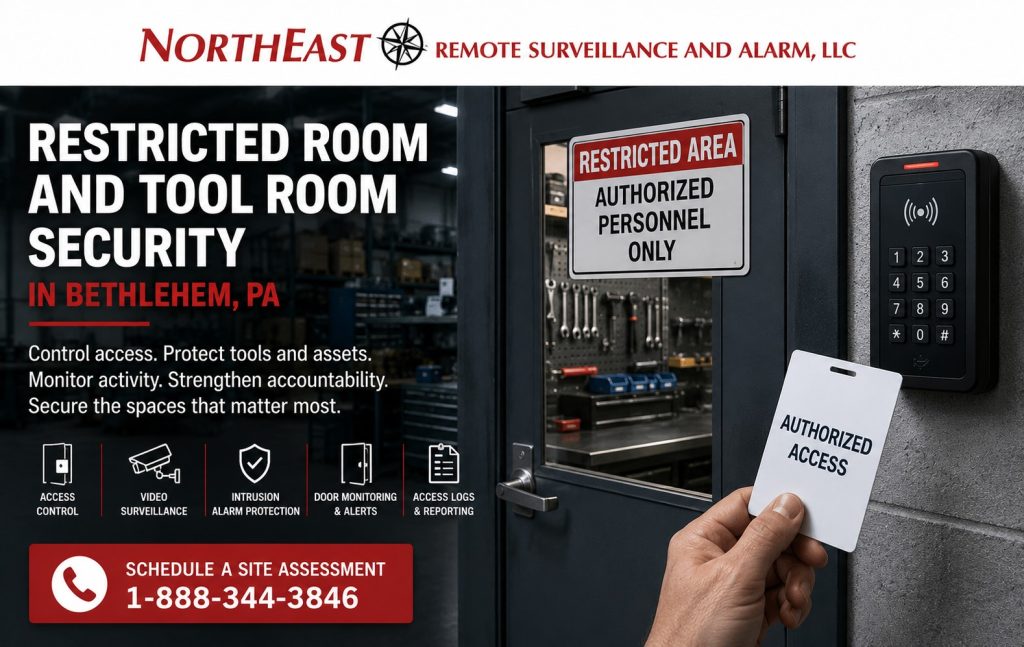
Restricted room and tool room security in Bethlehem, PA should be planned around controlled access, camera documentation, intrusion alarm protection, employee permissions, contractor access, inventory accountability, tool control, maintenance areas, IT rooms, utility spaces, and long-term management review. Northeast Remote Surveillance and Alarm, LLC designs commercial and industrial restricted room and tool room security systems for Bethlehem manufacturing facilities, warehouses, industrial buildings, production spaces, and multi-building properties. For broader Bethlehem manufacturing and industrial security planning, start with Manufacturing & Industrial Security Systems in Bethlehem, PA.
Restricted rooms and tool rooms are often some of the most important areas inside a commercial or industrial facility. They may contain tools, parts, equipment, materials, inventory, maintenance supplies, electrical panels, IT equipment, production controls, sensitive records, chemicals, or other assets that should not be accessed by everyone in the building. NERSA helps Bethlehem businesses protect these spaces with access control, cameras, intrusion alarms, monitoring, door status reporting, and practical security planning built around the way the facility actually operates.

Restricted Room and Tool Room Security for Bethlehem, PA Facilities
Restricted room security is not just about locking a door. A strong system should help management control who can enter, when they can enter, what activity occurred, whether the door was forced or held open, whether cameras documented the event, and whether alarms or monitoring should respond.
Tool rooms, maintenance rooms, IT rooms, utility rooms, electrical rooms, inventory spaces, production control areas, chemical storage rooms, parts rooms, and sensitive storage areas often need more protection than general building areas. These spaces may be used by employees, supervisors, maintenance staff, contractors, vendors, service providers, and managers with different access needs.
NERSA designs restricted room and tool room security systems that support accountability without slowing down daily operations. The goal is to give the business better control over sensitive areas while making the system easy to manage, expand, and support.
Why Restricted Rooms Need Dedicated Security Planning
Restricted rooms create a different kind of security challenge than main entrances or general office doors. A facility may allow many employees into the building, but only a smaller group should be allowed into a tool room, IT room, utility room, maintenance cage, inventory room, or controlled production area.
When these areas are not properly managed, businesses can face missing tools, unclear responsibility, unauthorized access, poor documentation, after-hours activity, service-provider confusion, and limited ability to review what happened. A key may be copied. A door may be propped open. A former employee may still have access. A contractor may enter an area outside the expected work zone.
Dedicated restricted-area planning helps the facility answer practical questions. Who entered the room? Was access approved? Was the door opened after hours? Was the door held open? Was a camera view available? Was inventory moved? Did the alarm system record the event? Should management receive an alert?
Access Control for Restricted Rooms and Tool Rooms
Access control is one of the most important layers of restricted room security. It helps businesses move away from unmanaged keys and toward controlled credentials, schedules, permissions, and activity records.
A restricted room access control system may include card readers, key fobs, mobile credentials, keypad entry, door position monitoring, request-to-exit devices, electrified locks, access schedules, user groups, and reporting. Permissions can be assigned by role, department, shift, door, room, schedule, or credential type.
For Bethlehem manufacturing and industrial access control planning, visit Industrial Access Control in Bethlehem, PA.
Access control helps management allow the right people into the right spaces without opening the entire facility. Maintenance personnel may need tool room access. IT staff may need network room access. Supervisors may need inventory room access. Contractors may need temporary access to a utility room. Each use case should be planned carefully.
Reducing Uncontrolled Key Use with Restricted Room and Tool Room Security in Bethlehem, PA
Traditional keys can create risk in restricted spaces. Keys can be lost, copied, shared, kept by former employees, loaned to contractors, or used without a clear activity record. When a sensitive room is protected only by a key, management may not know who entered or when access occurred.
Access control can reduce that risk by allowing credentials to be assigned, changed, disabled, or scheduled without rekeying the building. If an employee leaves, a credential can be removed. If a contractor only needs access for one day, access can be limited. If a department changes, permissions can be updated.
The system can also help management review activity when tools, parts, equipment, materials, or records are missing or questioned.
Camera Coverage for Restricted Rooms
Camera coverage can strengthen restricted room security by documenting activity near the door, inside the room where appropriate, or along nearby approach paths. Video can help management confirm who entered, whether someone followed another person inside, whether the door was propped open, and what activity occurred near the protected space.
Camera placement may include exterior door views, hallway approach views, interior room views where appropriate, tool checkout areas, inventory cages, maintenance counters, IT room entrances, utility room doors, and production transition points. For Bethlehem manufacturing camera planning, visit Manufacturing Security Cameras in Bethlehem, PA.
Camera planning should be practical. The goal is not to create unnecessary coverage everywhere. The goal is to capture useful activity that supports incident review, access accountability, management oversight, and long-term documentation.
Door Position Monitoring and Held-Open Alerts
A restricted room door should not only control access; it should also report whether the door actually closed. Door position monitoring helps management identify forced doors, held-open doors, propped doors, and after-hours openings.
Held-open alerts can be important for tool rooms, IT rooms, utility rooms, inventory spaces, electrical rooms, and production control areas. A valid credential may open the door, but the door still needs to close and secure properly after use.
When door position monitoring is paired with cameras, access logs, and alarms, management has a clearer picture of what happened. The system can show whether a credential was used, whether the door stayed open, and whether video captured the activity.
Intrusion Alarm Protection for Restricted Rooms
Restricted rooms may need dedicated intrusion alarm protection in addition to access control. Some areas should be protected after hours, during weekends, or when the building is partially occupied. Other rooms may need alarm devices even when the surrounding area is not fully armed.
Alarm protection may include door contacts, motion detection, glass break detection where appropriate, keypad control, partitions, sirens, monitoring communication, and video verification. For Bethlehem-specific alarm planning, visit Industrial Intrusion Alarm Systems in Bethlehem, PA.
Alarm design should match the way the facility operates. A tool room may need to stay protected after the office is open. A utility room may need limited access by maintenance staff. A warehouse cage may need after-hours protection. A network room may need alerts when accessed outside normal schedules.
Tool Room Security and Tool Accountability with Restricted Room and Tool Room Security in Bethlehem, PA
Tool rooms are high-value areas for many manufacturing and industrial facilities. They may contain hand tools, power tools, specialty tools, maintenance equipment, calibration equipment, spare parts, batteries, chargers, consumables, and job-specific equipment.
Security planning can help reduce uncertainty around tool access. Access control can document who entered. Cameras can show activity at the room or checkout area. Alarms can protect the space after hours. Door monitoring can identify forced or held-open doors. Management reports can help review repeated activity.
The goal is not to replace internal tool-control procedures. The goal is to support those procedures with better visibility, accountability, and documentation.
Maintenance Room and Parts Room Security
Maintenance rooms and parts rooms often support daily operations, repairs, machine uptime, and emergency response. These rooms may include spare parts, tools, supplies, electrical components, repair equipment, chemicals, lubricants, mechanical parts, and equipment documentation.
Unauthorized access can create operational risk. Missing parts can delay repairs. Uncontrolled access can make it difficult to determine who used supplies or removed equipment. Poor camera coverage can leave management without a useful record.
A strong maintenance room or parts room security plan may include controlled access, camera coverage, inventory-area visibility, alarm protection, door monitoring, and user permissions based on job role.
IT Room, Network Room, and Security Equipment Room Protection
IT rooms, network closets, server rooms, telecom rooms, MDF rooms, IDF rooms, and security equipment rooms require special attention. These spaces may contain network switches, servers, firewalls, video recorders, access control panels, alarm communicators, fiber equipment, backup power, and other critical infrastructure.
A problem in one of these rooms can affect cameras, access control, alarms, phones, production systems, network connectivity, monitoring, or business operations. Access should be limited, documented, and reviewed when needed.
Security may include controlled credentials, door contacts, cameras at the entrance, environmental alerts where appropriate, alarm protection, access reports, and coordination with the facility’s IT or management team.
Utility Room and Electrical Room Security
Utility rooms, electrical rooms, sprinkler rooms, mechanical rooms, boiler rooms, compressor rooms, generator rooms, and other infrastructure spaces should be protected because they support building operations and safety.
These rooms may be accessed by employees, maintenance teams, outside contractors, utility providers, inspectors, and emergency personnel. Security planning should allow authorized access while reducing unnecessary entry.
Controlled access, camera coverage, alarm contacts, door monitoring, and clear documentation can help management understand activity around these important spaces.
Restricted Production Area Security
Some manufacturing facilities have production areas that should not be open to every employee, contractor, visitor, or vendor. These areas may involve proprietary processes, quality-control spaces, sensitive materials, controlled equipment, specialized machinery, or safety-sensitive work zones.
Restricted production area security may include access control, cameras, alarm protection, intercom communication, signage, management procedures, and activity reporting. The design should support the operation without interrupting production.
Security should help management control access and document activity while keeping authorized work moving.
Contractor and Vendor Access to Restricted Rooms
Contractors and vendors may need access to restricted rooms for service, inspection, repair, maintenance, deliveries, utilities, or equipment work. That access should be controlled and documented.
A contractor should not automatically receive access to the entire building because they need to work in one room. Access can be limited by door, schedule, credential, user group, expiration date, or escort procedure. Cameras and intercoms can help verify arrival and activity.
For outside personnel planning, visit Contractor and Vendor Entrance Surveillance in Bethlehem, PA.
Employee Permissions and Department-Level Access
Not every employee needs the same access. A production employee may need access to the production floor but not the IT room. A maintenance technician may need access to the tool room and utility spaces. A supervisor may need access to a restricted inventory room. A warehouse employee may need access to shipping areas but not production control rooms.
Access control can help separate permissions by role, department, shift, schedule, or area. This allows management to protect sensitive spaces without making the building difficult to use.
This is especially important in manufacturing facilities where employee movement, contractor work, maintenance activity, and production schedules change throughout the day.
Loading Dock and Warehouse Restricted Areas
Restricted rooms near loading docks, warehouses, shipping offices, receiving areas, and staged freight zones may need additional protection. These areas often involve employees, drivers, vendors, contractors, materials, finished goods, pallets, trailers, and overhead doors.
A restricted storage room near a dock may need cameras and access control. A shipping office may need credentialed entry. A parts room near a warehouse may need alarm protection. A cage or inventory room may need door monitoring and reporting.
The security plan should account for how people and materials move between docks, warehouse areas, production spaces, and restricted rooms.
Alarm Monitoring and Event Verification
Alarm monitoring supports restricted room security when the facility is closed, partially staffed, or operating with limited supervision. A monitored alarm can help support escalation when a restricted room opens after hours, a door is forced, a motion detector activates, or an access event requires review.
Video verification can add useful context. If a restricted room alarm activates, nearby video can help determine whether the activity appears authorized, accidental, suspicious, or part of a larger security event.
The goal is to create a system that gives management better records, better visibility, and better response options when a sensitive area is accessed.
Door Hardware, Egress, and Fire Alarm Coordination
Restricted room and tool room security should be planned with awareness of door hardware, emergency egress, fire alarm coordination, controlled doors, electrified locks, electric strikes, electrified trim, magnetic locks, request-to-exit devices, door closers, power supplies, and inspection-sensitive conditions.
Security equipment should not create a conflict with emergency exit requirements or building operations. The correct locking method depends on the door, the occupancy, the egress path, the fire alarm system, the AHJ, and how the facility uses that room.
Door hardware and access control should be planned together before installation so the final system is secure, serviceable, and appropriate for the space being protected.
Low-Voltage Infrastructure for Restricted Room Security
Restricted room security depends on reliable low-voltage infrastructure. Cameras, card readers, door contacts, request-to-exit devices, electrified hardware, access control panels, alarm devices, intercoms, network switches, fiber links, PoE devices, backup power, and monitoring equipment all need proper planning.
Facilities may require cabling through masonry walls, metal doors, production ceilings, warehouse areas, mechanical rooms, IT closets, conduit pathways, or multi-building layouts. A clean infrastructure plan helps avoid exposed wiring, weak network performance, poor equipment locations, and service problems later.
Infrastructure planning also helps the system expand to additional doors, rooms, cameras, alarm devices, and monitoring needs as the facility changes.
Compliance-Aware Restricted Room Planning
Restricted room and tool room security should be planned with awareness of documentation, access records, video retention, user permissions, door hardware, emergency egress, fire alarm coordination, cybersecurity, monitoring procedures, and long-term service needs.
Security systems do not replace written policies, employee training, safety programs, HR procedures, inventory controls, contractor supervision, or compliance responsibilities, but they can help provide better records and accountability.
Compliance-aware planning is especially important for IT rooms, utility rooms, electrical rooms, tool rooms, chemical storage areas, production control areas, inventory cages, controlled doors, alarm events, and access records used for management review.
Common Restricted Room and Tool Room Security Problems We Help Solve
Bethlehem businesses often need help when tool rooms are unlocked, keys are shared, former employees still have access, doors are propped open, camera footage does not capture the entrance, missing tools cannot be traced, contractors enter the wrong area, alarms are not tied to door activity, or management has no reliable record of who entered a sensitive space.
NERSA can evaluate the room, door, hallway, production area, warehouse connection, and surrounding activity to recommend a practical system. That may include access control, camera coverage, door position monitoring, alarm contacts, motion detection, user permissions, access schedules, remote monitoring, intercoms, low-voltage cabling, or a complete restricted-area security upgrade.
The right design depends on the room, the asset, the users, the schedule, the door hardware, and the level of documentation the business needs.
Restricted Areas NERSA Can Help Secure
- Tool rooms
- Tool cribs
- Maintenance rooms
- Parts rooms
- Inventory rooms
- IT rooms
- Network closets
- Server rooms
- MDF rooms
- IDF rooms
- Electrical rooms
- Mechanical rooms
- Utility rooms
- Sprinkler rooms
- Compressor rooms
- Boiler rooms
- Generator rooms
- Production control rooms
- Quality-control areas
- Chemical storage rooms
- Sensitive storage areas
- Equipment cages
- Warehouse cages
- Shipping offices
- Receiving offices
- Records rooms
- Security equipment rooms
- Office-to-production transition rooms
- Contractor work areas
- Multi-building restricted spaces
Why Bethlehem Businesses Choose NERSA
Bethlehem businesses choose Northeast Remote Surveillance and Alarm, LLC because NERSA designs commercial and industrial security systems around real facility conditions. Restricted rooms, tool rooms, employee entrances, contractor doors, production areas, warehouse spaces, loading docks, gates, and after-hours schedules all need planning that matches how the property actually operates.
NERSA focuses on access control, video surveillance, intrusion protection, alarm monitoring, remote video monitoring, door hardware coordination, low-voltage infrastructure, documentation, and long-term support. Whether the facility needs one controlled tool room or a full restricted-area security plan across a manufacturing property, the design starts with the building, the people, and the assets that need protection.
Request a Restricted Room and Tool Room Security Assessment in Bethlehem
If your Bethlehem facility needs stronger tool room security, restricted room access control, camera coverage, door monitoring, alarm protection, remote monitoring, contractor access management, or low-voltage infrastructure, Northeast Remote Surveillance and Alarm, LLC can evaluate the property and recommend a system built around your operation.
Call 1-888-344-3846 to request a restricted room and tool room security assessment in Bethlehem, PA.
Restricted Room and Tool Room Security FAQs
What is restricted room and tool room security?
Restricted room and tool room security is the use of access control, cameras, intrusion alarms, door monitoring, user permissions, reporting, and monitoring procedures to protect sensitive rooms, tools, equipment, inventory, IT rooms, utility rooms, and other controlled areas.
Why do Bethlehem businesses need restricted room security?
Restricted rooms often contain tools, equipment, materials, parts, IT systems, utilities, records, or sensitive operations. Security helps control who enters, document activity, reduce uncontrolled key use, and support management review when something happens.
Can access control be used on tool rooms?
Yes. Tool rooms can be protected with card readers, key fobs, mobile credentials, keypads, door position monitoring, schedules, user permissions, and activity reporting.
Can cameras help protect restricted rooms?
Yes. Cameras can document activity near restricted room doors, tool checkout areas, storage areas, inventory cages, and nearby transition points. Camera coverage can help management review access events and incidents.
Can restricted rooms be alarmed separately?
Yes. Some restricted rooms can be planned with dedicated alarm zones, partitions, door contacts, motion detection, monitoring communication, and response procedures depending on the system design.
Can NERSA help reduce key problems for restricted rooms?
Yes. Access control can reduce dependence on physical keys by using managed credentials that can be added, removed, scheduled, or changed without rekeying the facility.
Can contractor access to restricted rooms be controlled?
Yes. Contractor and vendor access can be limited by door, schedule, credential, expiration date, user group, or escort procedure. Cameras and access logs can support activity review.
Can restricted room access be separated by department?
Yes. Access permissions can be separated by department, role, schedule, door, area, or credential type. This helps employees access the areas they need without opening sensitive spaces to everyone.
Can restricted room security connect to video verification?
Yes. Access control and intrusion alarm events can be paired with nearby camera footage so management can review who entered, whether the door was held open, and what activity occurred.
Does restricted room security need fire alarm or egress coordination?
Some controlled doors, electrified locks, access-controlled exits, and restricted areas may require fire alarm, door hardware, or emergency egress coordination. Security planning should account for life-safety requirements before equipment is installed.
Can restricted room security be expanded later?
Yes. A properly planned system can expand to additional rooms, doors, cameras, alarm devices, intercoms, buildings, monitoring procedures, and reporting needs as the facility changes.
Does NERSA install residential security systems?
No. Northeast Remote Surveillance and Alarm, LLC focuses on commercial and industrial security systems.
How do I request restricted room or tool room security in Bethlehem?
Call Northeast Remote Surveillance and Alarm, LLC at 1-888-344-3846 to request a commercial and industrial restricted room or tool room security assessment in Bethlehem, PA.
Schedule a Restricted Room and Tool Room Security Assessment
Restricted room and tool room security should be built around the way employees, managers, contractors, tools, parts, equipment, doors, cameras, alarms, and restricted spaces actually work at the facility. Northeast Remote Surveillance and Alarm, LLC can help your Bethlehem property plan a system that improves accountability, controls access, supports alarm response, documents activity, and protects the spaces that matter most.
Call 1-888-344-3846 to request a restricted room and tool room security assessment in Bethlehem, PA.