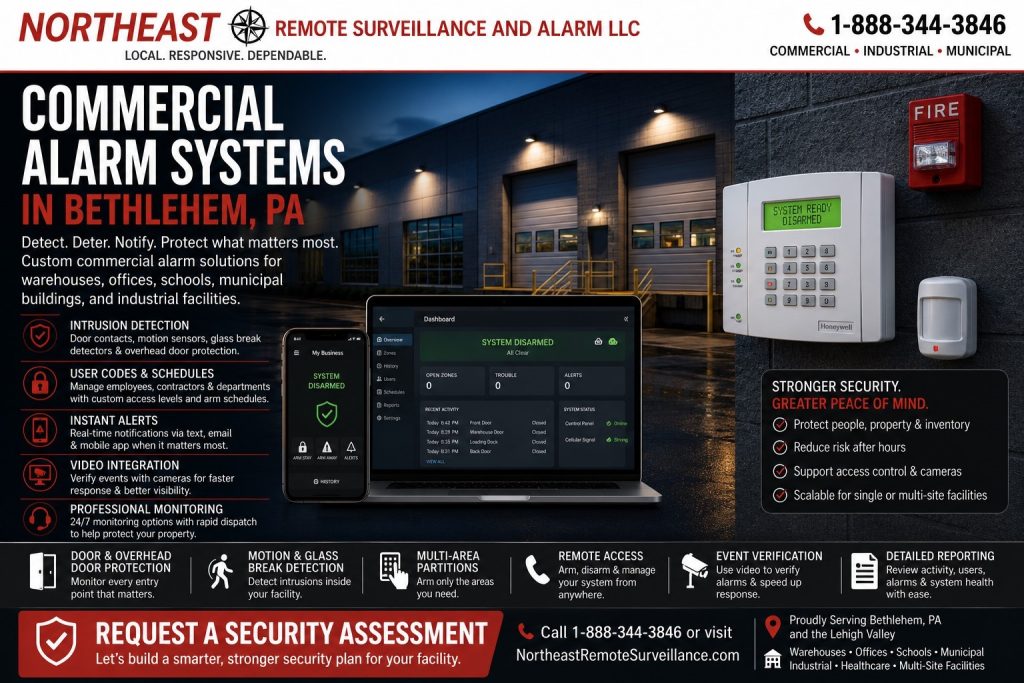
Commercial alarm systems in Bethlehem, PA should be planned around real building risk, after-hours activity, employee entrances, overhead doors, restricted rooms, warehouse areas, offices, exterior doors, alarm schedules, user codes, communication paths, and monitoring response. Northeast Remote Surveillance and Alarm, LLC designs and installs commercial intrusion alarm systems for Bethlehem warehouses, manufacturing facilities, logistics properties, offices, schools, municipal buildings, healthcare facilities, industrial sites, and multi-building commercial properties. For broader Bethlehem security planning, start with Commercial and Industrial Security Systems in Bethlehem, PA.
Call 1-888-344-3846 to schedule a Bethlehem commercial alarm assessment.

Commercial Alarm Systems in Bethlehem, PA Built Around Real Facility Risk
A commercial alarm system should do more than make noise when a door opens.
Bethlehem businesses often need alarm systems that support multiple doors, overhead doors, warehouse interiors, office areas, restricted rooms, employee entrances, after-hours schedules, user permissions, camera review, remote notifications, and monitoring procedures. A basic alarm package may not be enough for a warehouse, manufacturing building, school, municipal facility, healthcare property, logistics site, or multi-tenant commercial property.
Northeast Remote Surveillance and Alarm, LLC designs commercial alarm systems around how the property is actually used. The goal is to detect unauthorized activity, support faster review, improve documentation, and help the facility manage after-hours security with fewer blind spots and less confusion.
Commercial alarm planning may include:
- Door contacts
- Overhead door contacts
- Motion detection
- Glass break detection where appropriate
- Restricted-room protection
- Warehouse interior detection
- Office-area protection
- Alarm partitions
- User code management
- Schedules
- Cellular communication options
- Event notifications
- Video-supported review
- Monitoring coordination
- Remote arming and disarming where appropriate
- Low-voltage infrastructure
- Documentation and user training
For broader intrusion system planning beyond Bethlehem, visit Commercial & Industrial Alarm Installation.
Why Bethlehem Businesses Need Commercial Alarm Planning
Commercial alarms should be designed around the building, not around a generic device list.
A small office may only need a limited number of protected openings and motion detectors. A warehouse may need overhead door contacts, warehouse-area motion detection, office protection, dock-area awareness, and partitioned user control. A manufacturing facility may need restricted-area protection, tool room detection, maintenance-area coverage, and coordination with access control.
Bethlehem commercial alarm systems may help address:
- After-hours unauthorized entry
- Exterior door activity
- Overhead door exposure
- Office-area protection
- Warehouse interior protection
- Restricted-room entry
- Tool room or equipment room risk
- Tenant-area separation
- Employee access confusion
- Alarm user accountability
- Late-night or early-morning activity
- Communication path reliability
- Verified event review
- Monitoring response coordination
The strongest alarm systems are designed to help management understand what happened, where it happened, and how the event should be handled.
Intrusion Detection for Commercial Buildings
Intrusion detection is the core function of a commercial alarm system.
A proper design should identify the doors, rooms, interior paths, and building areas that need protection when the business is closed, partially occupied, or operating with limited staff.
Commercial intrusion detection may include:
- Exterior door contacts
- Interior door contacts
- Motion detectors
- Glass break detectors where appropriate
- Overhead door contacts
- Office-area motion detection
- Warehouse motion detection
- Restricted-room detection
- Equipment-room protection
- Alarm partitions
- Alarm keypads
- Alarm sirens or notification devices
- Monitoring communication paths
The alarm design should reflect the facility’s real use. A warehouse, school, municipal building, office, and manufacturing property may all need different alarm layouts.
Warehouse Alarm Systems in Bethlehem, PA with Commercial Alarm Systems in Bethlehem, PA
Bethlehem warehouses need alarm systems that account for large spaces, multiple doors, shipping and receiving areas, overhead doors, warehouse offices, employee entrances, and after-hours movement.
Warehouse alarm systems may support:
- Overhead door monitoring
- Dock door protection
- Employee entrance contacts
- Warehouse interior motion detection
- Shipping office protection
- Receiving office protection
- Tool room protection
- Inventory room protection
- Office area protection
- Alarm partitioning
- User code management
- Video-supported event review
For broader warehouse security planning, visit Warehouse Security Systems in Bethlehem, PA.
Loading Dock and Overhead Door Alarm Protection
Loading docks and overhead doors are high-priority alarm points for Bethlehem warehouses, logistics facilities, and industrial properties.
These openings are used for freight movement, trailer loading, shipping, receiving, vendor activity, and after-hours access. If a dock door or overhead door is not properly monitored, the facility may have a weak point where activity can occur without clear detection.
Dock and overhead door alarm planning may include:
- Overhead door contacts
- Dock door contacts
- Motion detection near dock areas
- Alarm schedules
- Door status review
- After-hours notifications
- Video-supported alarm review
- Shipping and receiving area protection
- Partitioned warehouse zones
- Monitoring procedures tied to dock activity
For dock-specific security planning, visit Loading Dock Security Systems in Bethlehem, PA.
Alarm Systems for Truck Yards and Exterior Exposure
Commercial alarm systems usually protect the building itself, but the alarm design should still consider exterior exposure.
Truck yards, trailer parking areas, employee lots, rear doors, fence lines, service lanes, and exterior storage areas may all affect how the alarm system should be planned. Cameras, remote monitoring, gate access control, and intrusion detection should support one another around these exterior risk areas.
Alarm planning for exterior-exposed properties may include:
- Rear door contacts
- Yard-adjacent door contacts
- Warehouse motion detection
- Gate activity coordination
- Truck yard camera coordination
- Trailer yard camera coordination
- After-hours event notifications
- Alarm schedules tied to site operations
- Video-supported review
- Monitoring procedures
For broader exterior and vehicle-area planning, visit Truck Yard & Trailer Security Systems in Bethlehem, PA.
Alarm Partitions and User Code Management
Many Bethlehem commercial facilities need more than one simple arm/disarm area.
Alarm partitions can help separate different areas of the building so a warehouse, office, tenant suite, restricted room, or shipping area can be managed independently when appropriate. This is especially useful when different teams, shifts, tenants, or departments operate on different schedules.
Alarm user management may support:
- Employee user codes
- Manager codes
- Contractor codes
- Cleaning crew codes
- Vendor access procedures
- Temporary codes
- Partition-specific permissions
- Opening and closing reports
- User activity review
- Former employee code removal
- Multi-building user control
A commercial alarm system should make it easier to manage users, not harder.
Commercial Alarm Monitoring and Communication Paths
A commercial alarm system needs a reliable way to communicate events.
Alarm communication can include cellular communication, IP communication, dual-path communication where appropriate, notification settings, monitoring procedures, escalation rules, and user contact lists. The best design depends on the facility, risk level, monitoring requirements, and available infrastructure.
Alarm communication planning may include:
- Cellular communicator options
- Internet communication where appropriate
- Backup communication planning
- Monitoring center coordination
- User notifications
- Contact list review
- Event escalation procedures
- Alarm signal testing
- Documentation of alarm zones
- Service and support planning
A strong alarm system should be designed so the correct people know what happened and how to respond.
Video Verification and Camera Coordination with Commercial Alarm Systems in Bethlehem, PA
Commercial alarms become more useful when cameras support the event.
An alarm signal may show that a door opened or a motion detector activated. Video can help authorized users review what happened before, during, and after the alarm event. This can reduce uncertainty and support better response decisions.
Camera and alarm coordination may support:
- Door alarm review
- Motion event review
- Dock-area alarm review
- Warehouse interior review
- Restricted-room review
- Office-area review
- After-hours activity verification
- Exterior approach review
- Alarm event investigation
- Management documentation
For broader camera planning, visit Commercial Video Surveillance Installation.
Remote Video Monitoring and Alarm Response Support
Some Bethlehem commercial and industrial properties need more than standard alarm signals.
Remote video monitoring can help add event review, verification, escalation, and live audio deterrence where appropriate. This may be useful for properties with exterior exposure, trailer yards, parking lots, loading docks, repeated trespassing, or after-hours activity concerns.
Remote monitoring may support:
- Alarm event review
- After-hours video verification
- Exterior approach review
- Parking lot activity review
- Dock activity review
- Yard activity review
- Escalation procedures
- Live talk-down where appropriate
- Monitoring workflows tied to site conditions
For monitored video and active deterrence planning, visit Remote Video Monitoring and Live Talk-Down.
Alarm Systems and Access Control Coordination
Access control and intrusion alarms should be planned together when a building has multiple users, restricted rooms, employee entrances, or after-hours access.
If an employee enters after hours, the alarm system should not create unnecessary confusion. If a restricted room is opened outside a schedule, the system should support documentation and review. If a former employee leaves the company, access credentials and alarm codes should both be addressed.
Access control and alarm coordination may include:
- Employee access schedules
- Alarm arming and disarming procedures
- Restricted-room alarms
- Door events tied to camera review
- Forced door events
- Propped door events
- User code management
- Credential removal procedures
- After-hours entry rules
- Management reporting
For employee, visitor, and restricted-area access planning, visit Employee & Visitor Access Control Systems in Bethlehem, PA.
Alarm Systems for Offices, Schools, Municipal Buildings, and Healthcare Facilities
Commercial alarm systems are not limited to warehouses and industrial properties.
Bethlehem offices, schools, municipal buildings, healthcare properties, institutional sites, and multi-tenant commercial buildings may need alarm systems that support after-hours protection, restricted rooms, records areas, staff entrances, public-facing doors, and building management procedures.
Alarm planning may include:
- Main entrance contacts
- Staff entrance contacts
- Office-area motion detection
- Records room protection
- IT room protection
- Storage room protection
- Medical support area protection
- Municipal department separation
- School office protection
- Multi-tenant partitions
- User code management
- Opening and closing reports
- Monitoring procedures
The alarm layout should match the building’s use, not a generic template.
Alarm Systems for Manufacturing Facilities with Commercial Alarm Systems in Bethlehem, PA
Manufacturing facilities in Bethlehem may need intrusion detection for office areas, production-adjacent areas, tool rooms, equipment rooms, shipping departments, receiving areas, finished-goods storage, and maintenance spaces.
Manufacturing alarm systems may support:
- Employee entrance protection
- Office protection
- Tool room detection
- Parts room detection
- Maintenance area protection
- Raw material storage protection
- Finished goods protection
- Shipping and receiving protection
- Production-adjacent motion detection
- After-hours monitoring
- Alarm partitions
- Camera-supported event review
Alarm systems should support production without creating unnecessary disruption to normal operations.
Fire Alarm and Life-Safety Coordination with Commercial Alarm Systems in Bethlehem, PA
Commercial intrusion alarms and commercial fire alarm systems are different systems with different purposes.
An intrusion alarm is designed to detect unauthorized activity, while a fire alarm and life-safety system is designed around occupant safety, code requirements, detection, notification, monitoring, and emergency response. These systems may overlap in the building, but they should not be confused or treated as the same thing.
Alarm planning may still require coordination around:
- Fire alarm monitoring
- Alarm communication paths
- Door hardware
- Emergency egress
- Access-controlled openings
- Fire alarm interfaces where required
- Inspection documentation
- AHJ expectations
- Building use changes
- Tenant improvement work
For fire alarm and life-safety planning, visit Commercial & Industrial Fire Alarm Installation.
Security systems should support the facility without creating avoidable conflicts with emergency exits, fire alarm operation, inspection requirements, or life-safety expectations.
Low-Voltage Infrastructure for Commercial Alarm Systems
Commercial alarm systems depend on reliable low-voltage infrastructure.
Alarm devices, keypads, sirens, power supplies, communicators, expanders, door contacts, motion detectors, glass break sensors, network connections, and cellular communicators all need proper installation, wiring, labeling, documentation, and service access.
Low-voltage planning may include:
- Alarm wiring
- Device placement
- Keypad placement
- Power supply planning
- Cellular communicator location
- Network communication planning
- Cable pathways
- Equipment labeling
- Zone documentation
- Backup power review
- Expansion planning
- User training and handoff
A commercial alarm system should be serviceable, understandable, and expandable.
Bethlehem Facilities That Need Commercial Alarm Systems
Northeast Remote Surveillance and Alarm, LLC supports commercial alarm planning for non-residential properties in Bethlehem and nearby Lehigh Valley markets.
Facilities may include:
- Warehouses
- Logistics facilities
- Distribution centers
- Manufacturing buildings
- Commercial offices
- Schools
- Municipal buildings
- Healthcare facilities
- Institutional properties
- Industrial buildings
- Multi-tenant commercial properties
- Contractor facilities
- Industrial park buildings
- Storage facilities
- Multi-building commercial sites
Our work is focused on commercial, industrial, municipal, institutional, and business-critical properties. We do not design consumer-grade residential alarm systems for homeowners.
Areas Near Bethlehem We Serve
This page supports commercial alarm system planning in and around:
- Bethlehem
- South Bethlehem
- West Bethlehem
- North Bethlehem
- Bethlehem Township
- Hanover Township
- Freemansburg
- Fountain Hill
- Hellertown
- Lower Saucon Township
- Route 22 commercial areas
- Route 33 commercial areas
- I-78 commercial and industrial corridors
- Nearby Lehigh County and Northampton County commercial properties
Commercial Alarm Design Process
Northeast Remote Surveillance and Alarm, LLC designs commercial alarm systems around the way the building operates.
A typical planning process may include:
- Reviewing the building layout
- Identifying exterior doors
- Identifying overhead doors
- Reviewing warehouse and office areas
- Reviewing restricted rooms
- Checking after-hours risk areas
- Reviewing user groups
- Evaluating alarm partitions
- Planning keypad locations
- Reviewing communication paths
- Reviewing camera coordination
- Reviewing access control coordination
- Reviewing monitoring procedures
- Planning documentation and training
- Reviewing long-term service needs
The result should be an alarm system that improves after-hours protection, supports event review, and helps management respond with better information.
What This Page Does Not Cover
This page is focused specifically on commercial alarm systems in Bethlehem, PA.
It is not the main Bethlehem commercial and industrial security hub. It is not the full commercial and industrial alarm installation page. It is not the warehouse security page. It is not the loading dock security page. It is not the truck yard security page. It is not the access control page. It is not the fire alarm page.
Those pages should own their broader service, regional, or facility-specific intent. This page should own Bethlehem commercial alarm system intent and route visitors to supporting NERSA pages when they need deeper detail.
Request a Bethlehem Commercial Alarm Assessment
If your Bethlehem warehouse, logistics facility, manufacturing plant, office, school, municipal building, healthcare facility, institutional property, industrial site, or multi-building commercial property needs stronger intrusion detection, better overhead door protection, cleaner user code management, video-supported review, monitoring coordination, or alarm system documentation, Northeast Remote Surveillance and Alarm, LLC can help.
NERSA can review your doors, overhead doors, restricted rooms, employee entrances, after-hours activity, user groups, alarm communication paths, monitoring needs, camera coordination, access control requirements, and long-term security goals.
Call 1-888-344-3846 or visit Request a Security Assessment to begin planning a commercial alarm system in Bethlehem, PA.
FAQ: Commercial Alarm Systems in Bethlehem, PA
What is a commercial alarm system?
A commercial alarm system is a security system designed to detect unauthorized activity around doors, overhead doors, interior areas, restricted rooms, offices, warehouses, and other protected spaces.
What types of Bethlehem businesses need commercial alarm systems?
Warehouses, manufacturing facilities, logistics properties, offices, schools, municipal buildings, healthcare facilities, institutional sites, industrial buildings, and multi-tenant commercial properties may need commercial alarm systems.
Are commercial alarm systems different from residential alarms?
Yes. Commercial alarm systems are designed around larger buildings, more users, more doors, schedules, partitions, monitoring procedures, documentation, and higher operational risk than typical residential alarm systems.
Should warehouse alarm systems include overhead doors?
Often, yes. Overhead doors are important alarm points because they are used for shipping, receiving, freight movement, and after-hours access.
Can commercial alarms work with security cameras?
Yes. Cameras can support alarm events by helping management or monitoring teams review what happened around doors, docks, offices, warehouses, parking lots, and restricted rooms.
Can commercial alarms work with access control?
Yes. Access control and alarms can be coordinated around user permissions, after-hours entry, restricted rooms, door schedules, alarm partitions, and management reporting.
Can commercial alarm systems be monitored?
Yes. Commercial alarm systems can be monitored through appropriate communication paths, monitoring procedures, contact lists, and escalation instructions.
Is a commercial alarm system the same as a fire alarm system?
No. Intrusion alarms and fire alarm systems serve different purposes. Fire alarm systems are life-safety systems, while intrusion alarms are designed to detect unauthorized activity.
Does NERSA serve commercial alarm projects outside Bethlehem?
Yes. NERSA serves Bethlehem and nearby Lehigh Valley commercial and industrial markets, including warehouse, logistics, manufacturing, municipal, institutional, healthcare, office, and multi-site commercial properties.
How do I start a Bethlehem commercial alarm project?
Call 1-888-344-3846 or use the Request a Security Assessment page to begin planning commercial intrusion detection, overhead door protection, user codes, monitoring, camera coordination, access control coordination, and alarm system documentation.