
Existing commercial doors can often be upgraded for modern access control when the opening, hardware, power and monitoring are evaluated as one system.

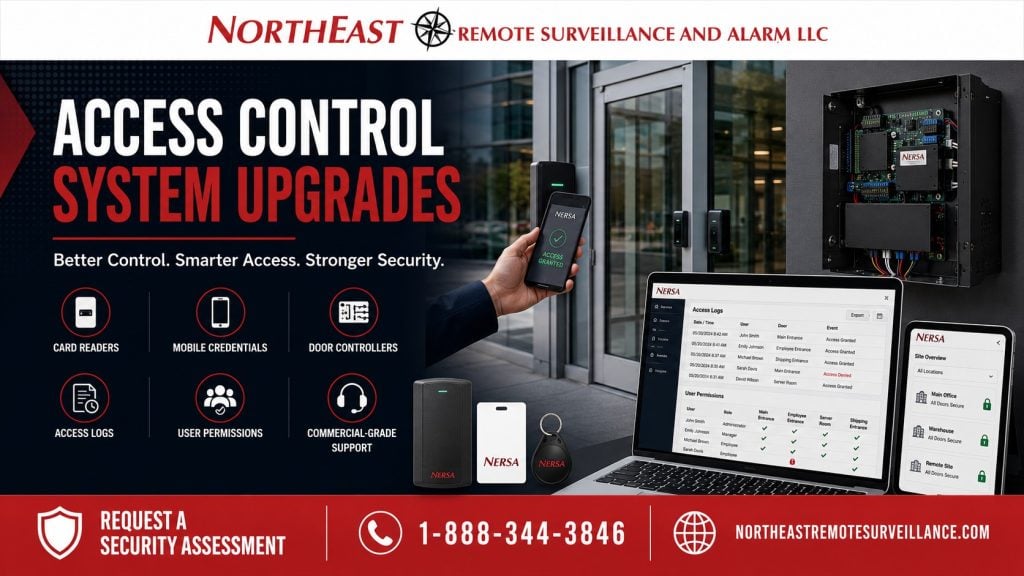
Northeast Remote Surveillance and Alarm, LLC (NERSA) upgrades existing commercial and industrial doors across Pennsylvania and selected Mid-Atlantic markets. We can add card or fob entry, assess unreliable electronic locks, or review an existing system with missing records.
For broader modernization involving access control, video surveillance, intrusion alarms and other existing security infrastructure, visit Commercial Security System Upgrades, Retrofits & Takeovers.
From small business to enterprise: NERSA supports single-door retrofits and phased upgrades across several doors or buildings, including industrial sites.
What an Access Control Door Retrofit Involves
A door-hardware retrofit adds or updates electronic entry on an existing commercial door. The door must still open, close, latch, and allow exit as required.
Depending on the opening, the work may include:
- An electric strike, electrified lockset or compatible exit-device hardware
- Request-to-exit equipment
- Door-position monitoring
- Power transfer into the moving door
- Lock power, relays and battery backup
- Existing wiring corrections
- Reader and controller coordination
- Adjustments or replacement recommendations for unreliable components
- Functional testing and documentation
Check which parts still work and suit the new design. Fix faults that affect the door, then add the equipment needed for reliable access control.
A retrofit should improve security without creating new mechanical, power or maintenance problems. Mounting a reader beside a door is only one part of the work. The opening must release when authorized, permit normal exit, close consistently, relatch securely and report meaningful activity.
Start With the Existing Opening
Hardware selection should begin with an inspection of the door rather than a preferred lock model. NERSA may evaluate:
- Door and frame construction
- Existing cylindrical, mortise or exit-device hardware
- Door handing, swing and traffic level
- Hinge, closer and latch condition
- Alignment and latch engagement
- Exterior exposure, weather seals and building pressure
- Existing wiring and available cable pathways
- Door contacts and request-to-exit equipment
- Lock power, relays and enclosure condition
- Service access and replacement-part availability
Electronic access will not fix a door that drags, sags, binds, or fails to latch. A door that needs a pull before it unlocks also needs review. These faults can cause failed releases, held-open alerts, hardware wear, and repeat service calls.
A buzzing electric strike may have a door or power problem. Check for pressure on the latch, binding, poor alignment, incorrect strike placement, or low voltage at the lock. Replacing the reader or extending the unlock time will not fix those faults.
When mechanical, structural, rated-door or specialized trade work is required, the condition should be identified before the electronic retrofit is finalized.
Reuse, Correct or Replace
Existing hardware can often stay if it is sound, correctly installed, and compatible with the new design. It must also suit the expected traffic and remain supportable.
Replacement may be the better choice when a component is:
- Worn, damaged or unreliable
- Improvised or incorrectly installed
- Obsolete or unsupported
- Incompatible with the new locking function
- Difficult to service or obtain parts for
- Inadequate for traffic, exposure or power requirements
Keep old parts when their condition and fit justify it. A sound door, exit device, power supply, or cable path may be worth reusing. Worn or unreliable hardware can lead to repeat faults and higher costs over time.
Check each part when taking over an existing system. Review locks, strikes, door contacts, exit devices, power supplies, relays, and cables. Some may be sound; others may have weak batteries, missing records, or unmarked wiring. State clearly what can stay and what needs repair or replacement.
Selecting Retrofit Hardware
The electronic locking method must fit the existing opening.
An electric strike needs a compatible frame, latch, and lock. Check alignment, latch size, keeper depth, and pressure on the latch. Also review traffic, weather exposure, voltage, and the required door function.
Doors with panic hardware may suit electrified trim or a powered exit device. Before reusing the device, confirm its make, model, function, and condition. Check that the trim and available power options are compatible.
An electrified lockset or mortise lock puts the powered lock in the moving door. Check the door construction, existing cutouts, and the path that carries power from the frame.
Choose hardware for reliable use and service over time. Ease of installation is only one factor. A device that can be electrified may still be a poor choice if it is worn or no longer supported.
Fail-safe or fail-secure behavior must also match the opening. Fail-safe hardware releases when lock power is removed. Fail-secure hardware remains secure from the controlled side when power is removed while required exit is maintained through the appropriate hardware arrangement. The complete door function—not the label alone—determines suitability.
Correcting Monitoring, Power and Wiring
Check what happens when someone exits. Request-to-exit devices help the system recognize a normal exit and apply the right timing. They can prevent a normal exit from being reported as a forced door. Check existing sensors and switches for wear, placement, and compatibility with the new lock setup.
A door-position contact reports whether a door is open or closed. It can support alerts for forced doors, doors left open, or doors that fail to close. A closed contact does not prove that every latch or bolt is engaged. Add further monitoring where it serves a clear need.
Wiring to a lock on a moving door needs a protected path from the frame. Options include electrified hinges, concealed transfers, and protected door loops. Check fit, wire count, current, door use, and service access. Replace old transfer wiring if flexing, rubbing, pinching, or impact has damaged it.
Check the lock’s voltage and current needs, including startup current. Review cable length, voltage drop, battery capacity, and how many locks run at once. Allow for planned growth. Label power supplies, relays, and wire ends so a technician can find and service them.
Installation, Testing and Documentation
Retrofit testing must evaluate the complete opening rather than only the reader or lock. Depending on the design, NERSA may test:
- Valid and invalid credential activity
- Lock release and normal exit
- Request-to-exit operation
- Door-open, forced-door and held-open reporting
- Closing and secure relatching
- Power-loss and backup-power behavior
- Repeated operating cycles
The required sequence is straightforward:
authorized release → normal opening → complete closing → secure relatching
The job is not complete until the door reliably returns to its intended secure state. Record door names, hardware functions, controller assignments, power supplies, relays, and monitored inputs. Make those records available to approved staff and future service teams.
Why Businesses Choose NERSA for Door Retrofits
NERSA has provided commercial and industrial electronic-security services since 2008. We approach an existing controlled door as a complete opening and evaluate the mechanical condition, electronic locking, power, wiring, monitoring and access-control interaction together.
NERSA supports additions to keyed commercial doors, corrections to unreliable openings, phased hardware upgrades and takeovers of existing access-control systems. The goal is a secure, reliable and serviceable opening—not simply a door that responds to a credential during the initial installation.
Frequently Asked Questions
Can existing commercial doors be retrofitted for access control?
Many can. The door, frame, lock, exit hardware, closer, wiring pathway, power requirements and mechanical condition should be evaluated before the retrofit design is selected.
Can existing door hardware be reused?
Yes, when it is mechanically sound, compatible, supportable and appropriate for the proposed function. Worn, obsolete, damaged or incompatible equipment may be better replaced.
Is an electric strike always the best retrofit option?
No. Some openings are better suited to electrified trim, an electrified lockset or another compatible arrangement. The existing door and hardware should determine the choice.
Why can an electric strike buzz without releasing?
Door preload, latch binding, misalignment, strike positioning, inadequate voltage or excessive voltage drop can prevent reliable release even when the access-control command is correct.
Can an existing access-control system be taken over?
Sometimes. A takeover should evaluate the controllers, locks, contacts, request-to-exit devices, power supplies, cabling, relays and documentation before determining which components should remain.
Request an Access Control Door Hardware Retrofit
If your business needs to add access control to existing commercial doors, correct unreliable locking hardware or modernize aging controlled openings, NERSA can evaluate the installed equipment and recommend a practical retrofit path.
Call 1-888-344-3846 or request a security assessment to review your doors, hardware, wiring, power, monitoring and access-control requirements.
Compliance, Codes & Project Standards
NERSA plans commercial and industrial security work with applicable code, documentation, inspection and authority-having-jurisdiction requirements in mind. Requirements vary by system, property and jurisdiction. These resources support project planning; they do not establish legal compliance, certification or AHJ approval.
Related guidance: Regulatory compliance & inspection readiness · Access control & door hardware standards · NFPA 101 & egress planning · ADA access-control planning