
A communicator upgrade modernizes how fire alarm, trouble and supervisory signals reach the monitoring center.

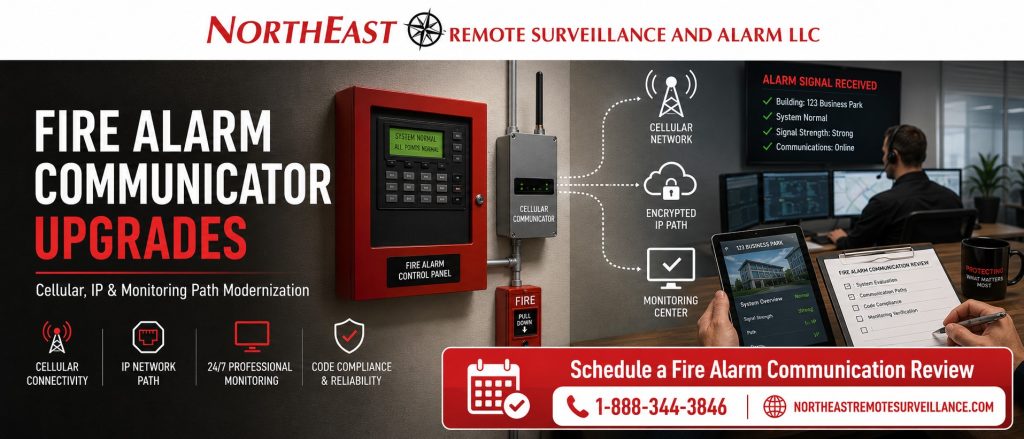
NERSA reviews outdated communicators, legacy phone lines and cellular or IP alternatives.
We also test signal reporting and improve records for long-term support.
Coordinate the change with the building’s requirements; Commercial & Industrial Fire Alarm Installation and Life Safety covers the wider planning.
Planning a Communicator Upgrade
Many commercial fire alarm systems still depend on old communication paths.
The fire alarm panel may still be serviceable. The initiating devices may still be working. The notification appliances may still function. But the communicator may be outdated, unsupported, unreliable, or tied to old phone-line service that no longer fits the building’s needs.
A fire alarm communicator upgrade focuses on the communication path between the building fire alarm system and the monitoring center.
The goal is to help the system report properly when there is an alarm, trouble, or supervisory condition.
When a Fire Alarm Communicator Needs an Upgrade
A commercial facility should consider a fire alarm communicator upgrade when the existing communication path is outdated, unreliable, or difficult to support.
Common signs include:
- The system still relies on traditional phone lines.
- Phone service is being removed, changed, or converted.
- The panel shows communication trouble conditions.
- Monitoring signals are not being received consistently.
- The communicator is obsolete or unsupported.
- The monitoring account information is outdated.
- The building has recurring fire alarm communication issues.
- Signal testing is incomplete or poorly documented.
- The fire alarm panel is still usable, but the communication path is weak.
- Telecom costs are increasing because of old line requirements.
- Inspection documentation needs to be cleaned up.
- The facility is preparing for renovation, ownership change, or system modernization.
A communicator upgrade can often solve the monitoring-path problem without replacing the entire fire alarm system.
What a Fire Alarm Communicator Does
A fire alarm communicator sends fire alarm system signals from the building to the monitoring center.
Depending on the system and building requirements, the communicator may transmit:
- Fire alarm signals
- Trouble signals
- Supervisory signals
- Waterflow signals
- Sprinkler supervisory signals
- Communication trouble signals
- System test signals
- Restoral signals
- Low battery or power-related signals where applicable
The communicator is not just an add-on device. For monitored fire alarm systems, it is a critical part of the life-safety reporting path.
Why Old Phone-Line Communicators Are Being Replaced
Many older fire alarm systems were installed with traditional phone-line communicators.
That approach can become a problem as telecom services change, analog lines become more expensive, phone service is converted, or communication reliability becomes harder to verify.
Old phone-line dependence can create issues such as:
- Higher monthly telecom costs
- Communication trouble conditions
- Unclear signal reliability
- Difficulty supporting old equipment
- Risk during phone service changes
- Monitoring uncertainty
- Inspection concerns
- Service delays when troubleshooting communication failures
A modern communicator upgrade can help the building move toward a more supportable monitoring path.
Cellular Communication
Cellular fire alarm communicators are commonly used when approved for the application.
A cellular communicator can help reduce dependence on legacy phone lines and provide a modern alarm transmission path. The correct cellular solution depends on the existing fire alarm panel, signal strength, building construction, monitoring center requirements, manufacturer instructions, AHJ expectations, backup power, and adopted code requirements.
Cellular communicator planning may include:
- Signal strength review
- Antenna placement
- Panel compatibility review
- Power requirements
- Battery backup requirements
- Monitoring account setup
- Signal testing
- Trouble reporting verification
- Documentation updates
- AHJ coordination where required
A cellular communicator should not simply be installed and left untested. It must be verified with the monitoring center.
IP Communication
Some facilities may use IP-based fire alarm communication when appropriate and accepted.
IP communicator planning requires careful review because network reliability, supervision, backup power, internet service, equipment location, and monitoring center compatibility all matter.
IP communicator planning may include:
- Network connection review
- Router or switch location review
- Backup power review
- Supervision requirements
- Monitoring account programming
- Signal testing
- Communication trouble reporting
- IT coordination
- Documentation
- AHJ awareness
The network supporting fire alarm communication must be treated seriously. A fire alarm communicator should not depend on unmanaged or unreliable infrastructure.
Dual-Path Fire Alarm Communication
Some buildings may require or benefit from dual-path communication.
Dual-path communication may combine cellular, IP, or other approved communication methods depending on the system design, local requirements, monitoring provider, and AHJ direction.
Dual-path planning may help improve communication resilience, but the correct approach depends on the facility, fire alarm panel, communicator model, adopted requirements, and monitoring path.
NERSA reviews the actual building conditions before recommending a communication method.
Existing Fire Alarm System Review
A communicator upgrade should begin with a review of the existing fire alarm system.
NERSA evaluates:
- Fire alarm control panel
- Existing communicator
- Current monitoring path
- Phone-line dependence
- Cellular signal availability
- IP/network availability
- Panel compatibility
- Communicator location
- Power availability
- Battery backup
- Monitoring account information
- Signal reporting needs
- Trouble conditions
- Zone or point descriptions
- Sprinkler monitoring connections where applicable
- Documentation condition
- AHJ or inspection concerns
- Future fire alarm upgrade needs
The review determines whether a communicator upgrade is the right path or whether the fire alarm system needs a broader modernization plan.
Monitoring Account Review
The communicator is only one part of the monitoring path.
The monitoring account must also be accurate. During a communicator upgrade, NERSA may review account information, signal descriptions, contact lists, test procedures, and monitoring center requirements.
Monitoring account review may include:
- Site name
- Site address
- Account number
- Emergency contact list
- Call list order
- Zone or point descriptions
- Alarm signal descriptions
- Trouble signal descriptions
- Supervisory signal descriptions
- Sprinkler monitoring information where applicable
- Signal test records
- Monitoring center receipt confirmation
A fire alarm communicator upgrade should leave the owner with a clearer understanding of how signals are being transmitted and received.
Signal Testing and Verification
A communicator upgrade is not complete until signals are tested.
NERSA verifies communication with the monitoring center where applicable. The goal is to confirm that the correct signal types are received from the correct account and that the upgraded communication path works as intended.
Signal testing may include:
- Alarm signal testing
- Trouble signal testing
- Supervisory signal testing
- Restoral signal verification
- Communication path supervision
- Monitoring center receipt confirmation
- Account identification confirmation
- Documentation of test results
The system should not be assumed to work just because the communicator powers on.
Fire Alarm Communicator Upgrade vs. Fire Alarm Replacement
A communicator upgrade is not the same as replacing the fire alarm system.
A communicator upgrade focuses on the communication path. A full fire alarm replacement may involve the fire alarm control panel, initiating devices, notification appliances, power supplies, annunciators, modules, wiring, elevator recall coordination, sprinkler monitoring, documentation, acceptance testing, and AHJ inspection.
A communicator upgrade may be appropriate when:
- The existing fire alarm panel is still serviceable.
- The field devices are still acceptable.
- The main concern is communication reliability.
- The monitoring path is outdated.
- Phone-line dependence needs to be reduced.
- Signal reporting needs to be corrected.
- Documentation needs improvement.
A full fire alarm system upgrade may be needed when the panel is obsolete, unsupported, failing, not accepted, or no longer suitable for the building.
Taking Over an Existing Communicator
Some communicator projects begin as takeovers.
An existing fire alarm monitoring setup may have unclear responsibilities. Identify who supports the communicator, whether account details are current and whether signals reach the monitoring center correctly. Confirm that the communication path remains acceptable.
NERSA can review existing communicator conditions and determine whether the system can be supported, corrected, upgraded, or replaced.
Takeover review may include:
- Existing provider status
- Communicator model
- Panel compatibility
- Monitoring account information
- Signal test history
- Trouble conditions
- Phone-line or cellular status
- Documentation
- Upgrade recommendations
Retrofitting an Existing Installation
A communicator retrofit may be needed when the existing panel remains in place but the communication equipment needs modernization.
A retrofit may include:
- Removing outdated communicator equipment
- Installing a new approved communicator
- Updating wiring as needed
- Coordinating power and backup power
- Programming account information
- Coordinating with the monitoring center
- Testing alarm, trouble, and supervisory signals
- Updating documentation
- Supporting inspection readiness
This approach can help modernize the communication path while preserving a serviceable fire alarm system.
Fire Alarm Communicator and Sprinkler Monitoring
Many commercial fire alarm communicator upgrades involve sprinkler monitoring.
A building may need reliable transmission of waterflow, valve tamper, supervisory, and trouble signals depending on the system design and building requirements.
Sprinkler monitoring communication should be reviewed carefully because supervisory and alarm signals must be described and tested properly.
Potential sprinkler monitoring points may include:
- Waterflow
- Valve tamper
- Low air supervisory
- Fire pump supervisory where applicable
- System trouble
- Restoral signals
The exact requirements depend on the building, fire alarm system, sprinkler system, monitoring arrangement, and AHJ direction.
AHJ and Code-Aware Planning
Fire alarm communicator upgrades must be handled with code awareness.
The Authority Having Jurisdiction has final authority over approval, inspection, and acceptance. Requirements may vary by municipality, building type, adopted code, system design, and monitoring arrangement.
NERSA plans communicator upgrades with attention to:
- AHJ expectations
- Adopted fire alarm requirements
- Manufacturer instructions
- Monitoring center requirements
- Signal supervision
- Backup power
- Documentation
- Testing
- Inspection readiness
For related code planning, see NFPA 72 Fire Alarm Standards for Commercial Buildings.
Fire Alarm Monitoring, Testing, and Inspection Support
A communicator upgrade should support long-term monitoring, testing, and inspection readiness.
The upgraded communication path should be easier to verify, easier to document, and easier to support during future inspections or service calls.
For related planning, see Fire Alarm Monitoring, Testing, and Inspection Requirements.
Before and After
| Before Communicator Upgrade | After Communicator Upgrade |
|---|---|
| Old phone-line communicator | Modern fire alarm communicator |
| Communication reliability was uncertain | Monitoring path reviewed and tested |
| Phone service changes created risk | Reduced dependence on outdated telecom service |
| Trouble conditions were harder to diagnose | Communication issues reviewed and corrected where possible |
| Monitoring account information may be outdated | Account details reviewed and updated where applicable |
| Signal testing was incomplete | Alarm, trouble, and supervisory signals tested where applicable |
| Documentation was limited | Better records for service and inspection readiness |
| Owner had uncertainty | Clearer long-term fire alarm communication support |
Planning by Facility Type
Fire alarm communicator upgrades are common in:
- Warehouses
- Distribution centers
- Manufacturing facilities
- Office buildings
- Healthcare offices
- Schools and education facilities
- Retail stores
- Industrial parks
- Multi-tenant commercial buildings
- Logistics facilities
- Professional offices
- Municipal buildings
- Institutional properties
- Buildings with sprinkler monitoring
- Buildings with older phone-line fire alarm monitoring
Each facility should be reviewed based on its fire alarm system, monitoring requirements, communication path, and AHJ expectations.
Related Planning
Confirm the panel, communicator, monitoring service, and testing requirements before changing the fire alarm communication path.
Project Planning and Support
Northeast Remote Surveillance and Alarm, LLC provides security and life-safety systems for commercial, industrial, and institutional facilities.
Fire alarm communicator upgrades require more than replacing a device. They require panel review, communicator compatibility, monitoring center coordination, signal testing, power review, documentation, and AHJ-aware planning.
NERSA helps commercial facilities improve the fire alarm monitoring path while avoiding unnecessary system replacement when a targeted communicator upgrade is the right solution.
When to Request a Review
A commercial facility should request a communicator upgrade review if:
- The fire alarm system still uses traditional phone lines.
- Phone service is being removed or changed.
- The panel shows communication trouble.
- Monitoring signals are inconsistent.
- The communicator is outdated or unsupported.
- The monitoring account information is unclear.
- The building has sprinkler monitoring that needs review.
- Inspection documentation is incomplete.
- The facility is preparing for renovation or ownership change.
- The owner wants a more supportable monitoring path.
- The existing fire alarm panel may still be usable, but communication needs modernization.
Planning Checklist
Before upgrading a commercial fire alarm communicator, evaluate:
- Fire alarm control panel
- Existing communicator
- Current monitoring path
- Phone-line dependence
- Cellular signal strength
- IP/network availability
- Backup power
- Panel compatibility
- Communicator location
- Alarm signal reporting
- Trouble signal reporting
- Supervisory signal reporting
- Sprinkler monitoring points
- Account information
- Emergency contact list
- Monitoring center requirements
- AHJ expectations
- Documentation
- Inspection readiness
- Future fire alarm system needs
Request a Communicator Review
NERSA can review old phone lines and fire alarm communication concerns at commercial properties. We serve offices, warehouses, healthcare facilities, schools, industrial and logistics sites, retail stores, municipal buildings and multi-tenant properties.
Frequently Asked Questions
What is a fire alarm communicator upgrade?
A fire alarm communicator upgrade replaces or modernizes the device that sends fire alarm system signals from a commercial building to the monitoring center. The upgrade may involve cellular, IP, or approved communication methods depending on the system and local requirements.
Why replace old fire alarm phone lines?
Older phone-line fire alarm communication can become expensive, unreliable, difficult to support, or affected by telecom service changes. A communicator upgrade can help reduce dependence on outdated phone-line service and improve monitoring path support.
Does a fire alarm communicator upgrade replace the fire alarm panel?
Not always. If the existing fire alarm panel is still serviceable and accepted for the building, the communicator may be upgraded without replacing the entire fire alarm system. If the panel is obsolete or unsupported, broader fire alarm modernization may be needed.
Can fire alarm systems use cellular communicators?
Yes, cellular fire alarm communicators are commonly used where appropriate and accepted. The correct solution depends on the panel, signal strength, monitoring center requirements, backup power, manufacturer instructions, and AHJ expectations.
Can fire alarm systems use IP communication?
Yes, IP communication may be used where appropriate and accepted. Network reliability, supervision, backup power, monitoring compatibility, and AHJ requirements must be reviewed.
What signals should be tested after a communicator upgrade?
Alarm, trouble, and supervisory signals should be tested where applicable. The monitoring center should confirm receipt of the correct signal types from the correct account.
Does the AHJ need to approve a fire alarm communicator upgrade?
The Authority Having Jurisdiction has final authority over approval, inspection, and acceptance. Requirements vary by building, municipality, adopted code, and system design.
Can NERSA upgrade a communicator on an existing fire alarm system?
Yes. NERSA can review the existing fire alarm panel, communicator, monitoring path, account information, signal reporting, and documentation before recommending the right upgrade path.
Is this the same as a commercial intrusion alarm communicator?
No. Fire alarm communicator upgrades are separate from intrusion alarm communicators, burglar alarm monitoring, and security alarm takeovers.
How do we start a fire alarm communicator upgrade?
For related planning, explore Commercial Security System Upgrades, Retrofits and Takeovers.
Call 1-888-344-3846 or use Request a Security Assessment.
NERSA can review the existing fire alarm communicator, monitoring path, account information, signal reporting, and upgrade options before recommending a solution.
Compliance, Codes & Project Standards
NERSA plans commercial and industrial security work with applicable code, documentation, inspection and authority-having-jurisdiction requirements in mind. Requirements vary by system, property and jurisdiction. These resources support project planning; they do not establish legal compliance, certification or AHJ approval.
Related guidance: Regulatory compliance & inspection readiness · Fire alarm inspection readiness · NERSA project standards