
Compare door hardware retrofits with full replacement by inspecting the existing opening, required functions, compatibility, condition, installation work, and ongoing maintenance.

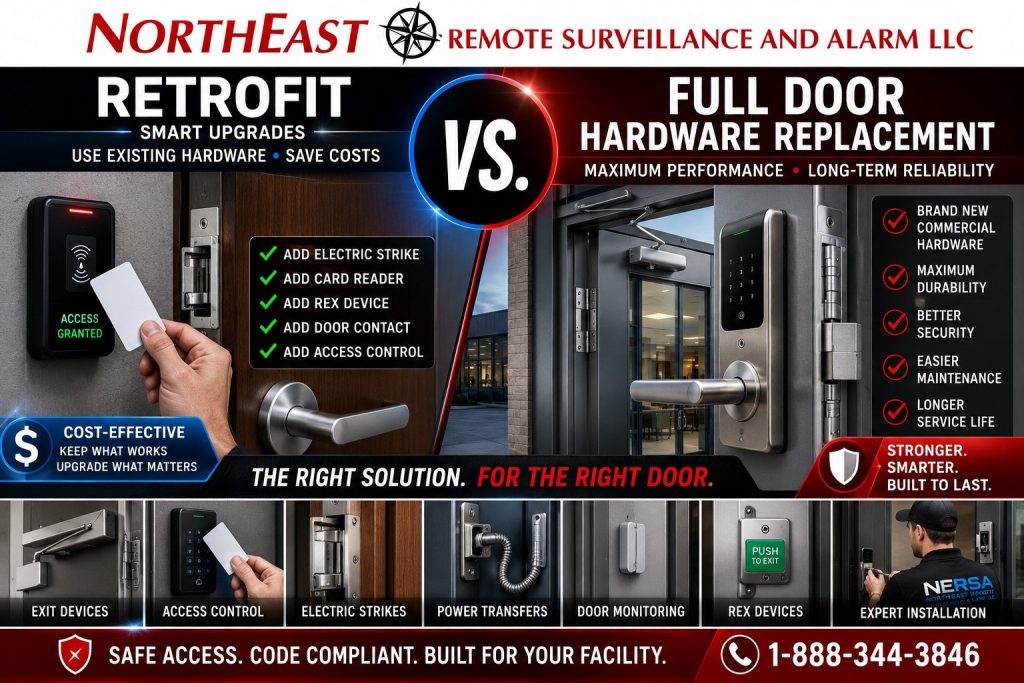
The right choice depends on the condition of the existing opening, the type of door, the exit hardware, code requirements, power needs, user traffic, and the long-term plan for the building.
For complete system planning, start with Commercial & Industrial Access Control Installation.
Retrofit vs. Full Door Hardware Replacement: Why the Decision Matters
Commercial doors are not just entry points. They are security points, life-safety points, employee access points, customer access points, vendor access points, emergency egress points, and long-term maintenance points.
When a business upgrades to electronic access control, the door hardware must be evaluated before equipment is selected. Some openings can be upgraded with electrified trim, an electric strike, a motorized latch retraction kit, a reader, a door contact, and access control wiring. Other openings are too worn, too damaged, too misaligned, too outdated, or too limited to support a clean retrofit.
A good access control installation does not begin with the question, “What device can we install?” It begins with the question, “What does this opening need to work safely, securely, and reliably for years?”
What Is a Door Hardware Retrofit?
A door hardware retrofit uses the existing door, frame, and some existing mechanical hardware while adding or modifying components to support electronic access control.
A retrofit may include:
- Adding an electric strike
- Adding electrified trim
- Adding a motorized latch retraction kit
- Adding a card reader or keypad reader
- Adding a mobile credential reader
- Adding a door position switch
- Adding a request-to-exit device
- Adding low-voltage wiring
- Adding a power supply
- Adding a power transfer hinge or door loop
- Integrating the opening with an access control panel
- Reusing the existing exit device when it is compatible
Retrofit work can be a smart option when the existing hardware is in good condition, the door closes and latches properly, the frame is usable, and the opening can support the required access control function without creating reliability or code problems.
For more detail on the hardware layer, see Access Control Trim & Strike Hardware.
What Is Full Door Hardware Replacement?
Full door hardware replacement means replacing major components of the opening instead of modifying what is already there. This may include replacing the exit device, lockset, trim, strike, closer, hinges, power transfer hardware, latch hardware, or other door components.
In some cases, full replacement may also involve replacing the door or frame if the existing opening is damaged, not compatible, poorly aligned, or not worth modifying.
A full replacement may include:
- New commercial-grade exit device
- New electrified trim
- New electrified lockset
- New electric strike
- New door closer
- New hinges
- New continuous hinge
- New latch hardware
- New power transfer hardware
- New door contact
- New request-to-exit device
- New reader and access control wiring
- New commercial door or frame where required
Replacement is usually the better choice when the opening needs a clean, long-term solution instead of another patch on aging hardware.
When a Retrofit Makes Sense
A retrofit can be the right choice when the existing door and hardware are still solid. This is common in facilities where the door is mechanically sound but needs to be connected to a modern access control system.
A retrofit may make sense when:
- The door closes and latches properly
- The frame is straight and secure
- The existing exit device is compatible with electrification
- The existing lock hardware is still in good condition
- The opening is not heavily damaged
- The access control function is straightforward
- The building wants to control cost
- The customer wants to upgrade in phases
- The opening does not require major code-driven changes
- The hardware manufacturer supports retrofit kits or electrified options
Retrofits are often used for office entrances, employee doors, warehouse personnel doors, interior restricted areas, IT rooms, storage areas, and certain exterior commercial doors.
The best retrofit projects are planned carefully. The hardware must be compatible, the wiring path must be realistic, the power supply must be sized correctly, and the door must be tested as a complete controlled opening.
When Full Door Hardware Replacement Is the Better Choice
Full replacement is often the better choice when the existing hardware is already worn out or when the access control upgrade would expose hidden problems. If the door does not close correctly today, adding electronic hardware will not solve the core issue.
Replacement may be the better option when:
- The exit device is old, worn, damaged, or unsupported
- The door does not latch consistently
- The frame is damaged or misaligned
- The opening has been modified too many times
- The existing hardware is not compatible with electrification
- The door is heavily used and needs stronger hardware
- The opening is exposed to weather or abuse
- The customer needs better reliability
- The existing installation is not serviceable
- The hardware does not support the required access control function
- The door is part of a larger renovation or security upgrade
A full replacement may cost more upfront, but it can reduce service calls, nuisance failures, user complaints, and future rework.
The Biggest Mistake: Electrifying Bad Hardware
One of the most common mistakes in access control projects is trying to electrify hardware that should have been replaced. A worn exit device, weak closer, loose hinge, bent frame, damaged latch, or misaligned door can create repeated problems after the access control system is installed.
The access control system may get blamed for problems that are actually mechanical.
Common symptoms include:
- Door not closing fully
- Door not latching
- Electric strike not releasing smoothly
- Exit device binding
- Reader grants access but door does not open
- Door held-open alerts
- False forced-open alarms
- Intermittent lock failure
- Employees propping the door open
- Excessive wear on electrified parts
Before adding readers, electrified trim, strikes, or motorized latch retraction, the door must be evaluated mechanically. If the opening is not sound, replacement may be the smarter long-term decision.
Retrofit Option: Electric Strike
An electric strike can be a strong retrofit option when the existing lock or latch can remain in place and the frame can support the strike. This is often used where controlled entry is needed without replacing the entire lockset or exit device.
Electric strikes can work well in the right opening, but they are not universal. The latch type, frame type, fire rating, egress requirements, traffic level, and door alignment must all be reviewed.
Electric strikes may not be the best choice when the frame is weak, the door is misaligned, the latch does not sit properly, the opening is high abuse, or the egress function requires a different approach.
Retrofit Option: Electrified Trim
Electrified trim is often used with exit devices to control entry from the secure side while allowing free egress from the inside. This can be a strong option for commercial and industrial doors where panic hardware or exit hardware must remain functional.
Electrified trim can allow a card reader, keypad, fob, or mobile credential to control access while preserving safe exit operation. It is commonly used on employee entrances, warehouse personnel doors, utility areas, office entrances, and restricted commercial spaces.
The existing exit device must be reviewed for compatibility, condition, power requirements, and long-term serviceability.
Retrofit Option: Motorized Latch Retraction
Motorized latch retraction can allow an exit device latch to retract electronically. This may be used for access control, scheduled unlock, remote release, or controlled entry applications.
This option requires careful power planning. Motorized latch retraction devices can have higher current demands than basic locking hardware, especially during activation. Proper power supplies, wiring, voltage-drop planning, and manufacturer requirements matter.
This is not a shortcut installation. It should be treated as a controlled hardware upgrade that must be tested for mechanical operation, access control operation, egress, and long-term reliability.
Replacement Option: New Exit Device and Electrified Trim
When an existing exit device is old, damaged, incompatible, or unreliable, replacing it with a new commercial-grade exit device and electrified trim may be the best long-term option.
This can provide:
- Better mechanical reliability
- Cleaner access control integration
- Easier serviceability
- Better parts availability
- Improved appearance
- More predictable operation
- Better compatibility with door contacts and REX devices
- Stronger long-term support
For facilities with high-traffic doors, shift changes, warehouse employees, restricted areas, or exterior entrances, full replacement may provide a better return than trying to retrofit aging hardware.
Replacement Option: New Electrified Lockset
Some doors are better served by a new electrified lockset instead of modifying the existing hardware. This may be appropriate for certain office doors, interior restricted areas, storage rooms, mechanical rooms, or controlled commercial spaces.
The correct lockset depends on the door type, function, traffic level, credential method, security requirement, and egress requirements. The opening should be evaluated before selecting fail safe, fail secure, monitored, or request-to-exit functions.
Replacement Option: Door, Frame, or Continuous Hinge Work
Sometimes the issue is not only the lock or exit device. The door itself may be the problem.
Replacement or repair may be needed when:
- The door is warped
- The frame is twisted
- The hinges are failing
- The door sags
- The latch does not line up
- The opening has impact damage
- The frame has been cut too many times
- The door is not suitable for the hardware being requested
- Weather exposure has damaged the opening
In these cases, adding access control without correcting the physical opening can create a system that looks complete but performs poorly.
Code, Egress, and AHJ Considerations
Door hardware decisions must account for egress and life safety. This is especially important for exit devices, panic hardware, fire-rated doors, delayed egress, magnetic locks, electrified locks, access-controlled egress doors, assembly occupancies, schools, healthcare facilities, warehouses, industrial spaces, and multi-tenant commercial buildings.
Planning should consider:
- Required means of egress
- Free egress from the inside
- Panic hardware requirements
- Fire-rated opening requirements
- Fire alarm interface requirements
- Fail safe versus fail secure operation
- Emergency release requirements
- ADA and accessibility considerations
- Local AHJ expectations
- Fire marshal requirements
- Inspection and testing documentation
The cheapest hardware option is not always the correct option. A controlled opening must be secure, usable, serviceable, and appropriate for the building.
For related planning, see NFPA 101, Door Hardware & Access Control Egress Compliance.
Cost Difference Between Retrofit and Replacement
A retrofit may cost less than full replacement when the existing opening is in good condition and compatible with the desired access control function. However, retrofit is not automatically the lowest-cost long-term option.
A retrofit can become expensive when:
- The existing hardware is difficult to modify
- Parts are outdated or hard to source
- Door alignment requires repeated adjustment
- Power requirements were underestimated
- Wiring paths are difficult
- The door needs return service after installation
- The access control function changes later
- The hardware cannot support future upgrades
Full replacement may cost more upfront, but it may provide a cleaner installation, better reliability, easier maintenance, and longer service life.
For budget planning, see Commercial & Industrial Access Control Cost.
How NERSA Evaluates Retrofit vs. Replacement
Northeast Remote Surveillance and Alarm, LLC evaluates each controlled opening as a complete system. We look at the door, frame, hardware, egress requirements, wiring path, access control platform, traffic level, facility use, serviceability, and future expansion plan.
Our review may include:
- Door condition
- Frame condition
- Exit device condition
- Lock and trim compatibility
- Electric strike suitability
- Power transfer requirements
- Reader location
- Door contact placement
- Request-to-exit requirements
- Controller location
- Power supply requirements
- Cable routing
- Fire alarm interface needs
- Egress and AHJ considerations
- Future access control expansion
The goal is to recommend the option that fits the facility, not force one hardware method onto every opening.
Retrofit vs. Replacement for Warehouses and Industrial Facilities
Warehouses and industrial buildings often place heavy demands on access-controlled doors. Employee entrances, shipping offices, dock areas, maintenance rooms, cage areas, tool rooms, IT rooms, and exterior personnel doors may see frequent use, shift changes, cart traffic, weather exposure, and physical abuse.
For these environments, full replacement may be the smarter choice when the existing door hardware is weak or worn. A clean commercial-grade hardware package can reduce nuisance service issues and improve long-term access control reliability.
That does not mean every warehouse door needs replacement. Some doors are excellent retrofit candidates. The decision should be based on the actual opening and how the facility uses the door.
Retrofit vs. Replacement for Offices and Commercial Buildings
Office buildings, corporate spaces, medical offices, schools, municipal buildings, and multi-tenant commercial properties often need access control that is clean, professional, and easy for users to operate.
Retrofit may be appropriate for interior doors, office suite entrances, storage rooms, IT closets, and restricted spaces when the existing hardware is in good condition.
Replacement may be better for main entrances, high-traffic employee doors, older exit devices, worn storefront doors, or openings that need better aesthetics and long-term durability.
Planning for Future Access Control Expansion
The best hardware decision should support what the building needs now and what it may need later. A business may start with one door and eventually expand to employee entrances, warehouse doors, IT rooms, executive areas, mechanical spaces, gates, parking areas, and multi-site access control.
Future planning should consider:
- More doors
- More users
- Mobile credentials
- Visitor management
- Employee schedules
- Contractor access
- Audit reporting
- Remote unlock
- Lockdown functions
- Video integration
- Intrusion alarm integration
- Multi-site management
A cheaper retrofit that limits future expansion may not be the best value. A full replacement that supports long-term growth may be the better system decision.
Questions to Ask Before Choosing Retrofit or Replacement
Before deciding, a facility should ask:
- Does the door close and latch correctly right now?
- Is the existing hardware still serviceable?
- Is the hardware compatible with electrification?
- Is the opening fire-rated?
- Is this door part of a required exit path?
- How much traffic does this door see?
- Is the door exposed to weather or abuse?
- Does the door need a reader, door contact, and REX device?
- Does the door need remote unlock or schedules?
- Does the door need forced-open or held-open reporting?
- Will more doors be added later?
- Will the access control system need to integrate with video or intrusion alarms?
- Is the current hardware worth investing in?
The answers help determine whether retrofit or replacement is the better path.
NERSA’s Recommendation
Retrofit the door when the opening is mechanically sound, the existing hardware is compatible, and the upgrade can be completed safely and reliably.
Replace the hardware when the existing opening is worn, unreliable, incompatible, poorly aligned, difficult to service, or not appropriate for the long-term access control plan.
The right answer is not always the cheapest first step. The right answer is the option that gives the facility secure access, safe egress, dependable operation, clear documentation, and long-term serviceability.
Retrofit vs. Full Door Hardware Replacement FAQs
Is retrofitting door hardware cheaper than full replacement?
A retrofit is often less expensive upfront when the existing door and hardware are in good condition. However, if the hardware is worn, incompatible, or difficult to service, replacement may be more cost-effective over the life of the system.
Can an existing exit push bar be used with access control?
Yes, some existing exit push bars can be upgraded with electrified trim or motorized latch retraction kits. The exact option depends on the model, condition, door type, power requirements, and egress requirements.
When should commercial door hardware be replaced instead of retrofitted?
Replacement is usually recommended when the existing hardware is worn, damaged, obsolete, incompatible with electrification, unreliable, or installed on a door that does not close and latch properly.
Can an electric strike be added to any commercial door?
No. Electric strikes must be selected based on the latch type, frame type, fire rating, egress requirements, traffic level, and door condition. Some openings are better suited for electrified trim or other hardware.
Does access control require replacing the entire door?
Not always. Many access control upgrades can be completed using the existing door and frame. Full door or frame replacement is only considered when the physical opening is damaged, unsuitable, or not reliable enough for the intended hardware.
What is the best option for warehouse access control doors?
It depends on the opening. A low-traffic, well-maintained door may be a good retrofit candidate. A high-traffic employee entrance, damaged exterior door, or worn exit device may be better served by full hardware replacement.
Should door contacts be included with access control hardware?
Yes, door contacts are recommended for many access-controlled openings because they allow the system to monitor door position, forced-open events, held-open events, and audit activity.
Do electrified doors need request-to-exit devices?
Many controlled openings require request-to-exit planning. The specific REX device depends on the hardware, door type, egress requirements, access control system, and code considerations.
Who decides whether retrofit or replacement is required?
The decision should be made after evaluating the door, frame, hardware, access control requirements, egress needs, and facility use. In code-sensitive applications, the AHJ, fire marshal, architect, engineer, or door hardware professional may also need to be involved.
Can NERSA upgrade one door now and more doors later?
Yes. NERSA can help plan phased access control upgrades so a facility can start with priority doors and expand later without rebuilding the system from scratch.
Plan the Right Door Hardware Upgrade
Retrofit and replacement both have a place in commercial access control. The key is knowing when to preserve existing hardware and when to invest in a stronger long-term opening.
Northeast Remote Surveillance and Alarm, LLC helps commercial and industrial customers evaluate doors, select access control hardware, plan wiring and power, coordinate electrified hardware, and support future system expansion.
Request a Security Assessment or call NERSA at 1-888-344-3846 to discuss retrofit door hardware, full door hardware replacement, electrified trim, electric strikes, exit devices, and commercial access control planning.
Plan Your Next Security Improvement
Tell NERSA about your commercial facility, existing systems, and project priorities. We can help you plan an installation, evaluate an upgrade, or coordinate security across multiple locations.