
Select electric strikes and electrified trim around the commercial door, frame, traffic level, access-control system, and required egress operation.

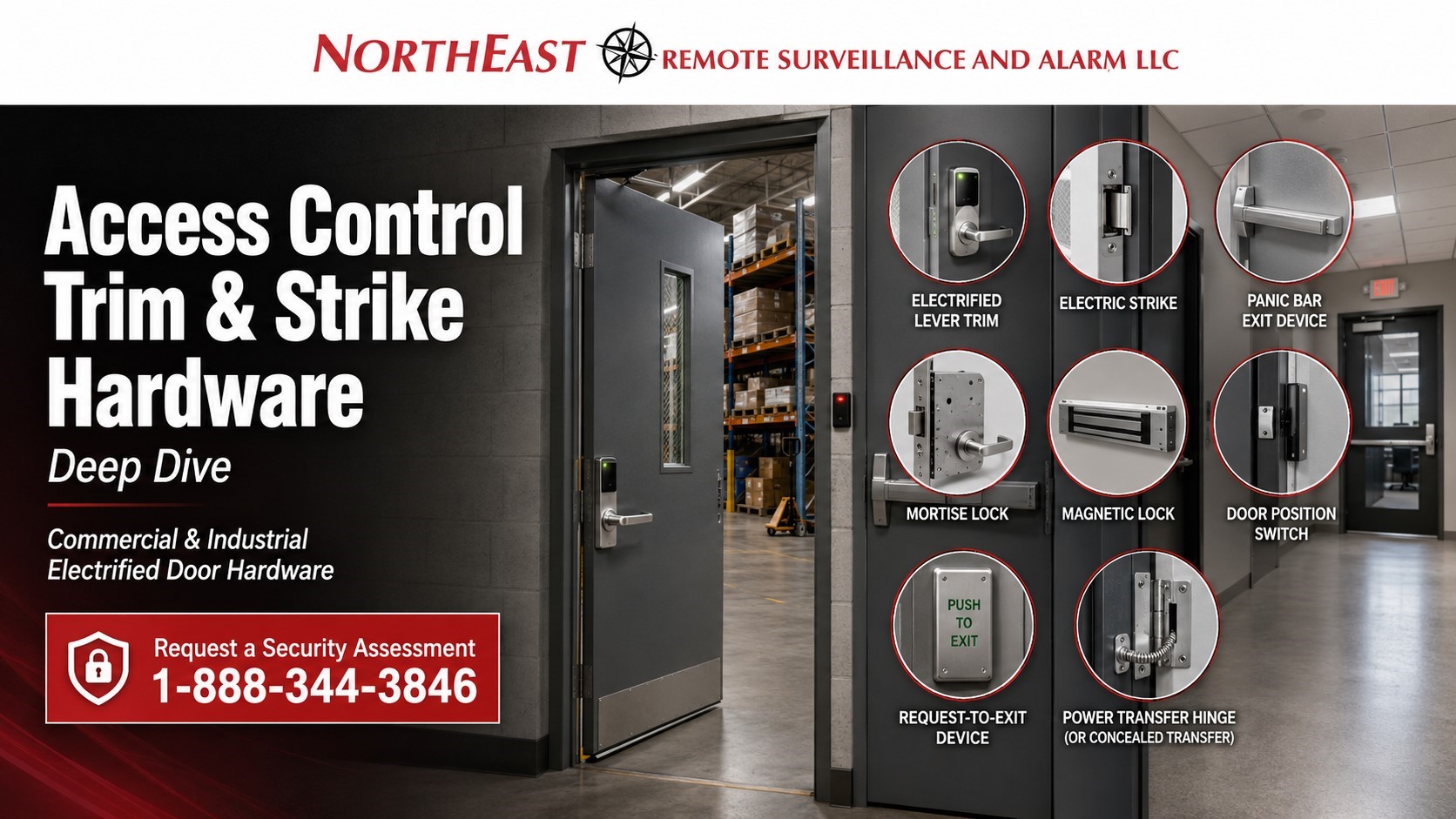
Northeast Remote Surveillance and Alarm, LLC (NERSA) designs and installs electric strikes and electrified trim for commercial and industrial access-controlled doors where the locking and release hardware must operate reliably with readers, controllers, power supplies and the physical opening.
NERSA supports scalable applications ranging from a single controlled entrance for a small business through high-cycle industrial doors, multi-building properties and enterprise access-control environments.
For complete system planning involving readers, controllers, credentials, permissions, schedules, software and system administration, visit Commercial & Industrial Access Control Systems.
Electrified Hardware at a Commercial Access-Control Door
The card reader or keypad authorizes entry, but the locking hardware physically controls the opening.
For many commercial doors, that function may be performed by:
- An electric strike
- Electrified trim used with compatible commercial lock or exit hardware
Neither approach is automatically better.
The correct choice depends on the:
- Door and frame
- Existing latch or exit hardware
- Traffic level
- Required durability
- Available wiring
- Power requirements
- Required operating behavior
- Egress requirements
- Long-term serviceability
The hardware should be selected around the actual opening rather than choosing a device first and attempting to make the door fit it afterward.
Electric Strikes
An electric strike is installed in the frame at the latch location.
The mechanical latch remains on the door while the strike releases when the access-control system authorizes entry.
Electric strikes may be appropriate for openings such as:
- Office entrances
- Interior restricted doors
- Commercial suite entrances
- Selected employee entrances
- Moderate-traffic commercial doors
A strike installation should be evaluated for door and frame condition, latch alignment, available frame preparation, traffic volume, power and the required locking behavior.
A properly selected strike should release consistently and allow the door to close, relatch and return to a secure condition after authorized entry.
Electrified Trim
Electrified trim electronically controls the exterior entry function of compatible commercial door or exit-device hardware.
The interior hardware continues to provide the designed exit function while entry from the secured side is controlled electronically.
Electrified trim may be appropriate for:
- Employee entrances
- Warehouse personnel doors
- Manufacturing entrances
- Commercial perimeter doors
- High-use controlled openings
- Doors equipped with compatible exit hardware
It may be particularly useful where the property requires durable commercial-duty hardware and frequent employee traffic.
The exact trim must be compatible with the installed lock or exit-device configuration.
Electric Strike vs. Electrified Trim
The primary difference is where the controlled entry function occurs.
Electric strike:
The electrically controlled release occurs at the frame-mounted strike.
Electrified trim:
The exterior lever or trim is electronically controlled through compatible door or exit hardware.
Selection should consider:
- Door construction
- Frame condition
- Existing lock or exit device
- Traffic level
- Required durability
- Wiring pathway
- Power requirements
- Fail operation
- Serviceability
The goal is not to standardize every controlled opening around the same hardware.
It is to select the hardware that best matches the door and the way the property actually uses it.
Door and Frame Condition Matters
Electrified locking hardware cannot compensate for a poorly operating door.
Before a strike or electrified trim is selected, the opening should be reviewed for conditions such as:
- Door alignment
- Frame condition
- Hinge wear
- Latch operation
- Door closer operation
- Existing hardware condition
- Exit-device condition
- Door sag
- Traffic level
- Fire rating where applicable
A door that already binds, fails to close or does not latch consistently can remain unreliable after new access-control hardware is installed.
The physical opening should therefore be evaluated before the electrified hardware is finalized.
Latch Alignment and Reliable Relatching
Latch alignment is especially important with electric strikes.
Poor alignment can cause:
- Latch binding
- Intermittent unlocking
- Incomplete latching
- Excessive pressure
- Premature strike wear
- Difficulty securing the opening
The strike should not be used as a substitute for correcting a badly aligned door.
A successful access-controlled opening must do more than unlock.
After authorized entry, the door should:
- Open normally.
- Close properly.
- Relatch.
- Return to its secured condition.
Reliable relatching is part of the access-control function.
Wiring, Power and Power Transfer
Electric strikes and electrified trim require dependable low-voltage power.
Planning may involve:
- Required voltage
- Current draw
- Cable distance
- Conductor size
- Power-supply capacity
- Controller relay operation
- Battery-backed power where applicable
- Wiring pathway
Electric strikes commonly receive power at the frame.
Electrified trim may require power to pass from the stationary frame into the moving door through an appropriate power-transfer method.
The wiring arrangement should remain reliable through repeated door cycles.
For high-use entrances, poor power transfer or inadequate wiring can create intermittent failures even when the reader and controller are functioning properly.
High-Cycle Commercial and Industrial Doors
Traffic level matters.
A private office door may operate only a limited number of times each day.
A warehouse or manufacturing employee entrance may cycle continuously during:
- Shift changes
- Break periods
- Deliveries
- Maintenance activity
- Contractor movement
- Normal employee traffic
Higher-use openings generally require greater attention to hardware durability, alignment, mounting strength, door condition and future serviceability.
A hardware arrangement suitable for a low-traffic office may not be appropriate for a multi-shift industrial entrance.
NERSA evaluates the opening around its actual use rather than applying the same trim or strike solution everywhere.
Fail-Safe, Fail-Secure and Egress
Electrified locking hardware must have the appropriate operating behavior when power is removed.
Depending on the specific device and application, hardware may be configured for fail-safe or fail-secure operation.
Fail-safe hardware releases its secured condition when power is removed.
Fail-secure hardware generally maintains secured entry from the outside when power is removed while required interior egress is preserved through the properly designed opening.
The appropriate arrangement depends on the specific door, occupancy, locking hardware, emergency operation and applicable requirements.
Electronic access control must not improperly interfere with required exit.
Where an opening involves panic hardware, fire-rated doors, specialized locking arrangements or other code-sensitive conditions, those requirements should be evaluated before equipment is selected.
Retrofit or Replace Existing Hardware?
Some commercial openings can be converted successfully while retaining much of the existing door, frame and mechanical hardware.
A retrofit may be reasonable when:
- Door and frame are in good condition
- Existing hardware is compatible
- Latch alignment is correct
- Required electrified components are available
- Traffic level is appropriate
More extensive hardware replacement may be appropriate when:
- Existing hardware is damaged
- Components are unsupported
- The opening is heavily worn
- Existing hardware cannot provide the required function
- Door or frame conditions prevent reliable operation
The objective is not to preserve existing hardware at all costs.
It is to create a dependable controlled opening using appropriate commercial hardware.
Commercial Applications
Electric strikes and electrified trim may be used on controlled openings serving:
- Small businesses
- Offices
- Warehouses
- Distribution facilities
- Manufacturing properties
- Healthcare facilities
- Multi-tenant buildings
- Industrial properties
- Commercial campuses
- Multi-building enterprise environments
Property size does not determine the hardware by itself.
A single-door small business may require a robust commercial opening, while a larger enterprise may use different hardware types across dozens of controlled doors.
Each opening should be evaluated individually while still fitting into the broader access-control system.
Frequently Asked Questions
What is an electric strike?
An electric strike is a frame-mounted electrified device that releases the mechanical latch when the access-control system authorizes entry.
What is electrified trim?
Electrified trim electronically controls the exterior entry function of compatible commercial locking or exit hardware while preserving the designed interior exit operation.
Which is better: electrified trim or an electric strike?
Neither is universally better. The correct choice depends on the door, frame, existing hardware, traffic level, durability, power, wiring and required operation.
Can an electric strike be installed on an existing commercial door?
Often, yes. The frame, latch, lockset, alignment, preparation and operating requirements should be evaluated first.
Is electrified trim appropriate for warehouse employee entrances?
It can be. Electrified trim may be appropriate for compatible high-use commercial and industrial doors where durable mechanical latching and controlled exterior entry are required.
Why does an electric strike sometimes fail to release?
Possible causes include latch pressure, door misalignment, inadequate power, wiring problems, hardware wear or incorrect strike selection.
Does electrified trim require wiring through the door?
Often, yes. When the electrified component is installed in the moving door, a suitable power-transfer method is required between the frame and door.
Does electrified access-control hardware affect emergency exit?
It can if designed incorrectly. Electrified entry hardware must be selected and installed so the opening maintains required exit operation.
Request a Commercial Electrified Hardware Assessment
If your commercial or industrial property needs an electric strike, electrified trim or evaluation of an existing access-controlled opening, NERSA can review the door, frame, existing hardware, traffic level, power requirements and required operating behavior.
Whether the project involves one controlled entrance for a small business or high-cycle openings across an enterprise or multi-building environment, the hardware should be selected around the actual opening and long-term operating requirements.
Request a Security Assessment.
Small Business – Enterprise Scalable Solutions
Commercial & Industrial Systems Only • Electric Strikes • Electrified Trim • Controlled Door Hardware