
Capital planning for commercial security helps businesses, facility managers, operations teams, and organizations make smarter long-term decisions about security investments, upgrades, replacements, expansions, and lifecycle planning.

Discuss your project with NERSA
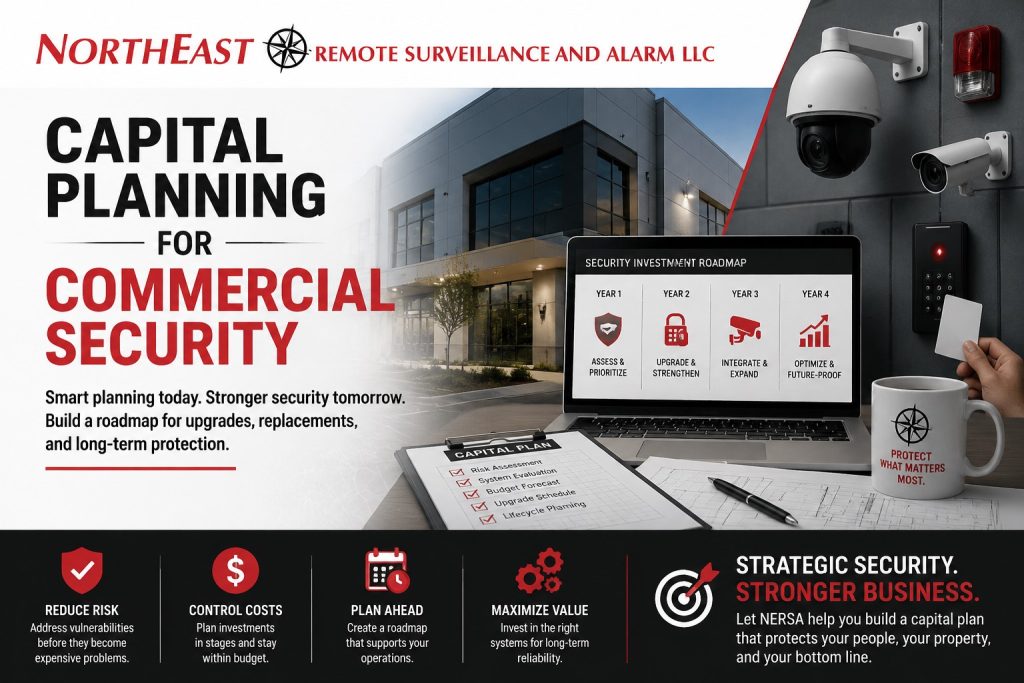
Northeast Remote Surveillance and Alarm, LLC helps organizations plan security improvements around risk, budget, daily operations, future growth and long-term reliability.
We serve small and growing businesses, warehouses, industrial and logistics properties, schools, municipal buildings, healthcare facilities, multi-site operators and large commercial properties.
For related system planning, explore Commercial Security System Retrofits.
Commercial security systems are not a one-time purchase. Cameras, access control systems, intrusion alarms, monitoring platforms, intercoms, gate systems, communication infrastructure, and low-voltage components all have different lifecycles, maintenance requirements, upgrade paths, and replacement considerations.
Without a capital plan, businesses often react to problems instead of planning ahead. A failed recorder, unsupported alarm panel, outdated access control system, poor camera coverage, or unreliable communication path can create unexpected expenses and operational disruption.
NERSA helps commercial and industrial organizations move from reactive security spending to proactive security planning.
Why Capital Planning Matters for Commercial Security
Security investments affect more than just equipment. A properly planned security program supports employee safety, asset protection, operational visibility, incident documentation, access control, compliance awareness, and long-term facility management.
Capital planning helps businesses answer important questions:
- What security systems need attention first?
- Which existing systems can continue operating?
- Which upgrades provide the greatest improvement?
- What should be budgeted this year versus future years?
- How should new locations or expansions be supported?
- What technology decisions will create problems later?
- A strong capital plan gives businesses a roadmap instead of forcing emergency decisions when equipment fails.
- Building a Commercial Security Capital Plan
A commercial security capital plan should consider the entire security environment, including cameras, access control, intrusion alarms, monitoring, communication infrastructure, intercoms, gates, low-voltage systems, power requirements, network support, documentation, and future expansion.
NERSA helps businesses evaluate current conditions, identify risks, prioritize improvements, and create a practical upgrade sequence.
The goal is not simply replacing equipment. The goal is investing in security improvements that provide measurable operational value.
Security System Lifecycle Planning
Every security system has a lifecycle. Cameras become outdated. Recorders reach capacity limits. Access control platforms stop receiving support. Alarm communicators require upgrades. Network infrastructure may no longer support new devices. User permissions become difficult to manage.
Capital planning helps businesses prepare for these changes before they become emergencies.
A lifecycle plan may include:
- Camera replacement schedules
- Recorder and storage upgrades
- Access control modernization
- Alarm panel and communicator upgrades
- Monitoring technology improvements
- Network and PoE infrastructure upgrades
- Intercom and gate system improvements
- Documentation updates
- Future expansion planning
By planning ahead, businesses can spread investments over time while maintaining reliable security operations.
Phased Security Investment Planning
Many businesses do not need to replace every system immediately. A phased capital plan allows organizations to address the highest-priority needs first while creating a long-term path forward.
A phased approach may include:
- Phase One: Security assessment and system documentation
- Phase Two: Critical repairs and risk reduction
- Phase Three: Camera, access control, or alarm upgrades
- Phase Four: Communication infrastructure improvements
- Phase Five: System integration and operational improvements
- Phase Six: Future expansion and technology planning
Phased planning helps businesses control costs while improving security where it matters most.
Capital Planning for Security Cameras
Video surveillance is often one of the largest areas of commercial security investment. Capital planning helps businesses determine when cameras should be repaired, upgraded, expanded, or replaced.
Planning considerations may include:
- Image quality requirements
- Coverage gaps
- Night visibility
- Recording retention needs
- AI analytics opportunities
- Remote access requirements
- Loading dock and yard visibility
- Parking lot coverage
- Production floor monitoring
- Multi-building visibility
A camera investment should support real operational needs, not just add more devices.
Capital Planning for Access Control
Access control systems require long-term planning because they affect employee movement, restricted areas, visitor access, and operational workflows.
Capital planning considerations may include:
- Door priorities
- Credential technology
- Employee access management
- Mobile credentials
- Visitor management
- Gate control
- Door hardware condition
- Future building expansion
- Integration with cameras and alarms
- A planned access control strategy helps businesses avoid inconsistent systems across different locations.
- Capital Planning for Intrusion Alarms and Monitoring
Intrusion alarm systems require lifecycle planning for panels, sensors, communicators, monitoring paths, and user management.
Capital planning may include:
- Alarm panel modernization
- Cellular or IP communicator upgrades
- Sensor replacement
- Zone cleanup
- False alarm reduction
- Monitoring improvements
- Emergency contact updates
- Integration with video verification
A reliable alarm system depends on more than the panel. It depends on the entire protection strategy.
Capital Planning for Communication Infrastructure
Security systems rely on communication infrastructure. Weak network paths, outdated cabling, poor PoE design, unstable wireless links, or outdated communication methods can limit system performance.
Capital planning should consider:
- Network readiness
- PoE switching
- Fiber infrastructure
- Wireless bridges
- Cellular backup paths
- Rack organization
- Equipment power
- System documentation
- Future bandwidth needs
A strong infrastructure plan protects future security investments.
Capital Planning for Multi-Site Organizations
Businesses with multiple locations need a different approach to capital planning. Each property may have different equipment, different vendors, different security risks, and different upgrade needs.
A multi-site capital plan helps organizations standardize:
- Security technology standards
- Camera platforms
- Access control procedures
- Alarm workflows
- User permissions
- Monitoring procedures
- Documentation
- Future expansion requirements
NERSA helps businesses create security standards that support both current locations and future growth.
Capital Planning for New Construction and Expansions
Commercial security capital planning is especially important during new construction, renovations, expansions, acquisitions, and facility changes.
Early planning can help businesses prepare for:
- Camera locations
- Access control doors
- Network pathways
- Security cabling
- Gate systems
- Intercom locations
- Alarm coverage
- Monitoring requirements
- Future technology upgrades
Planning security infrastructure early helps avoid expensive changes after construction is complete.
Avoiding Reactive Security Spending
Reactive security spending usually happens after something fails. A recorder crashes. A camera stops working. A door no longer controls access. An alarm communicator becomes unsupported. A business discovers the system no longer meets operational needs.
Capital planning helps businesses move from emergency replacement decisions toward planned improvements.
The result is:
- Better budgeting
- Less downtime
- Fewer emergency repairs
- Improved system reliability
- Better documentation
- Smarter technology decisions
Why Businesses Choose NERSA for Security Capital Planning
Northeast Remote Surveillance and Alarm, LLC approaches commercial security as long-term infrastructure, not isolated equipment purchases.
NERSA helps businesses evaluate existing systems, identify upgrade opportunities, prioritize investments, and create practical security improvement plans that align with operations and budgets.
The focus is on building security systems that are reliable, scalable, serviceable, and prepared for future growth.
Built for Commercial and Industrial Environments
Capital planning for commercial security applies to many environments, including:
- Warehouses
- Manufacturing facilities
- Industrial buildings
- Logistics properties
- Corporate offices
- Medical facilities
- Schools
- Municipal buildings
- Contractor yards
- Retail locations
- Multi-tenant properties
- Multi-site organizations
- Large commercial operations
Each environment has different risks, workflows, and investment priorities. A proper capital plan should match the way the facility actually operates.
Coordinating Budgets and Upgrade Priorities
Coordinate security budgets with equipment condition, operational priorities and the expected timing of future improvements.
It connects closely with:
- Commercial Security System Takeovers, Upgrades, and Retrofits
- Commercial Security System Integration Upgrades
- Phased Security Upgrades
- Security Communication Infrastructure Upgrades
- Multi-Site Security Standardization
- Commercial Security System Maintenance and Support
Review long-term security investments before equipment failures force emergency replacements.
Frequently Asked Questions
What is capital planning for commercial security?
Capital planning for commercial security is the process of evaluating current systems, identifying future needs, prioritizing upgrades, budgeting improvements, and creating a long-term roadmap for security investments.
Why should businesses plan security upgrades ahead of time?
Planning ahead helps businesses avoid emergency replacements, reduce downtime, improve budgeting, and make better technology decisions based on actual operational needs.
Does capital planning mean replacing the entire security system?
No. Capital planning often identifies which systems can remain, which components should be upgraded, and which improvements should happen first. Many businesses benefit from phased upgrades instead of immediate full replacement.
Can capital planning include cameras, alarms, and access control?
Yes. A commercial security capital plan can include video surveillance, access control, intrusion alarms, monitoring, intercoms, gates, communication infrastructure, and other security-related systems.
Is capital planning only for large companies?
No. NERSA supports small businesses, growing businesses, warehouses, industrial facilities, schools, municipal buildings, multi-site operations, and large commercial security environments. The planning process is scaled around the organization’s actual needs, budget, and growth goals.
When should a business start a commercial security capital plan?
Businesses should begin planning before systems fail, during facility expansion, when acquiring new locations, when technology becomes outdated, or when security needs change due to operational growth.
For related planning, explore Commercial Security System Upgrades, Retrofits and Takeovers.
Request a Commercial Security Capital Planning Assessment
Call Northeast Remote Surveillance and Alarm, LLC at 1-888-344-3846 to discuss commercial security capital planning, upgrade priorities, lifecycle planning, and long-term security investment strategies.
Compliance, Codes & Project Standards
NERSA plans commercial and industrial security work with applicable code, documentation, inspection and authority-having-jurisdiction requirements in mind. Requirements vary by system, property and jurisdiction. These resources support project planning; they do not establish legal compliance, certification or AHJ approval.
Related guidance: Regulatory compliance & inspection readiness · NERSA project standards · Documentation, testing & inspection readiness