
Tool cribs, parts rooms, inventory cages and equipment rooms often hold valuable assets.

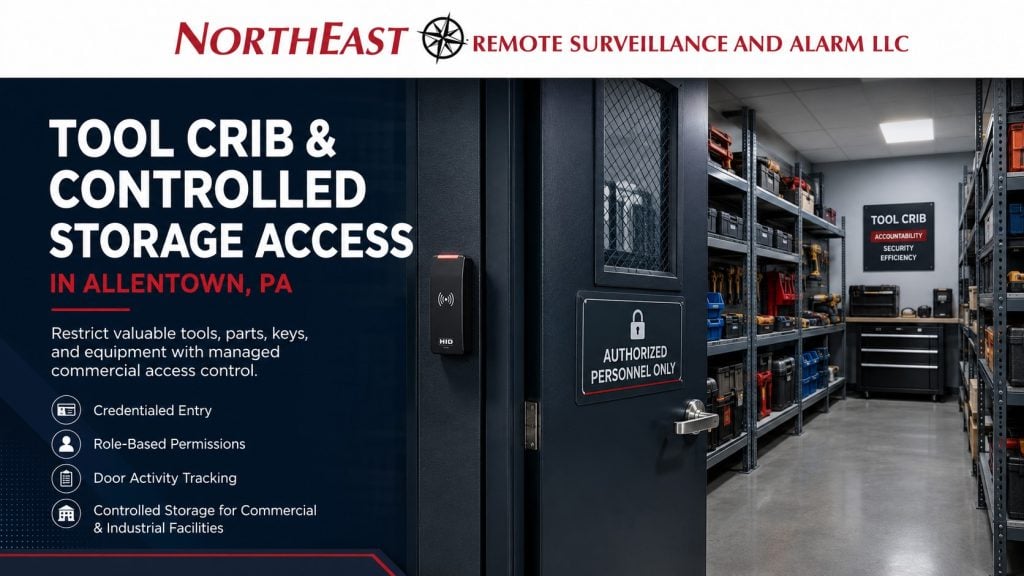
Maintenance shops and key-storage areas may also contain tools, spare parts, specialized equipment, sensitive materials, credentials or documents. Limit entry to the employees, contractors, vendors and visitors who need access.
Commercial access control can help Allentown businesses restrict these areas to approved users, organize permissions around actual job responsibilities, and create a clearer record of credential activity at the controlled opening.
Tool-crib and controlled-storage access may be appropriate for:
- Manufacturing plants
- Warehouses and distribution centers
- Industrial facilities
- Contractor and service businesses
- Fleet-maintenance operations
- Utility and mechanical areas
- Healthcare-support properties
- Institutional facilities
- Multi-tenant commercial buildings
- Businesses storing valuable tools, parts, keys, or equipment
Plan controlled storage around the assets, authorized users and operating hours. Check the opening and existing door hardware before selecting a reader or lock. Decide who will manage permissions and how access will change over time.
Role-Based Access for Employees and Departments
Not every credential holder should receive access to every storage area.
Permissions may be organized by employee, department, job function, shift, location, certification, supervisory authority, or temporary work assignment.
For example, maintenance technicians may need regular tool-crib access while production employees require access only during assigned shifts. Supervisors may need broader permissions, while contractors or equipment vendors may receive access to one specific opening during a limited schedule.
A structured permission plan helps the business provide necessary access without granting unnecessary building-wide or department-wide entry.
Access levels should be reviewed when employees change positions, move between departments, complete temporary assignments, or leave the organization.
Temporary Contractor and Vendor Access
Manufacturing, warehouse, and commercial facilities frequently need to provide temporary access to service contractors, equipment technicians, delivery personnel, maintenance vendors, and outside specialists.
Temporary credentials should be limited by:
- Approved doors
- Defined dates
- Permitted schedules
- Assigned work areas
- Authorized responsibilities
- Automatic expiration when supported
Shared credentials and common PINs weaken accountability because several people may appear under the same user record.
Individual credentials provide a clearer administrative trail and make it easier to remove one person’s access without affecting every contractor or vendor working at the property.
For broader access planning involving manufacturing floors, employee entrances, contractor doors, production-support areas, utility rooms, and restricted industrial spaces, use Manufacturing Security Systems in Allentown, PA.
Documenting Entry to Controlled Areas
Access control can record when a credential is presented, whether access is granted or denied, and whether the attempt occurs within the user’s approved schedule.
Depending on the system and installed door-monitoring devices, management may also be able to review:
- Door-forced conditions
- Door-held-open events
- Schedule-related denials
- Invalid credential attempts
- Administrative permission changes
- Credential activation or deactivation
- Controller or communication conditions
These records can help determine which credential was used and when the event occurred.
However, an access event does not automatically prove what was removed from the room, whether the authorized person allowed someone else to enter, or whether inventory procedures were followed.
Facilities requiring stronger documentation may combine credentialed entry with video coverage, tool sign-out procedures, inventory records, asset-management systems, or supervisor approval.
Door Hardware for Tool Cribs and Storage Rooms
The physical opening must be evaluated before electronic locking hardware is selected.
Tool cribs and controlled storage rooms may use:
- Electric strikes
- Electrified locksets
- Electrified trim
- Exit-device-compatible hardware
- Door-position contacts
- Request-to-exit devices
- Power-transfer hardware
- Access control power supplies
- Backup batteries
The appropriate hardware depends on the door and frame, latch type, traffic level, existing lock, required exit operation, environmental conditions, and the value or sensitivity of the protected area.
A frequently used tool-room entrance may require a different locking solution than a lightly used records room, interior equipment cage, or high-value parts-storage area.
For planning involving strikes, electrified trim, exit devices, door contacts, request-to-exit devices, power transfer, and controlled-opening operation, use Access Control Door Hardware in Allentown, PA.
Preventing Propped and Held-Open Doors
A controlled storage door provides limited protection when employees regularly prop it open for convenience.
Door-position monitoring can help the access control system identify when an opening remains open longer than expected or is opened without a corresponding authorized access event.
Depending on the platform, abnormal conditions may generate:
- Local alerts
- Management notifications
- Software events
- Door-held-open reports
- Door-forced records
- Video-review triggers
The system should be supported by clear operating procedures. Technology cannot fully correct a workplace practice that permits secured doors to remain unattended or routinely propped open.
Door closers, latch alignment, employee training, workflow, material movement, and traffic patterns should also be reviewed when a controlled door repeatedly remains open.
Tool-Crib Access for Warehouses and Distribution Facilities
Warehouse tool rooms and controlled storage spaces may be used for maintenance equipment, scanners, vehicle keys, replacement components, high-value inventory, shipping documents, technology equipment, and other operational assets.
Warehouse access planning should account for multiple shifts, temporary labor, maintenance personnel, supervisors, drivers, contractors, and frequent staffing changes.
Permissions should be limited to the areas and schedules required by each user group rather than providing every warehouse credential with identical access.
For complete planning involving warehouse employee entrances, shipping offices, inventory cages, secured storage rooms, maintenance areas, IT rooms, and office-to-warehouse transition doors, use Warehouse Access Control Systems in Allentown, PA.
Access Control Does Not Replace Inventory Management
Access control helps manage who may enter a tool crib or storage area. It does not determine what a person removes, whether an item is returned, or whether inventory records remain accurate.
A more complete asset-control process may combine:
- Individual access credentials
- Role-based permissions
- Door-position monitoring
- Video coverage
- Tool or equipment sign-out
- Inventory-management procedures
- Restricted after-hours schedules
- Supervisor authorization
- Regular user reviews
- Prompt employee offboarding
The access control system should support the business’s inventory and accountability procedures rather than being treated as a replacement for them.
Planning Controlled Storage Access in Allentown
Northeast Remote Surveillance and Alarm, LLC plans tool-crib and controlled-storage access around real commercial and industrial operating conditions.
The assessment may review:
- Assets being protected
- Authorized users
- Departments and shifts
- Contractor and vendor activity
- Existing credentials
- Door and frame construction
- Locking hardware
- Controller capacity
- Wiring and power
- Door monitoring
- Permission administration
- Event reporting
- Video coordination
- Future controlled openings
Tool cribs, inventory rooms, equipment cages, maintenance spaces, and controlled storage areas should operate within the property’s larger access control structure.
This creates one manageable system for credentials, users, schedules, permissions, door activity, employee changes, and future expansion instead of treating every restricted room as an isolated locking project.
Coordinate tool cribs and controlled storage with the wider Manufacturing Plant Security Systems plan, including employee entrances, production areas, and visitor access.
Use the Allentown tool-crib guide for local controlled-storage planning.
- Tool Crib Security Systems in Allentown, PA — Review controlled-storage planning for an Allentown facility.
Plan Your Next Security Improvement
Tell NERSA about your commercial facility, existing systems, and project priorities. We can help you plan an installation, evaluate an upgrade, or coordinate security across multiple locations.