
Allentown facilities use tool crib security systems to control entry, protect valuable equipment and create clear activity records.

Request a Physical Plant Security Assessment
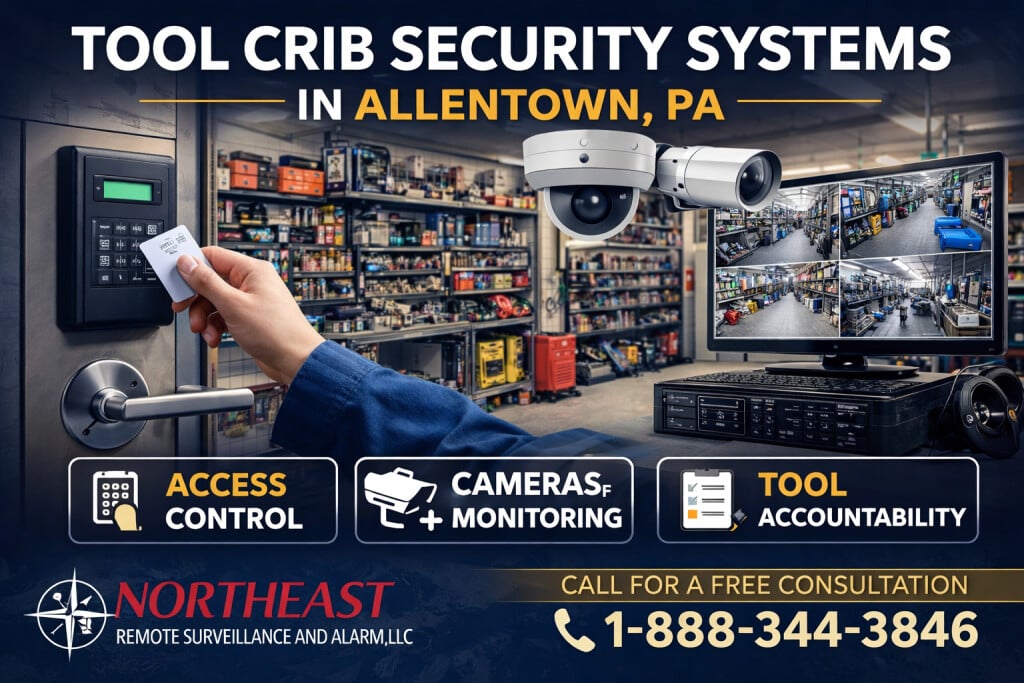
For broader planning of secured inventory areas, explore tool crib and controlled-storage access.
Protect Tools, Supplies and Daily Operations
Tool crib security systems in Allentown, PA help managers control who enters sensitive storage areas. First, the system limits access to approved employees, supervisors or contractors. Next, cameras document activity near doors, counters and high-value storage.
Missing tools can delay repairs, production and field work. Therefore, a focused security plan protects both inventory and operating schedules. It also gives managers reliable information when they review a loss or access concern.
Controlled Entry for the Tool Crib
Access control replaces shared keys with individual credentials. For example, employees can use cards, fobs, mobile credentials or assigned codes. Managers can then grant access by user, shift, day or location.
- Limit entry to authorized users.
- Remove access quickly when responsibilities change.
- Review entry records by assigned credential and time.
- Apply different schedules to employees, vendors and contractors.
- Control one tool room or several secured storage areas.
In addition, door contacts can report a forced or propped-open door. Alerts can reach designated staff when activity falls outside normal procedures.
Video Coverage for Reviewable Activity
Cameras should capture faces at the entrance and useful activity inside the room. Likewise, views can cover service counters, issue points, cages and storage aisles. Proper placement supports clear review without wasting coverage on low-value areas.
Time-synchronized access and video records help staff follow the same event across systems. A manager can match a credential event with the corresponding video. As a result, the facility gains stronger accountability for tools and supplies.
Alarm and Monitoring Options
An intrusion alarm can protect the tool crib after hours. Specifically, door contacts and motion detection can identify unauthorized entry. The system can then notify approved personnel or a monitoring service.
Remote video monitoring may support locations with higher after-hours risk. However, the design should match the facility’s staffing, response plan and operating hours. NERSA defines those procedures before configuring notifications.
Right-Sized for One Site or Many
A small shop may need one controlled door and a few cameras. By contrast, a manufacturer may manage several tool cribs across multiple buildings. Compatible systems can support coordinated credentials, permissions, alerts and reporting across locations when capacity and responsibilities are planned.
Most importantly, each location keeps a clear operating purpose. Managers can expand the system as storage areas, shifts or facilities change.
Plan the Allentown Tool Crib System
NERSA reviews doors, user groups, camera views, lighting, network access and response procedures. Then, we define the equipment and permissions around the facility’s actual workflow. Before handover, test an approved user, a denied credential, an after-hours event, and retrieval of a representative recording. Confirm the response contacts and record unresolved issues. Entry and camera records support investigation but do not replace the facility’s tool issue, return, and inventory procedures.
For facility-wide planning, review manufacturing security systems in Allentown.
You can also explore commercial access control and commercial security cameras.
Define custody of high-value tools and controlled inventory
A tool crib security plan must establish who can enter, who can remove items, who records checkout and who investigates missing equipment. Electronic door access can identify a presented credential and restrict a room to approved personnel, but it cannot prove which item left the space. Coordinate door events with existing inventory processes rather than describing a reader as a complete tool-tracking solution. Identify restricted storage zones for expensive calibrated equipment, cutting tools, consumables or hazardous materials where site policies require extra control.
Permissions and after-hours exceptions
Operators, maintenance mechanics, supervisors, purchasing personnel and approved contractors may need different access windows. Build permission groups by role and area, with individual credentials and automatic expiration for temporary work. Account for shutdowns, overnight maintenance and emergency repairs, when the normal crib attendant may not be present. If a supervisor grants an exception, record who approved it and for how long. Avoid shared untracked codes that undermine accountability precisely when a loss needs investigation.
Hardware, camera and record considerations
Survey door material, closer, mechanical latch, lock function, fire rating and required egress before adding electronic control. Where drawers, cages or interior cabinets require independent restrictions, document those decisions separately instead of assuming the room door controls every item. Consider camera coverage only where permitted and useful: check whether the lens can see the handoff counter and door without capturing unrelated private work areas. Align access logs, inventory timestamps and camera clocks for authorized investigations.
Verify the complete checkout workflow
Test a normal user entry, denied access by an unapproved employee, a time-limited contractor, an unlocked or held-open door, and resecured operation after a power or network fault under an approved plan. Ask the manager to retrieve the relevant access event and inventory checkout record. Keep a named procedure for lost tools, periodic permission reviews, account recovery and equipment maintenance. Strong crib control depends on staff practice as much as the reader or lock.
Schedule a Security Assessment
Finally, schedule an assessment to review tool crib access, camera coverage and after-hours protection at your Allentown facility.
Compliance, Codes & Project Standards
NERSA plans commercial and industrial security work with applicable code, documentation, inspection and authority-having-jurisdiction requirements in mind. Requirements vary by system, property and jurisdiction. These resources support project planning; they do not establish legal compliance, certification or AHJ approval.
Related guidance: Regulatory compliance & inspection readiness · NERSA project standards · Documentation, testing & inspection readiness