
NERSA designs and installs manufacturing facility and plant security systems for production areas, employee entrances, loading zones, restricted rooms, equipment, inventory and after-hours property exposure.

Request a manufacturing security assessment
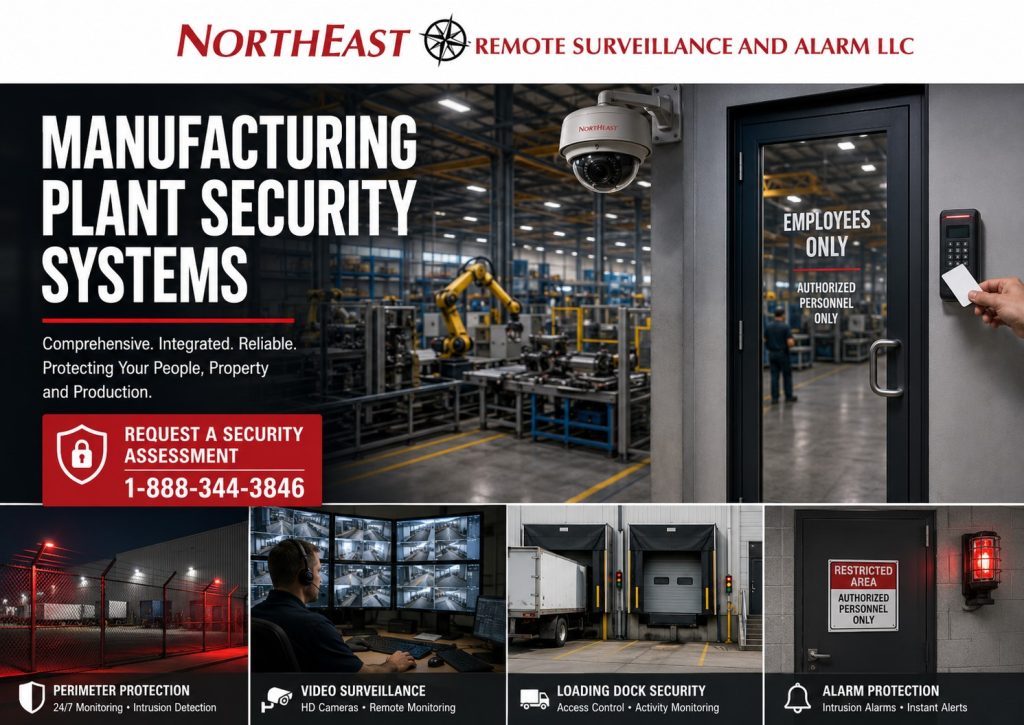
This guide covers security planning for manufacturing facilities, including video surveillance, access control, intrusion detection, fire and life-safety coordination, monitoring readiness and supporting infrastructure.
For broader planning by facility type, visit Industries We Serve.
Commercial and Industrial Systems Only • Manufacturing Facilities • New Installations • Upgrades • Retrofits • Takeovers • Monitoring
Security Systems Built Around Manufacturing Operations
Manufacturing facilities do not operate like standard office buildings.
They may include production floors, shipping and receiving areas, employee entrances, contractor access points, inventory storage, maintenance rooms, mechanical spaces, utility areas, exterior yards and restricted operational zones.
Security planning should reflect how the facility actually works.
Shift changes, vendors, truck deliveries, production schedules, maintenance activity, employee movement and after-hours operations can all affect the final system design.
NERSA plans manufacturing security around visibility, controlled access, dependable detection, practical response, life-safety coordination and reliable infrastructure.
For local production areas and controlled staff entrances, see manufacturing and industrial access control in Scranton.
Where Manufacturing Plants Need Security Coverage
Manufacturing facilities often require layered protection across interior and exterior areas.
Common security areas may include:
- Employee entrances
- Visitor entrances
- Shipping and receiving
- Loading docks
- Production floors
- Inventory storage
- Tool rooms
- Maintenance areas
- Mechanical and electrical rooms
- IT and network rooms
- Exterior doors
- Parking areas
- Perimeter approaches
- Equipment yards
- Restricted production spaces
The objective is not to install equipment everywhere.
The objective is to place the appropriate system where visibility, control, documentation or response matters most.
For a food-processing example of documentation and facility security, read the USA Pork Packers case study in Hazleton.
Additional industrial project proof includes Drug Plastics & Glass in Boyertown and the Prysmian Schuylkill Haven industrial security case study.
Video Surveillance for Manufacturing Facilities
The Lehigh Valley manufacturing video guide focuses this planning discussion on local production facilities and their camera coverage requirements.
Commercial video surveillance can help manufacturing facilities document incidents, improve property visibility and review activity around entrances, loading docks, shipping areas, production approaches, parking areas and exterior exposures.
Manufacturing camera design may need to account for lighting, ceiling height, dust, equipment obstruction, forklift movement, glare, vibration and the difference between general awareness and useful incident evidence.
For broader camera-system planning, visit Commercial & Industrial Video Surveillance Systems.
Access Control for Manufacturing Plants
Access control helps manufacturing facilities manage who can enter selected doors and restricted areas, when access is permitted and how entry activity is documented.
Applications may include:
- Employee entrances
- Office-to-plant transitions
- Production-area doors
- Tool rooms
- IT rooms
- Utility spaces
- Maintenance rooms
- Storage areas
- Restricted operational zones
The system should support daily movement without creating unnecessary bottlenecks.
For broader planning, visit Commercial & Industrial Access Control Systems.
Intrusion Detection and After-Hours Protection
Manufacturing plants may have large footprints, multiple exterior openings, overhead doors, offices, storage areas and sections that operate on different schedules.
Intrusion protection should be organized around the facility’s actual weak points and after-hours activity.
Depending on the property, the system may use door contacts, interior detection, partitions, individual users, monitored communication and separate operating areas.
For broader intrusion planning, visit Commercial & Industrial Intrusion Alarm Systems.
Loading Dock, Shipping and Receiving Security
Shipping and receiving areas can be among the highest-activity security zones in a manufacturing plant.
These areas may involve employees, drivers, vendors, trucks, finished goods, raw materials, pallets and equipment moving through the same operating space.
Planning may consider dock doors, personnel doors, trailer areas, staging zones, delivery lanes, exterior approaches and transitions between warehouse and production areas.
For dedicated planning, visit Loading Dock Security Systems.
Restricted Areas, Tool Rooms and Inventory Protection
Manufacturing plants often contain areas that should not be accessible to every employee, visitor or contractor.
These may include:
- Tool rooms
- Parts storage
- IT rooms
- Utility areas
- Maintenance spaces
- Records rooms
- High-value inventory
- Sensitive production areas
Access control and video surveillance can help separate general facility access from restricted-area access while maintaining useful event history and accountability.
Remote Monitoring and After-Hours Awareness
Some manufacturing properties may benefit from remote video monitoring around exterior areas with limited staffing.
Potential applications include parking areas, loading docks, fenced areas, storage yards, exterior doors and perimeter approaches.
Remote monitoring should be based on clearly defined cameras, schedules, event conditions and response procedures.
For manufacturing-specific planning, visit Industrial Remote Video Monitoring.
For broader operator intervention and live talk-down workflows, use Remote Video Monitoring and Live Talk-Down.
Fire Alarm and Life-Safety Coordination
Manufacturing facilities may include production areas, storage spaces, electrical rooms, mechanical areas, offices and loading zones that require careful coordination between security and life-safety systems.
Security equipment should not interfere with required egress, fire alarm operation, fire-rated openings, emergency release or other building functions.
For broader fire and life-safety planning, visit Commercial Fire Alarm and Life-Safety Systems.
For code-aware guidance, visit Regulatory Compliance and Inspection Readiness.
Network Infrastructure and System Reliability
Modern manufacturing security systems depend on dependable cabling, networks, communication and power.
Large facilities may require structured cabling, fiber, PoE switching, network segmentation, wireless links, equipment racks and backup power.
Manufacturing environments may also introduce distance, metal construction, electrical noise and other conditions that affect system reliability.
For detailed infrastructure planning, visit Commercial & Industrial Infrastructure and Cabling.
Manufacturing Security for Single-Site and Multi-Site Operations
Some manufacturers operate from one facility while others manage several plants, warehouses, offices or distribution locations.
Single-site systems may focus on local visibility, controlled doors and after-hours protection.
Multi-site organizations may require centralized user administration, coordinated video access, standardized credentials, common alarm procedures and consistent documentation.
For broader multi-location planning, visit Multi-Site Commercial Security Systems.
Existing Manufacturing Security Systems
An existing manufacturing security system does not automatically require complete replacement.
NERSA can evaluate cameras, access control, intrusion alarms, monitoring, infrastructure, administrator access and documentation to determine what may reasonably be retained, repaired, expanded, upgraded or replaced.
For existing-system evaluation, visit Commercial Security System Inspection and Assessment.
For modernization and takeover planning, visit Commercial Security System Upgrades, Retrofits and Takeovers.
Why Manufacturing Facilities Choose NERSA
Northeast Remote Surveillance and Alarm, LLC focuses on commercial and industrial security systems rather than single-family home alarm packages.
NERSA plans around real manufacturing operations, including employees, contractors, production areas, restricted spaces, loading activity, exterior exposure, monitoring requirements and supporting infrastructure.
The objective is not to force a manufacturing plant into a generic equipment package.
The objective is to provide useful visibility, controlled access, dependable detection, practical response and a security system that supports the way the facility actually operates.
Request a Manufacturing Plant Security Assessment
A manufacturing security assessment can review:
- Employee and visitor entrances
- Production areas
- Warehouse transitions
- Loading docks
- Parking areas
- Restricted rooms
- Utility and maintenance spaces
- Existing cameras
- Access control
- Intrusion protection
- Monitoring requirements
- Network and cabling conditions
- Fire and life-safety coordination
- Documentation
- Future expansion
Frequently Asked Questions About Manufacturing Plant Security Systems
What security systems do manufacturing plants need?
Depending on the facility, manufacturing plants may require video surveillance, access control, intrusion alarms, fire and life-safety systems, monitoring, intercoms and supporting network infrastructure.
Why is manufacturing plant security different from office security?
Manufacturing plants often include production areas, loading docks, multiple shifts, vendors, contractors, restricted rooms, inventory storage, equipment areas and exterior operations that require more operationally focused planning.
Where should cameras be installed in a manufacturing facility?
Common locations may include entrances, parking areas, loading docks, shipping and receiving, production approaches, warehouse transitions, restricted areas and exterior building approaches.
Can access control protect restricted production areas?
Yes. Access control can separate general employee access from restricted production spaces, tool rooms, IT rooms, maintenance areas and other controlled locations.
Do manufacturing plants need intrusion alarms?
Many do. Intrusion protection may be appropriate for exterior openings, offices, storage areas, warehouse spaces, detached areas and other after-hours risks. Manufacturing-plant alarm system cost depends on the number and type of protected openings, detection devices, alarm partitions, communication paths, monitoring requirements, cabling conditions, and whether compatible existing equipment can be retained.
Can remote video monitoring help manufacturing facilities?
Yes. Qualifying facilities may use remote video monitoring for selected exterior cameras, schedules and defined event conditions.
Should manufacturing security consider fire and life-safety requirements?
Yes. Security systems should be coordinated so they do not interfere with egress, fire alarm operation or other required building functions.
How does a manufacturing security project begin?
The project begins with a facility-specific assessment of operations, entrances, production areas, loading activity, restricted spaces, existing systems, infrastructure and future requirements.
Plan Installation Around Production and Verify the Handover
Agree on work windows with operations before changing cameras, controlled doors, alarm zones, cabling, or power. Identify production areas that require escorts or permits, coordinate temporary coverage, and assign who can approve interruptions. Keep the installation team informed about process changes and restricted work areas so the security upgrade fits the plant’s operating requirements.
At acceptance, walk representative employee, contractor, delivery, and after-hours routes with the people who will operate the system. Check useful recorded views under working conditions, door permissions across shifts, alarm schedules, and the agreed response to a communication failure. Record unresolved items and assign an owner before handover; provide authorized staff with current device records, account access, operating instructions, and the support contact.
Review access-control planning for tool cribs and controlled storage.
- Tool Crib and Controlled Storage Access — Plan who may enter tool-storage areas and how access is documented.
Plant planning by location
Use the local guide for site context, then apply the production, access, and handover checks above.
For other plant and distribution locations, browse the Mid-Atlantic manufacturing and logistics directory.
For Bethlehem plants, use the Bethlehem manufacturing security guide to plan protection around shifts and production areas.
For manufacturing plants in Reading, use the Reading manufacturing security guide to coordinate production, access, and shipping areas.
- Scranton plants — Plan around shifts, production areas, and delivery routes.
- Pittston plants — Coordinate plant security with nearby logistics activity.
- Wilkes-Barre plants — Review controlled areas and outdoor site coverage.
Discuss Your Manufacturing Security Priorities
Request a manufacturing security assessment with your facility layout, shift schedule, existing-system concerns, and priority areas so the scope can be planned around production.
Compliance, Codes & Project Standards
NERSA plans commercial and industrial security work with applicable code, documentation, inspection and authority-having-jurisdiction requirements in mind. Requirements vary by system, property and jurisdiction. These resources support project planning; they do not establish legal compliance, certification or AHJ approval.
Related guidance: Manufacturing compliance planning · NERSA project standards · Documentation, testing & inspection readiness