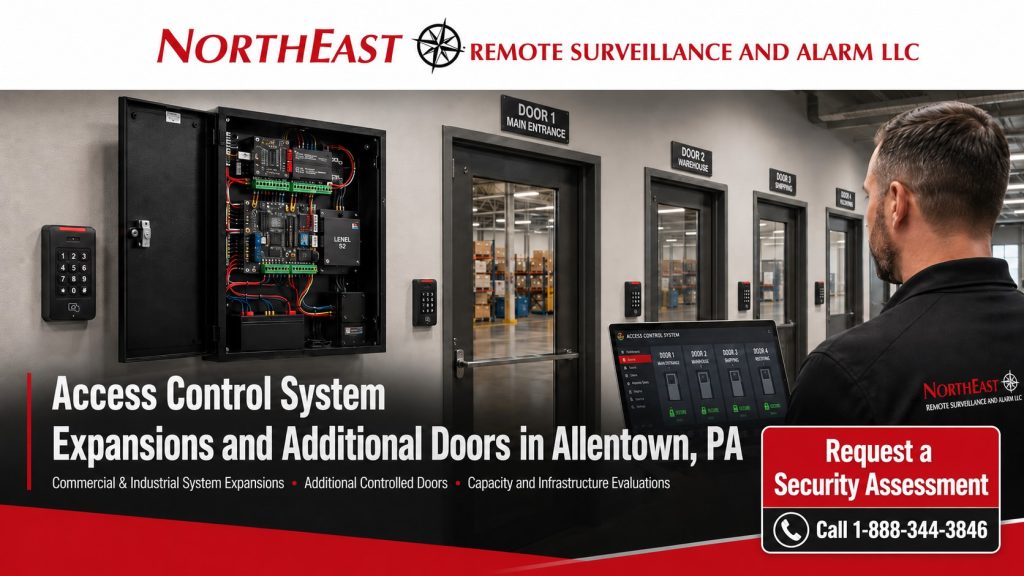
Access control system expansions and additional doors in Allentown, PA help commercial and industrial facilities extend an existing system to new entrances, restricted rooms, tenant spaces, operational areas, and additional buildings.
Northeast Remote Surveillance and Alarm, LLC evaluates existing controllers, software, licensing, readers, credentials, power supplies, network communication, wiring pathways, door hardware, and available system capacity before adding new controlled openings.
This page focuses specifically on expanding an existing access control system. For complete planning involving new installations, credentials, readers, controllers, permissions, schedules, gates, upgrades, takeovers, and property-specific applications, visit Commercial Access Control Systems in Allentown, PA.
Commercial and industrial systems only • Additional controlled doors • System-capacity evaluations • Phased access control expansion
Request a Commercial Security Assessment
Call 1-888-344-3846
Expanding an Existing Access Control System
An access control expansion adds controlled openings, users, departments, buildings, or management capabilities to a system that is already operating.
A business may begin with one employee entrance and later need access control at additional exterior doors, office-to-warehouse transition points, storage rooms, IT rooms, maintenance areas, tenant suites, production spaces, or other restricted locations.
Expansion should not begin by assuming that another reader can simply be connected to the existing panel. The current system must have the controller capacity, software licensing, communication capability, power, credential compatibility, wiring infrastructure, and administrative structure required to support the new openings reliably.
NERSA evaluates the existing system first and determines whether the expansion can use the current platform or requires additional controllers, interface modules, power supplies, network connections, licensing, or supporting infrastructure.
When an Allentown Facility May Need Additional Controlled Doors
Businesses frequently expand access control as their facilities, staffing, workflows, security requirements, and tenant arrangements change.
An expansion may be appropriate when:
- A business adds another employee entrance
- A warehouse needs controlled access between office and operational areas
- A manufacturing facility creates a new restricted production space
- An organization adds an IT, records, medication, inventory, or equipment room
- A commercial property adds tenant-suite access
- A facility needs separate permissions for departments or shifts
- A renovation changes entrances or interior traffic flow
- An addition creates new exterior or interior doors
- A company occupies another floor, building, or adjoining space
- Mechanical keys no longer provide adequate control
- Valuable tools, materials, documents, or technology require restricted access
- Contractors or vendors need limited entry to selected areas
- Management wants additional door activity records
- An existing standalone opening should be brought into the central system
- A business is expanding access control in phases
The purpose of an expansion is to extend structured control to additional openings without creating an inconsistent collection of unrelated readers, credentials, panels, or software platforms.
Controlled Openings Commonly Added During an Expansion
Additional access control doors may be located around the building exterior, inside the facility, between departments, or within restricted operational areas.
Common expansion locations include:
- Employee entrances
- Rear and side entrances
- Office entrances
- Tenant-suite doors
- Office-to-warehouse transition doors
- Warehouse personnel doors
- Shipping and receiving offices
- Manufacturing support areas
- Production-area entrances
- Tool cribs
- Parts rooms
- Inventory cages
- Records rooms
- IT and telecommunications rooms
- Electrical and mechanical rooms
- Medication and supply rooms
- Management offices
- Research or laboratory areas
- Maintenance spaces
- Stairwell doors
- Shared commercial entrances
- After-hours entry points
- Contractor and vendor entrances
Each opening must be evaluated individually. Two doors located in the same building may require different locking hardware, monitoring devices, schedules, permission groups, power arrangements, and emergency operating behavior.
Existing Controller Capacity
Controller capacity is one of the first considerations when adding doors to an existing access control system.
The assessment should determine:
- How many doors the current controller supports
- How many door positions are already in use
- Whether expansion modules are available
- Whether unused reader connections exist
- Whether additional inputs and outputs are available
- Whether the controller firmware supports expansion
- Whether the current enclosure has physical space
- Whether the platform can support another controller
- Whether network communication is available
- Whether the system has practical reserve capacity
An available terminal does not automatically mean the system is ready for another opening. Inputs may already be assigned to door-position contacts, request-to-exit devices, alarm conditions, elevator functions, or other system operations.
NERSA reviews the actual controller configuration rather than relying only on the panel’s advertised maximum capacity.
Access Control Software and Licensing
Some access control platforms require software licenses for each door, controller, reader, administrator, site, integration, or cloud-managed device.
Before an expansion begins, NERSA may review:
- Current software version
- Door or reader licensing
- Controller licensing
- Cloud subscription status
- Administrator access
- Available user capacity
- Database condition
- Manufacturer support
- Firmware compatibility
- Server or appliance requirements
- Multi-site licensing
- Mobile credential licensing
- Integration limitations
A system may have enough physical controller capacity but lack the licensing required to activate additional doors.
Licensing should be confirmed before hardware is installed so the project does not end with completed field wiring that cannot be commissioned through the existing software.
Reader and Credential Compatibility
An access control expansion should maintain a manageable credential environment.
The new opening may need to support the organization’s existing:
- Cards
- Key fobs
- Mobile credentials
- PINs
- Card-and-PIN procedures
- Supported biometric credentials
- Credential formats
- Facility codes
- Encryption requirements
Installing an incompatible reader may force employees to carry multiple credentials or require unnecessary credential replacement.
NERSA evaluates whether the existing reader technology remains appropriate and whether matching or compatible readers are still available. The review may also identify situations where the existing credential technology has become difficult to support or no longer aligns with the organization’s long-term security objectives.
When the primary objective is replacing outdated readers, controllers, credentials, or software across the existing system, use Access Control System Upgrades in Allentown, PA.
Power-Supply and Battery Capacity
Additional readers, locking devices, controllers, relays, request-to-exit devices, and door-position contacts increase the electrical load on the system.
Expansion planning should review:
- Existing power-supply rating
- Current connected load
- Locking-hardware power requirements
- Controller power requirements
- Reader power requirements
- Battery size and condition
- Required standby operation
- Voltage drop
- Cable length
- Distribution and fuse protection
- Enclosure capacity
- Separation of lock and control power where appropriate
- Available electrical circuits
An existing power supply should not be loaded beyond its reliable operating capacity merely because another output terminal is available.
Some expansions can use an existing listed access control power supply. Others require a new supply, additional battery capacity, another enclosure, or a revised power-distribution arrangement.
Network and Communication Requirements
Network-connected access control systems may require additional communication infrastructure when new controllers, buildings, or remote areas are added.
The expansion may depend on:
- Available Ethernet connections
- Approved network addressing
- Virtual LAN configuration
- Firewall coordination
- Cloud connectivity
- Controller communication paths
- Network-switch capacity
- Fiber connectivity
- Wireless bridge infrastructure
- Cellular or alternate communication
- Cybersecurity policies
- Coordination with the organization’s IT department
A new controlled opening should not be placed on an unstable or undocumented network connection.
NERSA coordinates the access control requirements with the customer’s authorized IT personnel so the system can communicate reliably without bypassing the organization’s network-management or cybersecurity procedures.
Wiring Pathways and Infrastructure
Adding another door may require wiring between the opening, reader, controller, power supply, network equipment, and related system devices.
Expansion planning may evaluate:
- Existing conduit
- Accessible ceiling space
- Cable pathways
- Fire-rated construction
- Door-frame access
- Cable distance
- Cable type
- Existing abandoned wiring
- Shared pathways
- Equipment-room capacity
- Protection in warehouse or industrial areas
- Exterior exposure
- Building-to-building communication
- Labeling and documentation
Existing cable may sometimes be reused when it is compatible, properly installed, in suitable condition, and clearly identified.
Unverified or damaged cable should not automatically be reused simply because it reaches the door. Poor infrastructure can create reader problems, intermittent locking, communication failures, voltage drop, nuisance events, and repeated service calls.
Evaluating the New Door Opening
The physical opening must be reviewed before access control hardware is selected.
NERSA may evaluate:
- Door material
- Frame construction
- Existing lock and latch
- Exit device
- Door closer
- Fire rating
- Door alignment
- Traffic volume
- Exterior exposure
- Required entry method
- Required exit operation
- Request-to-exit method
- Door-position monitoring
- Power-transfer pathway
- Automatic operator coordination
- Emergency release requirements
- Fire alarm interface where applicable
The access control platform may approve the credential, but the door hardware performs the actual locking, releasing, monitoring, and secure closing functions.
For detailed planning involving electric strikes, electrified trim, exit devices, request-to-exit equipment, door contacts, power transfer, and access-control power supplies, visit Access Control Door Hardware in Allentown, PA.
Door Position and Request-to-Exit Monitoring
An additional controlled door should normally provide the system with enough information to distinguish authorized entry from abnormal door activity.
Depending on the opening and platform, the system may monitor:
- Door open
- Door closed
- Access granted
- Access denied
- Door forced open
- Door held open
- Request to exit
- Lock status
- Controller communication
- Power conditions
A reader-only installation may unlock a door but provide limited information about whether the door opened, closed, remained propped, or was forced.
Proper door-position and request-to-exit planning gives administrators more useful event history and helps the system operate as a complete controlled opening.
Adding Doors Without Disrupting Existing Operations
Commercial access control expansions often need to be completed while the building remains occupied and operational.
The work may need to account for:
- Employee shift changes
- Shipping and receiving activity
- Production schedules
- Tenant operating hours
- Public entrances
- Medical or institutional operations
- Temporary door access
- Existing alarm schedules
- Network-change windows
- Required shutdown periods
- Coordination with locksmiths or door contractors
- Coordination with electricians, general contractors, or IT personnel
NERSA plans the transition so existing users and controlled openings remain operational whenever practical.
Testing, programming, credential changes, and final cutover should be coordinated with an authorized customer representative before the new door is placed into service.
User Permissions for Additional Doors
Adding a door also requires deciding who should be permitted to use it.
The organization may need to create or revise access levels based on:
- Department
- Job responsibility
- Work shift
- Building
- Floor
- Tenant
- Restricted area
- Management role
- Contractor status
- Vendor requirements
- Temporary assignment
- After-hours authorization
Not every existing cardholder should automatically receive access to every new opening.
The customer should identify who is authorized to approve access. NERSA can configure the platform around those decisions and help organize permission groups so the expansion does not create unnecessary building-wide access.
Schedules, Holidays, and Temporary Access
New doors may require different schedules than the rest of the building.
For example:
- An employee entrance may follow shift schedules
- A tenant-suite door may follow tenant business hours
- A warehouse transition door may remain restricted at all times
- A maintenance room may be available only to selected employees
- A vendor entrance may operate during a narrow delivery window
- A contractor credential may expire at the end of a project
- A management entrance may permit approved after-hours access
Expansion programming should account for normal operating schedules, holidays, temporary changes, emergency procedures, and exceptions authorized by management.
The objective is to provide the required access without granting broader or longer access than the user’s responsibilities require.
Adding Access Control During Renovations
Renovations are a common time to add controlled doors.
Expansion planning should begin before walls and ceilings are closed so the project can coordinate:
- Conduit
- Cable pathways
- Door frames
- Electrified hardware
- Power transfer
- Power supplies
- Controller locations
- Network connections
- Fire alarm coordination
- Automatic door operators
- Finish hardware
- Equipment enclosures
- Access for future service
Early planning can reduce visible wiring, unnecessary surface raceway, door modifications, duplicated labor, and delays caused by hardware that was not prepared for electronic access control.
NERSA can coordinate access control requirements with authorized property representatives, general contractors, electricians, locksmiths, door-hardware professionals, IT personnel, and other project participants.
Phased Access Control Expansion
Not every facility needs to add every proposed door at the same time.
A phased expansion may begin with:
- Primary employee entrances
- High-value storage areas
- IT and records rooms
- Office-to-warehouse transition doors
- Exterior doors with uncontrolled key use
- Production or maintenance areas
- Tenant separation points
- After-hours entry doors
Later phases can add lower-priority doors, additional buildings, visitor entry, mobile credentials, video integration, or centralized multi-site administration.
The initial phase should still be designed around the expected long-term system. Selecting a controller or power supply with no practical expansion capacity can create avoidable replacement costs during the next phase.
Warehouse Access Control Expansions
Warehouse and distribution facilities may add doors as staffing, inventory, shift structures, and operational layouts change.
Expansion locations may include:
- Employee entrances
- Shipping offices
- Receiving offices
- Office-to-warehouse doors
- Inventory cages
- High-value storage rooms
- Maintenance areas
- IT rooms
- Management offices
- Dock-adjacent personnel doors
- Driver or vendor entrances
Warehouse expansion planning should consider heavy traffic, temporary labor, shift schedules, contractor access, door durability, forklift-adjacent environments, and the need to keep employee movement efficient.
This section remains limited to the process of adding doors to an existing system rather than becoming a complete warehouse-security page.
Manufacturing Access Control Expansions
Manufacturing facilities may need additional controlled openings when production areas, tool rooms, utility spaces, maintenance areas, laboratories, inventory locations, or contractor routes change.
The expansion should support security without unnecessarily interrupting:
- Shift changes
- Production movement
- Material flow
- Maintenance procedures
- Contractor work
- Authorized emergency response
- Supervisor access
- Equipment service
Additional manufacturing doors may also require heavier-duty hardware, protected wiring, clearer permission groups, and closer coordination with facility management.
Office and Multi-Tenant Expansions
Office and multi-tenant properties may add access control when suites change, new tenants arrive, shared entrances are reorganized, or additional floors are occupied.
Expansion planning may need to separate:
- Building-management authority
- Tenant administrators
- Shared-entry permissions
- Suite-level permissions
- Cleaning personnel
- Maintenance staff
- Visitors
- After-hours users
- Temporary occupants
The platform should allow the property to manage common areas without creating unnecessary access across separate tenant spaces.
Medical, Institutional, and Municipal Expansions
Medical, institutional, and municipal properties may add controlled doors to protect records, supplies, medications, staff areas, equipment rooms, administrative spaces, or other restricted locations.
These projects may involve:
- Public-facing entrances
- Staff-only areas
- Privacy-sensitive spaces
- Emergency procedures
- Accessibility requirements
- Different administrator roles
- Temporary personnel
- Door-hardware and egress coordination
Expansion planning should reflect the actual operation of the facility rather than applying the same configuration used for a standard office entrance.
Expanding to Another Building
An organization may want to extend its existing access control platform to another building on the same property.
The assessment should determine:
- Whether the software supports multiple buildings
- Whether the existing license covers the new location
- How controllers will communicate
- Whether fiber, Ethernet, wireless, or another pathway is available
- Whether users will share credentials
- Whether permissions should be centrally managed
- Where panels and power supplies will be installed
- How system health will be monitored
- Whether the new building requires separate administrators
- Whether event reporting should be combined or separated
A multi-building expansion should create a consistent management structure without making every user, door, or administrator identical across the property.
Expansion Across Multiple Business Locations
Multi-site organizations may want the same credential to work at several facilities while preserving local permissions and administrator responsibilities.
A multi-site expansion may include:
- Centralized user management
- Shared credential technology
- Site-specific access levels
- Regional administrators
- Central reporting
- Standard controller hardware
- Standard reader technology
- Common naming conventions
- Consistent documentation
- Coordinated employee offboarding
- Location-specific schedules
The existing platform must be evaluated for multi-site licensing, network requirements, user capacity, database structure, and long-term serviceability before another location is added.
Access Control Expansion Versus System Upgrade
An expansion and an upgrade are not the same project.
An access control expansion adds doors, controllers, readers, users, buildings, or system capacity to an existing supportable platform.
An access control upgrade replaces or modernizes outdated readers, credentials, controllers, software, communication methods, door hardware, or management capabilities.
A project may involve both. For example, an organization may add six doors while also replacing an older controller that cannot support the expansion.
The primary intent of this page remains the addition of controlled openings. Projects primarily focused on modernization should use the dedicated Allentown access control upgrades page.
Expansion Versus New Access Control Installation
A new installation begins without a functioning access control platform at the property.
An expansion begins with an existing system that the organization intends to extend.
The distinction matters because an expansion must account for:
- Existing platform compatibility
- Existing credentials
- Existing user records
- Current licensing
- Installed controllers
- Current power supplies
- Existing network architecture
- Current door naming
- Existing schedules and access levels
- Available system capacity
New hardware should not be added until the existing environment has been evaluated.
Expansion Versus Access Control Takeover
A takeover focuses on establishing administrative control and service responsibility for a system installed or managed by another provider.
An expansion focuses on adding doors or capacity to a system that the organization can access and support.
When ownership, administrator credentials, licensing, or provider control remains unclear, those takeover issues should be resolved before the system is expanded.
Expansion Versus Maintenance and Repair
Maintenance and repair address existing openings that no longer work properly.
Common repair conditions include:
- Intermittent readers
- Doors that do not unlock
- Failed locks
- Communication faults
- Low batteries
- Power-supply failures
- Held-open alarms
- Forced-door events
- Door-position problems
- Request-to-exit failures
An expansion adds new controlled openings. Existing faults should be identified and corrected so unresolved problems are not carried into a larger system.
Access Control Expansion Process
Existing-System Review
NERSA identifies the platform, software, controller models, reader technology, credentials, licensing, communication method, available capacity, and current documentation.
Opening and Facility Evaluation
The proposed doors, frames, locking hardware, egress conditions, wiring pathways, power requirements, traffic patterns, and user workflows are reviewed.
Capacity and Compatibility Determination
NERSA determines whether the existing controller, software, power supplies, readers, credentials, network, and licensing can support the expansion.
Expansion Design
The project is planned around the required doors, user groups, schedules, hardware, controller capacity, power, communication, wiring, and long-term growth requirements.
Installation and Programming
Approved readers, controllers, door devices, locking hardware, power supplies, wiring, and related equipment are installed and programmed.
Testing and Commissioning
Each opening is tested for credential operation, locking, release, door-position reporting, request-to-exit operation, schedules, permissions, abnormal events, and applicable system interfaces.
Documentation and Training
Door names, controller assignments, reader information, user permissions, access levels, equipment locations, and system changes should be documented. Authorized administrators receive instruction on the functions included in the expansion.
Planning Reserve Capacity for Future Doors
A well-planned expansion should consider what may happen next.
The organization may later add:
- More employee entrances
- Additional restricted rooms
- Another tenant
- Another warehouse section
- Another production area
- Additional mobile credentials
- Visitor entry
- Video integration
- Another building
- Another business location
Future growth should be considered without unnecessarily oversizing the current project.
NERSA helps determine whether practical reserve capacity should be included in controller selection, power supplies, enclosures, licensing, network infrastructure, cable pathways, and equipment-room planning.
Documentation After an Expansion
Expansion documentation may include:
- Updated door list
- Controller assignments
- Panel and enclosure locations
- Reader models
- Credential technology
- Wiring identification
- Power-supply information
- Battery information
- Network requirements
- Door hardware
- Request-to-exit devices
- Door-position contacts
- Access levels
- Schedules
- Licensing changes
- Test results
- Administrator information
Clear documentation helps future service, troubleshooting, user management, additional expansion, and provider transition.
Why Allentown Businesses Choose NERSA
Northeast Remote Surveillance and Alarm, LLC focuses on commercial and industrial security systems rather than residential alarm packages or consumer smart-lock products.
NERSA evaluates the complete existing access control environment before adding doors, including:
- Software
- Licensing
- Controllers
- Readers
- Credentials
- Permissions
- Power supplies
- Batteries
- Networks
- Wiring
- Locking hardware
- Door conditions
- Egress operation
- Documentation
- Future capacity
The objective is not simply to attach another reader. The objective is to add a properly controlled, documented, supportable opening that works with the existing system and remains manageable as the organization grows.
Request an Access Control Expansion Assessment in Allentown, PA
If your Allentown business needs additional controlled doors, more system capacity, another controller, expanded employee access, new restricted areas, additional tenant doors, or access control extended into another building, Northeast Remote Surveillance and Alarm, LLC can evaluate the existing platform and develop a practical expansion plan.
Request a Commercial Security Assessment or call 1-888-344-3846 to discuss access control system expansions and additional doors in Allentown, PA.
Frequently Asked Questions About Access Control System Expansions in Allentown, PA
Can an existing access control system be expanded?
Many access control systems can be expanded, but the existing controller capacity, software licensing, reader technology, credentials, power supplies, network communication, wiring, and door hardware should be evaluated first.
How many additional doors can be added?
The number depends on the access control platform, controller model, available expansion modules, software limits, power capacity, licensing, communication architecture, and practical reserve capacity.
Can one additional door be added to an existing system?
Yes. A commercial system may be expanded by one door when the existing platform and infrastructure can support it. The opening still requires proper reader, controller, locking, monitoring, power, wiring, and programming planning.
Do we need a new controller to add more doors?
Not always. An existing controller may have unused capacity, or the platform may support an expansion module. A new controller is required when existing capacity is unavailable, unsuitable, unsupported, or impractical.
Can the new doors use our existing cards or fobs?
Often, yes. Existing credentials may continue to work when the new readers and controllers support the same credential technology and format.
Can new doors use mobile credentials while older doors use cards?
Possibly. The platform, readers, licensing, credential strategy, and user-management process must support both technologies. A mixed environment should be planned carefully so administration remains manageable.
Can access control be added to an existing commercial door?
In many cases, yes. The door, frame, latch, closer, exit device, fire rating, egress operation, wiring pathway, and locking-hardware requirements should be evaluated before equipment is selected.
Does adding doors require additional software licenses?
Some platforms require additional door, reader, controller, cloud, mobile credential, or site licenses. Licensing should be confirmed before installation begins.
Can access control be expanded into another building?
Yes, when the platform supports additional buildings and a dependable communication, power, network, licensing, and management structure can be established.
Can an expansion be completed in phases?
Yes. Businesses can prioritize employee entrances, restricted rooms, IT spaces, inventory areas, tenant doors, or other high-value openings and add lower-priority areas during later phases.
Is adding doors the same as upgrading the system?
No. Expansion adds controlled openings or capacity. An upgrade modernizes or replaces existing technology. Some projects include both expansion and upgrades.
Should existing access control problems be repaired before expansion?
Yes. Existing communication, reader, power, hardware, programming, and door-operation problems should be identified so they are not extended into the expanded system.
Can different employees receive access to different new doors?
Yes. Permissions may generally be assigned by employee, department, role, shift, tenant, building, location, schedule, or restricted area, depending on the platform.
Can contractors and vendors receive temporary access?
Yes. Supported systems can provide limited permissions for selected doors, schedules, buildings, or project periods. The organization should establish clear approval and removal procedures.
Will adding access control interfere with emergency exit?
It should not when the opening is planned correctly. Locking hardware, request-to-exit operation, exit devices, fire alarm interfaces, accessible entry, and required emergency behavior must be considered during the design.
What is the first step in expanding an Allentown access control system?
The first step is an assessment of the existing system and proposed openings. NERSA reviews controllers, software, licensing, readers, credentials, power, wiring, networks, door hardware, user requirements, documentation, and future growth before recommending the expansion design.