
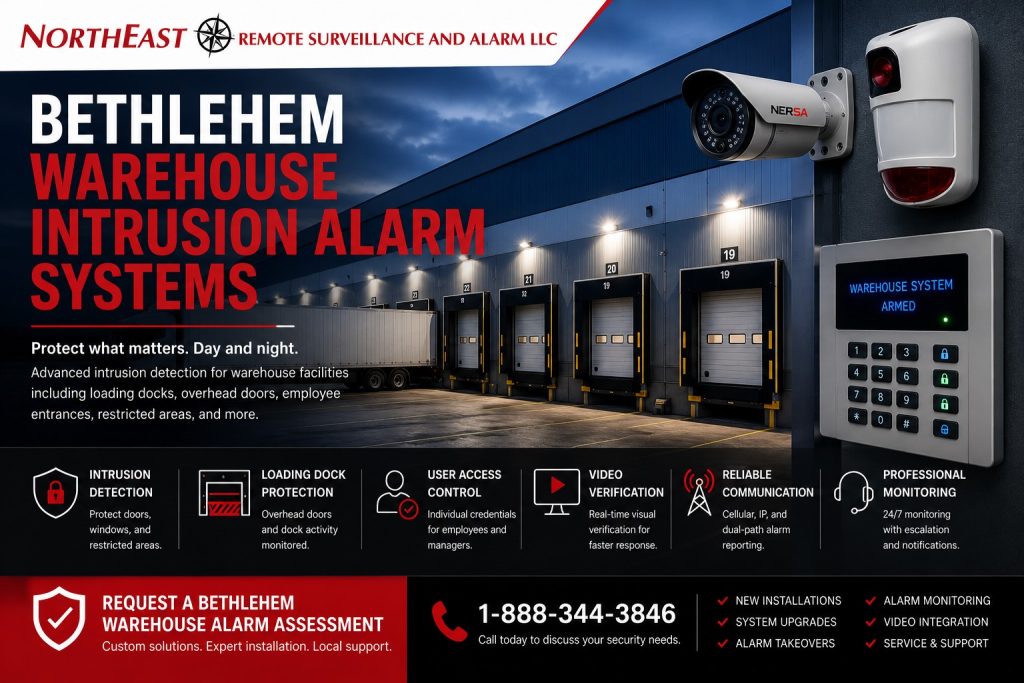
Bethlehem warehouse intrusion alarm systems monitor doors, interior zones, and restricted areas around shipping schedules and after-hours operations.

Return to the Bethlehem warehouse security systems guide for related services.
A dependable warehouse alarm system requires more than a basic control panel and several motion detectors. The design should account for personnel doors, overhead doors, loading docks, shipping offices, restricted storage, roof access, warehouse interiors, operating schedules, employee credentials, alarm communication, monitoring procedures, and authorized after-hours activity.
Northeast Remote Surveillance and Alarm, LLC designs, installs, upgrades, takes over, monitors, and supports commercial intrusion alarm systems for Bethlehem warehouses, distribution facilities, logistics properties, mixed office-warehouse buildings, manufacturing-connected warehouses, industrial parks, and multi-building commercial sites.
For broader city planning, visit Commercial and Industrial Security Systems in Bethlehem, PA.
NERSA’s Bethlehem and Lehigh Valley resources focus on commercial and industrial facilities and systems built around real operating conditions rather than residential-style alarm packages.
Project availability may depend on warehouse location, building layout, existing equipment, system compatibility, communication requirements, operating schedules, project scope, technical complexity, and long-term monitoring and support needs.
Warehouse Alarm Planning Based on Real Operations
Different warehouse areas may open and close at different times.
Map the openings and interior areas that need detection. Then record when staff, drivers, or contractors normally use each area. This helps the alarm plan fit working hours and after-hours activity.
Warehouse Alarm Partitions
Partitions let users arm and disarm separate warehouse areas independently.
For example, the shipping office may stay open after the main office closes. Separate alarm areas let authorized staff arm unused spaces while work continues elsewhere. Make the area names and permissions easy to understand.
Interior Motion Detection
Interior motion detection provides another protection layer after an exterior opening is breached or unauthorized movement occurs in a protected area.
Choose detector locations around the movement you need to detect. Also review racking, equipment, and normal activity that could affect a sensor. Test the planned coverage under typical warehouse conditions.
Roof Hatches, Windows, and Secondary Openings
Warehouse intrusion risks are not limited to ground-level personnel doors.
Review roof hatches, windows, and utility doors as part of the site survey. Include an opening when its location and use justify detection. Record any areas outside the agreed protection scope.
Alarm Communication Paths
A warehouse alarm system needs a dependable method for transmitting signals to the monitoring service.
Review cellular, internet, or dual-path signaling against the panel and monitoring service requirements. Check signal availability at the site. Then test event delivery with the monitoring provider.
False-Alarm Reduction
False alarms can interrupt warehouse operations, create unnecessary dispatches, frustrate employees, and reduce confidence in the system.
Review recurring events before replacing equipment. For example, an incorrect schedule or unclear closing procedure can trigger avoidable alarms. Check sensor placement and user instructions together, then document the correction.
Alarm Documentation and Handoff
Clear records help staff, monitoring personnel, and technicians understand the warehouse alarm.
Keep a current zone list, user permissions, and monitoring contacts. Also record device locations, test results, and service notes. Show authorized staff how to arm their areas and report a fault.
Related Planning Resources
Warehouse Access Control Systems for the Lehigh Valley and Mid-Atlantic
Commercial and Industrial Security Monitoring
Request a Warehouse Intrusion Assessment
Request a security assessment to review protected openings, alarm areas, schedules, and operating instructions.
There is no obligation to proceed with installation.
Prefer to discuss your property first?
Compliance, Codes & Project Standards
NERSA plans commercial and industrial security work with applicable code, documentation, inspection and authority-having-jurisdiction requirements in mind. Requirements vary by system, property and jurisdiction. These resources support project planning; they do not establish legal compliance, certification or AHJ approval.
Related guidance: Regulatory compliance & inspection readiness · Warehouse & logistics compliance · NERSA project standards