
Philadelphia healthcare and medical office access control systems should help facilities separate public areas from staff-only, administrative, clinical-support, medication, records, IT, and other restricted spaces while keeping authorized employee movement practical.

request a commercial security assessment
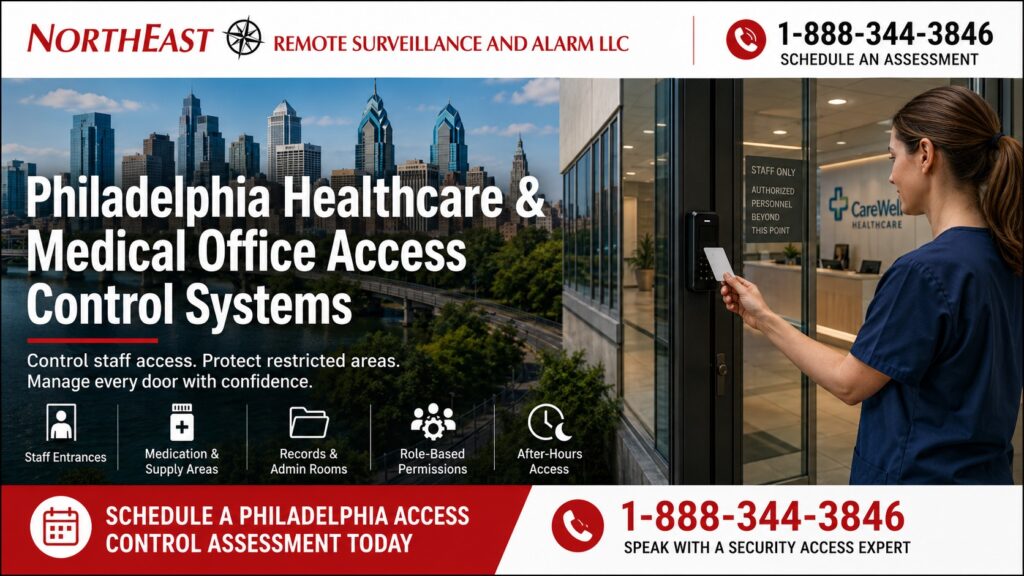
Northeast Remote Surveillance and Alarm, LLC designs, installs, upgrades and supports healthcare access control in Philadelphia. We serve medical offices, outpatient facilities, specialty practices, behavioral-health sites, healthcare offices, clinics and other qualifying facilities.
NERSA plans access control for Philadelphia healthcare and medical-office properties.
For broader city-level planning involving offices, warehouses, manufacturing facilities, credentials, gates, and other commercial applications, visit Philadelphia Commercial Access Control Systems.
Access Control Built Around Healthcare Operations
Healthcare properties often contain several levels of access within the same building.
A patient or visitor may be permitted in reception and waiting areas.
Clinical staff may require treatment and support areas.
Administrative personnel may need records or management spaces.
IT personnel may need server and telecommunications rooms.
Authorized employees may require medication, supply, or controlled-storage areas.
The access-control system should reflect those differences.
A healthcare credential should provide only the access appropriate for the user’s actual responsibilities.
Staff Entrances
Employee and staff entrances are often logical access-control points for medical and healthcare properties.
Controlled staff entry can help separate public-facing access from employee-only movement.
Planning may include:
- Individual staff credentials
- Scheduled access
- After-hours permissions
- Department-based access
- Door-position monitoring
- Held-open reporting
- Forced-door reporting
Employees who no longer work at the facility can have access removed without requiring the building to rekey every affected opening.
Role-Based Healthcare Permissions
Healthcare facilities may have employees with very different responsibilities.
Possible user groups include:
- Physicians
- Nurses
- Medical assistants
- Administrative staff
- Practice managers
- IT personnel
- Pharmacy or medication-authorized staff
- Maintenance
- Cleaning personnel
- Contractors
Not every user needs the same doors.
Role-based access allows administrators to assign permissions according to job function rather than granting broad building-wide access.
This can make a larger system easier to manage and review over time.
Medication and Supply Areas
Medication, pharmaceutical supply, specialized medical inventory, and selected supply rooms may require tighter access than general staff areas.
Electronic access control can limit entry to approved users while providing records of credential activity.
Permissions may be based on:
- Job role
- Department
- Individual authorization
- Schedule
- Facility policy
The system should not automatically grant access to every employee simply because the person is authorized to enter the building.
Medical Records and Administrative Areas
Healthcare facilities can contain records, administrative files, billing information, HR documents, and other sensitive business information.
Access control may be appropriate for:
- Records rooms
- Administrative offices
- Billing areas
- HR spaces
- Management offices
- Secure file storage
These areas can use separate permission groups from general staff spaces.
An employee may therefore have normal facility access without automatically receiving access to records or administrative rooms outside that person’s responsibilities.
IT and Telecommunications Rooms
Healthcare operations depend on network infrastructure, communications equipment, servers, and other technology systems.
Physical access to IT and telecommunications rooms can be limited to authorized personnel.
Possible users may include:
- Internal IT staff
- Approved service providers
- Management
- Authorized maintenance personnel
Access permissions can help prevent unnecessary entry while maintaining practical service access when needed.
Room access planning defines physical access permissions; cybersecurity and network-security design require separate review.
Staff-Only Clinical Support Areas
Some healthcare properties contain clinical-support spaces that are not intended for unrestricted public access.
Examples may include:
- Staff workrooms
- Equipment storage
- Clinical supply rooms
- Back-office support areas
- Procedure-support rooms
- Staff corridors
- Restricted treatment-support spaces
Whether electronic access is appropriate depends on how the facility operates.
The goal is not to place readers on every interior door.
The goal is to control openings where individual permissions provide real operational or security value.
Public-to-Staff Transitions
Medical offices and clinics often have a clear transition between public-facing and employee-only areas.
This may occur between:
- Reception and clinical areas
- Waiting rooms and staff corridors
- Public hallways and back-office areas
- Visitor spaces and administrative rooms
Access control can help manage these transition points.
Authorized staff may use individual credentials while patients, visitors, and vendors remain within appropriate public-facing spaces unless escorted or otherwise authorized.
After-Hours Healthcare Access
Healthcare properties may require staff access outside standard patient hours.
Possible users include:
- Physicians
- Managers
- On-call staff
- Maintenance personnel
- Cleaning personnel
- Approved contractors
Access schedules can limit other users outside normal operating periods.
After-hours permissions should be deliberate rather than automatically providing every credential with 24-hour access.
This can improve accountability while still supporting legitimate off-hours operations.
Temporary Contractors and Service Personnel
Healthcare facilities routinely use outside vendors and service providers.
Examples may include:
- Medical-equipment technicians
- IT contractors
- HVAC service
- Electrical contractors
- Cleaning companies
- Construction personnel
- Specialty equipment vendors
Temporary credentials can be restricted according to:
- Required doors
- Approved schedules
- Assignment dates
- Building areas
When the work is complete, access can be disabled without affecting permanent staff.
Department-Based Access
Larger healthcare properties may contain several departments with different access requirements.
The system may use separate permission groups for areas such as:
- Clinical operations
- Administration
- IT
- Management
- Records
- Supply
- Maintenance
Department-based access can reduce unnecessary cross-access while keeping user administration manageable.
When an employee transfers between departments, permissions can be updated to reflect the new role.
Door-Held-Open Monitoring
A controlled healthcare door may create a security problem if it remains open longer than intended.
Potential causes include:
- Staff traffic
- Deliveries
- Equipment movement
- A propped door
- Door closer problems
- Poor latching
Door-position monitoring can provide held-open reporting when appropriate.
Repeated events may indicate a physical door problem, workflow issue, or staff practice that needs correction.
Forced-Door Events
A forced-door event occurs when a controlled opening is opened without the expected authorized access event.
Possible causes may include:
- Unauthorized entry
- Tailgating
- Door hardware failure
- Physical forced entry
- A door that failed to latch
When the opening is properly monitored, the access-control system can provide information for authorized staff to review.
The usefulness of these events depends on reliable door hardware and correct system programming.
Employee Changes and Credential Removal
Healthcare organizations need a clear process for removing access when employees, contractors, or service personnel leave.
Credential administration should account for:
- New employees
- Terminated employees
- Lost credentials
- Department transfers
- Temporary workers
- Contractors
- Inactive users
Electronic access control allows an administrator to disable one user’s credential without affecting everyone else.
Shared badges and shared PINs should be avoided where individual accountability matters.
Multi-Site Healthcare Organizations
Healthcare organizations may operate several medical offices or facilities throughout Philadelphia.
A multi-site access-control system can help standardize:
- User roles
- Credentials
- Door naming
- Access schedules
- Administrator permissions
- User removal
- Restricted-area policies
A physician or manager who legitimately works at several locations may receive appropriate multi-site access.
Other employees may remain limited to one property.
The system should provide the access needed for the person’s job without automatically providing unrestricted access everywhere.
Existing Healthcare Access-Control Systems
Philadelphia healthcare properties may already have readers, controllers, credentials, locks, wiring, power supplies, and access-control software.
Existing equipment should be evaluated before complete replacement is recommended.
Possible issues include:
- Former employees still active
- Unsupported controllers
- Aging credential technology
- Poorly organized user groups
- Unknown administrator accounts
- Failed readers
- Unreliable locks
- Missing documentation
- Limited expansion capability
Where compatible equipment remains reliable and supportable, selective reuse may be appropriate.
Other components may require correction, replacement, or phased modernization.
Physical Door Hardware Matters
Healthcare access control is not only a credential-management system.
The physical opening must work correctly.
A controlled door may include:
- Reader
- Controller
- Electric strike
- Electrified lock
- Exit hardware
- Door contact
- Request-to-exit device
- Power supply
- Door closer
The system cannot provide dependable access if the physical door fails to close or relatch.
Readers, software, permissions, and credentials therefore need to be coordinated with reliable door hardware.
Egress and Compliance Boundaries
Healthcare properties can contain openings with additional life-safety, accessibility, fire-door, emergency-release, or occupancy-specific considerations.
Review broader compliance requirements with the appropriate qualified professionals.
Where a controlled opening requires additional review, the project should be coordinated with the appropriate design professional, door-hardware specialist, fire-alarm contractor, AHJ, or other responsible party.
This service remains focused on healthcare staff access, restricted-area permissions, schedules, and user administration.
Service Scope
NERSA plans commercial access control for Philadelphia healthcare and medical-office properties.
Access control planning covers:
- Staff entrances
- Role-based healthcare permissions
- Medication and supply-room access
- Records-room access
- Administrative-area permissions
- IT-room physical access
- Public-to-staff transitions
- After-hours staff access
- Contractor credentials
- Multi-site healthcare access administration
If your facility also needs visitor management, panic and duress systems, video surveillance, or intrusion alarms, include those priorities in your project assessment so access control can be coordinated with the wider security plan.
Explore Philadelphia commercial access control services for broader facility and system planning.
Why Philadelphia Healthcare Properties Choose NERSA
Northeast Remote Surveillance and Alarm, LLC has focused on commercial and industrial electronic security since 2008.
Healthcare access control requires more than placing card readers at employee entrances.
The system has to account for:
- Staff roles
- Restricted rooms
- Public-to-private transitions
- Medication and supply access
- Records areas
- After-hours users
- Contractors
- Existing door hardware
- Credential administration
- Multi-site growth
NERSA designs access-control systems around the way the facility actually operates.
Request a Philadelphia Healthcare Access Control Assessment
NERSA can assess access control for your Philadelphia healthcare property or medical office. We review staff entry, medication-room permissions, records areas, restricted clinical-support spaces, contractor access, and after-hours credentials, including upgrades to existing systems.
Call 1-888-344-3846 or request a commercial security assessment to review your staff entrances, restricted rooms, employee groups, existing equipment, schedules, and access-management requirements.
Frequently Asked Questions
What is healthcare access control?
Healthcare access control manages which employees, contractors, and other authorized users may enter selected doors or restricted areas and when those permissions are valid.
Can staff permissions be based on job role?
Yes. Access can be separated by role or department so employees receive only the doors and areas appropriate for their responsibilities.
Can medication rooms use separate access permissions?
Yes. Medication and supply areas can use more restrictive access groups than general employee entrances when the facility requires tighter control.
Can medical records rooms be access-controlled?
Yes. Records rooms, billing areas, HR spaces, and administrative areas can receive separate permissions where individual access control is appropriate.
Can healthcare staff receive after-hours access?
Yes. Approved employees can receive access schedules that support on-call, evening, weekend, or other legitimate off-hours requirements.
How should contractors receive access?
Contractors can receive individual temporary credentials limited by door, schedule, and assignment period rather than receiving unrestricted permanent access.
Can IT rooms have separate permissions?
Yes. Physical access to server and telecommunications spaces can be restricted to authorized IT, management, or service personnel.
Can one system manage several medical offices?
Many commercial access-control platforms can support multiple facilities when designed appropriately. Users can receive permissions only for the locations they need.
Can an existing healthcare access-control system be upgraded?
Often, yes. Existing readers, controllers, credentials, locking hardware, wiring, and software can be evaluated to determine what remains usable and what should be corrected or replaced.
How does a Philadelphia healthcare access-control project begin?
Start with staff entrances, employee groups and restricted areas. Review medication or supply rooms, offices, after-hours needs and contractor access. Existing hardware and administrator responsibilities also shape the design. NERSA uses these requirements to plan the system.
Compliance, Codes & Project Standards
NERSA plans commercial and industrial security work with applicable code, documentation, inspection and authority-having-jurisdiction requirements in mind. Requirements vary by system, property and jurisdiction. These resources support project planning; they do not establish legal compliance, certification or AHJ approval.
Related guidance: Regulatory compliance & inspection readiness · Access control & door hardware standards · NFPA 101 & egress planning · ADA access-control planning