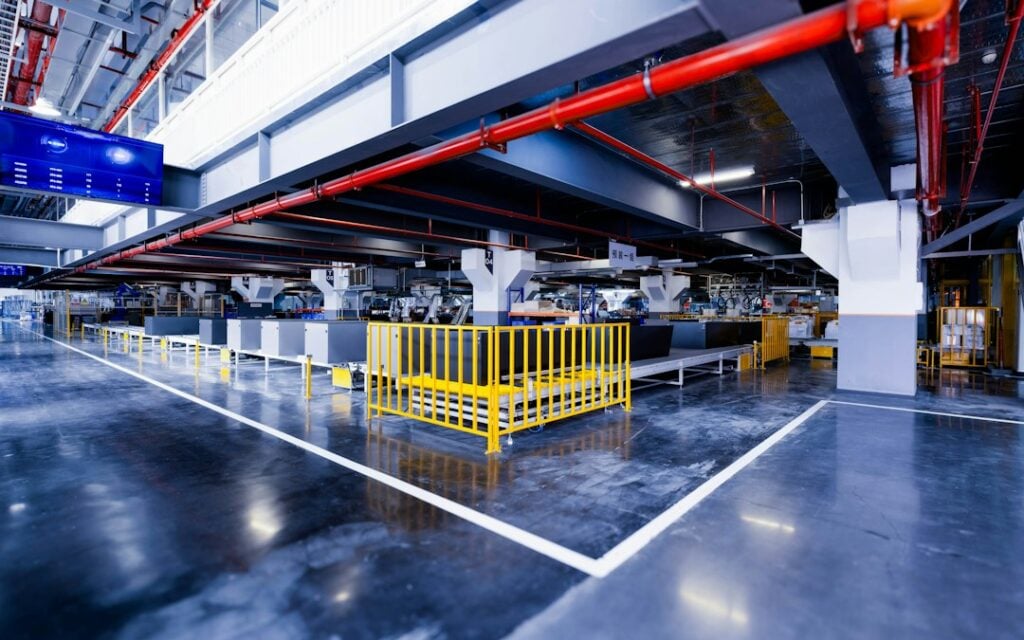
Actual appliance-recycling processing facility photograph by Homa Appliances (Unsplash).
The colored hot-spot annotation is an illustrative overlay, not a real thermal scan, temperature measurement, installed system, or NERSA project photograph.
UL 2684 is the safety standard for video and thermal image detectors used with fire alarm systems. Teledyne FLIR announced UL 2684 listings for A40, A50, and A70 thermal imaging cameras in September 2026. The development gives building owners and system designers a new option for detecting abnormal heat and coordinating a listed initiating device with an approved fire alarm system. It does not make every thermal camera a listed fire detector or eliminate local design and inspection requirements.
This is a technical reference within NERSA’s commercial video-surveillance compliance guide.
For system selection and integration, see commercial and industrial video surveillance and commercial fire alarm and life-safety services.
Design, listing verification, and AHJ approval must be handled for each proposed project.
What UL 2684 Actually Covers
ANSI/CAN/UL 2684, Video and Thermal Image Detectors for Fire Alarm Systems, is a product safety standard covering imaging detectors that sense smoke, flame, or heat using a focal-plane imaging array. It addresses detectors and specified accessories for non-dwelling fire alarm applications, including indoor video or thermal installations and outdoor thermal installations within the standard’s stated scope. Devices are intended for open-area protection and connection to compatible fire alarm control equipment.
UL 2684 was first published in June 2024 and revised in August 2025. It references applicable installation frameworks such as NFPA 72 and NFPA 70 in the United States. A product’s listing is evidence that the identified model and configuration were evaluated to the applicable product requirements; it is not the same as approval of a completed fire alarm installation. Local adopted codes, the design documents, product instructions, the fire alarm panel’s listing, and the Authority Having Jurisdiction (AHJ) still control.
Which FLIR Cameras Received the Listing?
On September 22, 2026, Teledyne FLIR announced that its A40, A50, and A70 Axx-Series thermal imaging cameras were the first models to achieve UL 2684 listing. In qualifying configurations, these devices can monitor thermal conditions continuously and signal abnormal-heat events through compatible fire alarm equipment. The exact ordered model, hardware, firmware, settings, output configuration, and certification scope should be verified against the current UL listing and manufacturer installation documentation before specifying an initiating device.
FLIR describes threshold and change-based alarm logic for its listed detection offering. Depending on the model and validated configuration, thermal imaging may provide multiple monitored regions, visual context, and fire-panel signal interfaces. Not every FLIR camera, firmware version, analytic mode, or third-party thermal imager is UL 2684 listed. A standard surveillance thermal camera should not be treated as a fire alarm initiating device simply because it can display temperature.
Why Recycling Centers Are a Strong Application
Recycling facilities can contain unpredictable combinations of paper, plastics, metals, equipment, batteries, baled materials, and incoming loads. Localized overheating can develop in a pile, bunker, conveyor transfer point, or equipment area before a smoke plume becomes visible. A correctly designed thermal detector can watch a defined field of view for changes that warrant attention while employees and operators manage the material flow.
- Tipping floors and waste bunkers: monitor designated surfaces and accumulation points where hot material may arrive within mixed loads.
- Conveyors and sorting equipment: define views around bearings, transfer points, and locations where friction or mechanical faults may raise temperatures.
- Bale and bulk-material storage: evaluate pile geometry, stacking, sightlines, and potential temperature buildup around combustible material.
- Battery-related areas: develop a separate hazard analysis for battery storage or processing; thermal imaging is a supplemental detection tool, not a substitute for required dedicated protective measures.
- Outdoor scrap and waste yards: assess weather, distance, occlusion, sun exposure, changing materials, and whether the selected listed configuration permits the specific outdoor arrangement.
How a Listed Thermal Detector Connects to Fire Protection
A compliant design begins with the hazard and response requirements, not the camera model. The design team identifies the protected area, likely heat sources, required detection characteristics, mounting geometry, alarm thresholds, environmental influences, supply and fault monitoring, and compatibility with the existing fire alarm control unit.
- Detection: the thermal camera observes the intended area and evaluates defined alarm conditions.
- Initiating signal: listed, compatible interfaces communicate the appropriate event to the fire alarm panel according to the approved design.
- Alarm versus supervisory/trouble: each signal is mapped to its approved panel function and response procedure; failures or communication problems must not be silently treated as normal operation.
- Operator context: a separate authorized video or operations interface may display the thermal scene and associated image for staff to investigate the location.
- Acceptance and maintenance: designers and qualified contractors document coverage, coordinate testing and inspections, train staff, and keep records required by the AHJ.
Important: The listing does not mean one camera automatically replaces all smoke detectors, heat detectors, sprinklers, or other required protections. Equivalency and permitted application must be determined by the approved design and AHJ. Ordinary VMS video recording is not a substitute for a listed fire alarm transmission path.
Thermal Camera Planning Checklist
- Confirm the exact detector model and its current UL 2684 listing, installation instructions, compatible interfaces, and required accessories.
- Document the occupancy, materials, possible ignition sources, ceiling height, ambient conditions, airflow, and any dust or debris that could affect detection.
- Evaluate field of view, pixel coverage, reflections, sun-heated surfaces, moving conveyors, occlusions, and seasonal changes.
- Determine thresholds, rate-of-rise or other approved criteria, nuisance-alarm handling, signal supervision, and response times appropriate to the facility.
- Coordinate power, network segregation, survivability where required, cable protection, documentation, panel interfaces, monitoring, and inspection responsibilities.
- Arrange AHJ review and witnessed acceptance testing where required; verify response procedures and ongoing inspection or maintenance intervals.
What UL 2684 Does Not Certify
UL 2684 applies to defined detector products and accessories within its published scope. It is not a general approval for a manufacturer’s entire camera lineup, a blanket guarantee of early detection in every environment, a certification of an installer, or a sign-off on a property’s full fire alarm system. Thermal readings can be influenced by emissivity, reflected radiation, distance, viewing angle, weather, dirty optics, and blocked sightlines. Fire safety decisions should rely on a qualified hazard analysis and approved system design, not a single promotional performance claim.
Questions Facility Managers Ask
Is UL 2684 the same as NFPA 72?
No. UL 2684 is a product standard for the covered imaging detectors. NFPA 72 is an installation, inspection, testing, and signaling code whose applicable edition and provisions depend on the jurisdiction and project. A listed product still needs a code-compliant system design and required approvals.
Can a standard thermal security camera trigger a fire alarm?
Some cameras offer temperature alarms for industrial condition monitoring, but that does not make them suitable as listed fire alarm initiating devices. Verify the specific UL 2684 listing, authorized connections, and approved system configuration before connecting a camera as part of a required fire alarm system.
Does FLIR’s new listing mean recycling plants must install these cameras?
No. A product listing creates an option for qualifying designs; it does not establish a universal requirement for recycling plants. Needs depend on the materials handled, occupancy, insurance and regulatory requirements, adopted codes, and AHJ decisions.
Can thermal imaging help before visible smoke appears?
It can identify an exposed abnormal heat signature that precedes visible smoke in some scenarios. Actual performance depends on camera location, scene visibility, material properties, environmental conditions, calibration, and the way the system is configured and tested.
Official References
- UL Standards & Engagement: ANSI/CAN/UL 2684 — scope and revisions.
- Teledyne FLIR: September 22, 2026 UL 2684 Axx-Series listing announcement.
- Teledyne FLIR: UL-listed thermal imaging detection specifications and application guidance.
Review Thermal Fire Detection for Your Facility
Northeast Remote Surveillance and Alarm, LLC supports commercial and industrial security and fire-alarm project planning across Pennsylvania and selected Mid-Atlantic markets. We can help review existing video infrastructure, define surveillance and thermal-monitoring objectives, and coordinate with qualified fire-alarm professionals and the AHJ when a listed fire-detection solution is being considered. Product availability, manufacturer authorization, approved design responsibilities, and installation scope must be verified for each project.
Call: 1-888-344-3846 · Email: nersasales@gmail.com.
Compliance, Codes & Project Standards
NERSA plans commercial and industrial security work with applicable code, documentation, inspection and authority-having-jurisdiction requirements in mind. Requirements vary by system, property and jurisdiction. These resources support project planning; they do not establish legal compliance, certification or AHJ approval.
Related guidance: Regulatory compliance & inspection readiness · NERSA project standards · Documentation, testing & inspection readiness