Commercial security camera installation in Wilkes-Barre, PA should deliver useful recorded evidence, not simply a camera count.
request a commercial video assessment
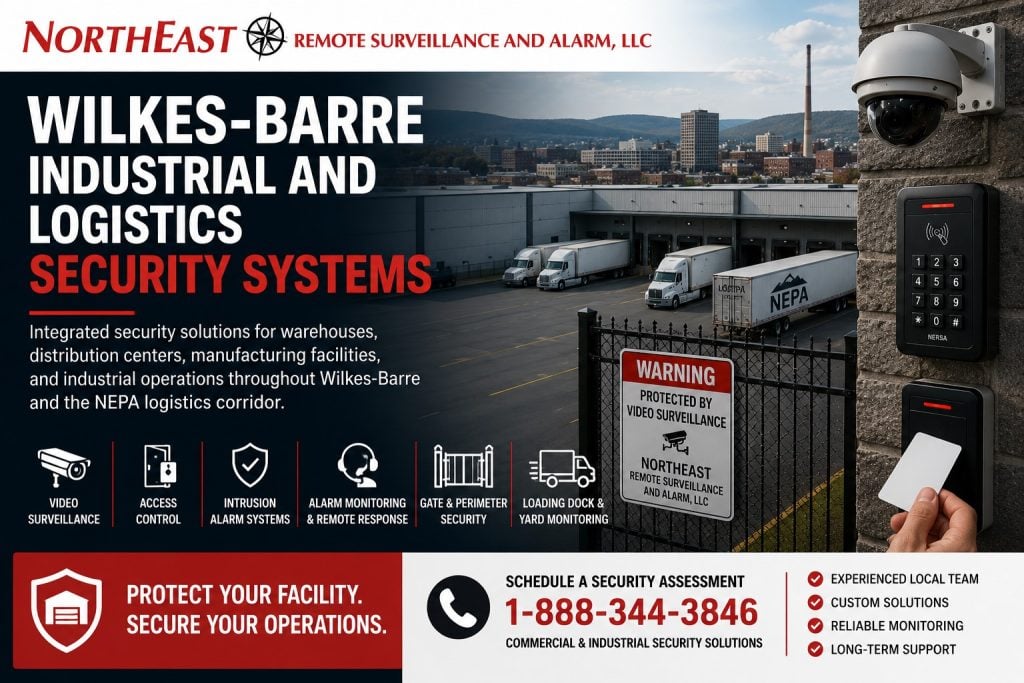
Northeast Remote Surveillance and Alarm, LLC (NERSA) plans and installs commercial video surveillance for warehouses, manufacturing plants, distribution buildings, truck yards, offices and professionally managed properties.
We coordinate camera views, mounting, recording, cabling, network capacity and customer handover.
For integrated door access, intrusion protection and facility-wide security, start with our Wilkes-Barre commercial security installation guide.
A well-designed Wilkes-Barre camera system considers what an owner must see during deliveries, incidents, restricted-area entry, shift changes or nighttime activity.
NERSA can review an existing DVR, NVR or IP-camera installation and recommend a phased upgrade or new design around real recorded results.
Call 1-888-344-3846 or request a commercial video assessment.
Plan Cameras Around the Evidence a Wilkes-Barre Business Needs
Before choosing a resolution, zoom level or manufacturer, identify the specific question footage must answer. A warehouse supervisor may need to verify a trailer’s arrival and departure; a manufacturing manager may need a timeline of material handling; an office manager may need a clear entrance view. One wide camera may establish context but lack identification detail. The plan should distinguish overview, identification and task-specific views rather than claiming every camera does everything.
Our planning process reviews entrances, loading docks, parking areas, truck courts, perimeter paths, production access, stored equipment and the control room or IT closet. We check sight lines, lighting changes, obstructions, mounting stability, cable paths and access for maintenance. The handover test should include representative recorded playback and a usable export, not only a live picture on installation day.
4K, Panoramic, PTZ and Low-Light Commercial Video Surveillance
Possible designs include fixed 4K turrets and bullet cameras, multi-sensor panoramic cameras, varifocal identification views and PTZ cameras when an operator needs a movable view. Higher pixel count is not a substitute for appropriate lens selection, placement, illumination or recording settings. We consider whether a single panoramic view or multiple dedicated angles provides better evidence at a dock, entrance, interior aisle or parking lot.
Nighttime performance should be evaluated with headlights, parking-lot lighting, shadows, wet pavement and winter weather in mind. A loading area looks different with trailer doors open and forklifts moving than when the yard is empty. Equipment and settings should be accepted under normal operating conditions, including the scene that matters most to the customer.
Thermal Imaging and Industrial Heat-Risk Camera Options
For selected exterior perimeters, mechanical equipment, processing areas and industrial storage conditions, NERSA can evaluate thermal imaging. A thermal view may reveal heat patterns where visible-light cameras struggle, and a radiometric system can be designed to evaluate temperature thresholds on suitable targets. A reliable design must account for distance, emissivity, reflections, changing ambient temperatures and what action follows an alert.
Important fire-detection distinction: A general-purpose thermal surveillance camera, hot-spot alert or AI smoke detection rule does not automatically replace a listed, code-required fire detection system.
Where camera-based technology is intended as part of an approved fire safety design, equipment listing, application engineering and authority requirements must be reviewed separately.
Learn more in our thermal-imaging fire detection and compliance guide.
License Plate Recognition and Vehicle-Capture Cameras
Industrial gates, controlled parking entrances and truck approaches can benefit from a dedicated license plate recognition (LPR) or plate-capture camera paired with a wider scene view. We assess approach direction, lane width, vehicle speed, plate angle, mounting distance, headlights and nighttime exposure. A panoramic yard camera may document the truck but should not be assumed to read a plate consistently.
A suitable LPR system may help authorized staff search vehicle events, review deliveries or coordinate an approved gate procedure. Plate reads must be validated in the actual lane, while access authorization, audit logs and retention policy remain separate customer decisions. The camera scope should show where vehicle identification is needed and where context from an overview is more valuable.
AI Video Analytics, Event Search and Remote Video Response
Video analytics can support people and vehicle classification, line crossing, perimeter intrusion zones, loitering, defined after-hours activity and faster review of recorded events. A useful analytic alert needs a clear operating rule, a designated recipient and an agreed response. Frequent dock traffic, forklifts, shadows, snow, wildlife and changing light can create conditions that must be tested during commissioning.
Remote video monitoring is a separate workflow from passive camera recording. If monitoring is proposed, define the covered hours, events submitted for review, contact sequence and permitted response. A camera with analytics alone should never be presented as automatically providing staffed monitoring or guaranteed detection.
Warehouse, Distribution and Manufacturing Camera Layouts
Wilkes-Barre and greater Wyoming Valley logistics properties need cameras that follow freight movement from the vehicle approach to the dock door, staging location, internal transfer and departure. A complete video plan separates trailer or license plate detail from dock context, inventory movement and staff entrance footage. We review cameras with normal rack layouts, parked trailers, loaded pallets and equipment obstructions in place.
For manufacturing, critical views may include restricted process entries, shipping, maintenance areas, tool rooms, outdoor inventory and employee circulation.
NERSA schedules installation around site access and ongoing operations, and identifies areas that require escorts, shutdown windows or coordination with other trades.
For coordinated alarms, doors and complete site protection, use the Wilkes-Barre warehouse and distribution security guide rather than treating surveillance as the whole system.
Fiber Optics, Structured Cabling, Wireless and Cellular Cameras
Recording reliability depends on appropriate network design. NERSA evaluates structured cabling, PoE budgets, dedicated network switches, fiber-optic links, test and certification requirements, secure remote access, time synchronization and backup-power needs. Where buildings are separated by a yard or roadway, point-to-point wireless bridges or fiber may provide the camera backbone, subject to a site survey and line-of-sight conditions.
For detached areas or temporary sites without practical utility and network service, wireless, cellular and solar-assisted camera systems may be considered. Battery reserve, winter solar production, data use, recording retention and service accessibility must be sized for that deployment; an outdoor camera is not automatically suitable for off-grid use. The installation scope should say which cameras record locally, which require an active uplink and how failures are reported.
Recorder Upgrades, Legacy Takeovers and Hybrid Expansion
An existing surveillance system may have cameras that still produce useful views while recorder security, storage, network capacity or account ownership prevents reliable use. Before recommending complete replacement, NERSA inventories cameras, wiring, recorders, software licenses, available credentials and supported firmware. Compatible infrastructure may be retained while weak components are upgraded; incompatible or insecure hardware should be identified explicitly.
A phased conversion should explain which views remain available during work, how history is retained or exported and when the customer can accept each stage. Final verification includes live image, recorded image, night examples, retention estimates, user roles, footage export, clock synchronization and the fault-notification process.
Wilkes-Barre Video Installation: Proposal and Acceptance Checklist
A useful proposal states the site locations to be covered, the reason for each view, mounting and cabling allowances, network or power dependencies, the recording method, expected retention, optional analytics or monitoring, service responsibilities and any recurring licensing charges. Camera count and megapixels alone do not define the result. Agree on acceptance scenes before ordering equipment.
NERSA’s wider regional experience includes a Luzerne County metal-recycling surveillance case study.
That project context can help buyers understand how to document a facility-specific problem.
We do not imply that the case study proves the suitability of any camera or analytics option for a different property.
Design for Facility Changes, Multiple Tenants and Growing Camera Counts
A camera layout that works in an empty distribution building may fail after racking, staging areas, trailers and tenant operations change. For a long-term Wilkes-Barre installation, NERSA can design a documented camera naming schedule, identify expansion ports and estimate future recording loads before the first cable is pulled. Floor plans should distinguish common areas from tenant-controlled spaces and record who can view each area. Changes to building use, dock assignments or site traffic should trigger a review of camera views rather than assuming yesterday’s footage requirements still apply.
For multi-building and industrial campuses, a single central recorder may not always be the most resilient choice. A distributed design can be evaluated where long distances, network downtime or separate operating schedules make local recording useful. Each alternative should be assessed for maintenance effort, remote retrieval, licensing, required bandwidth and how users recover footage after a connection fails. NERSA can coordinate these decisions with the customer’s network administrator without pretending that a one-size-fits-all system is appropriate.
Security of the Video Network, Accounts and Stored Evidence
Commercial video footage can contain information about staff, customers, deliveries and operations. Responsible deployment includes individual authorized user accounts, role-based access, administrator ownership, supported firmware, protected remote connectivity, and an agreed policy for retention and exports. We discuss who can download video, who approves outside requests and whether recorded events must be preserved for an investigation. Customers should understand the difference between live-view access, exporting footage and the ability to change settings.
Camera and recorder passwords should not be shared informally across a site. The handover can identify credential custody, system-health alerts, recovery contacts and software update responsibilities. For cloud-managed or hybrid recording, review bandwidth dependence and subscription terms before recommending the service. For local storage, review power interruption, disk capacity, replacement procedure and reasonable recovery expectations. These operational details matter as much as a high-resolution camera image.
What a Complete Installation Acceptance Test Should Prove
A Wilkes-Barre commercial camera system should be demonstrated through ordinary tasks the customer’s team would perform. Review a sample truck arrival and dock activity, find a selected time range, verify playback, search for a person or vehicle event where supported, and export a representative clip. Compare the recorded view in both day and night conditions with the installation’s defined purpose. Where an LPR camera or thermal alarm is specified, test those functions separately under representative conditions.
The final handover should include a camera list, general locations and purposes, installed recording components, labeled cable or network information where part of the scope, user-permission assignments and support contacts. It should also identify assumptions such as owner-provided network service, electrical work, maintenance of vegetation and required approval for regulated life-safety systems. A practical acceptance record makes a future service visit or expansion more efficient and helps preserve usable evidence.
Commercial Camera Scope Versus Complete Facility Security
This page owns the video-only installation, recorder, camera upgrade and video analytics requirements.
A complete commercial security project involves separate decisions about intrusion alarm zoning, access credentials, commercial door hardware, egress, intercom operation, remote monitoring contracts and integration testing.
For those decisions, the Wilkes-Barre commercial and industrial security installation guide is the primary resource; for employee and controlled-door projects, use the Wilkes-Barre access-control guide.
Keeping the scope clear produces a more useful proposal and avoids confusing one service with another.
Wilkes-Barre Security Camera Installation FAQs
Does NERSA install the cameras and the cabling together?
For the agreed project scope, NERSA can plan and coordinate IP cameras, recording hardware, structured cabling, fiber, network connections and commissioning. Any division of work with the customer’s IT staff or other contractors is defined in the proposal.
Can security cameras detect overheating or fires?
Some thermal devices can help alert on defined temperatures or conditions, but ordinary camera alerts do not automatically meet fire-code requirements. A specialized fire-detection application needs appropriate listed equipment and an approved design.
Will an AI camera identify every vehicle or license plate?
No. Recognition depends on camera geometry, lighting, motion, target size, compatible software and an actual test. We plan dedicated plate views and review realistic detection limits.
Can an old camera installation be upgraded in phases?
Often, yes. First inventory the existing cameras, recorders, cabling, licensing, system security and ownership. The scope can then distinguish reusable components from equipment that needs replacement.
Request Commercial Security Camera Installation in Wilkes-Barre
Planning new cameras, a video-system takeover, plate capture, AI analytics or thermal video monitoring at a Wilkes-Barre industrial or commercial property?
Contact Northeast Remote Surveillance and Alarm, LLC at 1-888-344-3846 or request a security assessment.
We will review the physical site, required views, infrastructure and practical acceptance criteria.
Compliance, Codes & Project Standards
NERSA plans commercial and industrial security work with applicable code, documentation, inspection and authority-having-jurisdiction requirements in mind. Requirements vary by system, property and jurisdiction. These resources support project planning; they do not establish legal compliance, certification or AHJ approval.
Related guidance: Regulatory compliance & inspection readiness · NERSA project standards · Documentation, testing & inspection readiness