
Plan commercial access control in Wilkes-Barre around your doors and the people who use them.

Request a commercial access-control assessment
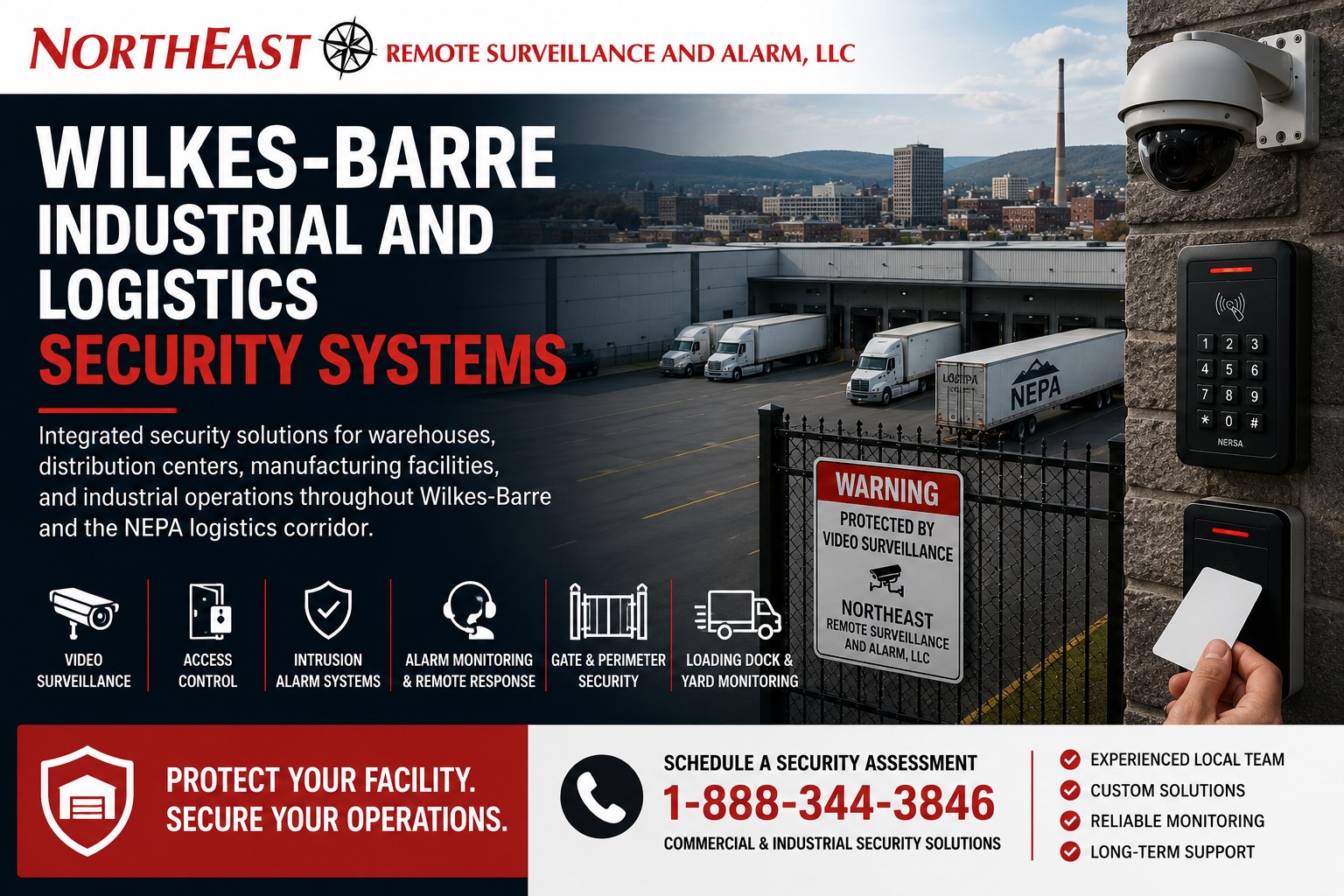
Northeast Remote Surveillance and Alarm, LLC supports warehouses, factories, offices, and other commercial sites. We review readers, cards and fobs, door hardware, staff schedules, upgrades, and provider takeovers.
For broader facility planning, see Wilkes-Barre Industrial and Logistics Security Systems.
For vehicle gates and truck-yard entry specifically, use Wilkes-Barre Gate and Vehicle Access Control.
Plan the Complete Controlled Opening
Start with the door, frame, lock, closer, and exit hardware. Then review power, wiring, reader placement, exit detection, and door-status reporting. A new reader will not fix a door that fails to close or latch. Check the hardware before finalizing the electronic work.
Cards, Fobs, Mobile Credentials, and Keypads
Credentials may include cards, fobs, mobile credentials, keypads, or another supported method. Choose the credential around administration, employee turnover, operating conditions, and the selected platform. Define who issues credentials, who changes schedules, how lost credentials are disabled, and what happens when employees or contractors leave.
Employee and Restricted-Area Access
Warehouses and distribution centers may use access control at employee entrances, shipping offices, IT rooms, maintenance areas, inventory cages, and other restricted spaces. Manufacturing facilities may add production-support rooms, tool areas, material storage, and contractor entrances. Offices may divide permissions between common entrances, tenant suites, and staff-only rooms.
Warehouse and Distribution Access Control
Wilkes-Barre logistics properties often operate across multiple shifts and may have separate employee, driver, visitor, and contractor workflows. Access-control schedules should reflect real operating hours rather than forcing every user group into the same permissions. Door events should use clear names so staff can identify the affected opening quickly.
Manufacturing and Industrial Access Control
Industrial facilities may need controlled entry at employee doors, maintenance rooms, tool cribs, network rooms, production-support spaces, and selected exterior openings. The system should support practical administration without creating unnecessary restrictions that interfere with normal production or emergency egress.
Door Hardware, Egress, and Reliable Closing
Review hinges, closer operation, latch alignment, exit hardware, strike or lock selection, request-to-exit, door-position monitoring, power supplies, and cable paths as part of the opening. Existing electrified hardware should be documented and verified for compatibility before reuse.
Where access-controlled openings are part of a broader life-safety or building project, coordinate responsibilities with the appropriate trades so the final door operation matches the approved requirements.
Gate and Vehicle Access Planning
Vehicle gates, truck entrances, and exterior lanes introduce traffic flow, intercom, safety-device, weather, power, communication, and emergency-access requirements that differ from ordinary personnel doors.
Those projects remain under the dedicated Wilkes-Barre Gate and Vehicle Access Control guide for vehicle entrances, gate operation, and access permissions.
Coordinate Access Control With Cameras and Alarms
Door events can provide useful context when compatible cameras or intrusion systems are intentionally coordinated. A forced or held-open door may be easier to investigate when the opening is clearly named and the relevant camera view is known. Integration should support a defined operational or response workflow rather than create complexity for its own sake.
For intrusion protection, use Commercial Alarm Installation in Wilkes-Barre.
Existing-System Takeovers and Expansion
For an inherited system, review controllers, readers, credentials, locks, power supplies, wiring, software access, account ownership, licensing, and available capacity before deciding what can remain. Retained equipment should be supportable and appropriate for the customer’s long-term needs.
For expansion, consider controller capacity, available power, network paths, credential strategy, door naming, and administrator roles so later openings or buildings can be added without creating a separate management model.
Commissioning and Door-by-Door Verification
At completion, test representative credentials, schedules, door-position monitoring, request-to-exit operation, lock release, and the physical closing and latching of controlled openings. Use clear door names and user groups, confirm administrator ownership, and document retained hardware, power supplies, controller locations, and known limitations.
The customer should leave the project with the access needed to add and remove users without depending on an installer-owned account.
Frequently Asked Questions
Does NERSA install commercial access control in Wilkes-Barre?
Yes. NERSA supports commercial and industrial access-control installation, upgrades, expansion, and takeovers for nonresidential properties in Wilkes-Barre and Northeastern Pennsylvania.
Can existing readers or door hardware be reused?
Sometimes. Compatibility, condition, supportability, wiring, power, controller capacity, software access, and the physical condition of the opening should be reviewed first.
Can access control work with cameras and intrusion alarms?
Compatible systems can support useful workflows when there is a defined operational reason. Each system should still retain a clear owner and purpose.
Request a Wilkes-Barre Access Control Assessment
Tell us which doors or gates need control, how credentials should be managed, what hardware already exists, and whether the system needs to expand later.
Request a commercial access-control assessment or call 1-888-344-3846.