Define cybersecurity and data protection responsibilities for network-connected security equipment, user accounts, remote access, software updates, and stored records.
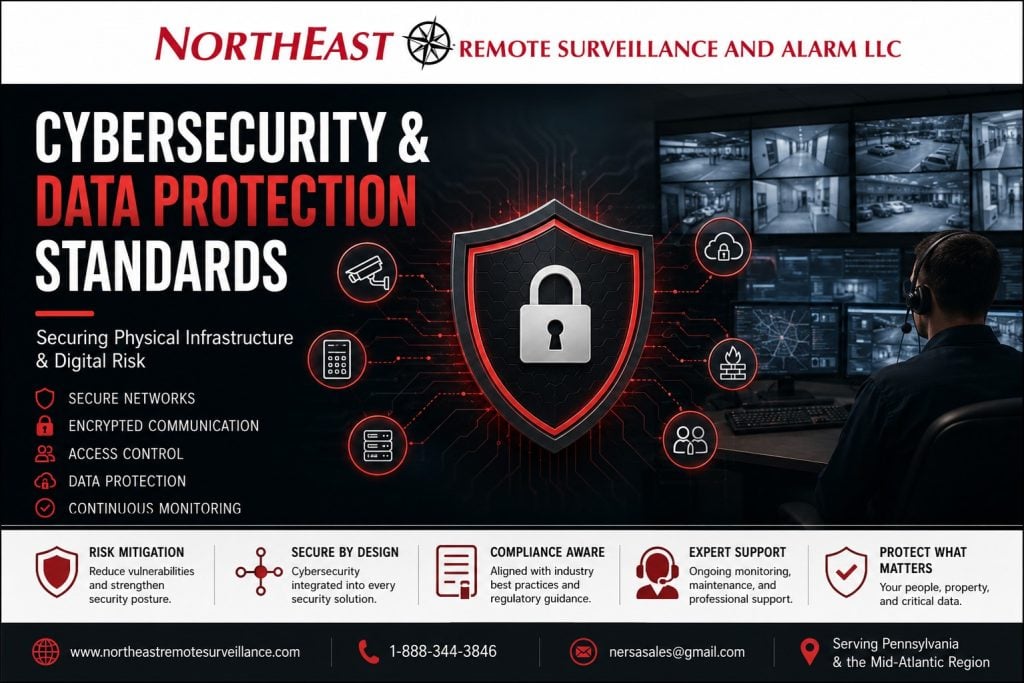
Video surveillance, access control, intrusion alarms, remote monitoring, cellular communicators, cloud platforms, and on-premise recording equipment often operate across business networks and internet-connected infrastructure.
For the parent trust framework, start with Commercial Security Trust & Project Standards.
Cybersecurity and Data Protection in Physical Security Planning
A commercial security system can protect a facility physically while also creating digital risk if it is poorly planned, poorly configured, or left unsupported. Network-connected cameras, access control panels, video recorders, cloud dashboards, remote monitoring portals, alarm communicators, mobile apps, and administrative logins all require careful attention.
Northeast Remote Surveillance and Alarm, LLC treats cybersecurity awareness as part of commercial and industrial security planning. Our goal is to help clients reduce avoidable exposure while maintaining practical system usability, remote access, serviceability, and operational efficiency.
Cybersecurity does not replace physical security, and physical security does not replace cybersecurity. Modern commercial facilities need both working together.
Systems Covered by These Cybersecurity & Data Protection Standards
These cybersecurity and data protection standards apply to commercial and industrial systems that may include:
- IP video surveillance systems
- Network video recorders
- Cloud video platforms
- Access control systems
- Intrusion alarm communicators
- Remote video monitoring systems
- Mobile security applications
- Intercom and entry systems
- Low-voltage security infrastructure
- Security system management software
- Cellular and IP alarm communication paths
- Hybrid on-premise and cloud-connected systems
These standards are especially important for warehouses, manufacturing facilities, logistics operations, offices, healthcare properties, schools, municipalities, contractor yards, industrial sites, and multi-site commercial organizations.
Security Design Philosophy
Northeast Remote Surveillance and Alarm, LLC follows a layered risk-reduction approach when planning network-connected physical security systems. The purpose is to reduce unnecessary exposure, limit access to authorized users, and support long-term serviceability.
Our planning approach may include:
- Least-privilege user access
- Unique administrative credentials
- Role-based permissions
- Network segmentation where appropriate
- Secure remote access planning
- Manufacturer-supported platforms
- Firmware and software maintenance awareness
- Documentation of key system information
- Restricted access to equipment and dashboards
- Client coordination with internal IT teams
NERSA does not recommend deploying commercial security systems using default credentials, open access, unsupported devices, or unmanaged remote access methods.
Network Security Planning
IP-based security systems should be reviewed as part of the broader business technology environment. Cameras, recorders, access control panels, intercoms, and monitoring devices may need to communicate across local networks, cloud platforms, mobile applications, or third-party monitoring services.
Network security planning may include VLANs, firewall review, managed switching, secure remote access, IP addressing plans, restricted permissions, and coordination with the client’s IT provider.
For deeper infrastructure planning, continue with Network Segmentation for Commercial Security Systems.
Remote Access and Credential Management
Remote access is useful for commercial security systems, but it must be controlled. Owners, managers, supervisors, monitoring staff, service providers, and administrators should not all have the same level of system access.
Northeast Remote Surveillance and Alarm, LLC recommends assigning access based on role, responsibility, and operational need. Administrative rights should be limited to approved users, and inactive accounts should be removed when employees, vendors, or managers leave the organization.
Good credential management includes:
- Unique user accounts
- Strong password practices
- Multi-factor authentication where supported
- Role-based permissions
- Timely user removal
- Limited administrator access
- Audit log review where available
- Controlled access to mobile apps and cloud dashboards
Shared logins and unmanaged user permissions create unnecessary risk for commercial security systems.
Video Data Protection
Commercial video surveillance systems may capture employees, visitors, vendors, vehicles, inventory, production areas, parking lots, loading docks, offices, public entrances, and restricted operational areas. That video footage should be treated as sensitive business information.
NERSA supports controlled access to video systems, permission-based playback, retention planning, secure export practices where available, and clear responsibility for who may view, download, or share footage.
Clients should understand who has access to stored video, how long footage is retained, where the footage is stored, and what procedures apply when video is needed for an incident, investigation, insurance claim, or internal review.
Access Control Data Protection
Access control systems may store credential data, user names, permission groups, entry events, door schedules, audit trails, and administrative changes. This information can reveal employee movement, vendor access, restricted-area activity, and operational patterns.
Northeast Remote Surveillance and Alarm, LLC recommends careful access control management for commercial and industrial properties. Each credential should be assigned to a known user, and permissions should be reviewed periodically.
When employees leave, contractors finish a project, vendors change, or managers move to different roles, access permissions should be updated quickly. Unmanaged credentials can become a serious security weakness.
Remote Monitoring and Alarm Transmission
Remote video monitoring, live talk-down, alarm monitoring, video verification, and alarm communication paths may rely on IP networks, cellular communicators, cloud platforms, monitoring dashboards, or third-party central station infrastructure.
Monitoring-related cybersecurity depends on the system design, manufacturer platform, telecommunications path, user permissions, and monitoring provider. Northeast Remote Surveillance and Alarm, LLC helps clients plan monitoring systems with credential control, transmission reliability, and operational response procedures in mind.
Clients should understand that telecommunications providers, internet service providers, cellular carriers, manufacturer cloud platforms, and third-party monitoring infrastructure may involve systems outside NERSA’s direct control.
Firmware, Software, and Manufacturer Support
Cybersecurity is not a one-time installation item. Commercial security systems should be maintained through supported platforms, firmware review, software updates, password management, and replacement of unsupported legacy devices when needed.
Outdated cameras, recorders, alarm communicators, access control panels, and software platforms can create service problems and cyber exposure. Unsupported devices may stop receiving firmware updates, security patches, or manufacturer support.
Northeast Remote Surveillance and Alarm, LLC recommends using professional-grade commercial systems with ongoing manufacturer support and clear maintenance expectations.
Physical Protection of Digital Security Equipment
Cybersecurity also depends on physical protection. A network video recorder, access control panel, server, switch, router, power supply, or alarm communicator can become a point of weakness if it is left exposed.
Security infrastructure should be protected from unauthorized access, tampering, accidental damage, poor environmental conditions, and avoidable power problems.
Planning may include:
- Locked equipment rooms
- Locked control cabinets
- Restricted network rack access
- Battery backup
- Surge protection
- Clean labeling
- Equipment documentation
- Environmental awareness
- Service access planning
Physical compromise can lead to digital compromise when security equipment is not properly protected.
Documentation and Accountability
Cybersecurity-aware security planning requires documentation. A client should know what equipment was installed, where it is located, how it is connected, who has access, what platform is being used, and who is responsible for managing credentials.
Documentation helps reduce confusion during service calls, staff turnover, system expansion, monitoring changes, insurance reviews, incident response, and vendor coordination.
For deeper recordkeeping guidance, use Security System Documentation Standards as the supporting documentation resource.
Data Retention and Privacy Considerations
Commercial security systems may store video footage, access control records, alarm history, user permissions, audit logs, and incident information. Retention expectations should be discussed before the system is designed or expanded.
Retention planning may involve video storage duration, access event history, alarm event history, exported clips, cloud storage limits, server capacity, and client policies.
Clients remain responsible for privacy, employment, regulatory, legal, insurance, and industry-specific obligations related to their own data and operations. Northeast Remote Surveillance and Alarm, LLC does not provide legal advice regarding surveillance, employee privacy, data retention, or regulatory compliance.
Framework and Industry Awareness
Northeast Remote Surveillance and Alarm, LLC plans commercial security systems with awareness of recognized cybersecurity and infrastructure guidance, including CISA guidance, NIST Cybersecurity Framework principles, manufacturer security recommendations, insurance risk expectations, and industry best practices for IP-connected physical security systems.
This resource does not claim certification, formal compliance approval, legal compliance, or cybersecurity audit completion. It describes the cybersecurity-aware planning standards NERSA applies when supporting commercial and industrial physical security projects.
Where formal cybersecurity compliance, legal review, penetration testing, or forensic investigation is required, clients should work with qualified cybersecurity, legal, or compliance professionals.
Client Responsibilities
Cybersecurity is shared between the security provider, manufacturer, monitoring provider, telecommunications provider, IT team, and client. NERSA can support secure deployment practices, but clients remain responsible for their internal networks, user management, password policies, IT oversight, privacy obligations, and ongoing technology governance.
Clients should maintain:
- Secure internal networks
- Updated user access lists
- Strong password policies
- Approved administrator accounts
- Current employee and vendor permissions
- IT coordination
- Cyber liability planning where appropriate
- Review of unsupported legacy equipment
- Procedures for lost phones, employee termination, and credential changes
A security system connected to an unsecured network may inherit that network’s weaknesses.
Incident Response Guidance
If a client suspects unauthorized access, credential compromise, data exposure, device tampering, or cybersecurity compromise involving a security system, immediate action is important.
Recommended first steps may include:
- Restricting system access
- Notifying internal IT personnel
- Changing affected credentials
- Preserving system logs where available
- Disconnecting affected network segments when appropriate
- Contacting NERSA service support
- Contacting the manufacturer or monitoring provider when needed
- Consulting a qualified cybersecurity professional for forensic investigation
Northeast Remote Surveillance and Alarm, LLC may assist with security system diagnostics, configuration review, device replacement, and support coordination, but NERSA is not a cybersecurity forensic investigation firm.
Continuous Improvement Commitment
Cyber threats, manufacturer platforms, cloud systems, remote access methods, and business technology environments continue to evolve. Northeast Remote Surveillance and Alarm, LLC remains committed to improving security system planning, recommending practical hardening steps, monitoring manufacturer support concerns, and helping clients reduce avoidable cybersecurity exposure.
Cybersecurity-aware physical security is an ongoing process. It requires proper design, responsible use, clear documentation, client participation, and continued maintenance.
The strongest commercial security programs treat cameras, access control, alarms, monitoring, infrastructure, and cybersecurity as connected parts of the same operational risk plan.
Frequently Asked Questions about Cybersecurity & Data Protection Standards
Why does cybersecurity matter for commercial security systems?
Cybersecurity matters because modern commercial security systems often connect to business networks, mobile apps, cloud dashboards, remote monitoring platforms, and internet-connected services. If these systems are poorly secured, they may create data exposure, unauthorized access, credential compromise, or network risk.
What types of security systems create cybersecurity concerns?
IP cameras, cloud video systems, network video recorders, access control panels, alarm communicators, intercom systems, remote monitoring platforms, and mobile applications can all create cybersecurity concerns when they connect to a network or online platform.
Does NERSA use default passwords on commercial security systems?
Northeast Remote Surveillance and Alarm, LLC does not recommend deploying commercial security systems using default credentials. Unique credentials, controlled administrative access, and client-approved user permissions are important parts of responsible system planning.
Should security cameras be placed on a separate network?
In many commercial environments, network segmentation can help reduce risk by separating security devices from the primary business network. The best approach depends on the client’s IT environment, system type, network design, remote access needs, and support requirements.
Who controls access to video footage?
Video access should be controlled by the client’s approved user permissions and administrative settings. NERSA does not access or retrieve client video footage unless authorized for service, troubleshooting, support, or contractual obligations.
How should access control credentials be managed?
Access control credentials should be assigned to individual users, managed by role, updated when employees or vendors change, and reviewed periodically. Shared credentials and inactive user accounts create avoidable security risk.
Does NERSA provide cybersecurity audits or forensic investigations?
No. Northeast Remote Surveillance and Alarm, LLC provides physical security infrastructure, secure deployment practices, and cybersecurity-aware planning for connected security systems. Formal cybersecurity audits, penetration testing, and forensic investigations should be performed by qualified cybersecurity professionals.
Does this guide guarantee cyber protection?
No. No connected system can guarantee protection from all cyber threats. These standards describe NERSA’s cybersecurity-aware planning approach for commercial and industrial security systems, but cybersecurity risk changes over time and requires ongoing client participation.
Request a Commercial Security Assessment for Cybersecurity & Data Protection Standards
Northeast Remote Surveillance and Alarm, LLC helps commercial and industrial clients plan security cameras, access control, alarms, monitoring, and infrastructure with cybersecurity awareness built into the project.
To begin with a structured review, request a commercial security assessment.
