A Comprehensive Guide to Securing Warehouses, 3PLs, and High-Throughput Facilities
Access control for logistics and distribution centers helps warehouses, 3PLs, and high-throughput facilities control who can enter the building, when they can enter, and which doors, gates, rooms, and restricted zones they can access. Northeast Remote Surveillance and Alarm, LLC designs and installs access control systems for warehouses, distribution centers, fulfillment operations, logistics campuses, contractor logistics sites, and multi-building commercial facilities that need better accountability, stronger entry control, and more reliable protection across active operations.
For broader commercial security planning, visit Commercial Security Systems.
This comprehensive guide explains how to design, implement, and govern access control for distribution and logistics facilities—so you reduce shrinkage, prevent unauthorized entry, support safety compliance, and scale across multiple buildings.
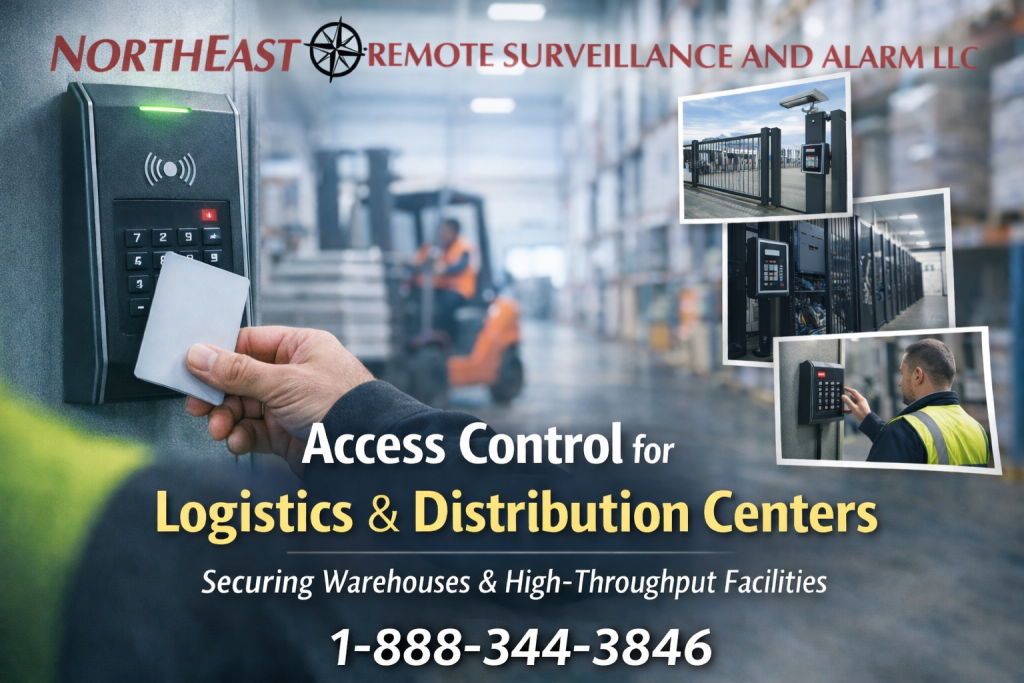
In logistics environments, access control is not just a door lock upgrade. It is a core operational security system. Employee entrances, dock offices, high-value inventory cages, IT rooms, yard gates, returns processing areas, maintenance rooms, and side or rear access points all need to be managed in a way that supports security, safety, and day-to-day workflow. When those areas are not controlled properly, facilities often face unauthorized entry, internal theft, after-hours access problems, credential misuse, and weak accountability during investigations.
A properly designed system helps distribution and logistics operators reduce shrink, support safer operations, manage high employee volumes, and create clear audit trails across buildings, shifts, and departments.
If your facility also needs integrated surveillance, alarm, and site-wide visibility, visit Unified Commercial Security Systems.
Why Access Control Matters in Logistics and Distribution Centers
Warehouses and distribution centers operate differently than office buildings. These facilities often deal with rotating shifts, seasonal labor, carrier traffic, dock activity, side-door use, trailer staging, equipment movement, and multiple building faces that create more security pressure around doors and access points.
Common challenges include:
- high employee counts across multiple shifts
- temporary and seasonal labor surges
- vendor and carrier traffic throughout the day
- multiple employee, office, and service entrances
- sensitive areas such as IT rooms, returns processing, and high-value cages
- dock offices with continuous activity
- exterior gates and perimeter entry points
- “convenience door” habits that weaken security
Every uncontrolled door creates unnecessary exposure. Facilities often experience risk from internal theft, unauthorized after-hours entry, tailgating during shift changes, shared credentials, lost keys, and doors that are left unsecured because they are used constantly during operations.
An enterprise-grade access control system replaces unmanaged keys and shared codes with stronger user accountability, access logs, faster credential revocation, and better operational control.
Core Objectives of Access Control in Logistics Facilities
An effective logistics access control system should do more than open doors. It should support the way the facility actually operates while helping ownership, operations leadership, IT, and security teams manage risk more effectively.
A strong system should help a facility:
- eliminate anonymous entry
- restrict access by role, shift, and department
- create searchable audit trails for investigations
- support integration with video surveillance
- respect life-safety and emergency egress requirements
- scale across multiple buildings or campuses
- align with IT and cybersecurity expectations
- improve control over after-hours activity
- reduce key duplication and unmanaged access
The 6-Zone Access Control Model for Distribution Centers
One of the best ways to plan access control in a warehouse or logistics environment is to divide the property into clear access zones. Each zone has different traffic patterns, risk levels, and operational demands.
Zone 1: Employee Entry Points
Employee entrances are often the highest-volume access points in a logistics facility. These doors need to handle heavy daily use while still preventing unauthorized entry and preserving accountability.
Primary goals
- prevent unauthorized building entry
- enforce shift-based permissions
- track arrival and departure activity
- reduce tailgating and shared credential use
Best practices
- credential-based access using cards, fobs, or mobile credentials
- permissions based on shift, role, or department
- door-held-open alerts
- camera coverage aimed at the credential-use area
- anti-passback where operationally appropriate
Avoid
- shared badges
- mechanical keys for primary employee entrances
- unmonitored side entrances
- doors that are routinely propped open for convenience
In many distribution centers, employee entrance control is one of the first places where stronger access control produces immediate results.
Zone 2: Dock Offices and Receiving Entry
Dock offices and receiving-side entrances are some of the highest-risk areas in logistics environments. They deal with frequent movement, high traffic, delivery coordination, and constant interaction between internal staff and outside parties.
Common security challenges
- drivers entering through unauthorized doors
- side doors left unlocked
- after-hours dock office access
- poor visibility into who entered and when
Recommended controls
- credential-based access for internal staff
- intercom and camera verification for drivers and vendors
- time schedules that limit dock office access
- door position monitoring
- event-linked camera coverage
Dock doors themselves may also need status monitoring for open and closed conditions, even though the overhead door mechanism is typically separate from the pedestrian access control hardware.
Zone 3: Interior Restricted Areas
Not every important area in a logistics facility is visible from the floor. Interior restricted zones often contain systems, assets, or records that require tighter control than general warehouse traffic areas.
Common restricted interior zones
- IT and server rooms
- tool cribs
- returns processing
- high-value inventory cages
- HR and admin offices
- maintenance storage
- security rooms
- management offices
Recommended configuration
- role-based access control
- card plus PIN for higher-risk rooms
- detailed audit logging
- after-hours access alerts
- clearly separated permissions by department or responsibility
These areas are often overlooked until there is an incident. In reality, they should be among the most controlled spaces in the building.
Zone 4: Yard Gates and Perimeter Access
Large logistics sites often depend on perimeter and gate control just as much as interior building access. If gates are not governed correctly, a facility may lose visibility into vehicle movement, contractor entry, and after-hours access.
Recommended controls
- credential-based gate entry
- user-specific access logs
- camera coverage tied to gate activity
- centralized credential governance
- elimination of unmanaged gate codes and remote clickers
On larger campuses, access control should help prevent gate-code sprawl and uncontrolled perimeter access.
Zone 5: Multi-Tenant Logistics Buildings
Shared industrial buildings and multi-tenant logistics campuses need a different access control strategy than single-user facilities. In these environments, the system needs to preserve tenant separation while still maintaining building-wide accountability.
Recommended approach
- tenant-segmented permissions
- common-area oversight by building ownership or property management
- separated governance roles
- no cross-tenant visibility unless specifically authorized
- centralized infrastructure with controlled administrative boundaries
Access control architecture in these properties should support tenant independence without sacrificing property-wide control.
Zone 6: Emergency Egress and Life-Safety Considerations
Access control must always be designed around safe egress and applicable life-safety requirements. Controlled doors should never create unsafe exit conditions in an emergency.
Key principles
- doors must allow safe, unobstructed exit in an emergency
- locking hardware must be selected based on the opening, occupancy, and code requirements
- magnetic locking systems require careful code-aware design and proper release methods
- where required, fire alarm interface and door release behavior must be handled correctly
- access-controlled openings should be designed with both security and emergency use in mind
In many warehouse and distribution environments, some locking approaches are more practical than others depending on the opening, the traffic pattern, and the life-safety requirements for that specific door.
Compliance, Safety, and Infrastructure Considerations
Access control in logistics facilities should also align with broader workplace safety, fire alarm behavior, cyber-physical security, and infrastructure planning.
Important considerations include:
- emergency action planning
- forklift and powered industrial truck traffic near controlled openings
- fire alarm release behavior where applicable
- secure network design for connected devices
- system segmentation and admin control
- structured cabling that supports long-term reliability
This is especially important in facilities where access control ties into surveillance, alarm systems, network infrastructure, and multiple buildings.
Access Control and Video Surveillance Integration
Access control becomes far more useful when it is integrated with surveillance. In a logistics facility, that means door activity should be easier to verify, review, and investigate.
Integrated systems can help with:
- camera bookmarks tied to door events
- better review of after-hours entry
- visual confirmation of credential use
- faster incident investigation
- stronger accountability at dock offices, employee entrances, and restricted rooms
This type of integration is especially valuable in high-throughput facilities where movement is constant and investigations need good timestamps and clear event records.
Cybersecurity and IT Alignment
Modern access control systems are network-connected systems and should be treated accordingly. In logistics environments, access control often needs to align with internal IT policies and cybersecurity expectations.
Best practices may include:
- network segmentation
- firmware updates
- controlled admin rights
- strong password policies
- multi-factor authentication for administrative access
- regular review of permissions and access levels
Operations, IT, and security teams should all have a clear role in how the platform is governed.
Credential Governance in High-Throughput Facilities
Credential management becomes especially important in logistics environments because staffing is often fluid. Facilities may deal with full-time staff, temporary labor, seasonal workers, contractors, carriers, cleaning crews, and vendor personnel.
Strong credential governance should include:
- no shared badges
- temporary credentials for temporary workers
- rapid deactivation when roles change
- permissions based on actual job function
- regular review of inactive or unnecessary users
- separate treatment for vendors and non-employees
A warehouse may have good hardware and still perform poorly if credential governance is weak.
Operational Benefits of Access Control in Distribution Centers
A well-designed system does more than improve security. It also improves management visibility and day-to-day operations.
Operational benefits can include:
- better accountability across shifts
- faster HR and internal investigations
- cleaner management of seasonal workforces
- stronger control over restricted inventory areas
- easier review of after-hours events
- improved gate and entry-point governance
- reduced key replacement and re-keying costs
- more scalable facility growth planning
In high-volume facilities, even small improvements in control and accountability can make a meaningful difference over time.
FAQ – Access Control for Logistics and Distribution Centers
1. Why is access control critical in distribution centers?
Because high employee volume, third-party vendors, dock traffic, and multiple entry points increase unauthorized entry risk and reduce accountability if doors are unmanaged.
2. Are keys acceptable in warehouse environments?
Keys are harder to track, easier to duplicate, and cannot be revoked instantly the way access credentials can.
3. Can access control systems scale across multiple distribution centers?
Yes. Enterprise platforms can support centralized multi-site management when designed correctly.
4. What credentials are most common in warehouse environments?
Badge cards, RFID credentials, key fobs, and mobile credentials are common depending on the facility and management preference.
5. Should seasonal workers receive temporary credentials?
Yes. Temporary workers should receive controlled temporary credentials instead of shared badges or codes.
6. Should employee entrances require badge or credential access?
Yes. Controlled employee entry helps eliminate anonymous building access.
7. Can dock offices be access-controlled?
Yes. Dock offices are often one of the most important places to apply controlled access, especially for after-hours restrictions.
8. What is door-held-open detection?
It is an alert generated when a controlled door remains open beyond a set threshold.
9. Should IT and server rooms be access-restricted?
Absolutely. These rooms should be limited to authorized personnel only.
10. Can a facility use centralized lockdown commands?
Yes. Many enterprise systems support centralized lockdown or other emergency control functions when configured appropriately.
11. Do access control systems interfere with emergency exits?
A properly designed system should support safe egress and comply with applicable life-safety requirements.
12. What is delayed egress hardware?
It is a controlled exit configuration that delays egress under specific conditions and must be used only where allowed and properly designed.
13. Should access logs be retained for investigations?
Yes. Retention should reflect the facility’s operational risk and investigation needs.
14. Can access control integrate with video surveillance?
Yes. Door events can be linked with camera views and recorded events for faster review.
15. Should yard gates use credential control?
Yes. Credential-controlled gate access improves audit trails and reduces unmanaged gate use.
16. Can alerts notify management in real time?
Yes. Many systems support app alerts, email alerts, or monitored notification workflows.
17. Should access control run on a separate VLAN?
Often yes. Network segmentation can improve security and management control.
18. Are firmware updates necessary?
Yes. Firmware and software updates are part of maintaining security and platform reliability.
19. Should admin access use multi-factor authentication?
It is strongly recommended wherever supported.
20. How often should permissions be reviewed?
Quarterly reviews are a strong baseline, though some facilities may need more frequent audits.
21. Can access control reduce internal theft?
It can help reduce internal theft by increasing accountability and limiting uncontrolled movement.
22. Does access control help during HR investigations?
Yes. Timestamped access records can provide useful evidence during internal reviews.
23. What is the ROI of warehouse access control?
Return often comes from reduced shrink, better accountability, faster investigations, cleaner credential management, and improved control over restricted areas.
24. Can systems expand as facilities grow?
Yes. A well-planned system should be scalable as the building, workforce, or campus grows.
25. Who should manage the system internally?
Typically operations leadership works alongside IT and security administrators, with clearly defined roles.
Request a Logistics Facility Access Control Review
If your warehouse, 3PL facility, or distribution center needs better control over employee entrances, dock offices, yard gates, IT rooms, restricted inventory areas, or after-hours building access, Northeast Remote Surveillance and Alarm, LLC can help design a system built around how the facility actually operates.
To discuss your site, call 1-888-344-3846 and schedule a facility review.