
Compare wireless and hardwired access control by opening requirements, communication paths, power, compatibility, maintenance, and long-term ownership.

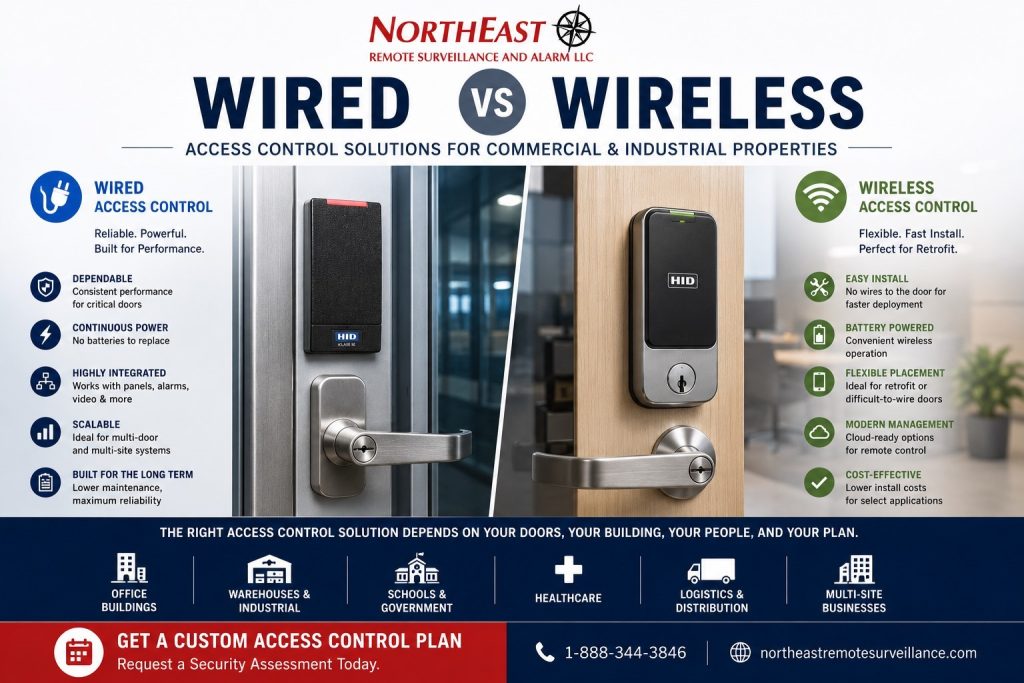
This Knowledge Center guide explains how wireless locks, wireless access devices, and hardwired door control systems compare for commercial and industrial properties.
For broader buyer education on commercial security planning, system comparisons, costs, infrastructure, and long-term decision-making, start with Knowledge Center
Wireless and Hardwired Options
Wireless access control usually relies on battery-powered locks, wireless communication, wireless hubs, or limited cabling to reduce installation complexity at certain doors.
Hardwired access control typically uses cabling between the door hardware, reader, request-to-exit device, door contact, power supply, and access control panel or controller.
The difference matters because access control is not just about unlocking a door. It affects employee access, restricted areas, audit history, emergency egress, system reliability, user management, maintenance, future expansion, and long-term security accountability.
What Is Wireless Access Control?
Wireless access control uses wireless communication or battery-powered devices to control access at a door without the same level of cabling required by a traditional hardwired access control system.
Wireless access control may include:
- Battery-powered electronic locks
- Wireless locksets
- Wireless readers
- Wireless door devices
- Wireless gateways or hubs
- Cloud-managed access control devices
- Mobile credential-compatible hardware
- Limited-cabling retrofit solutions
Wireless systems can be useful when a door is difficult to cable, when the building is occupied, when walls are finished, or when a business needs a faster retrofit option.
Wireless does not mean “no planning.” It still requires proper door evaluation, hardware selection, credential planning, wireless signal review, battery maintenance, user management, and egress awareness.
What Is Hardwired Access Control?
Hardwired access control uses physical wiring to connect door devices to controllers, power supplies, readers, locks, request-to-exit devices, door contacts, and related access control equipment.
A hardwired access control door may include:
- Card reader or keypad
- Electrified lock, electric strike, maglock, or electrified trim
- Door contact
- Request-to-exit device
- Power supply
- Access control controller
- Fire alarm interface where required
- Cabling through walls, ceilings, frames, or raceways
- Network-connected access control panel
Hardwired access control is often preferred for high-use doors, code-sensitive openings, perimeter doors, warehouse doors, main employee entrances, gates, schools, municipal buildings, healthcare facilities, industrial sites, and long-term commercial systems.
How the Connections Differ
Wireless access control usually prioritizes installation flexibility.
Hardwired access control usually prioritizes reliability, power stability, system control, and long-term scalability.
A wireless lock may solve a difficult retrofit problem. A hardwired system may be stronger for critical doors where performance, monitoring, power, and integration matter more.
The right choice depends on the door, the building, the risk level, the user count, the operating schedule, the infrastructure, and the long-term support plan.
Side-by-Side Comparison
| Category | Wireless Access Control | Hardwired Access Control |
|---|---|---|
| Installation complexity | Often easier for retrofits | More cabling and planning required |
| Power source | Often battery-powered | Usually powered by wired power supply |
| Reliability | Depends on battery, signal, and device type | Usually stronger for critical doors |
| Maintenance | Battery replacement and device checks required | Less battery maintenance, but wiring must be maintained |
| Best use | Interior doors, retrofit doors, lower-risk controlled areas | Main entries, perimeter doors, high-risk areas, high-traffic doors |
| Scalability | Good in some platforms, limited in others | Stronger for larger commercial systems |
| Integration | Varies by platform | Usually stronger with alarms, monitoring, video, and life-safety coordination |
| Egress coordination | Still required | Still required and often easier to coordinate cleanly |
| Long-term ownership | Can be convenient but battery-dependent | Stronger for durable long-term control |
| Best-fit properties | Offices, interior suites, tenant spaces, selective retrofits | Warehouses, schools, municipal buildings, healthcare, industrial, logistics, multi-door sites |
When Wireless Locks Make Sense
Wireless access control can be a strong option when the door is difficult to wire or the building conditions make hardwired installation expensive or disruptive.
Wireless may make sense for:
- Interior office doors
- Finished tenant spaces
- Older buildings where cabling is difficult
- Doors with limited access-control risk
- Administrative areas
- Low-traffic interior doors
- Temporary or phased access control needs
- Retrofit projects where walls and ceilings cannot be opened easily
- Sites where a compatible wireless platform is already in use
Wireless can also help when a customer wants to add controlled access to selected doors without building a full hardwired pathway immediately.
The key is using wireless where the risk, traffic, battery maintenance, signal conditions, and platform limitations are acceptable.
When a Hardwired Installation Fits
Hardwired access control is usually the better choice for doors that are critical to security, operations, compliance, or daily business movement.
Hardwired access control is often better for:
- Main employee entrances
- Exterior doors
- Warehouse doors
- Loading dock personnel doors
- High-traffic doors
- Restricted rooms
- IT and network rooms
- Medication or records areas
- School entrances
- Municipal building entrances
- Healthcare entrances
- Industrial facility doors
- Multi-tenant commercial buildings
- Doors that need tighter monitoring and integration
- Doors where battery maintenance would create operational risk
Hardwired systems are usually stronger when the customer needs dependable power, event history, door status, alarm coordination, video integration, and long-term expansion.
Wireless Advantages
Wireless access control can be useful because it may reduce installation disruption.
Potential advantages include:
- Less invasive installation at some doors
- Faster retrofit options
- Reduced cabling difficulty
- Useful for finished spaces
- Helpful for selective interior doors
- Flexible deployment in some platforms
- May support mobile or cloud-based management depending on the system
- Can help phase access control into older buildings
Wireless can be a practical tool when the door does not justify the cost or disruption of a full hardwired installation.
Wireless Limitations
Wireless access control has limitations that commercial buyers should understand before choosing it.
Common limitations include:
- Battery maintenance
- Wireless signal concerns
- Device compatibility limits
- Platform dependency
- Possible delay in status updates depending on system design
- Less ideal for high-risk perimeter doors
- Less ideal for heavy-use openings
- More maintenance planning for multi-door systems
- Possible integration limits with alarms, video, or monitoring
- Hardware constraints based on the door type
Wireless is not automatically weaker, but it has different maintenance and design realities. If the business ignores those realities, the system can become harder to support over time.
Hardwired Advantages
Hardwired access control is often preferred for commercial and industrial environments because it creates a stronger system foundation.
Potential advantages include:
- More dependable power
- Stronger door status monitoring
- Better support for high-use doors
- Cleaner integration with alarms and video
- Better support for multi-door systems
- Stronger long-term scalability
- Better fit for exterior and perimeter doors
- More predictable maintenance
- Better support for complex door hardware
- Better fit for code-sensitive and life-safety-aware planning
Hardwired systems usually require more planning up front, but they often provide stronger long-term value for serious commercial security environments.
Hardwired Limitations
Hardwired access control is not always simple. The system may require more installation work, more coordination, and more infrastructure planning.
Potential limitations include:
- More cabling required
- More invasive installation
- Higher upfront labor cost
- More coordination with walls, ceilings, frames, and pathways
- More planning around door hardware
- Possible coordination with electricians, contractors, IT teams, or building management
- More disruption in occupied finished spaces
Hardwired access control is often the stronger long-term choice, but it should be scoped correctly before installation begins.
Door Hardware Matters More Than the Wireless Question
The access control decision should not begin with wireless versus hardwired. It should begin with the door.
A commercial door may involve:
- Door frame condition
- Door swing
- Fire rating
- Existing lock hardware
- Panic hardware
- Electric strike compatibility
- Maglock suitability
- Electrified lever trim
- Door closer function
- Request-to-exit requirements
- ADA usability
- Egress requirements
- Power transfer
- Door contact placement
- Life-safety coordination
A weak hardware decision can create a poor access control system even if the platform is good.
For broader access control planning, use The Ultimate Commercial and Industrial Access Control Guide as the deeper educational resource.
Egress, Fire Alarm, and Life-Safety Coordination
Access control must never trap people inside a building or interfere with required emergency egress. This applies to both wireless and hardwired systems.
Code-aware planning may be needed when access control affects:
- Exit doors
- Fire-rated openings
- Panic hardware
- Maglocks
- Electrified locks
- Request-to-exit devices
- Delayed egress systems
- Fire alarm interfaces
- Emergency responder access
- ADA usability
- Door release requirements
Wireless access control does not avoid life-safety obligations. Hardwired access control does not automatically satisfy them. The door function, hardware, wiring, release method, and applicable requirements still matter.
This resource is educational and does not replace the authority having jurisdiction, architect, engineer, code consultant, fire marshal, legal advisor, or insurance review where required.
Warehouses and Industrial Facilities
Warehouses and industrial facilities often favor hardwired access control for primary doors because these environments usually have higher traffic, more users, larger buildings, exterior exposure, and more operational risk.
Hardwired access control may be better for:
- Main employee entrances
- Warehouse office entrances
- Shipping and receiving entrances
- Restricted inventory rooms
- IT rooms
- Production area doors
- Yard gates
- Dock personnel doors
- Multi-shift employee access
- Doors tied to alarm or video workflows
Wireless may still be useful for selected interior rooms, administrative spaces, or retrofit doors where the risk is lower and battery maintenance is manageable.
For warehouse-specific planning, use Warehouse Access Control Systems as the supporting property-type guide.
Access Control for Offices, Schools, Healthcare, and Municipal Buildings
Office buildings, schools, healthcare properties, and municipal buildings often need careful access planning because doors may involve public entry, staff access, visitor flow, restricted areas, and life-safety expectations.
Wireless may work for:
- Interior office suites
- Staff-only rooms
- Administrative spaces
- Low-risk interior doors
- Retrofit areas with difficult cabling
Hardwired may be better for:
- Public entrances
- Main employee entrances
- Emergency egress doors
- High-traffic corridors
- Records rooms
- Medication rooms
- IT rooms
- School entry points
- Municipal service entrances
- Doors requiring tighter monitoring or integration
The decision should be made door by door, not guessed at the building level.
Gates and Outdoor Areas
Outdoor gates, vehicle entrances, truck yards, contractor yards, and industrial perimeters usually need more durable planning than simple interior wireless locks.
Gate access control may involve:
- Vehicle readers
- Keypads
- Intercoms
- LPR cameras
- Gate operators
- Safety loops
- Remote release
- Communication paths
- Power availability
- Weather exposure
- Emergency access
- Camera views
- Event documentation
Hardwired infrastructure is often preferred where power, communication, reliability, and integration matter. Wireless communication may still be used in some outdoor applications, but it must be planned carefully around signal strength, power, weather, and serviceability.
Cost Factors
Wireless access control can sometimes reduce installation labor because less cabling may be required. However, the total cost should include hardware cost, batteries, platform licensing, gateway requirements, maintenance, and long-term support.
Hardwired access control may cost more up front because of cabling, door hardware coordination, controller installation, power supplies, and labor. However, it may offer better long-term value for high-use, high-risk, or multi-door commercial systems.
Cost factors include:
- Door count
- Door hardware condition
- Existing lock type
- Frame condition
- Cabling difficulty
- Ceiling access
- Network availability
- Power supply needs
- Reader type
- Credential type
- Software licensing
- Wireless gateway requirements
- Battery maintenance expectations
- Life-safety coordination
- Future expansion needs
For budget planning, use Commercial & Industrial Access Control Cost as the supporting cost guide.
Cybersecurity and Platform Considerations
Wireless and hardwired access control can both involve cybersecurity concerns because modern systems may use cloud dashboards, mobile credentials, network-connected controllers, remote management, and user accounts.
Commercial buyers should consider:
- User permissions
- Administrator access
- Mobile credential security
- Cloud account protection
- Multi-factor authentication where available
- Software updates
- Firmware updates
- Network segmentation
- Audit logs
- Lost credential procedures
- Vendor support
- Long-term platform stability
A door access system is also a data system. It should be planned with security and account management in mind.
Maintenance Considerations
Maintenance is one of the biggest differences between wireless and hardwired access control.
Wireless access control may require:
- Battery replacement
- Battery status monitoring
- Gateway review
- Wireless communication checks
- Device firmware updates
- Lock function checks
- Periodic physical inspection
Hardwired access control may require:
- Power supply review
- Reader testing
- Door contact testing
- Lock hardware review
- Request-to-exit testing
- Controller review
- Cable and connection troubleshooting
- Software and user management updates
Both systems need support. Wireless usually shifts more attention toward batteries and signal reliability. Hardwired usually shifts more attention toward wiring, power, hardware, and controller serviceability.
Future Expansion
A business should not choose an access control system only for today’s door count. The system should support future users, doors, schedules, credentials, buildings, and integrations.
Expansion questions include:
- Will more doors be added later?
- Will the building add tenants or departments?
- Will employee access schedules become more complex?
- Will cameras need to support access events?
- Will gates be added later?
- Will mobile credentials be used?
- Will the system need multi-site management?
- Will the platform support long-term growth?
- Will wireless batteries become hard to manage at scale?
- Will hardwired infrastructure be easier to expand later?
A small wireless system may work well at five doors but become harder to manage at fifty doors if the platform, batteries, gateways, or maintenance plan are not appropriate. A hardwired system may take more effort to install but support larger growth more cleanly.
Which Option Is Better?
Hardwired access control is usually better for critical commercial doors, high-traffic entrances, exterior openings, warehouses, schools, municipal buildings, healthcare facilities, industrial properties, and larger multi-door systems.
Wireless access control is usually better for selected interior doors, retrofit conditions, lower-risk areas, and projects where cabling would be unusually difficult or disruptive.
The best answer is often a hybrid design. A property may use hardwired access control for main doors, perimeter doors, and high-risk areas while using wireless access control for selected interior offices, storage rooms, or retrofit doors.
How to Decide
A business should consider hardwired access control when:
- The door is critical to security
- The door is exterior or perimeter-facing
- The door has heavy daily use
- The door needs tighter monitoring
- The system must integrate with alarms or cameras
- The site has many users or many doors
- Long-term reliability matters more than installation convenience
- Battery maintenance would create risk
- Life-safety coordination is important
A business should consider wireless access control when:
- The door is interior
- Cabling is difficult or disruptive
- The risk level is lower
- The building is already finished
- The door has moderate use
- Battery maintenance is acceptable
- The platform supports the needed features
- A phased retrofit is being planned
Request Access Control Planning
Choosing between wireless and hardwired access control should not be based only on convenience or price. It should be based on the door, hardware condition, building layout, egress requirements, user count, operating schedule, risk level, infrastructure, maintenance expectations, and future expansion plan.
Northeast Remote Surveillance and Alarm, LLC helps commercial and industrial clients plan access control systems around real facility conditions, controlled entry, user accountability, door hardware, life-safety awareness, and long-term support.
To review your facility, call 1-888-344-3846 or use Request a Security Assessment to schedule a commercial security assessment.
Frequently Asked Questions
What is the difference between wireless and hardwired access control?
Wireless access control uses wireless communication or battery-powered devices to control access at a door. Hardwired access control uses cabling to connect readers, locks, door contacts, request-to-exit devices, power supplies, and controllers.
Is wireless access control reliable?
Wireless access control can be reliable when used in the right application, but it depends on battery maintenance, wireless signal quality, platform design, device type, and door usage. It is usually better for selected interior or retrofit doors than critical high-traffic perimeter openings.
Is hardwired access control better than wireless access control?
Hardwired access control often suits critical, busy or exterior doors and larger multi-door systems. It can offer dependable power, monitoring, integration and room for growth. Common sites include warehouses, schools, municipal buildings, healthcare facilities and industrial properties.
When should a business use wireless access control?
A business should consider wireless access control for interior doors, finished spaces, lower-risk areas, retrofit projects, or doors where cabling would be unusually difficult or disruptive.
When should a business use hardwired access control?
A business should consider hardwired access control for main entrances, perimeter doors, employee entrances, restricted rooms, warehouse doors, school entries, municipal entrances, healthcare areas, industrial doors, and other higher-risk or high-use openings.
Does wireless access control still need door hardware planning?
Yes. Wireless access control still requires door hardware review, egress awareness, lock compatibility, credential planning, battery maintenance planning, and support considerations.
Does hardwired access control require more installation work?
Yes. Hardwired access control usually requires more cabling, power supply planning, controller installation, pathway coordination, and door hardware work. That extra work often creates a stronger long-term system for commercial properties.
Can wireless and hardwired access control be used together?
Yes. Many commercial properties benefit from a hybrid approach. Hardwired access control may be used for critical doors, while wireless access control may be used for selected interior or retrofit doors.
Is wireless access control safe for emergency exits?
Wireless access control must still support required emergency egress and door function. Any access-controlled opening that affects exiting, fire-rated doors, panic hardware, maglocks, or life-safety requirements should be reviewed carefully with the appropriate professionals or authority having jurisdiction where required.
How should a business choose between wireless and hardwired access control?
A business should evaluate door type, risk level, traffic volume, cabling difficulty, battery maintenance, user count, integration needs, egress requirements, platform compatibility, cybersecurity, and future expansion before choosing wireless, hardwired, or hybrid access control.
Plan Your Next Security Improvement
Tell NERSA about your commercial facility, existing systems, and project priorities. We can help you plan an installation, evaluate an upgrade, or coordinate security across multiple locations.
Compliance, Codes & Project Standards
NERSA plans commercial and industrial security work with applicable code, documentation, inspection and authority-having-jurisdiction requirements in mind. Requirements vary by system, property and jurisdiction. These resources support project planning; they do not establish legal compliance, certification or AHJ approval.
Related guidance: Regulatory compliance & inspection readiness · Access control & door hardware standards · NFPA 101 & egress planning · ADA access-control planning