
Compare monitored commercial alarms with local-only alarms by who receives an event, how it is handled, and which communication paths and response procedures are required.

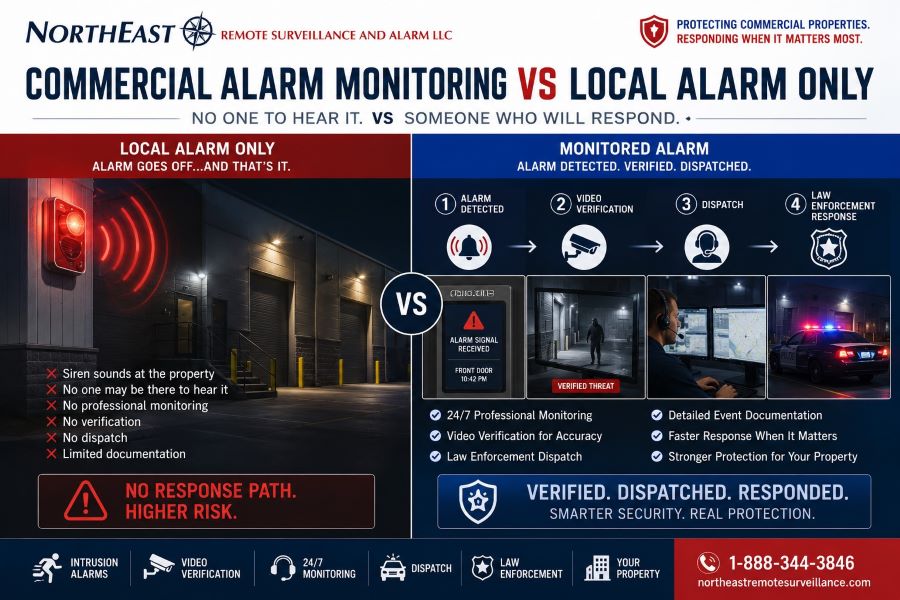
This Knowledge Center guide explains how monitored commercial alarm systems compare with alarms that only sound locally at the building.
For broader buyer education on commercial security planning, system comparisons, costs, monitoring, infrastructure, and long-term support, start with Knowledge Center.
How Monitored and Local-Only Alarms Differ
A local alarm-only system is designed to make noise at the property when an alarm event occurs. That may include a siren, bell, strobe, keypad alert, or on-site notification.
A monitored commercial alarm system sends alarm signals to a monitoring center or connected response workflow so the event can be reviewed, documented, and escalated based on the account setup.
The difference is simple:
Local alarm only asks people nearby to notice.
Commercial alarm monitoring creates a response path when the property may be empty, closed, or unattended.
What Is a Local Alarm-Only System?
A local alarm-only system activates at the property but does not send the alarm event to a professional monitoring center. The system may sound a siren, flash a strobe, activate a local device, or notify someone on-site.
Local alarm-only systems may be used for:
- Low-risk interior areas
- Basic deterrence
- Occupied buildings
- Internal alerting
- Equipment rooms
- Small commercial spaces with staff present
- Secondary non-critical alerts
The limitation is that the alarm depends on someone nearby hearing it, seeing it, or responding to it. If the property is closed, isolated, loud, remote, or unattended, the alarm may not create a reliable response.
What Is Commercial Alarm Monitoring?
Commercial alarm monitoring connects an alarm system to a monitoring path so alarm events can be transmitted, logged, and handled according to the customer’s account instructions.
Monitoring may support:
- Intrusion alarm signals
- Opening and closing activity
- After-hours burglary events
- Panic or duress signals where applicable
- Equipment or environmental signals where configured
- Responsible-party notifications
- Dispatch procedures where appropriate
- Signal history and documentation
- Communication path supervision
- Commercial response workflows
Commercial alarm monitoring is not just a siren. It is a structured response layer that helps make alarm events more actionable.
For a deeper service overview, use Commercial and Industrial Security Monitoring as the supporting monitoring page.
Why the Difference Matters for Your Business
Commercial properties often have risk after normal business hours. Warehouses, offices, schools, medical facilities, municipal buildings, contractor yards, truck yards, and industrial facilities may be empty at night, active during shift changes, or accessed by authorized personnel outside normal schedules.
A local alarm may create noise, but noise does not guarantee response.
Commercial alarm monitoring can help answer:
- What signal was received?
- When did the alarm occur?
- Which zone activated?
- Who should be contacted?
- Was the system armed or disarmed?
- Was there opening or closing activity?
- Was dispatch requested where appropriate?
- Is there signal history for review?
- Does the property have repeated alarm activity?
Those questions matter when a business needs accountability and documentation.
Side-by-Side Comparison
| Category | Local Alarm Only | Commercial Alarm Monitoring |
|---|---|---|
| Main function | Sounds locally at the property | Sends signals to a monitoring workflow |
| Response path | Depends on someone nearby | Escalation based on account instructions |
| After-hours value | Limited | Stronger for closed or unattended properties |
| Documentation | Minimal | Signal history and event records may be available |
| Best use | Low-risk or occupied areas | Commercial buildings with after-hours risk |
| False alarm management | Mostly local | Can support better signal review and contact procedures |
| Employee accountability | Limited | Can support opening, closing, and user-related records |
| Cost | Usually lower | Usually higher due to monitoring service |
| Long-term value | Basic deterrence | Better response, documentation, and oversight |
When Local Alarm Only May Be Enough
Local alarm-only systems can still have a place when the risk is limited and the business does not need a monitored response path.
Local-only alarms may be reasonable for:
- Occupied buildings during business hours
- Interior areas where staff are nearby
- Low-risk storage spaces
- Secondary alerts
- Equipment rooms with local supervision
- Non-critical deterrence
- Temporary or limited-use areas
The key is understanding the limitation. A local alarm can alert people who are present, but it may not help much if no one is there to hear it.
When Commercial Alarm Monitoring Is Stronger
Commercial alarm monitoring is usually stronger when the property has after-hours risk, limited staffing, valuable assets, multiple users, or areas that need better event accountability.
Monitoring is especially useful for:
- Warehouses
- Office buildings
- Medical offices
- Schools
- Municipal buildings
- Manufacturing plants
- Contractor yards
- Truck yards
- Industrial properties
- Multi-tenant commercial buildings
- Distribution and logistics facilities
- Buildings with employee access after hours
- Properties with repeated theft, trespassing, or break-in concerns
The more important the response path is, the less sense it makes to rely only on local noise.
Alarm Monitoring and After-Hours Protection
After-hours risk is one of the strongest reasons to use commercial alarm monitoring. Many burglaries, forced entries, unauthorized access events, and trespassing problems occur when no manager is present.
A monitored alarm can help support after-hours security by transmitting events from:
- Exterior doors
- Employee entrances
- Office doors
- Warehouse doors
- Overhead doors
- Restricted rooms
- Shops or support buildings
- Detached structures
- Interior motion zones
- Glass-break areas
- Perimeter alarm points where configured
A local-only siren may scare someone away, but a monitored signal gives the business a better chance of knowing that something happened.
Alarm Monitoring and Opening/Closing Activity
Commercial alarm systems often support opening and closing accountability. This can help businesses understand when the system was armed, disarmed, or used by assigned personnel.
Opening and closing activity can be useful when:
- Employees access the building after hours
- Managers need user accountability
- Cleaning crews or vendors enter outside normal hours
- Multiple shifts use the building
- A business wants better records of alarm activity
- The company needs to review unusual access times
Local-only alarms usually do not provide the same level of monitored accountability.
Alarm Monitoring and False Alarm Management
False alarms are a real issue for commercial properties. Poor device placement, user error, unsecured doors, weak schedules, outdated equipment, or unclear procedures can all create unnecessary alarm activity.
Commercial alarm monitoring can support better false alarm management by helping identify:
- Which zone triggered
- When the signal occurred
- Whether the system was recently armed or disarmed
- Whether a responsible party was contacted
- Whether multiple signals occurred
- Whether the same area is creating repeated problems
- Whether user training or system adjustment is needed
Monitoring does not automatically eliminate false alarms. Good system design, proper training, clear schedules, working devices, and strong support still matter.
Commercial Alarm Monitoring vs Local Alarm Only – Local Alarm Only and Its Weak Points
Local alarm-only systems are weaker when the property is empty, noisy, remote, or not closely watched.
Common weaknesses include:
- No professional monitoring response
- No dispatch workflow
- No signal escalation
- No responsible-party contact process
- Limited event history
- Limited after-hours value
- Reliance on neighbors or passersby
- Weak accountability for repeated events
- Less useful documentation for management review
For some properties, those weaknesses may be acceptable. For most serious commercial environments, they create too much uncertainty.
Commercial Alarm Monitoring and Video Verification
Alarm monitoring becomes stronger when paired with video verification or camera review. A signal from a door contact, motion detector, or perimeter area can be more useful when the property also has camera coverage to support event review.
Video can help determine whether an event may involve:
- A person inside the building
- A vehicle at the property
- Movement near a door
- Activity at a dock
- Someone entering a restricted area
- An animal or environmental condition
- A false alarm source
For properties comparing stronger after-hours deterrence, use Remote Video Monitoring and Live Talk-Down as a related planning page.
Commercial Alarm Monitoring and Intrusion System Design
Monitoring is only as good as the alarm system behind it. If the system has poor zone design, weak device placement, unreliable communication, outdated hardware, or confusing user procedures, monitoring may not solve the root problem.
A strong commercial intrusion alarm design should consider:
- Door contacts
- Motion detection
- Glass-break detection
- Overhead door protection
- Keypad locations
- User codes
- Alarm partitions
- Opening and closing schedules
- Monitoring communication paths
- Responsible-party procedures
- Interior and perimeter coverage
- Building layout and daily operations
For buyers comparing intrusion alarm scope and budget, use Commercial and Industrial Intrusion Alarm Installation Cost as the supporting cost guide.
Communication Paths Matter
A monitored alarm system needs a dependable communication path. Older alarm systems may have used traditional phone lines, but many commercial systems now rely on cellular, network, dual-path, or upgraded communication options depending on the property and platform.
Communication path planning may involve:
- Cellular signal strength
- Network availability
- Backup communication
- Alarm communicator condition
- Monitoring account setup
- Power availability
- Service history
- Supervision requirements
- Future replacement needs
A monitored system with a weak communication path can create reliability problems. The communication method should match the business risk and operating environment.
Fire Alarm Monitoring Is a Separate Life-Safety Topic
This resource focuses primarily on commercial intrusion alarm monitoring compared with local alarm-only protection. Fire alarm monitoring is a life-safety subject and may involve code requirements, AHJ expectations, inspection procedures, testing, documentation, and specific communication requirements.
A business should not treat fire alarm monitoring the same way it treats a basic local intrusion alarm.
When fire alarm systems, sprinkler monitoring, dedicated fire alarm communicators, inspection readiness, or AHJ coordination are involved, the project should be reviewed through a fire/life-safety planning path instead of this comparison alone.
Compliance, Police Response, and Documentation Considerations
Commercial alarm response may be affected by local ordinances, false alarm policies, police response practices, monitoring account procedures, insurance expectations, and internal company policy.
Businesses should understand:
- Who is responsible for alarm responses
- Who receives calls
- What happens after an alarm signal
- Whether dispatch is automatic or verified
- Whether local false alarm rules apply
- Whether alarm permits are required
- Whether fire/life-safety systems have separate requirements
- Whether user training is needed
- Whether documentation should be maintained
This resource is educational and does not replace legal, insurance, AHJ, police department, monitoring center, or code review where those apply.
Best Properties for Commercial Alarm Monitoring
Commercial alarm monitoring is especially valuable for properties where an unattended alarm event needs a response path.
Strong candidates include:
- Warehouses
- Distribution centers
- Manufacturing plants
- Office buildings
- Medical facilities
- Schools
- Municipal buildings
- Contractor yards
- Truck yards
- Industrial buildings
- Multi-tenant commercial properties
- Buildings with after-hours employee access
- Properties with valuable inventory, equipment, tools, vehicles, or records
If the business cannot rely on someone being nearby to hear a local alarm, monitoring becomes more important.
Cost and Value Considerations
Local alarm-only systems may cost less because they do not include ongoing monitoring service. That lower cost can be attractive, but it should be weighed against the risk of having no formal response path when the property is empty.
Commercial alarm monitoring may involve ongoing monthly service costs, account setup, communication equipment, system programming, and support. The value comes from stronger event handling, better documentation, after-hours response structure, and long-term oversight.
The better question is not only which option costs less.
The better question is:
What happens when the alarm activates and no one is there?
Which Option Is Better?
Commercial alarm monitoring is usually better for businesses that need after-hours protection, signal documentation, escalation procedures, opening and closing records, and a more dependable response path.
Local alarm-only systems may be enough for low-risk areas, occupied spaces, or secondary alerting where a monitored response is not necessary.
Many commercial properties benefit from a layered approach. Some areas may use local alerts, while critical doors, warehouses, offices, restricted rooms, and after-hours risk zones should be connected to monitoring.
How to Decide
A business should consider commercial alarm monitoring when:
- The property is empty after hours
- Valuable inventory, tools, equipment, vehicles, or records are present
- Employees access the building outside normal hours
- Management wants better alarm records
- The business needs responsible-party notification
- The site has repeated trespassing or break-in concerns
- The alarm system protects multiple areas or buildings
- A local siren would not create a reliable response
A local alarm-only system may be enough when:
- The area is occupied when the alarm matters
- The risk is low
- The alarm is only a secondary deterrent
- Staff can respond immediately
- The business does not need signal documentation
- The property does not require a monitored response path
Request Commercial Alarm Monitoring Planning
Choosing between commercial alarm monitoring and a local alarm-only system should not be based only on monthly cost. It should be based on the property, operating hours, after-hours risk, employee access, alarm zones, communication paths, response expectations, and documentation needs.
Northeast Remote Surveillance and Alarm, LLC helps commercial and industrial clients plan alarm systems around real building use, after-hours protection, monitoring paths, user accountability, and long-term support.
To review your facility, call 1-888-344-3846 or use Request a Security Assessment to schedule a commercial security assessment.
Frequently Asked Questions About Commercial Alarm Monitoring vs Local Alarm Only
What is the difference between commercial alarm monitoring and local alarm only?
Commercial alarm monitoring sends alarm signals to a monitoring workflow or monitoring center for handling based on account instructions. A local alarm-only system sounds at the property but does not create the same monitored response path.
Is a local alarm-only system enough for a business?
A local alarm-only system may be enough for low-risk, occupied, or secondary areas. It is usually weaker for commercial properties that are empty after hours, contain valuable assets, or need a documented response process.
Why should a business use commercial alarm monitoring?
A business should use commercial alarm monitoring when it needs after-hours protection, signal documentation, responsible-party notification, dispatch procedures where appropriate, opening and closing accountability, and a stronger response path than a local siren.
Does alarm monitoring stop break-ins?
Alarm monitoring does not physically stop every break-in. It helps create awareness, documentation, notification, and response workflows when an alarm event occurs. Stronger security may also require cameras, access control, lighting, doors, locks, and proper system design.
Can monitored alarms reduce false alarm problems?
Monitoring alone does not eliminate false alarms, but it can help identify signal patterns, zones, times, and procedures that may need correction. Proper system design, user training, equipment maintenance, and clear account instructions are still important.
Does commercial alarm monitoring work with video verification?
Yes. Alarm monitoring can be stronger when paired with camera coverage or video verification because video can help clarify what may have caused the alarm event.
Is fire alarm monitoring the same as intrusion alarm monitoring?
No. Fire alarm monitoring is a life-safety topic and may involve code requirements, AHJ review, inspection expectations, testing procedures, and specific communication standards. Intrusion alarm monitoring is primarily focused on burglary, unauthorized entry, and security events.
What communication path does a monitored alarm use?
A monitored alarm may use cellular, network, dual-path, or other communication methods depending on the system, property, platform, and monitoring requirements. Older phone-line systems may need review or replacement.
What types of businesses need monitored alarms?
Warehouses, offices, medical facilities, schools, municipal buildings, manufacturing plants, contractor yards, truck yards, distribution centers, and multi-tenant commercial properties often benefit from monitored alarms.
How should a business choose between monitoring and local alarm only?
A business should consider operating hours, after-hours risk, assets on site, staff availability, response expectations, alarm documentation needs, communication paths, false alarm concerns, and whether someone nearby can reliably respond to a local alarm.
Plan Your Next Security Improvement
Tell NERSA about your commercial facility, existing systems, and project priorities. We can help you plan an installation, evaluate an upgrade, or coordinate security across multiple locations.
Compliance, Codes & Project Standards
NERSA plans commercial and industrial security work with applicable code, documentation, inspection and authority-having-jurisdiction requirements in mind. Requirements vary by system, property and jurisdiction. These resources support project planning; they do not establish legal compliance, certification or AHJ approval.
Related guidance: Regulatory compliance & inspection readiness · NERSA project standards · Documentation, testing & inspection readiness