
Manufacturing video surveillance systems in Allentown, PA monitor entrances, parking areas, receiving doors, exterior approaches, production spaces, and after-hours activity.

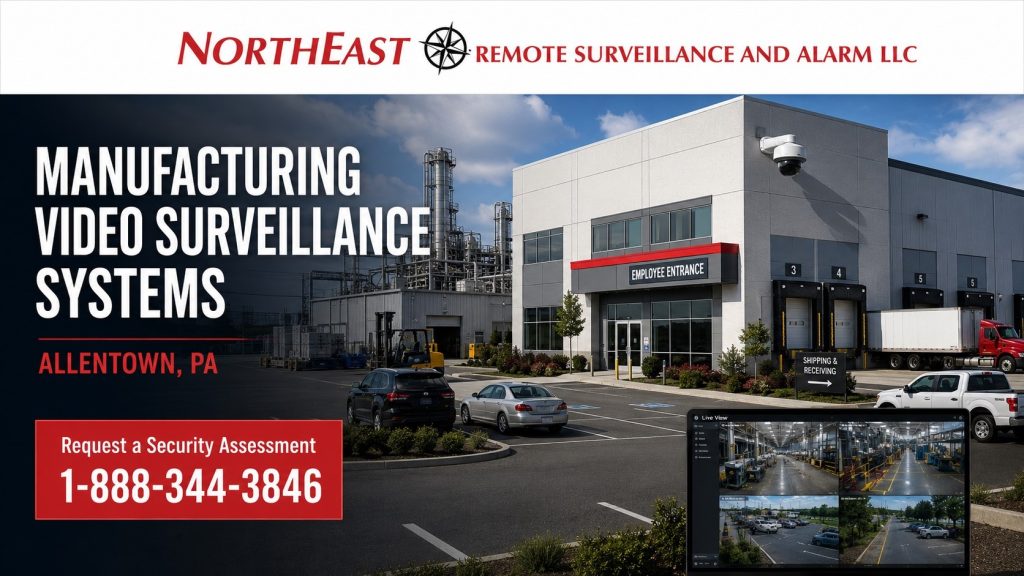
Northeast Remote Surveillance and Alarm, LLC designs camera coverage for light-industrial facilities and production buildings.
For facility-wide protection that also includes access control and alarms, review Manufacturing Security Systems in Allentown, PA.
Camera Planning for Allentown Manufacturing Facilities
Manufacturing facilities need camera systems that support real operational review. The goal is to capture useful video where employees, vehicles, visitors, materials, vendors, and exterior doors create risk.
Manufacturing sites combine production areas with offices, parking and receiving doors. Some also have utility rooms, small docks or shared tenant spaces. Match camera coverage to the actual layout and daily activity.
NERSA designs camera systems for Allentown manufacturers. We plan clear views, reliable recording and the network behind them so authorized staff can find useful footage after an incident.
Manufacturing Camera Coverage
Core manufacturing camera-planning needs include:
- Manufacturing facility camera placement
- Employee entrance camera coverage
- Exterior door surveillance
- Parking lot and vehicle activity visibility
- Receiving area and material movement review
- Production-adjacent camera coverage
- After-hours activity documentation
- Camera infrastructure planning for Allentown manufacturing buildings
Facilities can combine video surveillance with access control, intrusion alarms, fire coordination, gates, monitoring, intercoms, and network infrastructure when needed.
Employee Entrance and Visitor Area Cameras
Employee entrances are one of the most important areas to monitor in a manufacturing facility. These doors often handle shift changes, staff arrivals, visitors, vendors, deliveries, and after-hours access attempts.
Camera coverage should be positioned to capture faces, door activity, entry direction, surrounding movement, and the area immediately outside the entrance. However, a wide camera may only show that someone entered. A properly placed entrance camera helps identify who entered and when.
For cameras across other commercial property types, review Commercial Security Camera Systems in Allentown, PA.
Exterior Door and Building Perimeter Visibility
Manufacturing buildings often have side doors, rear doors, receiving doors, utility entrances, employee-only doors, and service access points that are not visible from the front office. These doors can create risk after hours or during low-staff periods.
A manufacturing camera layout should review each exterior opening and decide whether the goal is identification, activity review, general awareness, or incident documentation. However, not every door needs the same camera type. Weak exterior coverage can still leave important blind spots.
Camera placement should account for wall lighting, building corners, door swing, weather exposure, headlight glare, shadows, and the path people naturally take when approaching the building.
Parking Area and Vehicle Activity Coverage
Manufacturing facilities often have employee parking, visitor parking, delivery lanes, contractor vehicles, and after-hours vehicle movement. Parking-lot cameras can document vehicle incidents, suspicious activity, vandalism, unauthorized access, disputes, or after-hours presence.
Parking-area cameras should provide overview coverage and usable detail where vehicles or people enter. Some facilities may also need license-plate recognition or gate cameras.
The camera design should match the property layout instead of relying on one wide view that cannot capture useful detail.
Receiving and Material Movement Areas
Many Allentown manufacturing facilities have receiving doors, material drop-off areas, small dock zones, roll-up doors, or exterior staging areas. However, these areas still require visibility even when they do not operate like a full warehouse dock.
Camera coverage can document material arrivals, receiving access, staging time, after-hours doors, and damage near receiving points.
For manufacturing camera planning across the wider service area, review Video Surveillance for Manufacturing Facilities.
Production-Adjacent Camera Coverage
Production-adjacent cameras can cover entry points, material flow, and equipment approaches. Placement should account for lighting, safety zones, process sensitivity, and operational visibility.
For example, Allentown facilities may need views of walkways, entry points, material movement, restricted rooms, and office-to-production transitions.
The system should help facility managers understand what happened without overreaching into process monitoring, machine monitoring, employee productivity tracking, or specialized industrial surveillance.
Night, Lighting, and Image Quality
Manufacturing camera systems need to work when incidents actually happen, not only during perfect daytime conditions. Glare, shadows, reflective surfaces, wall packs, parking-lot lights, and low-light areas can affect video quality.
A reliable camera design should review:
- Camera height and viewing angle
- Lighting at entrances and exterior doors
- Parking lot glare and shadows
- Weather exposure
- Nighttime visibility
- Distance to the target area
- Lens selection
- Recording resolution
- Retention requirements
- Network and power reliability
The best camera system produces usable video when the facility actually needs it.
Recording, Remote Viewing, and Infrastructure
Manufacturing video surveillance depends on the infrastructure behind the cameras. Cabling, PoE switching, network closets, fiber pathways, storage, backup power, and remote permissions affect performance.
A camera system should be designed so authorized managers can review the right footage without searching through hours of unusable video. Teams should control, document, and limit remote viewing to appropriate users.
Larger Allentown buildings may require long cable runs, several network areas, exterior pathways, and future expansion.
Compliance and Operational Awareness
Manufacturing video surveillance should support security and incident review without interfering with life-safety systems, emergency exits, required access, fire alarm equipment, or workplace operations. Camera placement near doors, exits, employee areas, receiving zones, and restricted spaces should reflect building use.
Video surveillance does not replace OSHA procedures, fire alarm systems, access control, or written workplace policies. Instead, it supports documentation, investigation, visibility, and operational protection when planned correctly.
Frequently Asked Questions
What areas should manufacturing cameras cover in Allentown facilities?
Manufacturing cameras should cover employee entrances, visitor areas, exterior doors, parking lots, receiving areas, production-adjacent spaces, material movement areas, utility entrances, and after-hours risk points. The exact layout depends on the building, lighting, operating schedule, and exterior exposure.
Is this different from a full manufacturing security system?
Yes. This service covers video surveillance. A complete manufacturing security system may also include access control, intrusion alarms, fire coordination, gates, monitoring, intercoms, and supporting infrastructure.
Should cameras be installed inside production areas?
General manufacturing cameras cover facility visibility and production-adjacent areas. Specialized industrial projects may require additional planning for machine areas, process zones, and heavy-production spaces.
Can manufacturing cameras help with after-hours activity?
Yes. Cameras can help document after-hours movement near exterior doors, parking areas, receiving zones, utility entrances, and building approaches. Higher-risk locations may benefit from analytics or remote monitoring.
Are standard commercial cameras enough for manufacturing facilities?
Not always. Manufacturing facilities may need cameras selected for lighting, ceiling height, exterior exposure, distance, motion, dust, vibration, retention requirements, and network reliability. Camera placement often matters more than camera count.
What makes a manufacturing camera system reliable?
A reliable system combines proper camera placement, lighting review, clean cabling, stable networks, storage, backup power, and secure remote access.
Request Manufacturing Camera Planning in Allentown
Northeast Remote Surveillance and Alarm, LLC designs manufacturing video surveillance systems for entrances, parking areas, receiving doors, exterior approaches, production spaces, and after-hours activity.
Each system should provide usable video, reliable recording, clean infrastructure, and room for future expansion.
For project-specific recommendations, request a security assessment.
Compliance, Codes & Project Standards
NERSA plans commercial and industrial security work with applicable code, documentation, inspection and authority-having-jurisdiction requirements in mind. Requirements vary by system, property and jurisdiction. These resources support project planning; they do not establish legal compliance, certification or AHJ approval.
Related guidance: Regulatory compliance & inspection readiness · Video surveillance compliance · NERSA project standards