Video Surveillance for Manufacturing Facilities

Manufacturing video surveillance should do more than record activity after a loss. It should help manufacturers monitor production areas, document incidents, improve visibility, support safety review, protect equipment and materials, and strengthen accountability across active industrial environments. Your source draft already frames manufacturing as a higher-risk, higher-value, and more operationally complex environment than a standard commercial interior.

Northeast Remote Surveillance and Alarm, LLC provides video surveillance for manufacturing facilities that need more than a basic camera package. We design commercial and industrial surveillance systems for production floors, machinery zones, loading areas, employee entrances, restricted spaces, exterior perimeters, and other operationally important areas where visibility, documentation, and long-term system performance matter. For broader service-level coverage, continue to [Commercial & Industrial Video Surveillance Systems].

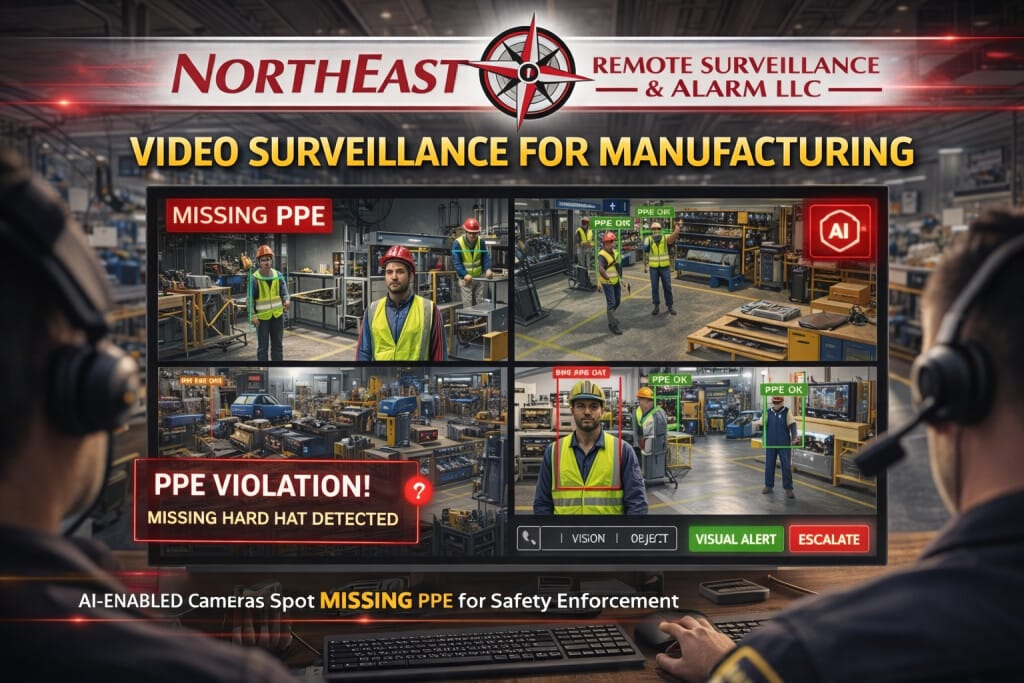
AI-enabled video surveillance screen detecting missing PPE in a manufacturing facility, highlighting worker without hard hat, with Northeast Remote Surveillance & Alarm LLC branding and monitoring operator reviewing live feeds.

Why Manufacturing Facilities Need a Different Surveillance Strategy

Manufacturing environments are different from offices, storefronts, and standard commercial interiors. They often include expensive equipment, raw materials, finished goods, contractor activity, employee movement, machinery hazards, forklift traffic, loading activity, and wider operational exposure that create different surveillance requirements.

A manufacturing surveillance system should be designed around:

  • production-floor visibility
  • machinery-area oversight
  • employee and contractor entry points
  • loading and shipping areas
  • perimeter and yard exposure
  • restricted or higher-risk zones
  • safety-sensitive activity
  • incident review and evidence retention

This page is focused specifically on manufacturing surveillance use cases. It should support the broader surveillance hub without trying to replace it.

What Manufacturing Video Surveillance Helps Monitor

Manufacturing surveillance can support both security-sensitive and operations-sensitive visibility.

Production Floors

Production areas often need camera coverage for workflow visibility, incident review, movement awareness, equipment-area documentation, and investigation support when safety or operational events occur.

Machinery and Restricted Areas

Some manufacturing facilities need stronger documentation around machinery zones, robotics areas, maintenance spaces, tool rooms, material-control areas, and other restricted-access spaces.

Employee and Contractor Entrances

Manufacturing sites often need better visibility around employee entrances, service doors, office-to-plant transition points, and contractor access routes.

Loading, Receiving, and Shipping Areas

Loading zones are often among the most important areas to monitor because they affect inventory movement, dock activity, deliveries, trailer positioning, and after-hours exposure.

Exterior and Perimeter Areas

Some manufacturing properties also need yard-facing or perimeter-facing coverage for gates, fences, outdoor storage, equipment areas, and vehicle approaches. For broader exterior planning, continue to [Parking Lot and Perimeter Surveillance Systems].

Common Camera Types Used in Manufacturing Environments

Manufacturing video surveillance should be built around the actual environment and the actual visibility goal, not a generic camera list.

Commonly used camera types may include:

  • fixed dome cameras for interior zones
  • bullet cameras for longer directional views
  • multi-sensor cameras for broader plant areas
  • PTZ cameras for larger exterior or open industrial spaces
  • thermal cameras for harder outdoor environments
  • license plate recognition cameras at vehicle entry points where appropriate

For narrower spoke topics, continue to [License Plate Recognition Camera Systems], [Thermal Camera Systems for Commercial and Industrial Facilities], and [AI Video Analytics for Commercial Security].

Manufacturing Surveillance and Safety Documentation

Manufacturing surveillance is not only about theft deterrence. In many facilities, it also supports documentation around incidents, safety-sensitive activity, restricted zones, and operational review. Your source draft specifically ties manufacturing surveillance to safety enforcement documentation, machinery-zone oversight, PPE-related visibility, and production-floor monitoring.

A properly designed system can help support:

  • incident reconstruction
  • operational visibility
  • machinery-area review
  • contractor and employee movement review
  • restricted-area documentation
  • safety-sensitive event review
  • management and insurance documentation

For broader workplace safety context, continue to [OSHA and Electronic Security Systems].

Manufacturing Surveillance and AI Analytics

AI-assisted analytics can be useful in manufacturing facilities where the site needs more than passive recording. Your source draft references functions such as PPE-related visibility, behavioral review, intrusion analytics, object classification, line crossing, and faster event search.

Depending on the site, analytics may support:

  • activity alerts in restricted areas
  • line-crossing alerts near operational boundaries
  • after-hours person or vehicle alerts
  • event filtering for faster review
  • PPE-related alerting where appropriate
  • operational review in higher-risk zones

This page should mention AI only as it applies to manufacturing surveillance. Broader AI topic ownership belongs on [AI Video Analytics for Commercial Security].

Manufacturing Surveillance and Integration

Manufacturing video surveillance systems are often strongest when they are not isolated. Depending on the facility, they may be integrated with:

  • access control at employee or restricted entrances
  • intrusion alarms for after-hours notification
  • monitored event review
  • intercoms at controlled entries
  • broader unified security workflows

For related planning, continue to [Commercial & Industrial Access Control Systems], [Commercial & Industrial Alarm Systems], and [24/7 Commercial Security Monitoring & Live Talk-Down].

Retention and Evidence in Manufacturing Environments

Manufacturing facilities often need retention strategies that reflect the pace, liability profile, and operational reality of the site. A smaller plant may need a different retention approach than a larger operation with multiple shifts, contractor traffic, equipment incidents, dock activity, and broader insurance or documentation expectations.

The right retention strategy depends on:

  • the number of cameras
  • recording resolution
  • operating hours
  • incident frequency
  • internal review expectations
  • insurance and legal documentation needs
  • management use of footage

For a narrower retention spoke, continue to [Commercial Video Retention and Evidence Strategy].

For Broader and adjacent topics belong on [Commercial & Industrial Video Surveillance Systems], [Commercial Video Surveillance Installation Cost], [Industrial Video Surveillance Systems], and [Cloud Video Surveillance].

Why Manufacturers Choose NERSA for Video Surveillance

Manufacturing facilities need more than cameras mounted wherever there is open wall space. They need surveillance planned around workflow, equipment areas, loading activity, employee movement, restricted spaces, exterior exposure, and long-term system usability.

Northeast Remote Surveillance and Alarm, LLC designs video surveillance for manufacturing facilities that need stronger visibility, cleaner documentation, and more usable commercial and industrial security infrastructure. For broader company and service context, continue to [About Northeast Remote Surveillance and Alarm, LLC].

Request a Manufacturing Video Surveillance Assessment

If your manufacturing facility needs better production-floor visibility, stronger machinery-area documentation, improved entrance coverage, broader loading-area awareness, or a more scalable surveillance system, Northeast Remote Surveillance and Alarm, LLC can help assess the property, the operating conditions, and the level of video infrastructure the site actually requires.

Scroll to Top
1-888-344-3846