
Start with the equipment locations and the routes between them.

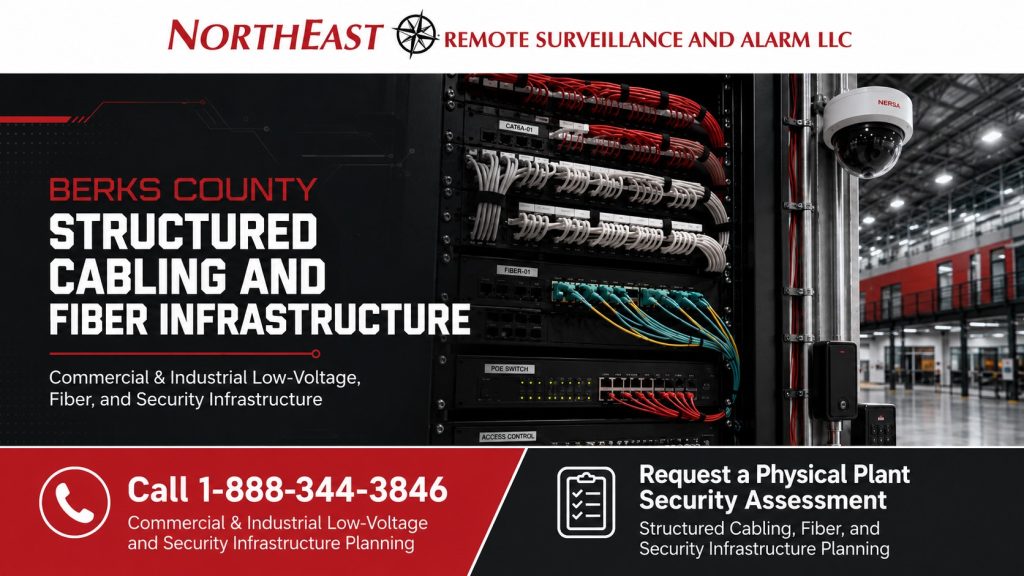
Plan cabling for cameras, controlled doors, gates, wireless links, and future expansion.
Coordinate fire-alarm-related work where needed.
NERSA designs and installs low-voltage infrastructure for commercial and industrial properties across Reading and Berks County.
The Berks County security guide helps identify the building and yard systems that the cabling must support.
Boyertown Project Experience: Drug Plastics & Glass
The Drug Plastics & Glass Boyertown project included structured cabling and network cable certification using NERSA’s Fluke Versiv equipment, alongside surveillance and controlled-entry installation.
Structured Cabling and Fiber Infrastructure Planning for Berks County Facilities
Security systems depend on reliable cabling and communication infrastructure. Cameras, access control panels, alarm devices, intercoms, gate systems, fire alarm pathways, network switches, remote viewing, monitoring connections, and wireless bridges all need properly planned infrastructure to work reliably over time.
Plan low-voltage infrastructure around daily operations and future expansion. Map camera locations, door hardware, network rooms and equipment racks. Check distances between buildings, cable routes and ceiling conditions. Account for production and dock areas, parking lots and exterior gates.
Northeast Remote Surveillance and Alarm, LLC does not install single-family home systems. Our focus is commercial, industrial, municipal, institutional, healthcare, logistics, and enterprise environments where infrastructure planning, system reliability, documentation, and long-term support matter.
Why Security Systems Need Proper Cabling Infrastructure
Security systems are only as reliable as the infrastructure behind them. A high-quality camera, access control reader, gate intercom, alarm communicator, or monitoring connection can still perform poorly if the cabling, network path, power, or equipment location is not planned correctly.
Structured cabling and fiber infrastructure may support:
- IP security cameras
- Access control doors
- Intercom systems
- Gate access control
- Intrusion alarm devices
- Fire alarm communication pathways
- Network closets
- PoE switches
- Wireless bridge locations
- Remote viewing
- Monitoring connections
- Multi-building system expansion
- Equipment racks and enclosures
- Parking lot and exterior camera coverage
- Truck yard and gate connectivity
The goal is not just to pull wire. The goal is to build a reliable pathway for the security systems the property depends on.
CAT6 and CAT6A Cabling for Commercial Security Systems
CAT6 and CAT6A cabling may be used for IP cameras, access control panels, intercoms, network equipment, workstations, wireless access points, and other low-voltage systems. The right cabling design depends on distance, bandwidth needs, equipment location, pathway conditions, and future expansion.
For security systems, cable routing should be planned around camera locations, door controllers, equipment rooms, ceiling access, conduit paths, building construction, and serviceability. Poor cable placement can make future troubleshooting, expansion, or replacement more difficult.
A proper installation should include clean routing, labeling, termination, testing, documentation, and organization so the system can be supported after the initial installation.
Fiber Infrastructure for Multi-Building and Long-Distance Security Systems
Fiber is often needed when facilities have long cable distances, multiple buildings, separate warehouses, remote gate areas, large industrial sites, parking lot camera poles, or network extension needs beyond standard copper cabling limits.
Fiber infrastructure can help connect buildings, network closets, camera locations, gate systems, remote equipment areas, and security system head-end locations. It may also support better performance when large numbers of cameras or remote security devices need reliable communication.
Fiber planning should account for pathway distance, conduit availability, equipment locations, switch placement, protection, termination, labeling, future strands, and long-term maintenance.
Cabling for Commercial Video Surveillance Systems
Commercial video surveillance systems require reliable network and power planning. IP cameras may need CAT6, fiber, PoE switching, network closets, surge protection, exterior-rated pathways, pole infrastructure, wireless bridge links, and proper equipment placement.
Camera cabling should be planned around usable coverage, not just the easiest place to run wire. Parking lots, docks, truck yards, warehouse aisles, production areas, building entrances, gates, and exterior approaches may all require different infrastructure planning.
For broader camera system planning, use the Berks County Commercial Video Surveillance Systems page.
Cabling for Access Control Doors and Controlled Areas
Access control systems often require cabling for card readers, keypads, door contacts, request-to-exit devices, electrified locks, power supplies, controllers, intercoms, and network connections. Each door should be planned around the hardware, door type, wall construction, pathway, power requirements, and egress considerations.
Access control cabling should be organized so the system can be serviced, expanded, and documented properly. Employee entrances, restricted rooms, office doors, warehouse doors, production areas, utility spaces, and multi-building access points may all require different infrastructure planning.
For broader door access planning, use the Berks County Commercial Access Control Systems page.
Cabling and Pathways for Fire Alarm Coordination
Commercial fire alarm systems may require dedicated wiring pathways, monitoring connections, notification circuits, detection circuits, communicator paths, and coordination with building layout, occupancy, and local Authority Having Jurisdiction expectations.
Security infrastructure planning should not interfere with life-safety requirements. When access control, fire alarm, emergency egress, door hardware, monitoring, or building expansion are involved, cabling and system pathways should be coordinated carefully.
For fire alarm installation and life-safety planning in Berks County, use the Berks County Commercial Fire Alarm Systems page.
Network Closets, Equipment Rooms, and Security Head-End Planning
A clean equipment room or network closet can make a major difference in the long-term reliability of a security system. Cameras, access control panels, alarm modules, network switches, recording equipment, fiber terminations, patch panels, power supplies, UPS units, and monitoring equipment should be organized for serviceability.
Poorly organized equipment creates troubleshooting problems, limits expansion, and makes future upgrades harder. A proper infrastructure plan should account for equipment location, ventilation, power, labeling, rack space, patching, network separation, and service access.
The goal is a system that can be maintained years after installation, not a temporary collection of devices and wires.
PoE Switching, Network Paths, and Remote Viewing
Many commercial security systems rely on PoE switches, network connections, recorders, cloud-connected devices, remote access, and monitoring pathways. These systems should be planned so cameras, access control, intercoms, gates, and remote monitoring tools have stable connectivity.
Network infrastructure should account for camera count, bandwidth, cable distance, switch capacity, equipment locations, uplinks, remote viewing needs, and future expansion. A system that works on day one may still fail later if the network was not designed with growth in mind.
Remote viewing and monitoring also depend on reliable internet service, secure access, proper permissions, and stable connections between the field devices and the equipment room.
Cabling for Parking Lots, Gates, and Exterior Security Areas
Exterior security areas often need special infrastructure planning. Parking lot cameras, gate access systems, intercoms, license plate recognition cameras, truck yard cameras, trailer yard monitoring, and exterior wireless links may be located far from the main building.
These areas may require conduit, fiber, CAT6, weather-rated enclosures, surge protection, pole-mounted equipment, wireless bridges, power coordination, and careful pathway planning.
For properties with controlled vehicle entrances, use the Berks County Commercial Gate Access Control Systems page.
Wireless Bridges and Network Extension
Some properties cannot easily be connected with standard cabling because of distance, pavement, building separation, property layout, or trenching limitations. In those cases, properly designed wireless bridges may help connect remote cameras, gates, buildings, yards, or exterior equipment.
Wireless bridge planning should account for line of sight, distance, mounting height, power, weather exposure, interference, bandwidth, and the importance of the security device being connected.
Wireless bridges can be useful, but they should not be treated as a casual shortcut. They should be planned and tested as part of the overall security infrastructure.
Infrastructure for Warehouses and Manufacturing Facilities
Warehouses and manufacturing facilities often require more infrastructure planning than standard commercial offices. Large open spaces, high ceilings, long cable paths, production equipment, loading docks, storage areas, racking, forklift movement, multiple shifts, and future expansion all affect cabling design.
Cameras, access control, alarms, fire alarm pathways, intercoms, and network equipment should be planned around the facility layout and the way people, materials, vehicles, and equipment move through the building.
For manufacturing-specific security planning, use the Berks County Manufacturing Facility Security Systems page.
Infrastructure for Truck Yards and Logistics Properties
Truck yards, trailer lots, distribution centers, and logistics properties often need security infrastructure that extends outside the main building. Cameras, gates, intercoms, license plate recognition, remote monitoring, and yard visibility may all require network extension and reliable cabling pathways.
These systems should be planned around vehicle movement, yard layout, exterior lighting, gate locations, camera poles, trailer staging, and after-hours exposure.
For yard and trailer-focused security planning, use the Berks County Truck Yard and Trailer Security Systems page.
Testing, Labeling, and Documentation
Structured cabling should be documented so the system can be serviced and expanded later. Labels, test results, cable routes, patch panel organization, network closet layouts, device locations, and system drawings can all make future troubleshooting easier.
A properly documented installation helps facility managers, IT teams, security providers, and service technicians understand how the system is connected. It also reduces confusion when cameras are added, doors are upgraded, network equipment is replaced, or a system is expanded.
Documentation is part of the infrastructure, not an afterthought.
Upgrading Existing Cabling and Security
Many Berks County facilities already have cabling, but the infrastructure may no longer match the security system. Common issues include unlabeled wires, overloaded network switches, damaged cable, poor terminations, outdated pathways, limited rack space, weak wireless links, missing fiber, or cable routes that cannot support future expansion.
An upgrade may include new CAT6 or CAT6A cabling, fiber installation, rack cleanup, patch panel organization, switch upgrades, network closet improvements, wireless bridge installation, conduit planning, camera pathway improvements, or better equipment-room organization.
The best upgrade is not always more cable. The best upgrade is a reliable infrastructure plan that supports the systems the facility actually needs.
Request a Berks County Structured Cabling Assessment
NERSA can evaluate cabling and connectivity at your Berks County facility. We review fiber, network extensions, camera and access-control wiring, gate connections, wireless bridges, PoE switching, and equipment-room organization. Planning can also account for future security expansion.
Request a Physical Plant Security Assessment to discuss structured cabling and fiber infrastructure in Berks County, PA.
Frequently Asked Questions About Berks County Structured Cabling and Fiber Infrastructure
What is structured cabling for security systems?
Structured cabling for security systems is the planned low-voltage infrastructure that connects cameras, access control, intercoms, alarms, gates, network switches, recorders, monitoring equipment, and other security devices.
Do commercial security systems need CAT6 or CAT6A cabling?
Many IP cameras, access control systems, intercoms, and network-connected security devices use CAT6 or CAT6A cabling. The right cabling depends on distance, bandwidth, equipment requirements, building layout, and future expansion needs.
When is fiber needed for a security system?
Fiber may be needed for long cable distances, multi-building properties, remote camera locations, parking lot camera poles, gate systems, large warehouses, industrial sites, or areas where copper cabling is not practical.
Can structured cabling support security cameras?
Yes. IP camera systems often rely on structured cabling, PoE switching, network pathways, equipment rooms, and recording infrastructure. The cabling should be planned around camera placement and review needs.
Can structured cabling support access control?
Yes. Access control systems may require wiring for readers, keypads, door contacts, request-to-exit devices, electrified locks, controllers, power supplies, and network connections.
Can fiber connect multiple buildings?
Yes. Fiber is commonly used to connect multiple buildings, network closets, remote equipment locations, and security systems across larger commercial or industrial properties.
Can wireless bridges be used instead of trenching?
In some cases, yes. Wireless bridges may help connect remote cameras, gates, buildings, or exterior security devices when trenching or new cabling is not practical. They should be planned around line of sight, bandwidth, distance, and reliability.
Why does labeling and documentation matter?
Labeling and documentation make it easier to troubleshoot, service, expand, and upgrade the system. Without good documentation, future service work can take longer and become more expensive.
Can existing cabling be reused?
Sometimes. Existing cabling should be inspected and tested before reuse. Damaged, unlabeled, outdated, poorly terminated, or unsupported cabling may need to be replaced or upgraded.
How do we start a structured cabling project in Berks County?
Start with a site assessment. Northeast Remote Surveillance and Alarm, LLC can review the building layout, security system needs, cable pathways, equipment rooms, network infrastructure, fiber requirements, exterior areas, and expansion goals.
Plan Your Next Security Improvement
Tell NERSA about your commercial facility, existing systems, and project priorities. We can help you plan an installation, evaluate an upgrade, or coordinate security across multiple locations.
Compliance, Codes & Project Standards
NERSA plans commercial and industrial security work with applicable code, documentation, inspection and authority-having-jurisdiction requirements in mind. Requirements vary by system, property and jurisdiction. These resources support project planning; they do not establish legal compliance, certification or AHJ approval.
Related guidance: Regulatory compliance & inspection readiness · Low-voltage infrastructure compliance · NEC & low-voltage wiring