
Berks County industrial security should follow the movement of people, goods, and vehicles through your site.

Request a physical-plant security assessment
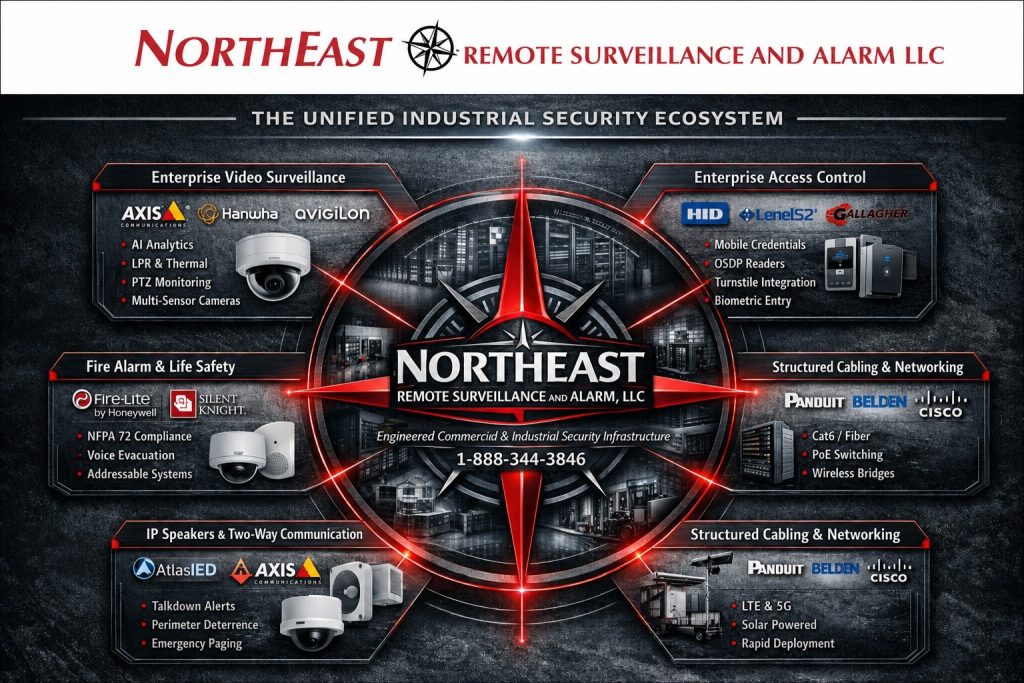
Northeast Remote Surveillance and Alarm, LLC (NERSA) plans systems for warehouses, plants, freight sites, and properties with several buildings.
First, identify the areas that need better views, controlled entry, or after-hours response. Then use these guides to plan a focused upgrade or a larger project.
Choose a Facility Guide
A busy plant and a storage building can need very different controls.
For example, a plant may run several shifts while a warehouse closes each evening.
Choose the facility guide that matches your operating schedule and the routes used by people and goods.
- Warehouses and fulfillment operations — Review security around inventory, staff access and warehouse activity.
- Manufacturing facilities — Coordinate protection around production areas and controlled spaces.
- Distribution centers and freight operations — Plan coverage for freight transfers, docks and vehicle movement.
- Cold-storage and food-processing facilities — Consider security needs in temperature-controlled and food-processing environments.
- Industrial parks — Find guidance for individual industrial parks in the Greater Reading area.
- Multi-building properties — Coordinate access, cameras and administration across separate buildings.
Berks County Industrial Security Services
Next, define what each system must do.
Cameras need a useful view of the event you want to review.
Controlled doors need clear access rules, while alarms need an agreed response.
For broader commercial sites, start with Greater Reading commercial security systems.
Choose the service guide for the visibility, controlled-entry, detection, monitoring, or infrastructure function your project needs.
- Video surveillance — Define the views and recorded evidence needed at the property.
- Access control — Plan controlled openings, user permissions and credential management.
- Commercial intrusion alarms — Review intrusion detection and alarm-response requirements.
- Fire alarm and life-safety systems — Coordinate fire alarm work with the property’s life-safety requirements.
- Remote video monitoring — Define which camera events need operator review and response.
- Infrastructure and cabling — Check the power and communications needed to connect security equipment.
- Berks County Commercial Access Control Systems — Review local planning for controlled doors and access administration.
Protect Docks, Yards, and Vehicle Routes
First, look at where trucks stop, drivers check in, and staff cross vehicle routes. Then check the view during real site activity. Parked trailers, glare, and changing light can affect the detail a camera captures.
For example, a broad yard view may show movement but lack clear plate detail. A focused view needs a suitable approach and tested lighting. Also plan how staff approve gate entry and handle arrivals outside normal hours.
Use these guides to examine the dock, yard, gate, vehicle-identification, or parking area that needs attention.
- Loading-dock security — Document activity where goods move between trailers and the building.
- Truck-yard and trailer security — Review outdoor coverage and after-hours activity around parked equipment.
- Gate access control — Plan how employees, visitors and delivery vehicles receive entry.
- License-plate capture — Assess vehicle-documentation needs at defined entry and exit points.
- Parking-lot cameras — Review camera views for parking areas and pedestrian routes.
Review Existing Systems and Plan Growth
Existing equipment may still be useful. First, check ownership, authorized account access, condition, and available support. Then test coverage and connections before choosing what to retain, repair, or replace.
For larger sites, plan room for extra cameras, doors, users, and buildings. Also set clear names and access rules so staff can manage the system as it grows. Phase installation around shifts, shipping, and approved downtime.
Use the assessment checklist to define priorities and the upgrade guide to compare practical changes to existing systems.
- Security upgrades, retrofits, and takeovers — Assess existing equipment before deciding what to retain or replace.
- Berks County industrial assessment checklist — Prepare the site information needed for an informed system review.
Test the Finished System With Staff
Finally, test the functions people will use each day. Review camera views, entry schedules, event records, and agreed response steps. Then provide clear operating instructions, equipment names, account responsibilities, and support contacts.
Berks County industrial security works best when the site team understands both the equipment and the procedures behind it. Keep the records current as staff, shifts, and building uses change.
Request an Industrial Security Assessment
Tell us how the property operates, what is not working, and what needs to improve. NERSA can review a focused service need or a phased project across several buildings.
Request a physical-plant security assessment.
Compliance, Codes & Project Standards
NERSA plans commercial and industrial security work with applicable code, documentation, inspection and authority-having-jurisdiction requirements in mind. Requirements vary by system, property and jurisdiction. These resources support project planning; they do not establish legal compliance, certification or AHJ approval.
Related guidance: Regulatory compliance & inspection readiness · Warehouse & logistics compliance · NERSA project standards