
Plan gate access around who arrives, where they enter, and when access is allowed.

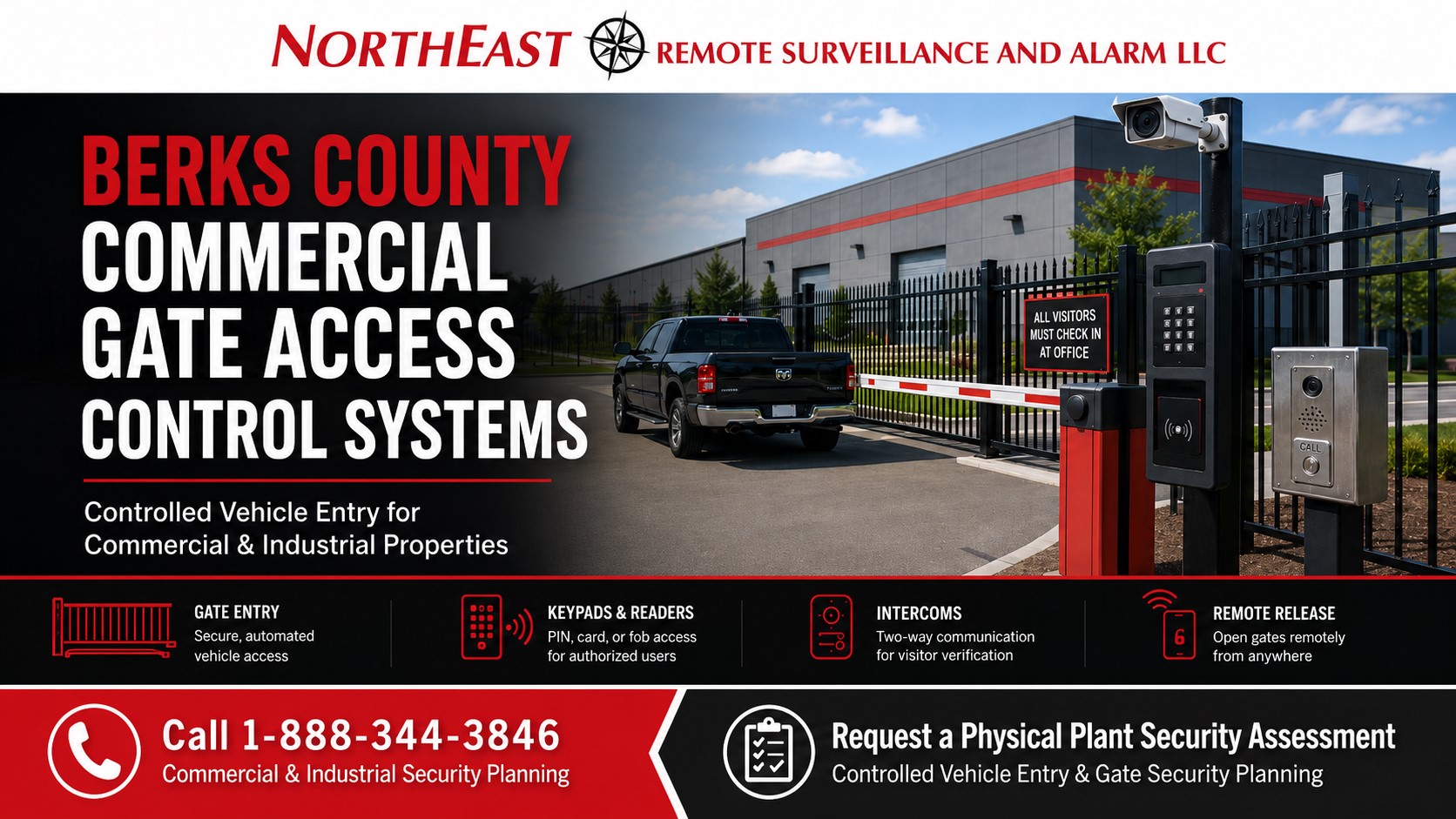
Include deliveries, employee parking, visitors, and after-hours use.
NERSA designs and installs gate access control for commercial and industrial sites across Reading and Berks County.
For related building and yard security decisions, see the Berks County security guide.
Planning Commercial Gate Access
Plan gate access around the people and vehicles entering the property. Define who can enter, at what times and how deliveries are approved. Set a separate process for arrivals when the site is closed or lightly staffed.
Gate access control can support industrial properties, warehouses, logistics facilities, fenced lots, employee parking areas, service entrances, contractor yards, fleet areas, schools, municipal sites, healthcare properties, and multi-building commercial properties.
Northeast Remote Surveillance and Alarm, LLC does not install single-family home systems. Our focus is commercial, industrial, municipal, institutional, healthcare, logistics, and enterprise environments where system design, infrastructure, controlled access, and long-term support matter.
Where Commercial Gate Access Control Makes Sense
Gate access control is most useful where a property needs better control over vehicle movement or perimeter entry. A gate system may help manage employees, vendors, delivery drivers, contractors, visitors, service vehicles, emergency access, and after-hours activity.
Common commercial gate access control locations include:
- Main vehicle entrances
- Employee parking entrances
- Visitor parking entrances
- Delivery gates
- Truck yard entrances
- Trailer yard gates
- Fleet parking areas
- Contractor yard entrances
- Service gates
- Municipal facility entrances
- Healthcare campus service access points
- School or institutional vehicle entrances
- Fenced industrial property entrances
- After-hours controlled access points
The system should be designed around the actual flow of vehicles, people, deliveries, staff, and site operations instead of relying on a generic gate package.
Gate Readers, Keypads, Credentials, and Intercoms
Commercial gate access control may include card readers, key fobs, mobile credentials, keypads, intercoms, telephone entry, remote release, vehicle credentials, and controlled access schedules. The right setup depends on the property type, gate location, user groups, traffic volume, and how entry needs to be managed.
A trucking yard needs a different entry process from a healthcare campus or office. Plan employee, visitor and vendor access separately. Define after-hours rules so the gate supports daily work while controlling entry.
Gate access should also be easy for authorized users to manage. Credentials, schedules, user permissions, and access records should be organized so the property can maintain control as employees, vendors, tenants, or operating needs change.
Coordinate Gates and Building Entry
Gate access control should often be planned with the building’s broader access control system. A property may need one system to manage doors, gates, employee entrances, restricted areas, parking access, and audit trails.
A connected access control design can help management review who entered the building, who entered the property, when access was granted, and which areas were involved in an event.
For broader access control planning across doors, credentials, readers, controllers, and permissions, use the Berks County Commercial Access Control Systems page.
Vehicle Entrances, Delivery Lanes, and Truck Access
Commercial gate systems must account for the type of vehicles using the entrance. Passenger vehicles, box trucks, tractor trailers, delivery vans, service vehicles, emergency vehicles, and fleet vehicles may all require different planning.
Before installation, review the gate location, lane width, vehicle turning space, and room for vehicles to queue. Check reader and keypad height, call box and intercom placement, and safety devices. An entrance designed for employee cars may not suit trucks or deliveries.
For properties with frequent truck traffic, trailer staging, fleet parking, or yard activity, gate access should be designed around the way vehicles actually approach, stop, enter, and leave.
Gate Cameras and Video Verification
Gate access control is stronger when it is supported by useful camera coverage. Cameras can help document which vehicle approached the gate, who used the intercom, when the gate opened, what direction the vehicle traveled, and whether an access event matched the activity on site.
Gate camera coverage may include overview cameras, vehicle approach cameras, intercom-area views, exit-lane cameras, and targeted views for vehicle documentation. Camera placement should account for lighting, distance, glare, mounting height, weather exposure, and the direction of vehicle movement.
A gate access control system should not depend on access logs alone when video review is needed.
License Plate Recognition at Controlled Entrances
Some Berks County properties need more than a camera showing that a vehicle entered. License plate recognition can support vehicle documentation at gate entrances, exit lanes, fleet areas, delivery lanes, and controlled access points.
LPR planning depends on vehicle speed, lane position, lighting, camera angle, mounting height, distance, and whether the goal is to document entrances, exits, after-hours movement, employee vehicles, visitor vehicles, or delivery traffic.
For dedicated plate capture and searchable vehicle review, use the Berks County License Plate Recognition Camera Systems page.
Gate Access for Truck Yards, Trailer Areas, and Industrial Sites
Truck yards, trailer lots, contractor yards, fleet areas, and industrial properties often need gate access control because exterior areas may contain vehicles, trailers, tools, equipment, materials, or inventory that should not be freely accessible.
Gate access may help manage who can enter the yard, when access is allowed, which vehicles are using the site, and how after-hours movement is documented. These properties may also need cameras, license plate recognition, intrusion detection, lighting coordination, and remote monitoring workflows.
For yard and trailer-focused planning, use the Berks County Truck Yard and Trailer Security Systems page.
Employee Parking and Controlled Vehicle Areas
Employee parking areas, staff-only lots, gated parking, visitor lots, and shared commercial parking areas may require controlled entry. Gate access control can help limit access to authorized employees, vendors, tenants, administrators, or approved vehicles.
The system should account for shift changes, visitor arrival, employee turnover, delivery access, after-hours entry, and emergency access. Parking access should be easy to manage while still supporting a clear record of activity.
Gate access control should be planned with parking lot camera coverage when vehicle incidents, after-hours activity, or entrance visibility are important to the property.
After-Hours Gate Access and Remote Release
Many gate access issues happen after normal business hours. A delivery driver may need access after closing, a service provider may arrive early, an employee may need weekend access, or a manager may need to release a gate remotely.
Commercial gate access control can support controlled after-hours entry through schedules, credentials, intercom calls, remote release, camera review, and event history. The goal is to make after-hours access more controlled and easier to review.
The system should be designed so the property is not relying only on unlocked gates, shared codes, or informal access practices that become difficult to manage over time.
Access Logs, User Management, and Accountability
Gate access control can help create a record of who entered the property and when access was granted. That record may support internal review, vendor accountability, employee access management, delivery verification, and after-hours investigation.
User management should be planned carefully. Shared codes, unmanaged credentials, inactive users, and poor access schedules can weaken the value of the system. A proper setup should allow the business to add users, remove users, update permissions, and review gate activity when needed.
The system should support the property’s real operations without becoming difficult to maintain.
Cabling, Power, and Communications
Gate systems need reliable power and communications. Depending on the site, connections may use low-voltage cabling, a network link, wireless bridges, or cellular service. Plan equipment enclosures, surge protection, safety devices, intercom wiring, and access control panels. Coordinate these connections with the gate operator.
Gate locations are often exposed to weather, distance, vehicles, lightning, temperature swings, and physical impact. Infrastructure planning should account for long-term serviceability and expansion.
For security cabling, network extension, and fiber planning, use the Berks County Structured Cabling and Fiber Infrastructure page.
Gate Safety and Operational Coordination
Gate access control should be coordinated with gate operator safety devices, emergency access needs, fire department access requirements, vehicle detection, loop detectors, photo eyes, edge sensors, signage, and safe traffic flow.
A gate system should not create unsafe vehicle movement or block emergency access. The security plan should support controlled entry while still allowing the property to operate safely and responsibly.
When fire alarm systems, emergency access, life-safety requirements, or local review are involved, the gate access plan should be coordinated before installation.
Remote Monitoring for Gate Activity
Some properties need stronger awareness around gate activity after hours. Remote video monitoring may help support event review when vehicles approach gates, enter restricted areas, move through parking lots, or access yards after normal business hours.
Remote monitoring may be useful for industrial properties, warehouses, truck yards, trailer areas, fenced lots, exterior storage areas, and facilities that do not want every gate event going only to an owner’s phone.
For active off-site event review and after-hours monitoring planning, use the Berks County Remote Video Monitoring page.
Upgrading an Existing Installation
Many Berks County properties already have gates, but the access control setup may no longer fit the property’s needs. Common issues include shared codes, unreliable intercoms, poor camera views, weak remote release, no access logs, outdated readers, limited user management, no license plate view, or poor after-hours review.
An upgrade may include new readers, mobile credentials, better keypads, intercom replacement, camera integration, remote release, improved user permissions, license plate recognition, access schedules, or better network connectivity.
The best upgrade is not always a new gate. The best upgrade is a controlled entry system that matches the property’s vehicle flow, users, risk, schedule, and review needs.
Request a Berks County Gate Access Control Assessment
NERSA can review vehicle access at your Berks County property, including employee parking and delivery gates. Options may include intercoms, keypads, card readers, remote release, and license plate recognition. Gate cameras and after-hours activity review can support the overall entry plan.
Request a Physical Plant Security Assessment to discuss commercial gate access control systems in Berks County, PA.
Frequently Asked Questions
What is a commercial gate access control system?
A commercial gate access control system helps manage vehicle entry at gated entrances, employee parking lots, delivery gates, service entrances, truck yards, fenced properties, and controlled access points using readers, keypads, intercoms, credentials, remote release, and access permissions.
What types of properties need gate access control?
Warehouses, manufacturing facilities, distribution centers, truck yards, contractor yards, municipal sites, healthcare campuses, schools, office properties, fleet areas, and multi-building commercial properties may need gate access control when vehicle entry must be managed.
Can employees use their existing credentials?
Yes. Gate access can often use card readers, key fobs, mobile credentials, or other approved credentials so employees can access controlled areas based on schedules and permissions.
Can a gate system include an intercom?
Yes. Gate systems may include intercoms, telephone entry, video intercoms, remote release, call routing, and visitor communication depending on the property’s needs.
Should the entrance include security cameras?
In many commercial settings, yes. Cameras can help document vehicle approach, gate activity, intercom use, access events, and after-hours movement around the controlled entrance.
Can license plate recognition be used at a commercial gate?
Yes. License plate recognition may be used to support vehicle documentation at gate entrances, exits, delivery lanes, truck yards, employee parking areas, and controlled vehicle access points.
How can entry be managed after hours?
Use schedules, credentials, intercom calls, and remote release to manage entry after hours. Access records, camera review, and monitoring workflows can help staff review activity when the facility is closed or lightly staffed.
Can an existing gate be upgraded with access control?
Yes. Many existing gate systems can be upgraded with readers, keypads, intercoms, cameras, remote release, access control panels, user permissions, or license plate recognition depending on the gate operator and site infrastructure.
What network and cabling work is needed?
Often, yes. Gate systems may require low-voltage cabling, network connectivity, power coordination, wireless bridges, cellular communication, equipment enclosures, and connection to access control panels or monitoring systems.
How do we start a commercial gate access control project in Berks County?
Start with a site assessment. Northeast Remote Surveillance and Alarm, LLC can review the gate location, vehicle flow, user groups, delivery needs, parking access, intercom requirements, camera coverage, network infrastructure, and after-hours exposure.
Plan Your Next Security Improvement
Tell NERSA about your commercial facility, existing systems, and project priorities. We can help you plan an installation, evaluate an upgrade, or coordinate security across multiple locations.
Compliance, Codes & Project Standards
NERSA plans commercial and industrial security work with applicable code, documentation, inspection and authority-having-jurisdiction requirements in mind. Requirements vary by system, property and jurisdiction. These resources support project planning; they do not establish legal compliance, certification or AHJ approval.
Related guidance: Regulatory compliance & inspection readiness · Access control & door hardware standards · NFPA 101 & egress planning · ADA access-control planning