
Berks County truck yard and trailer security systems should be designed around vehicle movement, trailer staging, gated entrances, driver access, loading areas, exterior storage, after-hours activity, and the way each property actually operates.

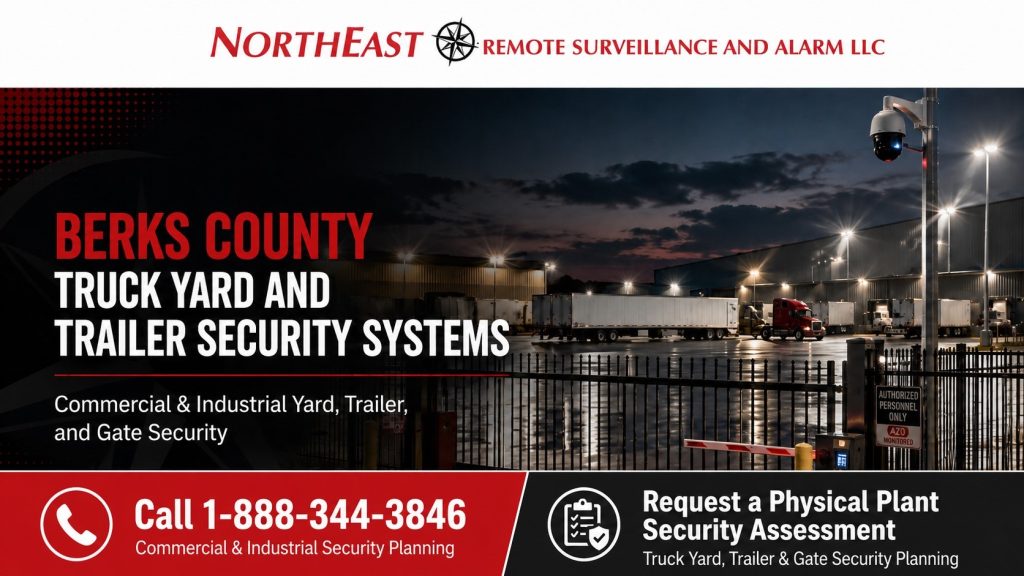
Northeast Remote Surveillance and Alarm, LLC designs and installs commercial and industrial security systems throughout Reading and Berks County.
We serve truck yards, trailer lots, logistics properties, warehouses and distribution centers.
Our scope also includes manufacturing facilities, contractor yards, fleet areas and multi-building sites.
If the truck yard serves warehouses or other industrial buildings, Berks County Industrial & Logistics Corridor Security Systems helps you coordinate their security with the yard’s entry and vehicle activity.
Berks County Truck Yard and Trailer Security Systems Planning
Truck yards and trailer areas create different security concerns than standard commercial parking lots. These areas often include tractor trailers, box trucks, delivery vehicles, fleet vehicles, service vehicles, parked trailers, exterior inventory, employee movement, driver activity, vendors, gates, fences, and after-hours exposure.
A proper truck yard security system should be built around how vehicles enter, where trailers sit, where drivers walk, how deliveries are handled, how gates are controlled, and which areas are most exposed when staff are not present.
Northeast Remote Surveillance and Alarm, LLC does not install single-family home systems. Our focus is commercial, industrial, municipal, institutional, logistics, healthcare, and enterprise environments where system design, infrastructure, site visibility, and long-term support matter.
Where Truck Yard Security Should Focus
Truck yard and trailer security should focus on the places where vehicles, freight, employees, vendors, and unauthorized activity are most likely to overlap.
Common truck yard security areas include:
- Main vehicle entrances
- Gate areas
- Trailer staging rows
- Truck courts
- Loading and receiving areas
- Fleet parking areas
- Delivery lanes
- Driver access points
- Fenced yard entrances
- Exterior storage areas
- Rear building approaches
- Side building approaches
- Employee parking near yard areas
- Service entrances
- After-hours approach points
The system should make it easier to understand what happened, where vehicle movement occurred, which trailer or area was involved, and whether the activity happened during normal operations or after hours.
Security Cameras for Truck Yards and Trailer Areas
Truck yard cameras should be designed for usable review, not just wide exterior visibility. A camera that sees the yard but cannot clearly show vehicle movement, trailer activity, gate activity, or after-hours approach points may not provide enough value when an incident needs to be reviewed.
Camera planning may include overview cameras for yard context, targeted cameras for gates and entrances, trailer-row coverage, dock-adjacent views, parking-area views, and cameras aimed at exterior storage or vulnerable approach points.
For broader camera system planning across Berks County commercial and industrial properties, use the Berks County Commercial Video Surveillance Systems page.
Gate Access Control for Truck Yards
Many truck yards and trailer areas need controlled vehicle entry. Gates, keypads, intercoms, card readers, remote release, vehicle credentials, and access schedules can help manage who enters the property and when.
Gate access control should be planned around truck traffic, employee access, delivery access, service vehicles, visitor access, after-hours entry, emergency access, lane width, reader placement, and vehicle turning movement.
For gate readers, keypads, intercoms, remote release, and controlled vehicle entry, use the Berks County Commercial Gate Access Control Systems page.
License Plate Recognition and Vehicle Documentation
Truck yards often need better vehicle documentation than a standard exterior camera can provide. License plate recognition may help document vehicles entering or exiting the property, using a gate, entering a yard, moving through a controlled lane, or accessing a trailer area after hours.
LPR planning depends on vehicle speed, lane position, camera angle, lighting, mounting height, distance, and whether the system is designed to document entrances, exits, gate events, delivery traffic, or after-hours vehicle movement.
For dedicated plate capture and searchable vehicle review, use the Berks County License Plate Recognition Camera Systems page.
Trailer Staging and Yard Visibility
Trailer staging areas can create security gaps when they are not clearly visible from the building or main office. Parked trailers, empty trailers, loaded trailers, drop lots, fenced storage, and overnight yard activity should be reviewed as part of the security plan.
Camera coverage should help document which vehicles entered the area, where trailers were parked, whether trailer doors were accessed, and what activity occurred around the yard before or after an incident.
A strong layout may combine yard overview cameras, targeted trailer-row views, gate cameras, license plate views, lighting coordination, intrusion detection, and remote monitoring workflows.
Loading Dock and Truck Court Coverage
Truck yards are often connected to loading docks, receiving areas, shipping lanes, and truck courts. These areas should be planned together because vehicle activity, trailer movement, dock activity, and freight movement often overlap.
Dock and truck-court cameras can document when trailers arrive, are loaded, and leave. They can also help identify who moved through the area. Those views support review of delivery disputes, claims, missing products, and after-hours events.
A truck yard security plan should support both exterior vehicle review and dock-adjacent activity review.
Parking Areas, Fleet Lots, and Exterior Vehicle Storage
Truck yards often include more than trailers. Many Berks County properties also have fleet vehicles, employee parking, visitor parking, service vehicles, company trucks, equipment storage, and exterior inventory near the yard.
These areas may need dedicated camera coverage, lighting review, controlled access, and remote viewing. Vehicle incidents, after-hours movement, unauthorized parking, vandalism, and access concerns are easier to review when the camera system is planned around the actual lot layout.
For parking-area visibility and exterior incident review, use the Berks County Parking Lot Security Cameras page.
After-Hours Truck Yard Security
Truck yards and trailer areas often become more exposed when the property is closed, lightly staffed, or operating with limited overnight supervision. Gates, trailer rows, exterior storage, rear approaches, loading areas, and side entrances may become more vulnerable during nights, weekends, holidays, and shift changes.
After-hours truck yard security may include recorded video, analytic alerts, gate activity review, intrusion detection, license plate recognition, remote viewing, and remote video monitoring depending on the site’s risk level.
The system should be designed so the business is not relying only on discovering a problem the next morning.
Remote Video Monitoring for Truck Yards
Some truck yards need active after-hours event review. Remote video monitoring can support visibility around gates, trailer areas, truck courts, loading areas, parking lots, exterior storage, and vehicle approach points when staff are not present.
A remote monitoring plan should be built around camera coverage, lighting, event rules, schedules, nuisance activity, response expectations, and the areas where unauthorized activity is most likely to occur.
For active off-site event review and after-hours monitoring design, use the Berks County Remote Video Monitoring page.
Intrusion Detection and Alarm Support
Truck yard security may also involve intrusion alarm planning for buildings, gates, yard entrances, overhead doors, warehouse spaces, shipping offices, restricted rooms, and exterior access points.
Alarm events are stronger when they can be reviewed with camera coverage. Video verification can help connect alarm activity with visual context so management can better understand whether an event appears to involve a person, vehicle, employee, vendor, delivery activity, or unauthorized movement.
The right alarm design depends on the facility layout, operating hours, yard exposure, and how the business wants events reviewed.
Lighting, Camera Angles, and Blind Spot Reduction
Truck yards can be difficult to cover because vehicles, trailers, fences, buildings, stacked materials, changing parking patterns, and lighting conditions can block camera views. A camera that works during the day may not provide enough review value at night.
A proper site assessment should review lighting, mounting height, camera distance, glare, shadows, weather exposure, trailer placement, gate location, and vehicle flow. Blind spots should be identified before equipment is installed.
The goal is not to cover everything with one wide view. The goal is to create useful views of the areas where activity matters most.
Network, Cabling, and Yard Infrastructure
Truck yard security systems depend on reliable infrastructure. Cameras, gate access control, intercoms, license plate recognition, remote monitoring, wireless bridges, fiber links, access panels, and network switches all require properly planned communication pathways.
Yard areas may be far from the main building, exposed to weather, or difficult to cable without planning. Infrastructure may include CAT6, CAT6A, fiber, wireless bridges, equipment enclosures, surge protection, PoE switching, and network extension.
For security cabling, fiber, and network planning, use the Berks County Structured Cabling and Fiber Infrastructure page.
Upgrading Existing Truck Yard Security Systems
Many Berks County properties already have cameras, gates, locks, or alarms, but the system may not be designed around truck yard risk. Common issues include weak gate visibility, poor trailer-row coverage, no license plate views, limited night footage, shared gate codes, unreliable intercoms, blind spots, and no clear monitoring workflow.
An upgrade may include repositioning cameras, adding targeted gate views, improving lighting coordination, adding LPR, upgrading gate access control, increasing recording retention, improving remote access, or creating a stronger after-hours monitoring process.
The best upgrade is not always more equipment. The best upgrade is a system that matches the property’s vehicle movement, yard layout, operating hours, and review needs.
Request a Berks County Truck Yard Security Assessment
NERSA can evaluate your Berks County truck yard and help plan appropriate improvements. Tell us about trailer coverage, gate access, license plate recognition, fleet parking, and dock visibility. We can also review after-hours monitoring and remote viewing.
Request a Physical Plant Security Assessment to discuss truck yard and trailer security systems in Berks County, PA.
Frequently Asked Questions About Berks County Truck Yard and Trailer Security Systems
What is a truck yard security system?
A truck yard security system brings together cameras, gate controls, and vehicle documentation. Depending on the site, it may include license plate recognition, alarms, lighting coordination, remote viewing, and monitoring procedures. These elements support security across trailer areas, fleet lots, delivery lanes, and other exterior vehicle spaces.
What areas should truck yard cameras cover?
Truck yard cameras should commonly cover gate entrances, exit lanes, trailer staging areas, truck courts, loading areas, delivery lanes, fleet parking, exterior storage, fenced areas, side approaches, rear approaches, and after-hours activity points.
Are truck yard cameras different from parking lot cameras?
Yes. Truck yard cameras must account for larger vehicles, trailer rows, gate movement, delivery traffic, wide exterior areas, changing vehicle positions, and after-hours yard exposure. Parking lot cameras usually focus more on employee, visitor, and general vehicle activity.
Should truck yards have gate access control?
In many cases, yes. Gate access control can help manage employee entry, delivery access, vendor access, visitor entry, after-hours access, and controlled vehicle movement into fenced or restricted yard areas.
Can license plate recognition help secure truck yards?
Yes. License plate recognition can help document vehicles entering or exiting the property, using a gate, moving through a controlled lane, or accessing a yard after hours. It should be planned around lane position, vehicle speed, lighting, and camera angle.
Can remote video monitoring help truck yards after hours?
Yes. Remote video monitoring can support after-hours event review around gates, trailer areas, truck courts, parking lots, exterior storage, and yard approaches when staff are not present.
Can an existing truck yard camera system be upgraded?
Yes. Existing systems can often be improved by repositioning cameras, adding gate views, adding license plate recognition, improving night visibility, expanding recording retention, improving remote access, or adding monitoring workflows.
Do truck yard security systems require cabling or network upgrades?
Often, yes. Truck yard cameras, gates, intercoms, LPR cameras, remote monitoring, and wireless bridges may require cabling, fiber, network extension, PoE switching, equipment enclosures, or improved connectivity.
Is truck yard security only for logistics companies?
No. Truck yard and trailer security can apply to warehouses, manufacturing facilities, contractor yards, distribution centers, fleet operations, municipal sites, service businesses, supply houses, and any property with exterior vehicle or trailer exposure.
How do we start a truck yard security project in Berks County?
Start with a site assessment. Northeast Remote Surveillance and Alarm, LLC can review the yard layout, gates, trailer areas, lighting, vehicle movement, camera locations, network infrastructure, after-hours exposure, and monitoring needs.
Plan Your Next Security Improvement
Tell NERSA about your commercial facility, existing systems, and project priorities. We can help you plan an installation, evaluate an upgrade, or coordinate security across multiple locations.
Compliance, Codes & Project Standards
NERSA plans commercial and industrial security work with applicable code, documentation, inspection and authority-having-jurisdiction requirements in mind. Requirements vary by system, property and jurisdiction. These resources support project planning; they do not establish legal compliance, certification or AHJ approval.
Related guidance: Regulatory compliance & inspection readiness · Warehouse & logistics compliance · NERSA project standards