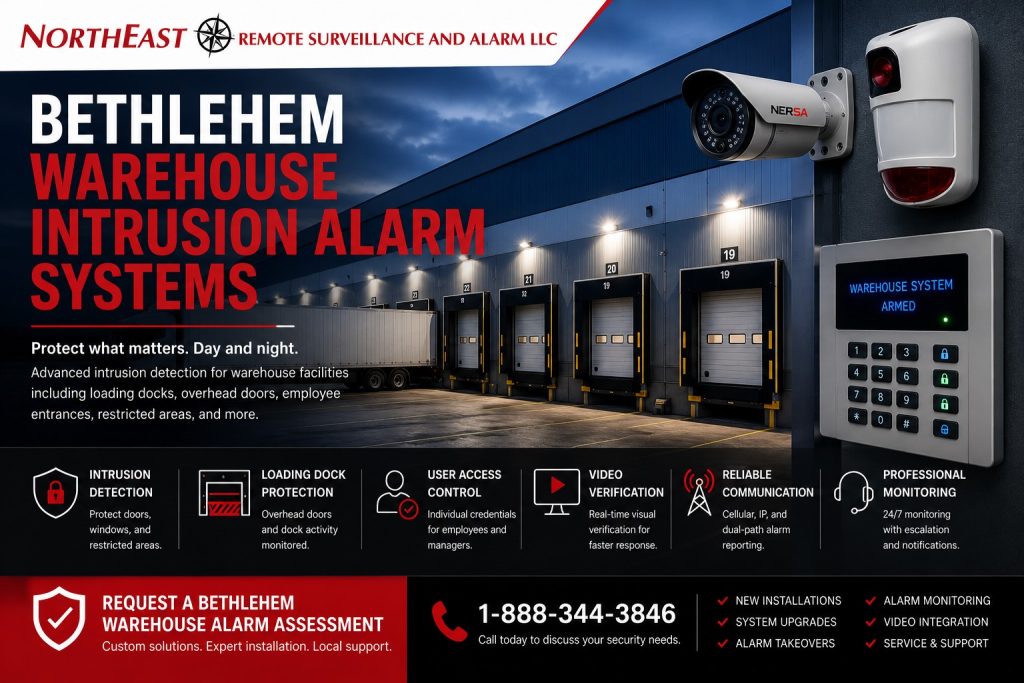
Commercial intrusion detection, overhead-door protection, alarm partitions, individual user control, professional monitoring, video verification, upgrades, and takeovers for Bethlehem warehouses and distribution facilities.
Bethlehem warehouse intrusion alarm systems should be designed around how employees, managers, drivers, contractors, cleaners, vendors, inventory, and freight move through the property.
A dependable warehouse alarm system requires more than a basic control panel and several motion detectors. The design should account for personnel doors, overhead doors, loading docks, shipping offices, restricted storage, roof access, warehouse interiors, operating schedules, employee credentials, alarm communication, monitoring procedures, and authorized after-hours activity.
Northeast Remote Surveillance and Alarm, LLC designs, installs, upgrades, takes over, monitors, and supports commercial intrusion alarm systems for Bethlehem warehouses, distribution facilities, logistics properties, mixed office-warehouse buildings, manufacturing-connected warehouses, industrial parks, and multi-building commercial sites.
This page focuses specifically on warehouse intrusion detection and monitored alarm response. For coordinated planning across cameras, access control, loading docks, truck yards, gates, fire alarm, monitoring, and infrastructure, visit Warehouse Security Systems in Bethlehem, PA.
For broader city planning, visit Commercial and Industrial Security Systems in Bethlehem, PA. NERSA’s Bethlehem and Lehigh Valley resources focus on non-residential commercial and industrial facilities and systems built around real operating conditions rather than residential-style alarm packages. (Northeast Remote Surveillance)
Project availability may depend on warehouse location, building layout, existing equipment, system compatibility, communication requirements, operating schedules, project scope, technical complexity, and long-term monitoring and support needs.
Request a Bethlehem Warehouse Alarm Assessment or call 1-888-344-3846 to discuss your facility. (Northeast Remote Surveillance)

Warehouse Alarm Planning Based on Real Operations
A warehouse should not be protected as if every part of the building opens and closes at the same time.
The property may include:
- Employee entrances
- Driver and visitor entrances
- Loading docks
- Overhead doors
- Shipping and receiving offices
- Warehouse interiors
- Inventory cages
- Tool and maintenance rooms
- IT and network rooms
- Office areas
- Roof hatches
- Detached buildings
- Truck courts
- Gates
- Exterior storage
- Multiple tenants or departments
Each area may require a different level of protection, arming schedule, user permission, alarm zone, or monitoring response.
A warehouse office may remain occupied while the main storage area is armed. Shipping employees may arrive before administrative staff. Drivers may approach the property during scheduled delivery windows. Cleaning or maintenance personnel may use only one part of the building after normal hours.
The alarm system should reflect those operating conditions without becoming unnecessarily difficult for employees to use.
What a Warehouse Intrusion Alarm System May Include
A Bethlehem warehouse alarm system may include:
- Commercial alarm control panels
- Keypads and arming stations
- Exterior-door contacts
- Heavy-duty overhead-door contacts
- Window contacts
- Motion detectors
- Glass-break detection where appropriate
- Roof-hatch protection
- Gate or detached-building contacts
- Panic or duress devices
- Local sirens and annunciation
- Individual employee credentials
- Temporary contractor credentials
- Alarm partitions
- Arming and disarming schedules
- Opening and closing reporting
- Late-to-open or late-to-close alerts
- Cellular communication
- Internet Protocol communication
- Dual-path communication
- Professional monitoring
- Video-supported alarm verification
- Access-control coordination
- Backup batteries
- System-health supervision
- Selected environmental inputs
The device list should follow the design rather than replace it.
Sensor type and placement should reflect the opening, room size, ceiling height, construction, warehouse activity, temperature variation, air movement, machinery, racking, and expected after-hours conditions.
Loading-Dock and Overhead-Door Protection
Loading docks and overhead doors are among the most important alarm points in a warehouse.
These openings may be used by:
- Shipping and receiving employees
- Drivers
- Vendors
- Forklift operators
- Maintenance personnel
- Cleaning crews
- Early deliveries
- Late pickups
- After-hours managers
Alarm protection may include:
- Heavy-duty overhead-door contacts
- Individual dock-door zones
- Interior motion detection
- Shipping-office protection
- Scheduled arming
- Alarm partitions
- Camera-supported verification
- Access-control event coordination
- Professional monitoring
- Clearly documented response procedures
The system should help management determine:
- Which door opened
- When the opening occurred
- Whether the area was armed
- Whether the activity was authorized
- Which user controlled the system
- Whether nearby video is available
- Which response procedure applies
A single generic zone labeled “warehouse doors” provides limited value when a facility has ten, twenty, or more loading positions.
Descriptions such as “North Dock Door 7” or “Receiving Overhead Door 2” make monitoring, service, training, and incident review more useful.
Employee Entrances and After-Hours Access
Employee entrances may be active during several shifts even when the rest of the warehouse is closed.
Protection may include:
- Door-position contacts
- Interior motion detection
- User-specific alarm credentials
- Scheduled access
- Entry-delay programming
- Camera coverage
- Forced-door event coordination
- Opening and closing reports
- Monitoring instructions
Warehouse managers should understand:
- Which employees may disarm the system
- Which areas each user may control
- Whether credentials are shared
- What happens when someone enters outside an approved schedule
- How former employees are removed
- Who reviews opening and closing activity
Individual user credentials are generally preferable to one shared alarm code because they improve accountability and simplify employee changes.
Warehouse Alarm Partitions
Partitions allow separate portions of a warehouse to be armed and disarmed independently.
Partitions may be appropriate for:
- Administrative offices
- Warehouse storage areas
- Shipping and receiving
- Inventory cages
- Tool rooms
- IT rooms
- Tenant spaces
- Detached buildings
- Restricted storage
- Maintenance departments
- After-hours operating sections
For example:
- The office may remain occupied while the warehouse is armed.
- Shipping may open before the rest of the facility.
- A restricted inventory area may remain protected while employees work nearby.
- Separate tenants may control their own alarm areas.
- A detached maintenance building may operate independently from the main warehouse.
Partition design should remain understandable to everyday users.
An overly complicated system can create missed arming, false alarms, frustrated employees, and inconsistent use. The goal is practical control, not unnecessary complexity.
Interior Motion Detection
Interior motion detection provides another protection layer after an exterior opening is breached or unauthorized movement occurs in a protected area.
Potential motion-detector locations include:
- Warehouse transitions
- Main aisles
- Office corridors
- Shipping offices
- Restricted storage
- Tool rooms
- IT rooms
- Maintenance spaces
- Inventory areas
- Remote warehouse sections
Detector placement should account for:
- Ceiling height
- Racking
- Inventory changes
- Machinery
- Forklift movement
- Air movement
- Heating equipment
- Temperature variation
- Reflective surfaces
- Partitions
- Normal employee traffic
- Operating schedules
A motion detector should not be installed simply because a convenient wall or column is available.
Its detection pattern should match the area being protected and avoid predictable conditions that may cause nuisance alarms.
Restricted Storage, Tool Rooms, and IT Spaces
Some warehouse spaces need protection even when the larger building is occupied.
These may include:
- Inventory cages
- High-value storage
- Tool rooms
- IT and network rooms
- Records rooms
- Maintenance areas
- Returns departments
- Controlled stock rooms
- Customer-owned materials
- Sensitive equipment spaces
A restricted-area plan may combine:
- Door contacts
- Separate alarm zones
- Independent partitions
- Motion detection
- Individual user permissions
- Access-control records
- Camera coverage
- Alarm verification
- Management notification
Warehouse access control can also help manage employee entrances, shipping offices, inventory cages, IT rooms, and other restricted spaces while producing activity records tied to individual credentials. (Northeast Remote Surveillance)
For broader door and credential planning, visit Warehouse Access Control Systems for the Lehigh Valley and Mid-Atlantic.
Roof Hatches, Windows, and Secondary Openings
Warehouse intrusion risks are not limited to ground-level personnel doors.
Some buildings may require protection around:
- Roof hatches
- Office windows
- Vestibule glass
- Remote utility doors
- Mechanical rooms
- Detached storage buildings
- Shared tenant walls
- Secondary warehouse openings
The appropriate detection may include:
- Door or hatch contacts
- Glass-break detection
- Interior motion detection
- Vibration or shock detection where suitable
- Camera coverage
- Separate alarm zones
Glass-break and motion detectors should be selected according to the actual environment, including room dimensions, acoustics, machinery noise, curtains, ceiling height, air movement, and interior obstructions.
Alarm Communication Paths
A warehouse alarm system needs a dependable method for transmitting signals to the monitoring service.
Communication options may include:
- Cellular communication
- IP communication
- Dual-path cellular and IP communication
- Replacement of older telephone-line communication
Communication planning should review:
- Cellular signal strength
- Internet reliability
- Backup communication
- Equipment supervision
- Power failure
- Backup batteries
- Firewall and network requirements
- Alarm-panel compatibility
- Monitoring compatibility
- Communicator location
- Surge protection
- Long-term supportability
Businesses should understand:
- Where alarm signals are transmitted
- Whether the communication path is supervised
- Whether backup communication is available
- Who receives notifications
- Whether trouble conditions are reported
- Whether monitoring contacts are current
A communicator upgrade should be tested as part of the complete alarm system rather than treated as an isolated equipment replacement.
Professional Warehouse Alarm Monitoring
A dependable warehouse alarm requires more than field devices and communication equipment.
The facility also needs a documented event-response process.
Monitoring planning may address:
- Alarm-signal receipt
- Primary and backup contacts
- Call-list order
- Alarm verification
- Video-supported verification
- Panic or duress events
- Opening and closing reports
- Late-to-close events
- Communication failures
- System trouble
- Responsible-party notification
- Escalation procedures
- Event documentation
Mobile alerts to an owner or manager do not automatically replace professional monitoring.
Self-monitoring depends on whether the recipient sees the alert, understands the event, has access to supporting information, and can respond at that moment.
Professional monitoring can provide a more structured process for receiving, documenting, verifying, and escalating selected events.
For broader monitoring planning, visit Commercial and Industrial Security Monitoring.
Video Verification for Warehouse Alarm Events
An alarm signal may identify that a zone activated, but it may not explain what caused the event.
Nearby cameras may provide context around:
- An unauthorized person
- A driver
- An employee
- A contractor
- An unsecured overhead door
- A delivery
- Weather
- Equipment movement
- An accidental activation
- A confirmed intrusion
Video verification should support properly designed intrusion detection rather than replace contacts, motion detectors, panic devices, or other required alarm components.
Useful verification views may include:
- Employee entrances
- Loading docks
- Shipping offices
- Warehouse transitions
- Yard approaches
- Gates
- Exterior doors
- Restricted storage areas
The camera view should be useful under actual nighttime conditions and should not be blocked by parked trailers, racking, or equipment.
Coordination with Access Control
Intrusion alarms and access control perform different functions:
- The intrusion alarm detects protected conditions.
- Access control manages authorized entry.
- Video surveillance provides visual information.
Where compatible platforms support coordination, a warehouse may gain additional context around:
- Scheduled arming and disarming
- After-hours credential use
- Forced doors
- Held-open doors
- User identity
- Restricted-area activity
- Gate events
- Camera views associated with door activity
Integration should make events easier to understand without creating an overly complicated daily process.
Employees should not need to follow several conflicting procedures just to enter or leave the warehouse.
Panic and Duress Devices
Panic or duress devices may provide employees with a way to request assistance during a threatening event.
Potential locations include:
- Shipping offices
- Reception desks
- Driver check-in locations
- Cash-handling areas
- Security stations
- Executive offices
- Customer-service counters
- Restricted administrative areas
A complete duress plan should establish:
- Who receives the event
- Whether the device is silent or audible
- What verification is available
- Which response process applies
- How employees are trained
- How devices are tested
- How events are documented
Installing a button without a written response procedure does not create a complete duress system.
Environmental and Critical-Condition Inputs
This page focuses on warehouse intrusion detection, but some compatible commercial alarm systems may also monitor selected environmental or operational conditions.
These may include:
- Temperature
- Freezer or cooler conditions
- Water detection
- Sump-pump status
- Power failure
- Generator status
- Refrigeration conditions
- Humidity
- Equipment-room conditions
Environmental alerts should use response contacts appropriate to the condition.
A freezer-temperature event may require a warehouse or facilities manager rather than the same escalation used for an intrusion alarm.
NERSA’s broader commercial alarm resource covers intrusion detection as well as selected environmental and condition-monitoring applications. (Northeast Remote Surveillance)
New Warehouse Alarm Installations
A new warehouse alarm system should be planned from the facility layout, operating schedule, vulnerable openings, user groups, communication needs, and response procedures.
The design should consider reasonable capacity for:
- Additional loading docks
- Additional employees
- New warehouse sections
- New tenants
- More partitions
- Additional buildings
- Video verification
- Access-control integration
- New communication requirements
- Additional monitored conditions
A system should not use every available zone, user slot, partition, wireless resource, or power capacity when future growth is expected.
Existing Alarm-System Upgrades
An existing warehouse alarm system should be reviewed when it has:
- Repeated false alarms
- Outdated control equipment
- Unsupported communication
- Limited zone capacity
- Shared user codes
- Confusing zone descriptions
- Missing loading-door protection
- Poor user management
- No cellular backup
- Weak reporting
- Incomplete monitoring information
- No video verification
- No integration capability
- Missing documentation
- Limited expansion capacity
An upgrade may retain useful contacts, sensors, wiring, sirens, or keypads while replacing or reorganizing the parts that no longer support the property.
The correct approach depends on compatibility, equipment condition, parts availability, panel ownership, programming access, monitoring requirements, and long-term serviceability.
Warehouse Alarm-System Takeovers
A warehouse changing providers should not assume that every panel, device, communicator, application, user credential, and monitoring account can automatically transfer.
A takeover assessment may review:
- Alarm-panel condition
- Equipment ownership
- Installer access
- Existing programming
- Device compatibility
- Communication equipment
- Monitoring compatibility
- User lists
- Alarm zones
- Partitions
- Backup batteries
- Locked or proprietary equipment
- Documentation
- Service history
A system inspection helps determine which equipment may be retained, repaired, reconfigured, upgraded, integrated, expanded, or replaced.
False-Alarm Reduction
False alarms can interrupt warehouse operations, create unnecessary dispatches, frustrate employees, and reduce confidence in the system.
Common causes may include:
- Shared user codes
- Unsecured doors
- Incorrect schedules
- Poor user training
- Contractor activity
- Cleaning crews
- Forklift or machinery movement
- Improper detector placement
- Aging devices
- Environmental changes
- Inaccurate zone descriptions
- Confusing partitions
- Communication problems
- Unmanaged employee turnover
False-alarm reduction may involve:
- Individual employee credentials
- Clear zone descriptions
- Better training
- Detector replacement or repositioning
- Schedule corrections
- Partition cleanup
- Reliable communication
- Updated contact lists
- Video-supported verification
- Better documentation
- Review of recurring events
The objective is not to weaken alarm detection. It is to correct preventable causes while maintaining meaningful protection.
Alarm Documentation and Handoff
A warehouse alarm system should be documented so managers, users, monitoring personnel, and technicians understand how it is organized.
Documentation may include:
- Alarm-zone lists
- Device descriptions
- Partition assignments
- User permissions
- Keypad locations
- Panel and module locations
- Communication paths
- Monitoring information
- Contact lists
- Wireless-device records
- Battery information
- Test records
- Service notes
- Expansion recommendations
Descriptions such as “Zone 18” or “Door 4” provide limited operational value.
Descriptions such as:
- North Employee Entrance
- Receiving Office Panic Button
- Loading Dock Door 11
- South Warehouse Motion
- High-Value Inventory Cage
make monitoring, response, service, and training more useful.
Warehouse Alarm Planning and Fire Alarm Coordination
A warehouse intrusion alarm is a security system. A warehouse fire alarm is a separate regulated life-safety system.
Intrusion-alarm planning does not replace:
- Required fire alarm systems
- Sprinkler supervision
- Fire alarm monitoring
- Emergency egress
- Accessibility requirements
- Life-safety testing
- Employee emergency procedures
- Authority Having Jurisdiction requirements
The systems may still require coordination around access-controlled doors, communication infrastructure, emergency release, monitoring accounts, and project documentation.
Fire and intrusion alarm signals should remain clearly identified and routed according to the applicable system and response process.
Why Bethlehem Warehouses Choose Northeast Remote Surveillance and Alarm, LLC
Northeast Remote Surveillance and Alarm, LLC is based in Bethlehem and focuses on non-residential commercial and industrial security environments.
NERSA plans warehouse intrusion systems around:
- Building layout
- Personnel and overhead doors
- Loading operations
- Employee schedules
- Driver and contractor activity
- Warehouse interiors
- Restricted rooms
- Alarm partitions
- Individual users
- Communication reliability
- Professional monitoring
- Video verification
- Access-control coordination
- Existing equipment
- False-alarm history
- Documentation
- Future expansion
- Long-term supportability
The objective is not to install a basic panel and leave the warehouse with shared codes, unclear alarm zones, unreliable communication, repeated nuisance events, or incomplete documentation.
The objective is dependable detection, manageable daily operation, useful event reporting, and a clear response process built around the facility.
Request a Bethlehem Warehouse Alarm Assessment
A warehouse intrusion alarm assessment may review:
- Property layout
- Operating hours
- Employee and contractor schedules
- Exterior and employee doors
- Loading docks
- Overhead doors
- Windows and roof hatches
- Warehouse interiors
- Restricted rooms
- Existing alarm zones
- Partitions
- User credentials
- Communication paths
- Monitoring information
- Contact lists
- False-alarm history
- Video-verification options
- Access-control coordination
- Backup power
- Documentation
- Future expansion
Northeast Remote Surveillance and Alarm, LLC can help determine what should be installed, retained, repaired, reorganized, upgraded, integrated, or replaced.
Request a Bethlehem Warehouse Alarm Assessment or call 1-888-344-3846.
Frequently Asked Questions About Bethlehem Warehouse Intrusion Alarm Systems
What areas should a warehouse intrusion alarm protect?
Common alarm points include employee entrances, loading docks, overhead doors, shipping offices, warehouse interiors, restricted storage, tool rooms, IT rooms, windows, roof hatches, detached buildings, and other vulnerable openings.
How is a warehouse alarm different from a basic commercial alarm?
Warehouses may have large footprints, numerous loading doors, several shifts, multiple departments, high ceilings, restricted storage, truck activity, and separate operating areas.
The alarm system should be designed around those conditions rather than adapted from a small office or residential package.
Can loading-dock doors be monitored individually?
Yes. Individual overhead doors can be assigned separate alarm zones and clear descriptions so management and monitoring personnel know which opening generated the event.
Can offices and warehouse areas be armed separately?
Yes. Alarm partitions may allow offices, warehouse sections, shipping areas, tenant spaces, restricted rooms, or separate buildings to be armed independently.
Should warehouse employees have individual alarm codes?
Individual credentials are generally preferable because they improve accountability, simplify employee removal, and provide user-specific activity records.
Can a warehouse alarm use cellular communication?
Yes. Many modern commercial systems use cellular, IP, or dual-path cellular and IP communication.
Compatibility, signal strength, network conditions, backup power, and monitoring requirements should be evaluated.
Can cameras verify warehouse alarm activity?
Compatible cameras may provide visual context around doors, loading docks, warehouse approaches, shipping offices, yards, or other alarm events.
Video verification should supplement properly designed intrusion detection.
Can warehouse alarms integrate with access control?
Yes, where compatible platforms and project requirements support coordination.
Integration may provide additional context around credential use, forced doors, held-open doors, employee entry, gate activity, and after-hours events.
Can different warehouse departments use separate schedules?
Yes. Partitions, user permissions, and schedules may allow separate departments or areas to operate independently.
The design should remain understandable for employees and managers.
Can NERSA take over an existing warehouse alarm system?
Often, yes.
NERSA can evaluate the panel, contacts, motion detectors, wiring, programming, communication equipment, monitoring compatibility, users, partitions, batteries, and documentation to determine what can be retained or upgraded.
How can warehouse false alarms be reduced?
False alarms may be reduced through individual user credentials, better training, proper detector placement, clear zone descriptions, improved schedules, equipment maintenance, updated contact lists, reliable communication, and video verification.
Can the alarm system monitor warehouse temperature or water conditions?
Some compatible commercial alarm platforms can monitor selected environmental or equipment conditions.
Those alerts should use notification and response procedures appropriate to the condition.
Is a warehouse intrusion alarm the same as a fire alarm?
No. An intrusion alarm protects against unauthorized entry and selected security conditions. A fire alarm is a regulated life-safety system with separate design, testing, inspection, monitoring, and documentation requirements.
Can NERSA support small warehouses and large distribution facilities?
Yes. NERSA can plan a focused alarm system for a smaller warehouse or a larger distribution facility with numerous docks, several partitions, multiple shifts, professional monitoring, video verification, and integrated access control.
What happens during a warehouse alarm assessment?
An assessment may review vulnerable openings, operating schedules, users, alarm zones, partitions, communication paths, monitoring, false-alarm history, camera coverage, access-control coordination, backup power, existing equipment, documentation, and expansion needs.
How does a business begin a Bethlehem warehouse alarm project?
Begin with Request a Bethlehem Warehouse Alarm Assessment or call 1-888-344-3846 to discuss the facility, current system, loading doors, operating hours, monitoring requirements, false-alarm concerns, and future expansion.