Northeast Remote Surveillance and Alarm, LLC is a commercial-only security company focused on protecting business and professionally managed properties that need dependable cameras, access control, alarms, monitoring, life-safety coordination, and long-term system support.
This resource explains NERSA’s focus on businesses, industrial and institutional facilities, and professionally managed apartment communities.
Apartment-community work covers shared entrances, common areas, grounds, and building operations.
NERSA does not provide security installations for individual homes or single-family residences.
For company background, service focus, and commercial-only positioning, start with about Northeast Remote Surveillance and Alarm, LLC
Security Planned Around Business Operations
Commercial and industrial properties have different risks than homes. A business may have employees, visitors, vendors, delivery drivers, tenants, contractors, loading activity, restricted rooms, outdoor yards, vehicle gates, inventory, equipment, life-safety systems, and multiple decision-makers involved in security planning.
That is why a commercial-only security company matters. A single-family home alarm package or basic consumer camera installation is usually not designed for real business conditions.
NERSA focuses on business and professionally managed properties where security has to support daily operations, incident documentation, access control, alarm reliability, monitoring expectations, and long-term system expansion.
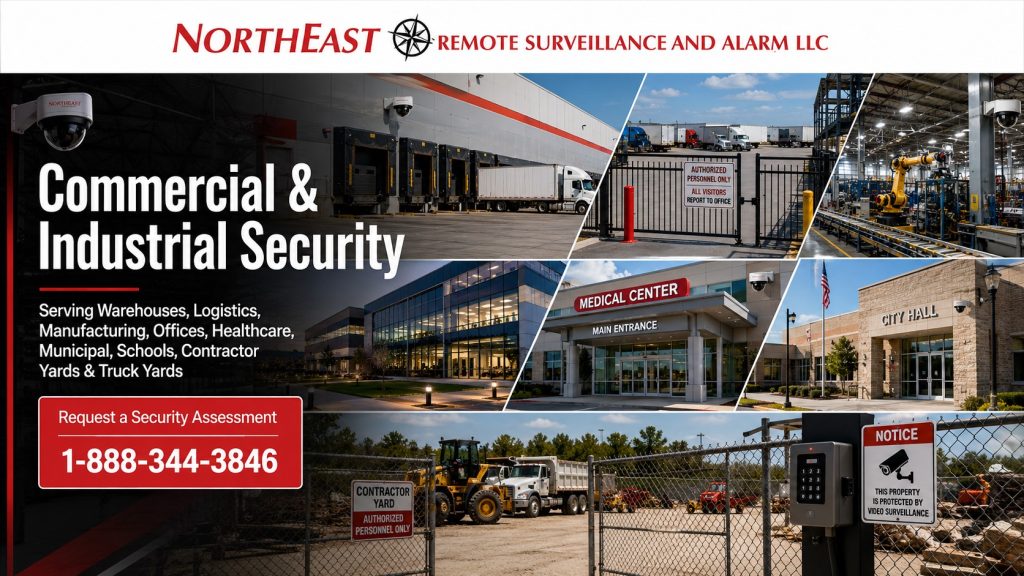
Built for Business, Industrial, and Institutional Properties
NERSA designs security systems for commercial environments that require stronger planning than a basic alarm or camera package.
The company works with properties such as:
- Warehouses
- Distribution centers
- Logistics facilities
- Manufacturing plants
- Office buildings
- Medical and healthcare facilities
- Municipal buildings
- Schools
- Contractor yards
- Truck yards
- Industrial parks
- Multi-tenant commercial buildings
- Storage and service facilities
- Commercial buildings with multiple doors, users, cameras, or risk areas
Each property type has different operating conditions. A warehouse may need dock and trailer visibility. A manufacturing plant may need restricted-area control. A medical office may need controlled entry and privacy-aware camera placement. A contractor yard may need gate control, perimeter cameras, and after-hours documentation.
A commercial-only security company understands that those environments cannot be protected with one-size-fits-all single-family home security equipment.
Why NERSA Focuses on Businesses and Managed Properties
For the broader selection criteria, read why organizations choose NERSA for commercial security and compare those considerations with your project’s requirements.
NERSA does not position itself as a single-family home alarm dealer, consumer camera installer, or low-cost home security provider. The company is built around commercial and industrial security planning.
That focus helps NERSA stay aligned with business customers that need:
- Scalable camera systems
- Employee access control
- Vendor and visitor management
- Alarm protection for commercial buildings
- Yard, gate, dock, and perimeter security
- Monitoring paths that support commercial response expectations
- Fire alarm and life-safety coordination
- Low-voltage infrastructure planning
- Documentation for incidents, claims, and management review
- Long-term support as the property changes
single-family home security usually focuses on a smaller number of doors, users, cameras, and alarm points. Commercial security has to handle larger sites, more users, more risk zones, more complex infrastructure, and more operational pressure.
Commercial-Only Planning Creates Better Security Decisions
A commercial security system should be planned around the way a property actually operates. That includes how employees enter, where visitors report, where vendors deliver, where trucks stage, where inventory is stored, where doors are vulnerable, where cameras need usable views, and where after-hours activity creates risk.
NERSA evaluates business security around real facility conditions, including:
- Employee movement
- Visitor access
- Vendor entry
- Delivery patterns
- Loading docks
- Truck courts
- Trailer areas
- Office entrances
- Restricted rooms
- Network closets
- Exterior doors
- Vehicle gates
- Outdoor storage areas
- Alarm coverage
- Existing wiring and infrastructure
- Future expansion needs
That planning approach helps prevent disconnected systems, weak camera coverage, uncontrolled access points, and alarm designs that do not match how the business actually works.
Security Systems Designed Around Operations
A commercial-only security company has to think beyond equipment. Cameras, alarms, card readers, locks, gates, intercoms, monitoring, and wiring all have to support the same operational goal.
NERSA designs around questions that matter to commercial decision-makers:
- Who is entering the property?
- Which doors or gates need controlled access?
- Which areas need camera documentation?
- Can managers review an incident quickly?
- Is the alarm system matched to actual building use?
- Are employees, visitors, vendors, and vehicles separated properly?
- Can the system expand as the business grows?
- Does the system support future doors, cameras, users, or buildings?
- Does the security plan consider life-safety and emergency access issues?
For complete system planning across cameras, access control, alarms, monitoring, fire/life-safety coordination, and infrastructure, use Commercial & Industrial Security Systems in Pennsylvania and the Mid-Atlantic
Commercial Security Requires Scalable Infrastructure
Business security systems often need to grow. A company may add doors, cameras, users, buildings, gates, tenants, warehouses, production areas, or outdoor yards over time.
That makes infrastructure planning important.
Commercial systems may require:
- Proper low-voltage cabling
- Network planning
- Equipment locations
- Power supply planning
- Backup power considerations
- Recorder or server capacity
- Cloud, on-premise, or hybrid video planning
- Camera placement for usable footage
- Access control expansion planning
- Monitoring path reliability
- Documentation for future service
A commercial-only security company understands that installation day is not the end of the project. The system has to remain serviceable, expandable, and understandable as the business changes.
Access Control for Business Environments
Commercial access control is different from single-family home door control. Businesses may need to manage employees, supervisors, vendors, contractors, visitors, tenants, delivery personnel, cleaning crews, maintenance teams, and after-hours access.
A commercial-only approach helps plan access control around:
- Employee entrances
- Restricted rooms
- Office suites
- Warehouse doors
- Production areas
- IT rooms
- Medication or records areas
- Municipal or school access points
- Contractor yard gates
- Truck yard gates
- Multi-tenant access schedules
- User permissions and audit history
Access control should not just unlock a door. It should help the business control who can enter, where they can enter, when they can enter, and how access events are documented.
Video Surveillance for Real Business Risk
Commercial camera systems need more than wide views. They need usable views.
A business may need cameras for:
- Entry points
- Parking areas
- Reception areas
- Loading docks
- Shipping and receiving areas
- Warehouse aisles
- Production areas
- Cash handling areas
- Vehicle gates
- Trailer rows
- Outdoor storage
- Perimeter fence lines
- Employee entrances
- Restricted areas
The right camera design depends on lighting, distance, mounting height, lens selection, field of view, network conditions, retention needs, and the type of activity being documented.
A commercial-only security company does not simply place cameras where they are easy to install. It plans camera coverage around the areas where the business actually needs visibility.
Alarm Protection for Commercial Buildings
Commercial alarm systems need to match how the property is used. A warehouse, office, school, medical building, municipal property, contractor yard, or manufacturing plant may need different alarm zones, user codes, schedules, contacts, motion detection, glass-break detection, and monitoring paths.
NERSA plans alarm protection around:
- Building layout
- Business hours
- After-hours access
- Employee entrances
- Overhead doors
- Office areas
- Storage areas
- Detached buildings
- Shops and support spaces
- Restricted rooms
- Yard buildings
- Monitoring expectations
A commercial-only alarm design helps reduce weak coverage, nuisance conditions, poor user management, and unclear event documentation.
Code-Aware and Life-Safety-Aware Security Planning
Commercial security systems can affect more than security. Access control, door hardware, electrified locks, fire alarm coordination, emergency egress, low-voltage wiring, backup power, monitoring paths, and emergency access can all connect to broader building and life-safety considerations.
NERSA plans commercial security with awareness of:
- Door function
- Emergency egress
- Fire alarm coordination
- Access-controlled openings
- Low-voltage wiring conditions
- Backup power needs
- Inspection readiness
- Emergency responder access
- Commercial documentation needs
This does not replace the authority having jurisdiction, engineer, architect, code consultant, insurance provider, or legal review where required. It does help businesses avoid treating security devices as isolated equipment when they may affect building operation, emergency access, or life-safety expectations.
Assessment-First Security for Commercial Properties
A commercial-only security company should not recommend equipment before understanding the property. NERSA uses an assessment-first approach to identify real security priorities before system design.
A commercial security assessment can help identify:
- Weak camera coverage
- Uncontrolled entrances
- Poor visitor flow
- Vulnerable loading areas
- Exposed exterior doors
- Gate access issues
- Alarm coverage gaps
- Outdated security equipment
- Poor documentation
- Infrastructure limitations
- Expansion needs
- Life-safety coordination concerns
For buyers who want to understand how NERSA evaluates a facility before recommending equipment, use Security Assessment Process as the next planning step.
Best-Fit Customers for a Commercial-Only Security Company
NERSA is a strong fit for organizations that need more than a basic alarm or camera installation.
Best-fit customers include:
- Commercial property owners
- Facility managers
- Operations directors
- Warehouse operators
- Logistics companies
- Distribution centers
- Manufacturing facilities
- Municipal facilities
- Schools
- Healthcare and medical offices
- Office properties
- Contractor yards
- Truck yards
- Industrial property managers
- Multi-site commercial organizations
- Businesses replacing outdated systems
- Companies that need better visibility, access control, alarms, monitoring, and documentation
NERSA is not the right fit for bargain single-family home alarm shopping or consumer DIY camera systems. The company is built for commercial and industrial environments that require professional planning and dependable long-term support.
Why Commercial-Only Focus Helps Buyers
A commercial-only focus helps buyers work with a provider that understands business risk. Instead of forcing a single-family home security mindset onto a commercial property, NERSA plans around real operating conditions.
That focus helps businesses get better answers to important questions:
- What areas are most exposed?
- Which doors should be controlled?
- Which cameras need identification-level views?
- How should vendors and visitors enter?
- Where is after-hours activity most likely?
- Which buildings need alarm protection?
- How should the system expand later?
- What infrastructure is needed now?
- How can management review incidents faster?
Commercial buyers need practical answers, not generic equipment lists.
Request a Commercial Security Assessment
Choosing a commercial-only security company helps businesses avoid residential-style systems, disconnected devices, weak documentation, poor access control, and security designs that do not match the property.
Northeast Remote Surveillance and Alarm, LLC provides commercial and industrial security planning for organizations that need stronger protection, better visibility, controlled access, alarm reliability, monitoring options, life-safety awareness, and long-term support.
To review your facility, call 1-888-344-3846 or use Request a Security Assessment to schedule a commercial security assessment.
Frequently Asked Questions About Commercial-Only Security Companies
What is a commercial-only security company?
A commercial-only security company focuses on business and professionally managed properties such as businesses, warehouses, offices, industrial facilities, schools, healthcare properties, municipal buildings, contractor yards, truck yards, and multi-site commercial organizations.
Why should a business use a commercial-only security company?
A business should use a commercial-only security company because commercial properties have different risks than homes. Businesses often need scalable camera systems, access control, alarm protection, monitoring, infrastructure planning, documentation, and life-safety-aware design.
Does NERSA install single-family home security systems?
No. NERSA does not provide security installations for individual homes or single-family residences. We serve businesses, industrial and institutional facilities, and professionally managed apartment communities, including shared entrances, common areas, and grounds.
What types of properties does NERSA work with?
NERSA works with warehouses, logistics facilities, distribution centers, manufacturing plants, office buildings, schools, municipal buildings, healthcare facilities, contractor yards, truck yards, industrial parks, and multi-tenant commercial properties.
Why is commercial security different from home security?
Commercial security usually involves larger buildings, more users, more doors, more cameras, employee access, vendor access, outdoor risk areas, alarm schedules, monitoring expectations, documentation needs, and future expansion requirements.
Can NERSA help with cameras, access control, and alarms together?
Yes. NERSA designs commercial systems that may include video surveillance, access control, intrusion alarms, monitoring, gate control, intercoms, paging, fire/life-safety coordination, and supporting low-voltage infrastructure.
Does a commercial-only security company help with long-term system growth?
Yes. Commercial security systems often need to expand as a business adds users, doors, cameras, buildings, gates, tenants, yards, or additional locations. NERSA plans systems with long-term support and scalability in mind.
Can NERSA replace an outdated commercial security system?
Yes. NERSA can evaluate outdated cameras, access control, alarms, wiring, monitoring paths, and system design to recommend upgrades, replacements, or phased improvements.
Does NERSA provide security assessments?
Yes. NERSA provides commercial security assessments to help identify weak points, camera coverage needs, access control issues, alarm concerns, infrastructure limitations, and system planning priorities.
How do I start with NERSA?
The best starting point is a commercial security assessment. NERSA can review the property, identify security priorities, discuss system goals, and recommend a commercial security plan based on the facility’s real operating conditions.
Compliance, Codes & Project Standards
NERSA plans commercial and industrial security work with applicable code, documentation, inspection and authority-having-jurisdiction requirements in mind. Requirements vary by system, property and jurisdiction. These resources support project planning; they do not establish legal compliance, certification or AHJ approval.
Related guidance: Regulatory compliance & inspection readiness · NERSA project standards · Documentation, testing & inspection readiness