Commercial security systems can appear operational while important devices, communication paths, recording functions, batteries, controllers, or monitoring connections have already failed.
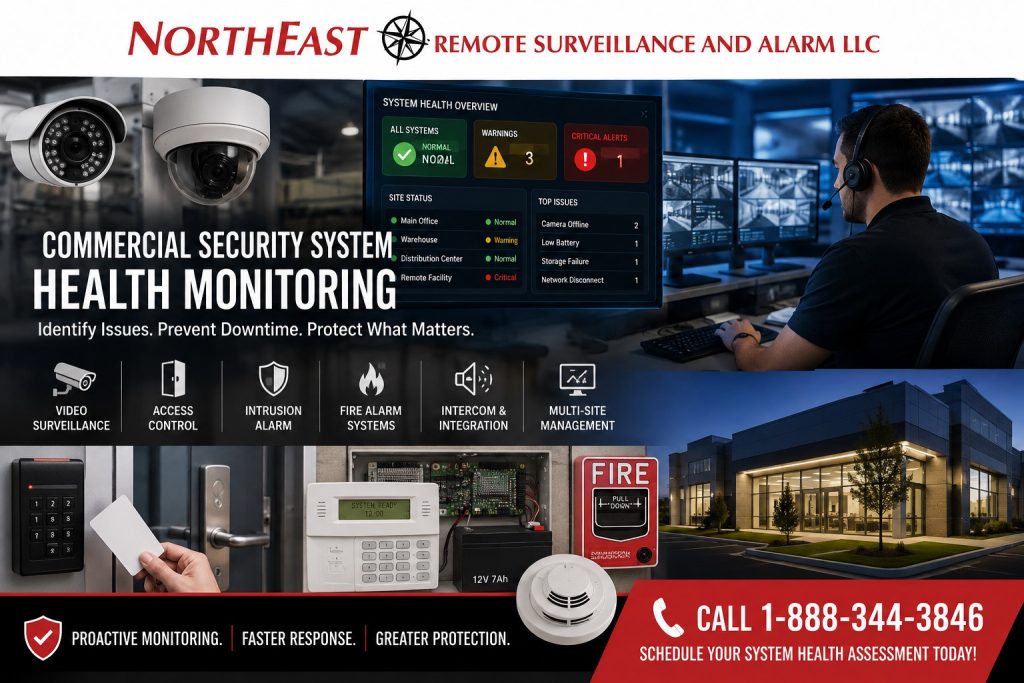
A camera may still display live video but no longer record. An access-control panel may continue making local door decisions after losing communication with the management platform. An intrusion-alarm communicator may develop trouble without the condition reaching the correct person. A backup battery may remain installed long after it can provide dependable standby power. A remote site may stop reporting while everyone assumes it is still protected.
Commercial security system health monitoring helps businesses identify these technical conditions sooner—before a hidden failure is discovered during an incident, investigation, inspection, emergency, or after-hours response.
On this page: What it detects · Program planning · Limitations · Assessment
Northeast Remote Surveillance and Alarm, LLC provides system-health monitoring, diagnostic review, failure notification, remote troubleshooting, service coordination, and lifecycle support for compatible commercial and industrial security systems.
Services may support:
- Video surveillance cameras, recorders, servers, and storage
- Access-control controllers, readers, doors, and communication paths
- Commercial intrusion-alarm systems and communicators
- Fire alarm communication and supervised system conditions
- Intercom, paging, and controlled-entry equipment
- Integrated and unified physical-security platforms
- Network-connected security devices
- Multi-site security environments
For broader ongoing administration, managed services, documentation, maintenance planning, and multi-system support, visit Managed Security Systems and System Health Monitoring.
What Is Commercial Security System Health Monitoring?
System health monitoring checks whether security and life-safety equipment can perform its intended function. It reviews connection status, availability, recording and communication on an ongoing basis.
Depending on the installed platform and service agreement, health monitoring may collect or review information from:
- Cameras
- Video recorders
- Video-management servers
- Storage devices
- Access-control panels
- Door controllers
- Readers
- Power supplies
- Backup batteries
- Alarm panels
- Alarm communicators
- Fire alarm communicators
- Network switches
- Wireless bridges
- Cloud gateways
- Intercom controllers
- Integrated security servers
- Software licenses
- Remote-site connections
When a monitored condition changes, the system may generate an alert, trouble event, dashboard notification, email, service ticket, or other approved response.
The purpose is not merely to collect alerts. A useful health-monitoring program establishes:
- Which systems and devices are being supervised
- Which technical conditions can be detected
- Which conditions require notification
- Who receives each notification
- How urgent conditions are prioritized
- When remote troubleshooting begins
- When an on-site service visit is required
- How recurring failures are documented
- Who is responsible for corrective action
- How system performance is reviewed over time
Not every system exposes the same diagnostic information. Available monitoring depends on the manufacturer, equipment, platform, communication method, system configuration, network, software, licensing, and service scope.
Why Security System Failures Often Remain Hidden
Many security-system failures do not create an obvious interruption in normal business operations.
Employees can continue working when one camera stops recording. A warehouse can continue shipping while an exterior camera is offline. A controlled door can continue granting access from its locally stored database after the controller loses communication with the server. An alarm panel can continue operating while a backup battery deteriorates. A remote user can view some cameras without realizing that other devices have stopped reporting.
These conditions may remain unnoticed until the organization needs the system to:
- Retrieve recorded video
- Investigate a theft
- Review a workplace incident
- Verify an alarm
- Produce an access-control report
- Confirm who entered a restricted area
- Document a vehicle accident
- Review loading-dock activity
- Respond to unauthorized entry
- Support an insurance claim
- Prepare for an inspection
- Investigate property damage
- Review an employee complaint
- Confirm fire alarm communication
- Manage an emergency
At that point, the business may discover that a critical system function had been unavailable for days, weeks, or longer.
Health monitoring reduces the dependence on someone manually noticing every failure. It does not guarantee uninterrupted operation, but it can substantially improve awareness, accountability, and response coordination.
Health Monitoring Is Different From Security Event Monitoring
Security system health monitoring and security event monitoring serve different purposes.
System Health Monitoring
Health monitoring focuses on whether the underlying equipment and communication infrastructure are functioning properly.
Examples include:
- A camera stops communicating
- A recorder reports a failed hard drive
- A controller goes offline
- A panel reports low battery
- A remote site loses network connectivity
- A software license expires
- A storage array becomes degraded
- A communicator reports trouble
- A system stops checking in
- A device repeatedly disconnects
Security Event Monitoring
Event monitoring focuses on activity that may require a security response.
Examples include:
- An intrusion alarm activates
- A person enters a restricted area
- A camera analytic detects activity
- A panic button is pressed
- A forced-door event occurs
- A monitoring operator reviews suspicious behavior
- A fire alarm signal is received
- A live audio warning is issued
A system can be technically healthy without an active security event. It can also experience a security event while one or more supporting devices are impaired.
Organizations may need one service or both. The service agreement should clearly distinguish technical system supervision from active event monitoring and emergency response.
Health Monitoring Is Different From Preventive Maintenance
Health monitoring provides technical visibility between service visits. Preventive maintenance involves physical inspection, testing, cleaning, adjustment, and replacement.
Remote monitoring may identify that a camera is offline, but it cannot repair damaged cable. It may report a low battery, but it cannot physically replace the battery. It may identify that a door controller is communicating, but it cannot confirm that the door closes and latches correctly without appropriate testing or inspection.
Preventive maintenance may include:
- Cleaning camera lenses
- Verifying camera views
- Testing recorded-video retrieval
- Inspecting recorders and servers
- Testing storage
- Checking door operation
- Testing locks and request-to-exit devices
- Inspecting power supplies
- Load-testing batteries
- Testing alarm devices
- Inspecting communication equipment
- Reviewing wiring and terminations
- Confirming system documentation
- Verifying user and administrator accounts
The strongest long-term support strategy combines health monitoring with scheduled inspection and corrective service.
What Commercial Security System Health Monitoring May Detect
A compatible system may provide information about:
- Device communication loss
- Repeated offline and online cycling
- Recorder failure
- Recording interruption
- Failed or degraded storage
- Insufficient storage capacity
- Camera communication loss
- Controller communication loss
- Network-path failures
- Internet or cloud connectivity problems
- Alarm-panel trouble
- Communicator trouble
- Low backup batteries
- AC power failure
- Power-supply trouble
- Enclosure tamper conditions
- Device tamper conditions
- Time synchronization problems
- Software-service failures
- Database issues
- License or subscription problems
- Remote-site communication loss
- Firmware concerns
- Integration failures
- Abnormally high event volumes
- Systems that stop reporting
- Devices approaching capacity
- Unsupported hardware or software
The exact level of visibility varies considerably between systems.
A health-monitoring assessment should identify what the installed equipment can report rather than assuming every device provides complete diagnostic supervision.
Video Surveillance System Health Monitoring
A video surveillance system depends on more than cameras.
Useful recorded evidence requires a complete operating path:
- The camera must receive power.
- The camera must communicate through the network.
- The recorder, server, or cloud platform must receive the video.
- The system must record according to the intended schedule.
- Storage must remain available.
- Footage must be retained for the expected period.
- The camera view must remain usable.
- The system time must be accurate.
- Authorized users must be able to retrieve recordings.
- Exported video must be playable when needed.
Video health monitoring may help identify:
- Offline cameras
- Cameras that repeatedly disconnect
- Recording failures
- Recorder or server problems
- Hard-drive trouble
- Degraded storage arrays
- Reduced retention
- Network communication loss
- Cloud connection problems
- Failed edge-storage devices
- Licensing issues
- Time and date errors
- Cameras that stop reporting
- Platform-service failures
A camera showing as online does not automatically prove that usable footage is being retained. Recording status, storage availability, actual retention, image quality, and video retrieval should also be considered.
For detailed camera, recorder, storage, and video-platform oversight, visit Managed Video Surveillance and Camera System Health Monitoring.
Access Control System Health Monitoring
A controlled opening may include:
- A credential
- A reader
- A door controller
- Access-control software
- Network communication
- Locking hardware
- A door-position contact
- A request-to-exit device
- A power supply
- Battery backup
- A door closer
- Emergency-release equipment
- Fire alarm interface functions
Health monitoring may provide awareness of:
- Offline controllers
- Reader communication problems
- Remote-site communication loss
- Door-held-open events
- Forced-door events
- Power failure
- Low battery
- Enclosure tamper
- Network interruption
- Cloud-platform communication loss
- Software problems
- License expiration
- Systems that stop reporting
- Unusually high denied-access activity
Electronic monitoring cannot confirm every physical condition at a door.
A controller may report normally while a damaged closer prevents the door from latching. A lock may receive the correct command while a misaligned opening remains unsecured. A door contact may fail or become improperly aligned.
System-health monitoring should therefore be combined with physical inspection and door-hardware maintenance.
For dedicated controller, credential, reader, door, and access-platform management, visit Managed Access Control Systems and System Health Monitoring.
Commercial Intrusion Alarm Health Monitoring
A commercial intrusion-alarm system may depend on:
- Alarm control panels
- Keypads
- Door contacts
- Motion detectors
- Glass-break detectors
- Beam detectors
- Panic and duress devices
- Wireless transmitters
- Power supplies
- Backup batteries
- Cellular or IP communicators
- Monitoring-center connections
- Integrated video-verification equipment
Depending on the platform, health monitoring may identify:
- Panel trouble
- Communication failure
- Low battery
- AC power loss
- Device tamper
- Wireless-device supervision loss
- Low wireless-device batteries
- Expander communication problems
- Bus faults
- Cellular communication trouble
- IP communication trouble
- Failure to check in
- Zone trouble
- System clock problems
- Account or service issues
A security system may still arm while one or more devices are bypassed, impaired, or not reporting correctly. Trouble conditions should be reviewed rather than treated as routine background messages.
Fire Alarm System Health Awareness
Commercial fire alarm systems are supervised life-safety systems and must be serviced, inspected, tested, and maintained according to applicable requirements and the authority having jurisdiction.
System-health awareness may involve conditions such as:
- Fire alarm panel trouble
- Supervisory conditions
- Communication failure
- AC power loss
- Battery trouble
- Ground faults
- Device communication problems
- Signaling-line circuit trouble
- Notification-appliance circuit trouble
- Disabled points
- Communicator trouble
- Failure to transmit or check in
- Networked panel communication problems
Remote awareness does not replace required inspection, testing, maintenance, documentation, emergency procedures, or code compliance.
Fire alarm trouble, supervisory, and alarm conditions must be handled according to the system design, monitoring arrangement, customer procedures, applicable requirements, and service agreement.
Intercom and Controlled-Entry Health Monitoring
Commercial intercom and visitor-entry systems may rely on:
- Door stations
- Video intercom devices
- Master stations
- Mobile applications
- Cloud platforms
- Network switches
- Power supplies
- Door-release relays
- Access-control integration
- Telephone or SIP services
- Internet connectivity
Potential health conditions include:
- Door station offline
- Master station offline
- Cloud communication failure
- Network interruption
- Power loss
- Audio or video communication problems
- Failed door-release integration
- License or subscription issues
- Mobile application connection problems
- Devices that stop reporting
Because visitor-entry systems may control access to occupied buildings, problems should be routed to a defined contact rather than discovered when a visitor or delivery arrives.
Network Infrastructure and Security System Availability
Modern physical-security systems frequently depend on the organization’s network.
Cameras, access-control controllers, alarm communicators, servers, intercoms, cloud gateways, wireless bridges, and remote-management tools may all depend on network availability.
Failures may result from:
- Failed PoE switches
- Damaged copper cabling
- Fiber-link trouble
- Wireless-bridge interruption
- Incorrect IP addressing
- Duplicate IP addresses
- VLAN changes
- Firewall changes
- Disabled switch ports
- Router failure
- Internet outages
- Domain-name resolution problems
- Expired certificates
- Bandwidth limitations
- Customer IT changes
- Power failures
- Uninterruptible power supply problems
A device-offline alert identifies a symptom. Effective troubleshooting determines whether the cause is the security device, power, cabling, network equipment, internet service, software, or another dependency.
NERSA can coordinate physical-security troubleshooting with designated customer IT personnel, network providers, manufacturers, monitoring providers, and other responsible parties.
Cloud, On-Premises, and Hybrid System Monitoring
Health-monitoring capabilities depend partly on system architecture.
Cloud-Managed Security Systems
Cloud platforms may provide centralized dashboards, remote device status, software updates, user management, event history, and system notifications.
Health monitoring may cover:
- Device-to-cloud communication
- Gateway availability
- Subscription status
- User-account status
- Firmware
- Cloud services
- Internet connectivity
- Remote-site status
- Licensing
A cloud dashboard does not eliminate local dependencies. Controllers, cameras, locks, power supplies, wiring, networks, and physical devices must still operate at the facility.
On-Premises Security Systems
On-premises systems may use local servers, software, databases, storage, and workstations.
Health monitoring may include:
- Server availability
- Software services
- Database condition
- Storage capacity
- Recorder status
- Controller communication
- Backup status
- Operating-system concerns
- Licensing
- Remote access
- Network communication
These systems may require closer coordination with customer IT departments and local infrastructure.
Hybrid Security Systems
Hybrid systems combine local operation with cloud-based administration, remote access, reporting, health dashboards, or selected storage.
Both the local equipment and the cloud communication path must be considered. A cloud platform may remain available while a local gateway is offline, or the local system may continue operating while remote administration is unavailable.
Multi-Site Security System Health Monitoring
Organizations with multiple facilities face a larger visibility challenge.
Each location may have different:
- Cameras
- Recorders
- Access-control platforms
- Alarm panels
- Communicators
- Network configurations
- User accounts
- Software versions
- Service providers
- Maintenance histories
- Documentation
- Replacement priorities
Without centralized oversight, each site may depend on local employees noticing and reporting failures.
A multi-site health-monitoring program may help establish:
- A current equipment inventory
- Site and device naming standards
- Centralized health dashboards
- Consistent escalation procedures
- Primary and backup customer contacts
- Standard service priorities
- Recurring failure reports
- Supported-platform standards
- Software and firmware planning
- Battery replacement schedules
- Storage and capacity reviews
- System lifecycle priorities
- Phased upgrade plans
- Clear responsibility for corrective action
Multi-site standardization does not require replacing every system immediately. Existing equipment may remain in service while the organization develops a controlled migration strategy.
System Dashboards, Alerts, and Reports
A dashboard is useful only when the information is accurate, understood, and connected to a response process.
Health information may be presented through:
- Platform dashboards
- Email notifications
- Mobile alerts
- Monitoring-center signals
- Service tickets
- Automated reports
- Device-status summaries
- Monthly health reports
- Exception reports
- Multi-site scorecards
Too few alerts may allow important failures to remain hidden. Too many low-value alerts can create alert fatigue and cause urgent conditions to be overlooked.
A properly configured program should classify conditions by priority.
Critical Conditions
Examples may include:
- Complete recorder failure
- Loss of all cameras at a critical site
- Access-control server failure
- Alarm communication failure
- Fire alarm communicator trouble
- Complete remote-site communication loss
- Critical platform outage
High-Priority Conditions
Examples may include:
- A critical camera offline
- Degraded storage
- A controlled-door controller offline
- Repeated panel communication trouble
- Failed backup battery
- Critical integration failure
Routine Conditions
Examples may include:
- Noncritical device offline
- License-renewal notice
- Storage approaching a threshold
- Intermittent communication
- Nonurgent firmware review
- Documentation discrepancies
Priority definitions should reflect the facility, device purpose, operational impact, and customer requirements.
Remote Diagnostics and Corrective Service
When a health alert is received, the first step is determining whether the condition is genuine and identifying the likely cause.
Remote diagnostics may include:
- Confirming the device is still offline
- Reviewing recent communication history
- Checking platform services
- Reviewing recorder or server status
- Examining available logs
- Confirming network reachability
- Reviewing software licensing
- Checking storage status
- Confirming user or account access
- Coordinating with customer IT
- Restarting approved services or devices
- Verifying whether communication returns
- Documenting recurring failures
Some conditions can be corrected remotely.
Others require:
- On-site troubleshooting
- Device replacement
- Battery replacement
- Cabling repair
- Network repair
- Door-hardware service
- Recorder or server replacement
- Storage replacement
- Manufacturer support
- Internet-service-provider assistance
- Customer IT changes
- Software upgrades
Health monitoring does not automatically mean that every repair, replacement part, manufacturer charge, subscription, or service visit is included. The service agreement should define the scope clearly.
Preventing Repeated Security System Failures
Repeated offline events should not be treated as unrelated incidents.
A device that disconnects every week may indicate:
- Unstable power
- Damaged cabling
- Network congestion
- A failing switch port
- An aging device
- Environmental exposure
- Inadequate wireless connectivity
- Incorrect configuration
- Software instability
- Insufficient storage
- A failing hard drive
- An overloaded server
- An unsupported operating system
Tracking recurring conditions helps identify patterns and prioritize corrective work.
Health reports can support decisions about:
- Repair
- Replacement
- Network improvements
- Power improvements
- Firmware updates
- Storage expansion
- Platform migration
- Preventive maintenance
- Equipment standardization
- Capital planning
The goal is not simply to clear alerts. The goal is to improve long-term system reliability.
Existing Security System Health Assessments
NERSA can evaluate compatible security systems installed by another provider.
An existing-system health assessment may review:
- Equipment manufacturers and models
- Administrative access
- Account ownership
- Available system-health functions
- Camera and controller status
- Recording and storage
- Alarm communication
- Fire alarm communication
- Network dependencies
- Power supplies
- Backup batteries
- Software and firmware
- Licensing
- User accounts
- Remote access
- System documentation
- Recurring trouble conditions
- Manufacturer support status
- Replacement priorities
Some systems can be enrolled in ongoing health monitoring without major changes.
Others may require updated software, new communication equipment, corrected network settings, replacement recorders, supported controllers, new licenses, or migration to a more manageable platform.
NERSA evaluates what can be retained before recommending replacement.
Cybersecurity and Administrative Control
Security system health platforms may provide remote access to cameras, access records, alarm information, users, credentials, floor plans, system settings, and operational data.
Administrative access should be controlled through:
- Individual user accounts
- Role-based permissions
- Multi-factor authentication where supported
- Strong password practices
- Customer ownership of primary accounts
- Removal of former users
- Limited provider access
- Secure credential recovery
- Audit-log review
- Network segmentation
- Encrypted communication where supported
- Documented authorization procedures
- Periodic administrator reviews
Shared credentials reduce accountability and create unnecessary risk.
The customer should retain appropriate ownership and authority over its systems, data, users, accounts, and service relationships.
Security System Lifecycle Monitoring
Health monitoring can also reveal when an operating system is becoming difficult to support.
Lifecycle concerns may include:
- Discontinued cameras
- Obsolete recorders
- Unsupported access-control panels
- Aging alarm communicators
- Expired cellular technology
- Unsupported operating systems
- Discontinued software
- Limited storage
- Unavailable replacement parts
- Expired licenses
- Unsupported mobile applications
- Unencrypted communication methods
- Manufacturer support changes
- Cybersecurity limitations
- Capacity restrictions
- Repeated hardware failures
A system does not need to fail completely before modernization begins.
NERSA can help identify equipment that remains serviceable, devices requiring immediate attention, and systems that should be migrated through a phased upgrade.
Commercial and Industrial Applications
Security system health monitoring may support:
- Warehouses
- Distribution centers
- Manufacturing facilities
- Industrial plants
- Logistics operations
- Commercial offices
- Healthcare properties
- Schools and educational facilities
- Municipal buildings
- Institutional facilities
- Contractor yards
- Equipment yards
- Commercial campuses
- Industrial parks
- Multi-tenant properties
- Retail and customer-facing businesses
- Small commercial properties
- Multi-site enterprises
The appropriate monitoring scope depends on the number of systems, sites, devices, critical openings, recording requirements, business hours, internal resources, and operational risk.
Building a Commercial Security System Health-Monitoring Program
A dependable program should begin with an assessment rather than a generic monitoring package.
NERSA’s planning process may include:
- Identifying the systems and locations to be monitored
- Creating or confirming an equipment inventory
- Reviewing platform compatibility
- Confirming account ownership and administrative access
- Identifying available diagnostic information
- Documenting network and power dependencies
- Prioritizing critical devices and locations
- Defining alert thresholds
- Establishing primary and backup contacts
- Defining escalation and service procedures
- Reviewing preventive maintenance requirements
- Identifying unsupported equipment
- Establishing reporting expectations
- Planning corrective work and future upgrades
The result should clearly explain what is monitored, what is not monitored, how notifications are handled, and who is responsible for each next step.
What Security System Health Monitoring Does Not Guarantee
Health monitoring improves technical visibility, but it cannot prevent or immediately detect every possible failure.
Limitations may include:
- Equipment failure without advance warning
- Conditions not exposed by the manufacturer
- Internet outages
- Customer network changes
- Utility-power interruptions
- Unsupported third-party equipment
- Physical damage
- Deliberate destruction
- Environmental damage
- Customer changes made outside approved procedures
- Blocked camera views
- Propped doors
- Mechanical door problems
- Credential sharing
- Events outside camera coverage
- Delayed platform notifications
- Incorrect customer contact information
- Manufacturer or cloud-service outages
No security system can guarantee that every incident will be detected, recorded, prevented, interrupted, or resolved.
The service agreement should identify monitored equipment, available notifications, escalation procedures, customer responsibilities, exclusions, and corrective-service terms.
Why Businesses Choose Northeast Remote Surveillance and Alarm
Northeast Remote Surveillance and Alarm, LLC focuses on commercial and industrial physical-security systems.
We understand that long-term reliability requires more than installing equipment. Cameras, recorders, storage, controllers, readers, alarm panels, communicators, power supplies, networks, software, accounts, and documentation must continue working together.
Our commercial capabilities include:
- Security system health monitoring
- Remote diagnostics
- Failure notification
- Managed video surveillance
- Managed access control
- Commercial alarm-system support
- Fire alarm communication support
- Integrated security systems
- Multi-site system management
- Preventive maintenance planning
- System takeovers
- Upgrades and phased migrations
- Network and low-voltage troubleshooting
- System documentation
- Lifecycle planning
NERSA supports small commercial properties, large industrial facilities, and enterprise organizations throughout Pennsylvania and selected commercial projects across New Jersey, Delaware, Maryland, and the surrounding Mid-Atlantic region.
Frequently Asked Questions About Security System Health Monitoring
What is commercial security system health monitoring?
System health monitoring checks the condition of cameras, recorders, access-control panels, alarms and communicators. It also reviews storage, power supplies, networks, software and other connected security equipment.
What types of systems can be health monitored?
Compatible video surveillance, access control, intrusion-alarm, fire alarm communication, intercom, network-connected, and integrated security systems may provide health information. Available capabilities depend on the equipment and platform.
Can health monitoring detect an offline camera?
Compatible video platforms may report when a camera loses communication. Additional review may be needed to determine whether the cause is the camera, power, cabling, network, recorder, software, or another dependency.
Can a camera be online but not recording?
Yes. Live video may remain available even when recording has stopped because of a storage, recorder, software, licensing, schedule, or configuration problem.
Can NERSA monitor whether an access-control panel is online?
Compatible access-control systems may report controller communication, power, battery, tamper, network, and other technical conditions.
Does health monitoring include intrusion-alarm monitoring?
Health monitoring may supervise certain technical trouble conditions. Intrusion-alarm event monitoring and emergency dispatch are separate functions that must be specifically included in the monitoring arrangement.
Can fire alarm systems be included?
Compatible fire alarm panels and communicators may report alarm, supervisory, trouble, power, battery, communication, and other supervised conditions. Health awareness does not replace required inspection, testing, maintenance, documentation, or code compliance.
Is health monitoring the same as preventive maintenance?
No. Health monitoring provides technical awareness between service visits. Preventive maintenance involves physical inspection, testing, cleaning, adjustment, and component replacement.
Can every security-system failure be detected remotely?
No. Monitoring is limited to the information made available by the equipment and platform. Physical damage, blocked camera views, mechanical door problems, damaged wiring, and certain sudden failures may require inspection or user reporting.
Can NERSA monitor a system installed by another company?
Possibly. NERSA must evaluate the equipment, platform, administrative access, licensing, network, manufacturer support, and available diagnostic functions.
Does every alert require an on-site service visit?
No. Some issues can be diagnosed or corrected remotely. Others require an on-site technician, customer IT support, a manufacturer, an internet provider, or another responsible party.
Can health monitoring support multiple facilities?
Yes. NERSA can help organizations centralize device health, site contacts, service priorities, reporting, documentation, and lifecycle planning across multiple locations.
Can health monitoring support both small businesses and enterprise systems?
Yes. A program may cover a small commercial property with several devices, a large manufacturing or warehouse facility, or an enterprise organization with multiple systems and locations. The monitoring scope should match the size and complexity of the operation.
Does NERSA provide single-family home security system health monitoring?
No. NERSA does not provide security installations for individual homes or single-family residences. We serve businesses, industrial and institutional facilities, and professionally managed apartment communities, including shared entrances, common areas, and grounds.
Request a Commercial Security System Health Assessment
Do not wait until an incident, investigation, inspection, or emergency reveals that a critical security system was no longer operating correctly.
NERSA can assess the health information available from your existing security systems. The review may cover cameras, access control, intrusion alarms, fire alarm communication, intercoms and other connected equipment. We identify where staff need better visibility into faults or system status.
We can help your organization:
- Identify hidden system failures
- Establish equipment and site inventories
- Configure meaningful health alerts
- Prioritize critical devices
- Improve escalation procedures
- Coordinate remote and on-site service
- Track recurring problems
- Plan preventive maintenance
- Identify unsupported equipment
- Build a phased modernization plan
Call 1-888-344-3846 to schedule a commercial security system health-monitoring assessment.
Plan Your Next Security Improvement
Tell NERSA about your commercial facility, existing systems, and project priorities. We can help you plan an installation, evaluate an upgrade, or coordinate security across multiple locations.
Compliance, Codes & Project Standards
NERSA plans commercial and industrial security work with applicable code, documentation, inspection and authority-having-jurisdiction requirements in mind. Requirements vary by system, property and jurisdiction. These resources support project planning; they do not establish legal compliance, certification or AHJ approval.
Related guidance: Regulatory compliance & inspection readiness · NERSA project standards · Documentation, testing & inspection readiness