
Contractor and vendor entrance surveillance helps industrial facilities document outside personnel, service vehicles, delivery activity, maintenance access, receiving entrances, contractor gates, and after-hours movement.

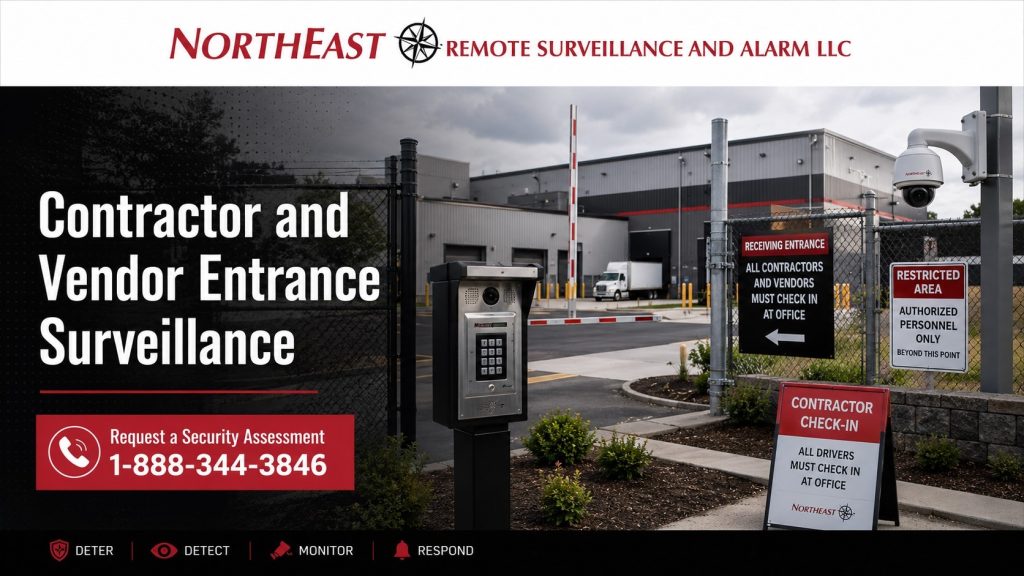
Northeast Remote Surveillance and Alarm, LLC designs contractor and vendor entrance camera systems for manufacturing plants, industrial buildings, warehouses, utility areas, service doors, receiving areas, and multi-building commercial properties across Pennsylvania and the Mid-Atlantic.
For broader industrial camera planning, start with Industrial Video Surveillance Systems.
Surveillance for Contractor and Vendor Access Points
Contractors and vendors often use entrances that are separate from main employee doors or front office entrances. These access points may include receiving doors, service gates, maintenance entrances, utility access points, delivery lanes, exterior equipment yards, dock areas, and restricted industrial transitions.
A strong surveillance plan helps document who arrived, when they arrived, what vehicle entered, which entrance was used, whether the person checked in, and whether activity stayed within the approved area. This is especially important for facilities that rely on maintenance contractors, delivery vendors, utility providers, cleaning crews, inspectors, repair technicians, and third-party service companies.
The goal is not to make contractor access harder than necessary. The goal is to improve visibility, support accountability, reduce blind spots, and give management usable video when questions arise about access, delivery activity, property damage, missing inventory, or after-hours movement.
Why Contractor and Vendor Entrances Need Dedicated Camera Coverage
Contractor and vendor entrances can create security exposure because they are often located away from normal supervision. A rear service door, side gate, receiving entrance, or utility access point may not have the same visibility as a main lobby or employee entrance.
Common risks include unauthorized entry, unverified vehicle activity, tailgating, doors being propped open, access outside approved hours, movement near restricted spaces, and disputes about when a vendor arrived or left. In industrial environments, these access points may also connect to machinery areas, utility spaces, chemical storage, loading zones, or production-sensitive areas.
Dedicated camera coverage helps create a clear record of activity at these entrances instead of relying on memory, paper logs, or incomplete access events.
Camera Views That Matter at Contractor Entrances
Contractor and vendor entrance cameras should be positioned for useful evidence, not just general motion. A single camera looking at a door may not be enough if it cannot show the person, vehicle, approach path, access device, gate activity, or surrounding conditions.
The strongest layouts may include views for:
- Exterior approach paths
- Contractor parking or staging areas
- Service gates and receiving entrances
- Badge readers, keypads, or intercom stations
- Vehicle lanes and delivery approaches
- Door openings and interior transition points
- Restricted-area approaches
- After-hours activity near access points
Each camera should have a purpose. One view may identify the person, another may document the vehicle, and another may show whether the contractor entered the correct area or moved toward a restricted zone.
Receiving Entrances and Service Doors
Receiving entrances and service doors are high-use access points for vendors, delivery drivers, maintenance crews, and service technicians. These doors often sit near dock areas, side walls, mechanical rooms, storage spaces, or industrial corridors.
Camera placement should document both the outside approach and the inside transition whenever possible. This helps management review whether a door was opened, whether anyone followed behind an authorized person, whether materials were moved, and whether activity occurred during approved hours.
For facilities with electronic credentials, contractor entrance cameras should support access event review so management can compare door activity with video evidence.
Contractor Gates and Vehicle Access
Industrial facilities with contractor gates or vehicle access points need camera coverage that captures more than a doorway. Gates may need views of the vehicle lane, driver interaction point, keypad or intercom, gate arm, license plate area, surrounding fence line, and yard entry path.
Lighting, weather, vehicle speed, glare, and camera angle all affect whether the footage will be useful. A vehicle may be visible on camera without being identifiable, which is why contractor gate coverage should be planned around evidence quality.
For facilities with larger exterior areas, contractor gate surveillance should work with Industrial Perimeter Security Cameras so access points are not isolated from the rest of the property’s exterior security plan.
After-Hours Contractor and Vendor Activity
After-hours contractor access creates a higher-risk environment because fewer employees may be present to verify activity. Emergency repairs, HVAC service, janitorial work, electrical work, utility service, equipment maintenance, and special projects may all require access outside normal hours.
Surveillance should document arrivals, departures, vehicle position, door activity, gate use, and movement near restricted or sensitive areas. If the facility uses monitoring or analytics, after-hours contractor activity can also be reviewed against approved access windows.
This helps management separate authorized work from unexpected activity, unauthorized access, or movement that needs follow-up.
Integration With Access Control and Intercoms
Contractor and vendor entrance surveillance becomes more useful when it is connected to the systems that control entry. Cameras can support access control events, intercom calls, keypad use, gate activity, temporary credentials, alarm events, and remote review.
Access control can show which credential or code was used. Video can show who actually entered, what vehicle was present, and whether anyone followed behind. An intercom can document the access request, while the camera view documents the person and surrounding conditions.
For facilities managing doors, gates, credentials, and restricted areas, use Commercial & Industrial Access Control Systems for broader access-control planning.
Camera Types for Contractor and Vendor Entrances
The best camera type depends on the entrance layout, lighting, distance, mounting location, weather exposure, and identification goal.
Fixed IP cameras are often used for door approaches, badge-reader views, service corridors, and interior transition points. Bullet cameras may be useful for exterior approaches, gate lanes, receiving areas, and long directional views. Turret and dome cameras can support covered entrances, interior check-in areas, receiving offices, and protected exterior locations.
Some contractor gates may also require license plate recognition, multi-sensor cameras, or wider overview coverage depending on vehicle activity and site layout. Camera selection should follow the actual risk and evidence requirement, not a generic camera package.
Evidence Quality, Lighting, and Retention
Contractor entrance cameras should be planned for evidence quality. A camera that only shows movement may not help when the facility needs to identify a person, confirm a vehicle, document a delivery, review damage, or investigate after-hours access.
Lighting should be reviewed during daytime, early morning, evening, overnight, and poor-weather conditions. Exterior entrances may create issues with glare, headlights, shadows, reflective signs, open overhead doors, and seasonal changes.
Retention also matters. If a delivery dispute, property damage claim, missing inventory issue, or access concern is discovered days or weeks later, the footage must still be available and easy to retrieve.
Compliance and Documentation Support
Contractor and vendor entrance surveillance does not replace contractor policies, visitor management, supervision, safety training, written procedures, or regulatory responsibilities. It can, however, support documentation, incident review, access accountability, restricted-area awareness, workplace review, and inspection readiness.
Industrial facilities should consider how contractor entrance cameras interact with safety-sensitive areas, hazardous zones, fire/life-safety conditions, access-controlled doors, and emergency access paths. Surveillance should support the facility’s operational procedures without creating confusion around life-safety or access requirements.
For broader industrial documentation and compliance planning, use Industrial and Warehouse Security Compliance.
Contractor and Vendor Entrance Surveillance for Industrial Facilities
Northeast Remote Surveillance and Alarm, LLC designs contractor and vendor entrance surveillance for manufacturing plants, industrial buildings, warehouses and distribution facilities. Coverage can include equipment yards, utility access points, service gates, receiving areas, loading zones and multi-building commercial properties.
Each system should be designed around the facility’s real access patterns. That includes who enters, when they enter, what vehicles are used, which doors and gates are involved, where contractors are allowed to go, and what areas require stronger documentation.
A properly designed system gives management a clearer record of contractor and vendor activity without relying on disconnected cameras, paper sign-in sheets, or incomplete access logs.
Request a Contractor and Vendor Entrance Surveillance Assessment
NERSA can assess coverage at contractor gates, service doors, receiving entrances, vendor lanes, and loading areas. We plan camera views around who uses each entrance and how access works during normal operations and after hours.
Call 1-888-344-3846 or use the Request a Security Assessment page to begin a contractor and vendor entrance surveillance review.
Compliance, Codes & Project Standards
NERSA plans commercial and industrial security work with applicable code, documentation, inspection and authority-having-jurisdiction requirements in mind. Requirements vary by system, property and jurisdiction. These resources support project planning; they do not establish legal compliance, certification or AHJ approval.
Related guidance: Regulatory compliance & inspection readiness · NERSA project standards · Documentation, testing & inspection readiness