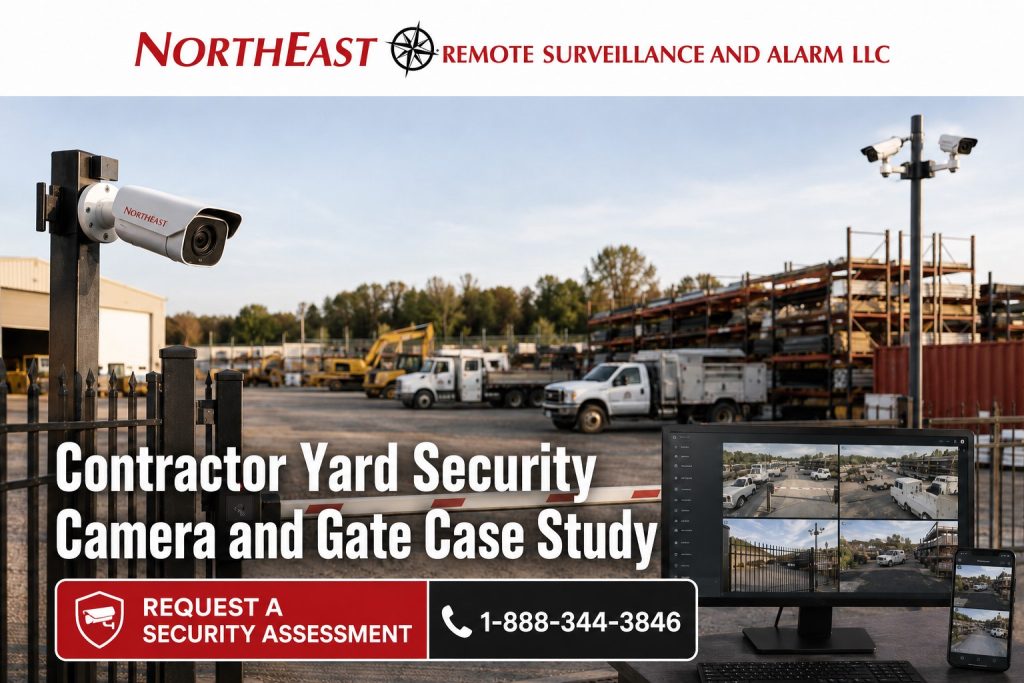
Contractor yard security camera and gate systems help protect outdoor equipment, work trucks, trailers, materials, tools, fenced lots, storage areas, vehicle entrances, and after-hours exterior property exposure. This anonymous case study shows how Northeast Remote Surveillance and Alarm, LLC approaches a contractor yard security project when a commercial property needs better gate control, stronger camera coverage, improved perimeter visibility, and practical documentation around after-hours yard activity. For the full proof library, visit Commercial and Industrial Security Case Studies.
Call 1-888-344-3846 to request a contractor yard security assessment.
Case Study Overview
This case study is based on a common contractor yard security challenge: the property had valuable assets stored outside, but the yard needed stronger control around the vehicle entrance, better visibility across parked equipment, and a more reliable way to review after-hours activity.
The site did not need a standard office camera package. It needed an exterior security layout built around a fenced yard, gate access, work vehicles, equipment storage, material movement, and after-hours exposure.
The goal was to improve security around:
- Vehicle gate access
- Fence-line exposure
- Parked work trucks
- Trailers
- Equipment storage
- Material storage
- Yard lanes
- Side and rear approaches
- Exterior lighting conditions
- After-hours activity
- Unauthorized vehicle movement
- Incident review
- Remote visibility
This page focuses only on the contractor yard security camera and gate case study. For broader commercial gate planning, visit Commercial Gate Access Control Systems. For broader video system planning, visit Commercial Video Surveillance Systems.
Property Type
The property was an anonymous contractor yard and exterior commercial storage site with a fenced lot, parked vehicles, materials, equipment, trailers, and a controlled vehicle entrance.
The site included:
- A fenced exterior yard
- A vehicle gate
- Contractor vehicles
- Trailers
- Outdoor equipment storage
- Material storage areas
- Perimeter exposure
- Limited after-hours staffing
- Exterior lighting
- Existing security gaps around the yard entrance
- A need for better incident documentation
Like many contractor yards, much of the value was not inside the building. The most important security exposure was outside, where trucks, tools, equipment, and materials remained vulnerable after hours.
The Security Challenge
The main challenge was exterior exposure.
The business needed better control over who entered the yard and stronger visibility around what happened once vehicles, workers, vendors, or unauthorized visitors approached the property.
Common concerns included:
- Open or weakly controlled vehicle access
- Limited visibility at the gate
- Poor documentation of vehicle entry and exit
- After-hours movement near equipment
- Material and tool storage exposure
- Blind spots near fence lines
- Limited review of yard activity
- No clear way to connect gate activity with video evidence
- Management needing better remote visibility
This is a common issue for contractor yards, fleet yards, equipment lots, and outdoor commercial storage properties. A locked building does not protect assets sitting outside the building.
For broader exterior commercial protection, visit Remote Video Monitoring and Live Talk-Down.
Why Contractor Yards Need a Different Security Layout
A contractor yard does not function like a standard office, retail space, or interior warehouse.
Contractor yards often include:
- Work trucks
- Service vehicles
- Trailers
- Tools
- Ladders
- Copper, wire, pipe, and materials
- Heavy equipment
- Outdoor storage racks
- Dumpsters
- Fuel areas
- Gate entrances
- Fence lines
- Driver and employee movement
- Vendor access
- After-hours exposure
The security system must be planned around exterior risk, not just doors and interior rooms.
A strong contractor yard security plan should answer:
- Who can enter the yard?
- When can they enter?
- Which vehicles came in or left?
- What areas of the yard are visible?
- Are materials and equipment documented?
- Are gate events connected to video?
- Can management review activity remotely?
- Can suspicious after-hours activity be verified?
The system should be designed around how the property actually operates.
Gate Access Control Strategy
The vehicle gate was treated as a priority because it controlled the primary path into the yard.
A contractor yard gate system may include:
- Keypad access
- Card reader access
- Fob access
- Mobile credential access
- Intercom-assisted entry
- Remote release
- Gate cameras
- Entry and exit documentation
- Schedules
- Authorized user permissions
- Vendor or employee access rules
Gate access control helps reduce uncontrolled vehicle entry and creates a stronger process for managing who can access the yard.
For broader vehicle-entry planning, visit Commercial Gate Access Control Systems.
Gate Camera Coverage
Gate access control should not stand alone. A gate event tells management that access occurred, but a camera view helps show what happened visually.
Gate camera coverage may help document:
- Vehicle arrival
- Vehicle departure
- Gate opening
- Gate closing
- Tailgating
- Vendor access
- Employee access
- Unauthorized approach
- After-hours vehicle movement
- Driver interaction
- Vehicles stopped near the entrance
The gate area often becomes the first and most important camera view in a contractor yard security layout.
If an incident begins at the entrance, management needs a usable view of how the vehicle or person approached the property.
Yard Camera Coverage Strategy
The yard camera layout was planned around the areas where value and exposure were highest.
Camera planning considered:
- Gate views
- Drive lanes
- Equipment rows
- Material storage areas
- Work truck parking
- Trailer storage
- Side fence lines
- Rear property edges
- Exterior building approaches
- Lighting conditions
- Potential obstructions
- Camera mounting locations
- Night visibility
- Remote viewing needs
- Future monitoring options
The goal was not to install cameras randomly across the lot. The goal was to create useful views that help management understand movement through the yard.
Perimeter and Fence-Line Visibility
Contractor yards often rely on fencing, but fencing alone is not enough if nobody can see activity near the perimeter.
Perimeter camera coverage can help document:
- People approaching fence lines
- Vehicles stopping near the property edge
- Cut-through activity
- Material movement near the perimeter
- Suspicious after-hours activity
- Remote yard corners
- Side and rear exposure points
- Activity near exterior storage
Fence-line visibility is especially important when a yard borders other commercial lots, roads, vacant land, shared driveways, or poorly lit areas.
A fence slows access. Cameras help document what happens around it.
Equipment, Tool, and Material Storage Coverage
Contractor yards often store assets that are easy to target because they are outdoors and movable.
Camera coverage may focus on:
- Tool storage areas
- Equipment parking
- Work truck rows
- Trailer rows
- Material storage
- Pipe, wire, and copper storage
- Outdoor racks
- High-value inventory areas
- Fuel or utility zones
- Maintenance areas
The system should be designed around the highest-value and highest-risk assets, not just the most convenient camera mounting locations.
Remote Viewing for Contractor Yard Management
Contractor yard owners and managers are not always on-site when activity happens.
Remote viewing can help authorized users:
- Check gate activity
- Review after-hours movement
- Confirm employee or vendor access
- Review vehicle activity
- Inspect yard conditions
- Verify whether a gate is open or closed
- Review material movement
- Support incident investigation
- Manage multiple properties
Remote access should be planned with strong passwords, role-based permissions, and clear rules for who can view or export video.
For monitored and remote response planning, visit Remote Video Monitoring and Live Talk-Down.
After-Hours Yard Exposure
Many contractor yard risks increase after hours.
Nights, weekends, holidays, and low-staff periods can create more exposure around:
- Vehicle gates
- Work trucks
- Trailers
- Outdoor materials
- Fence lines
- Rear approaches
- Side lots
- Equipment storage
- Poorly lit areas
- Areas not visible from the street
A contractor yard security layout should account for how the property looks when staff is not present, not only during working hours.
Camera views, lighting, gate control, remote access, and monitoring options should all be evaluated with after-hours risk in mind.
Live Talk-Down and Active Deterrence Options
Some contractor yards may benefit from remote video monitoring and live talk-down.
Live talk-down can allow an operator to issue a real-time voice warning when suspicious activity is verified.
This may be useful near:
- Gate entrances
- Equipment storage areas
- Trailer rows
- Material storage
- Fence lines
- Remote yard corners
- Building approaches
Live talk-down works best when the camera view is clear enough for the operator to verify activity and the speaker location is close enough to be heard in the area being protected.
For active response planning, visit Remote Video Monitoring and Live Talk-Down.
Alarm and Access Control Coordination
Contractor yard security may involve more than cameras and gates.
Depending on the property, the system may also include:
- Intrusion alarms
- Door contacts
- Motion detection
- Gate status alerts
- Building alarms
- Equipment room alarms
- Yard motion detection
- Video verification
- Alarm monitoring
- Employee access control
- Restricted room access control
The strongest design connects the right system layers without overcomplicating the property.
For alarm planning, visit Commercial and Industrial Alarm Installation.
Operational Result
The contractor yard security design helped the property move from limited exterior awareness toward a more structured security layout.
The system supported:
- Better gate visibility
- Better control over yard entry
- Better review of vehicle activity
- Better perimeter awareness
- Better documentation around equipment areas
- Better after-hours visibility
- Better remote management access
- Better support for incident review
- Stronger protection around exterior commercial assets
No sensitive customer information, exact camera maps, passwords, access schedules, gate codes, alarm zones, or security weaknesses are published in this case study.
The value of the project was the design strategy, not just the equipment.
What This Case Study Does Not Cover
This page is focused specifically on a contractor yard security camera and gate case study.
It is not the main commercial video surveillance page. It is not the main gate access control page. It is not the main alarm page. It is not the main remote monitoring page. It is not a warehouse security page. It is not a city hub.
For commercial camera planning, visit Commercial Video Surveillance Systems.
For gate control planning, visit Commercial Gate Access Control Systems.
For remote monitoring planning, visit Remote Video Monitoring and Live Talk-Down.
For alarm system planning, visit Commercial and Industrial Alarm Installation.
For the full case-study hub, visit Commercial and Industrial Security Case Studies.
Lessons From This Contractor Yard Security Case Study
This case study highlights several important lessons for contractor yards, fleet yards, and exterior commercial storage properties.
Contractor Yard Security Starts at the Gate
The gate is often the most important control point because it defines how vehicles, employees, vendors, and unauthorized visitors enter the yard.
Cameras Must Be Planned Around Outdoor Assets
The most valuable items in a contractor yard may be stored outside. Camera coverage should focus on equipment, trucks, trailers, materials, and yard movement.
Fencing Needs Visibility
A fence can delay or discourage access, but camera coverage helps document what happens near the perimeter.
Remote Viewing Helps Owners and Managers
Contractor yard managers may need to check the property after hours, during weekends, or while traveling between job sites. Secure remote viewing can support faster review and better awareness.
Gate Access Control and Cameras Work Better Together
Gate control manages entry. Cameras document activity. Together, they create a stronger record of who approached, entered, or moved through the yard.
Recommended Contractor Yard Security Assessment
A contractor yard security assessment should review the full exterior operation before equipment is selected.
Northeast Remote Surveillance and Alarm, LLC may review:
- Gate locations
- Vehicle entrances
- Fence lines
- Yard lanes
- Work truck parking
- Trailer storage
- Tool storage
- Material storage
- Equipment parking
- Lighting conditions
- Existing cameras
- Existing gate equipment
- Access control needs
- Alarm needs
- Remote viewing needs
- Monitoring options
- Camera mounting locations
- Power and network availability
- After-hours exposure
- Future expansion
The goal is to design a security system that matches how the contractor yard actually operates.
Frequently Asked Questions About Contractor Yard Security Cameras and Gates
What is a contractor yard security camera and gate system?
A contractor yard security camera and gate system combines exterior cameras, vehicle gate control, remote viewing, access management, and optional monitoring to help protect outdoor equipment, work trucks, trailers, materials, and fenced commercial storage areas.
Why do contractor yards need security cameras?
Contractor yards often store valuable equipment, tools, vehicles, trailers, and materials outside the building. Cameras help document activity around gates, fence lines, storage areas, work trucks, and after-hours movement.
Why is gate access control important for contractor yards?
Gate access control helps manage who can enter the yard, when they can enter, and how access is documented. It reduces uncontrolled vehicle entry and supports better accountability.
Should a gate have a camera?
Yes. A gate camera helps document vehicles, drivers, vendors, employees, gate activity, tailgating, and after-hours approach events. Gate access control is stronger when paired with usable video.
Can contractor yard cameras be viewed remotely?
Yes. Contractor yard cameras can be configured for secure remote viewing so authorized owners, managers, or operations staff can review yard activity from off-site.
Can live talk-down be used in contractor yards?
Yes. Live talk-down can be used when remote monitoring and speakers are installed. Operators can issue voice warnings when suspicious activity is verified.
What areas should contractor yard cameras cover?
Common camera areas include gates, vehicle entrances, work truck rows, trailer storage, equipment areas, material storage, side fence lines, rear fence lines, exterior building approaches, and remote yard corners.
Can existing cameras be reused?
Sometimes. Existing cameras may be reused if they provide clear views, proper angles, reliable recording, usable night performance, and support remote viewing or monitoring needs. If the views are weak, upgrades may be needed.
Can gate access control work with cards or keypads?
Yes. Contractor yard gates may use keypads, cards, fobs, mobile credentials, intercoms, remote release, or other access methods depending on the property and user requirements.
Can contractor yard security include intrusion alarms?
Yes. Some contractor yards may also use intrusion alarms for buildings, shops, storage rooms, equipment areas, or restricted spaces. Cameras can help support video verification of alarm events.
Is a contractor yard security system the same as warehouse security?
No. Warehouse security usually focuses on the building, docks, inventory areas, employee entrances, and interior operations. Contractor yard security focuses heavily on exterior gates, parked vehicles, equipment, materials, trailers, and fence-line exposure.
Does NERSA publish exact customer yard layouts?
No. Northeast Remote Surveillance and Alarm, LLC does not publish sensitive customer camera maps, gate codes, alarm zones, access schedules, passwords, or security weaknesses in public case studies.
Does NERSA install residential gate systems?
No. Northeast Remote Surveillance and Alarm, LLC focuses on commercial, industrial, warehouse, logistics, manufacturing, institutional, municipal, healthcare, and enterprise security systems.
How do I request a contractor yard security assessment?
Call 1-888-344-3846 or request a security assessment. Northeast Remote Surveillance and Alarm, LLC can review your yard layout, gate access, camera coverage, lighting, remote viewing needs, and after-hours exposure.
Request a Contractor Yard Security Camera and Gate Assessment
Contractor yard security should be designed around real exterior exposure. Gates, fence lines, work trucks, trailers, equipment, materials, storage areas, lighting, remote access, and after-hours movement all affect the final system design.
If your contractor yard, fleet yard, equipment lot, fenced storage property, industrial yard, or exterior commercial site needs better gate control and stronger camera coverage, Northeast Remote Surveillance and Alarm, LLC can evaluate the property and recommend a practical security layout.
Call 1-888-344-3846 or request a security assessment.