
A DVR to NVR security camera upgrade helps commercial buildings move from older analog camera recording to a cleaner, more flexible, and more supportable video surveillance platform.

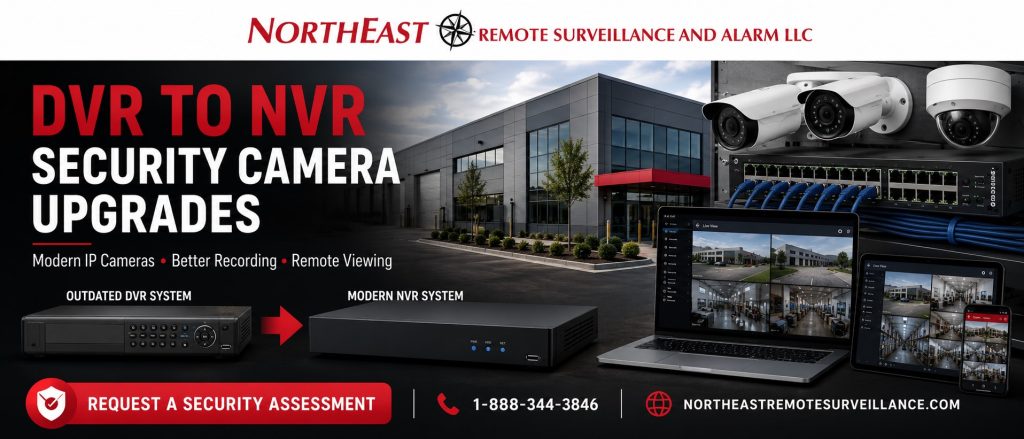
Northeast Remote Surveillance and Alarm, LLC helps commercial and industrial facilities upgrade outdated DVR systems, evaluate existing coax or network cabling, replace weak cameras, improve recording quality, configure remote viewing, and build a long-term camera system around how the property operates today.
For related guidance, see our Commercial Security Camera Upgrades and Commercial Security System Upgrades, Retrofits & Takeovers services.
Commercial DVR to NVR Camera Upgrades
Before replacing a DVR, document the camera models, cable routes, recording problems and views your staff need. NERSA reviews those conditions to define a migration scope: what can remain, what needs replacement and how the proposed recorder will support playback, retention and authorized access.
The cameras may still show video, but the system often has poor image quality, limited remote viewing, weak playback tools, short retention, aging hard drives, outdated mobile apps, and camera views that no longer support the business.
A DVR to NVR upgrade can help modernize the system by moving toward network video recording, IP camera support, PoE switching, better remote access, cleaner camera naming, improved search tools, and a stronger expansion path.
The goal is not just to replace the recorder. The goal is to make the camera system more useful when an incident needs to be reviewed.
What Is the Difference Between a DVR and an NVR?
A DVR, or digital video recorder, is commonly used with analog or HD-over-coax cameras. These systems often use coaxial cable from each camera back to the recorder.
An NVR, or network video recorder, is used with IP cameras. These systems normally use network cabling, PoE switches, and network-based video streams.
In practical terms:
- DVR systems are usually older analog or coax-based systems.
- NVR systems are usually newer IP-based systems.
- DVR systems often have fewer modern video management features.
- NVR systems usually support better camera resolution, easier expansion, and more flexible network design.
- DVR-to-NVR upgrades may involve replacing cameras, reusing some pathways, adding network switches, or using hybrid equipment depending on site conditions.
NERSA reviews the existing system before recommending whether the right path is full NVR conversion, hybrid upgrade, phased camera replacement, or recorder-only correction.
When a DVR System Needs an Upgrade
A commercial DVR system may need to be upgraded when it no longer provides useful video review.
Common signs include:
- Camera footage is blurry or low resolution.
- The DVR is slow or difficult to search.
- Remote viewing does not work reliably.
- The mobile app is outdated.
- The system has short or unknown retention.
- Hard drives are failing.
- Camera names are unclear.
- Footage is hard to export.
- Night video is poor.
- Parking lot and loading dock views lack detail.
- The business wants 4MP, 8MP, or 4K cameras.
- Additional cameras are needed but the DVR is full.
- The building has expanded or changed layout.
- Existing analog cameras no longer meet security needs.
- Management wants better remote viewing and user permissions.
If the system cannot help identify what happened, where it happened, and when it happened, it is time to evaluate an upgrade.
DVR to NVR Upgrade Options
Not every DVR upgrade is the same.
NERSA may recommend one of several paths depending on the existing system, budget, cabling, camera condition, and long-term goals.
Full DVR to NVR Conversion
A full conversion replaces the old DVR and analog cameras with an NVR, IP cameras, network cabling or reused pathways where practical, PoE switches, and modern remote access.
This is often the best option when the existing cameras are outdated, image quality is poor, and the business wants a long-term IP camera platform.
Hybrid Recorder Upgrade
A hybrid recorder can support existing analog cameras while allowing new IP cameras to be added.
This may be useful when some existing cameras still have value, but the business wants to begin moving toward IP cameras without replacing everything at once.
Phased Camera Upgrade
A phased upgrade replaces the weakest cameras first, then continues upgrading the system over time.
This can help a business improve priority views such as entrances, parking lots, loading docks, truck yards, and exterior doors while spreading the investment across phases.
Recorder-Only Upgrade
In some cases, the recorder may be the weak point while some cameras remain usable.
A recorder-only upgrade may improve remote viewing, search, storage, and export, but it will not fix poor camera resolution, weak camera placement, or bad night visibility.
Existing System Review
Every DVR to NVR upgrade should start with a system review.
NERSA evaluates:
- Existing DVR condition
- Camera count
- Camera types
- Camera resolution
- Camera locations
- Camera image quality
- Coaxial cable condition
- Network cable availability
- Power supply condition
- Recorder storage
- Hard drive health
- Remote viewing setup
- Mobile app access
- User permissions
- Camera names
- Playback and export tools
- Blind spots
- Night performance
- Network equipment
- PoE switch needs
- Future expansion requirements
This review helps determine what can be reused and what should be replaced.
Reusing Existing Coax Cable
Some commercial DVR systems already have coaxial cable installed throughout the building.
In some cases, existing coax can be reused with certain HD-over-coax systems or hybrid recorders. In other cases, the better long-term path is to install network cabling for IP cameras.
NERSA evaluates existing coax for:
- Cable condition
- Distance
- Pathway condition
- Termination quality
- Interference issues
- Power method
- Camera location value
- Serviceability
- Long-term upgrade goals
Reusing coax can reduce disruption, but it should not be reused if it limits the system too much or creates future service problems.
Moving to IP Cameras
The biggest advantage of a DVR to NVR upgrade is the ability to move toward IP cameras.
IP camera upgrades can support:
- Higher-resolution video
- Better wide-area coverage
- Improved low-light performance
- More flexible camera placement
- PoE power and data over one network cable
- Better recording and search tools
- Easier expansion
- Improved remote viewing
- Stronger camera grouping and naming
- Better integration with access control and alarms
The correct camera depends on the view. A main entrance, parking lot, warehouse aisle, loading dock, office hallway, and truck yard may all need different camera planning.
PoE Switch and Network Planning
An NVR system depends on the network.
PoE switches power IP cameras and carry video traffic back to the recorder or video platform. Poor network design can cause camera dropouts, recording gaps, slow playback, weak remote access, and service problems.
NERSA reviews:
- PoE switch capacity
- Camera power requirements
- Network cable paths
- Switch locations
- Equipment cabinet layout
- UPS backup
- Internet reliability
- Remote viewing needs
- Network segmentation where appropriate
- Future camera expansion
- Service access
A DVR to NVR upgrade should include network planning, not just recorder replacement.
For related infrastructure planning, see Commercial Low Voltage and Network Infrastructure Services.
Better Recording and Retention
Older DVRs often have limited storage, weak hard drives, slow search tools, and unclear retention.
An NVR upgrade can improve:
- Recording reliability
- Storage capacity
- Retention planning
- Search speed
- Playback tools
- Camera grouping
- Event review
- Clip export
- User permissions
- System health review
- Future expansion
The business should know how long video is retained and how quickly footage can be found when needed.
Remote Viewing Improvements
Remote viewing is one of the main reasons businesses upgrade from DVR to NVR.
Older DVR mobile apps are often unreliable, unsupported, or difficult to manage. A modern NVR platform can provide better remote viewing for authorized users.
Remote viewing planning should include:
- Owner access
- Manager access
- Site supervisor access
- Mobile app access
- Desktop access
- Camera group permissions
- Playback permissions
- Clip export permissions
- User removal procedures
- Password control
- Multi-site access where applicable
Remote viewing should be useful, but it should not be uncontrolled.
Camera Naming and Organization
Many older DVR systems have camera names like “Camera 1,” “Camera 2,” or “CH03.”
That slows down incident review.
A DVR to NVR upgrade is the right time to organize camera names around real locations.
Better camera names may include:
- Main Entrance Exterior
- Front Lobby
- Employee Entrance
- Rear Door
- Loading Dock 1
- Warehouse Aisle 3
- Parking Lot East
- Truck Yard Gate
- Office Hallway
- Shipping Desk
- Electrical Room Entrance
Clear names help management find the right video faster and help technicians service the system more efficiently.
Parking Lot and Exterior Camera Upgrades
Parking lots and exterior areas often expose the limits of older DVR systems.
Older analog cameras may show a general view but not enough detail to review vehicle movement, property damage, theft, dumping, unauthorized parking, or after-hours activity.
A DVR to NVR upgrade can improve exterior coverage with:
- Higher-resolution cameras
- Better low-light performance
- Better lens selection
- Improved mounting locations
- Longer retention
- Better remote viewing
- Camera views designed for actual review
For properties that need stronger vehicle documentation, license plate review may also be considered.
Warehouse and Loading Dock Camera Upgrades
Warehouses and loading docks often need stronger camera coverage than older DVR systems can provide.
A DVR to NVR upgrade can improve review of:
- Dock door activity
- Truck arrivals and departures
- Trailer movement
- Warehouse aisles
- Shipping and receiving areas
- Employee movement
- Freight handling
- Vendor activity
- After-hours access
- Overhead doors
- Exterior loading zones
For related planning, see Customer case studies.
DVR to NVR Upgrades and Access Control
NVR-based camera systems can better support access control review.
When cameras are placed near controlled doors, management can review door events with video context.
This helps with:
- Staff entry review
- Denied access attempts
- Held-open doors
- Forced-door events
- Visitor entry
- Vendor access
- After-hours access
- Multi-tenant door activity
For related access planning, see Commercial & Industrial Access Control Systems.
DVR to NVR Upgrades and Intrusion Alarms
Camera upgrades can also support intrusion alarm review.
If a business has after-hours alarms, motion events, door alarms, or video verification needs, the camera layout should support those alarm points.
Useful camera views may include:
- Main entry doors
- Rear doors
- Overhead doors
- Warehouse aisles
- Office corridors
- Exterior approaches
- Yard areas
- High-value storage areas
- Dock areas
- Perimeter zones
For related alarm planning, see Commercial Burglar Alarm and Intrusion Detection Systems.
Before and After
| Before DVR Upgrade | After NVR Upgrade |
|---|---|
| Older DVR with limited features | Modern NVR or hybrid platform |
| Low-resolution analog cameras | Higher-resolution IP camera options |
| Slow search and playback | Better video search and review |
| Limited remote viewing | Improved remote viewing for authorized users |
| Short or unclear retention | Better storage and retention planning |
| Weak camera names | Cleaner camera naming by location |
| Limited expansion | More scalable camera platform |
| Poor integration with other systems | Better support for access control, alarms, and monitoring workflows |
DVR to NVR Upgrade vs. Full Camera Replacement
A DVR to NVR upgrade may involve full camera replacement, but it does not always have to.
Some businesses may start with a hybrid recorder or phased replacement plan. Others may benefit from a complete IP camera conversion.
The right path depends on:
- Existing camera condition
- Existing cable condition
- Budget
- Required image quality
- Recorder condition
- Remote viewing needs
- Retention requirements
- Number of future cameras
- Building layout
- Long-term support goals
NERSA helps determine whether a phased upgrade or full conversion makes more sense.
Commercial Facilities That Benefit From DVR to NVR Upgrades
DVR to NVR upgrades are common for:
- Warehouses
- Distribution centers
- Manufacturing facilities
- Office buildings
- Healthcare offices
- Schools and education facilities
- Retail stores
- Contractor shops
- Auto repair shops
- Laundromats
- Industrial parks
- Multi-tenant buildings
- Logistics facilities
- Truck yards
- Professional offices
- Municipal and institutional properties
Each upgrade should be designed around the facility’s camera views, risk areas, operating hours, and long-term support needs.
Why Businesses Choose NERSA for DVR to NVR Upgrades
Northeast Remote Surveillance and Alarm, LLC focuses on commercial, industrial, institutional, and business and facility security systems.
A DVR to NVR upgrade requires more than swapping a recorder. It requires camera review, cabling review, PoE and network planning, storage planning, remote access setup, user permissions, camera naming, and long-term support.
NERSA designs camera upgrades around how the facility actually operates.
When to Request a DVR to NVR Upgrade Review
A business should request a DVR to NVR upgrade review if:
- The DVR is outdated.
- Cameras are blurry or unreliable.
- Video is hard to search.
- Remote viewing is unreliable.
- Footage is difficult to export.
- More cameras are needed.
- Parking lot video is not useful.
- Loading dock video is weak.
- The system has limited retention.
- Existing coax may need review.
- The business wants IP cameras.
- The company wants better remote access and support.
- The current system is not scalable.
DVR to NVR Upgrade Checklist
Before upgrading from DVR to NVR, evaluate:
- Existing DVR model
- Camera count
- Camera resolution
- Camera locations
- Coax cable condition
- Network cable availability
- Power supplies
- Recording retention
- Hard drive health
- Remote viewing access
- User accounts
- Mobile app support
- Playback speed
- Export capability
- Camera naming
- Network switches
- PoE capacity
- Internet reliability
- UPS backup
- Future expansion
- Integration with access control or alarms
Request a DVR to NVR Camera Upgrade Assessment
If your commercial building, warehouse, office, healthcare facility, school, industrial property, logistics facility, retail site, contractor yard, or multi-tenant property still relies on an older DVR camera system, Northeast Remote Surveillance and Alarm, LLC can help.
Frequently Asked Questions About DVR to NVR Security Camera Upgrades
What is a DVR to NVR security camera upgrade?
A DVR to NVR security camera upgrade modernizes an older commercial camera system by moving from a DVR-based analog recording platform toward an NVR or hybrid platform that can support IP cameras, better recording, remote viewing, and future expansion.
Do I need to replace all my existing cameras?
Not always. Some systems can be upgraded in phases or moved to a hybrid recorder. If the existing cameras are too low-quality, unreliable, or not useful for review, replacement may be recommended.
Can existing coax cable be reused?
Sometimes. Existing coax may be reusable with certain hybrid or HD-over-coax systems, but it should be evaluated for condition, distance, terminations, and long-term suitability.
Are IP cameras better than analog cameras?
IP cameras often provide higher resolution, better flexibility, easier expansion, and stronger integration with modern recording platforms. The best solution depends on the building, camera views, budget, and long-term needs.
What is a hybrid recorder?
A hybrid recorder can support some existing analog cameras while also allowing IP cameras to be added. This can be useful for phased upgrades where the business does not want to replace every camera at once.
Can a DVR to NVR upgrade improve remote viewing?
Yes. A modern NVR or hybrid platform can often improve remote viewing, mobile access, playback, camera search, clip export, and user permissions.
Will an NVR upgrade improve video quality?
It can, but only if the cameras and recording settings are upgraded appropriately. Replacing only the recorder may not improve image quality if the existing cameras are still low-resolution.
Can NERSA upgrade parking lot cameras during a DVR to NVR project?
Yes. Parking lot and exterior camera upgrades are common during DVR to NVR projects because older systems often lack the detail needed for vehicle and after-hours review.
Can the upgraded camera system work with access control?
Yes. Cameras can be placed near controlled doors so managers can review access events with video context, including denied access, held-open doors, staff entry, vendor access, and after-hours activity.
How do we start a DVR to NVR camera upgrade?
Call 1-888-344-3846 or use Request a Security Assessment.
NERSA can review the existing DVR, cameras, cabling, network equipment, remote access, retention, and upgrade options before recommending the right path.
Compliance, Codes & Project Standards
NERSA plans commercial and industrial security work with applicable code, documentation, inspection and authority-having-jurisdiction requirements in mind. Requirements vary by system, property and jurisdiction. These resources support project planning; they do not establish legal compliance, certification or AHJ approval.
Related guidance: Regulatory compliance & inspection readiness · Video surveillance compliance · NERSA project standards