Northeast Remote Surveillance and Alarm, LLC designs, installs, upgrades, expands, repairs, and takes over healthcare and medical office access control systems in Easton, Pennsylvania for physician offices, outpatient facilities, specialty practices, medical office buildings, administrative healthcare properties, treatment centers, and other commercial healthcare environments.
Healthcare properties often combine public areas with spaces that should remain limited to employees, authorized clinicians, administrators, contractors, or selected personnel.
A properly designed access control system can help manage entry to:
- Staff entrances
- Employee-only corridors
- Medical supply rooms
- Medication storage areas
- Records rooms
- IT and telecommunications spaces
- Administrative offices
- Laboratory or testing areas
- Equipment rooms
- Utility spaces
- Restricted treatment areas
- After-hours entrances
- Tenant suites
- Shared medical office building entrances
The goal is to provide authorized personnel with dependable access while helping keep restricted areas separated from public and general-use portions of the property.
For broader commercial access-control planning throughout Easton, visit Commercial Access Control Systems Easton, PA.
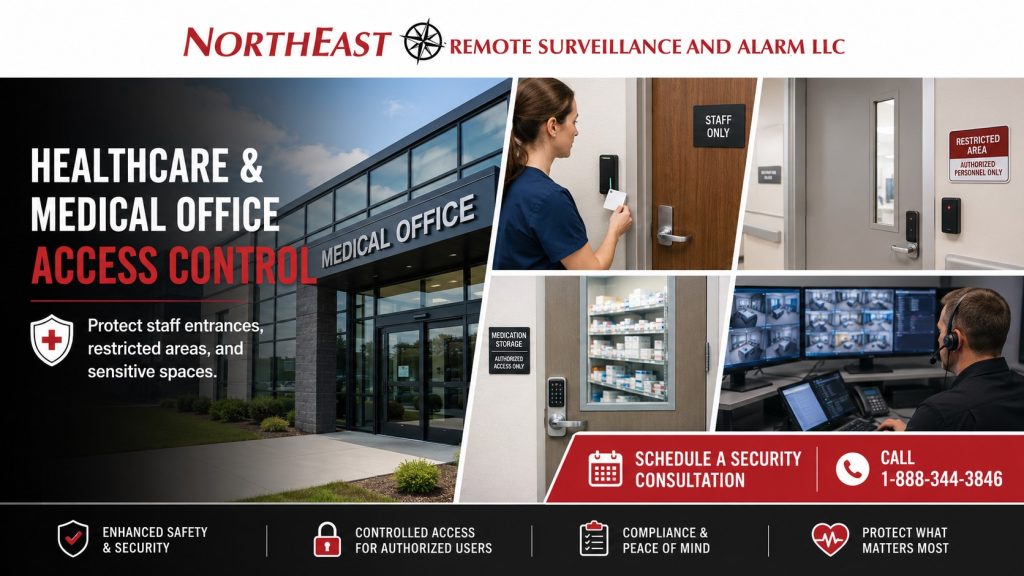
Access Control Designed Around Healthcare Operations
Medical offices and healthcare properties often have several groups of people moving through the same facility.
These may include:
- Physicians
- Nurses
- Medical assistants
- Administrative employees
- Patients
- Visitors
- Vendors
- Cleaning personnel
- Maintenance contractors
- IT contractors
- Delivery personnel
- Temporary employees
Each group may require different access.
A patient may need access only to public and treatment areas.
An employee may need the staff entrance and selected interior spaces.
A practice manager may require access to records, administrative areas, and other restricted rooms.
An IT contractor may need temporary entry to a telecommunications room without receiving unrestricted access throughout the facility.
Electronic access control allows these differences to be managed through individual credentials, schedules, and door permissions.
Staff Entrances and Employee-Only Areas
Staff entrances are one of the most common applications for healthcare access control.
A controlled employee entrance can help separate staff access from public entrances while allowing authorized personnel to enter according to approved schedules.
Controlled staff areas may include:
- Employee entrances
- Break rooms
- Administrative corridors
- Back-office areas
- Clinical support spaces
- Supply rooms
- Records areas
- IT rooms
- Employee-only treatment support areas
Permissions may be organized according to:
- Employee
- Department
- Job responsibility
- Work schedule
- Building
- Suite
- Restricted area
- After-hours authorization
This helps healthcare organizations provide the access employees need without automatically granting every credential holder unrestricted entry throughout the property.
Medical Records and Administrative Areas
Medical and administrative records may be stored in physical rooms, file areas, offices, or secure storage spaces.
Access control can help limit entry to approved personnel.
Controlled areas may include:
- Records rooms
- Administrative offices
- Billing departments
- Human resources areas
- Practice-management offices
- File storage
- IT rooms
- Network closets
Individual credentials can also provide a record of access activity at selected controlled doors.
Access control is one part of a broader information-security process and should be coordinated with the organization’s operational and privacy requirements.
Medication, Supply, and Equipment Rooms
Healthcare facilities may contain medications, supplies, equipment, controlled inventory, or other materials that should not be accessible to every employee or visitor.
Electronic access control can be used to restrict entry to:
- Medication rooms
- Medical supply rooms
- Equipment storage
- Specialty inventory areas
- Laboratory support spaces
- Maintenance storage
- Restricted clinical supply areas
Permissions can be assigned according to employee responsibility instead of distributing mechanical keys widely throughout the organization.
The access-control system does not replace inventory-management or medication-management procedures, but it can add another layer of control around who is permitted to enter selected rooms.
Employee Onboarding and Offboarding
Healthcare organizations frequently experience staffing changes, temporary assignments, contractors, and changing employee responsibilities.
A consistent access-management process should define responsibility for:
- Creating users
- Issuing credentials
- Assigning permissions
- Changing permissions
- Managing lost credentials
- Removing former employees
- Reviewing inactive users
- Protecting administrator accounts
When an employee transfers to a different role, existing permissions should be reviewed rather than simply adding more access.
When employment ends, credentials should be disabled promptly.
Organizations using integrated commercial security systems may also need to address:
- Alarm codes
- Video-system accounts
- Mobile credentials
- Monitoring contacts
- Administrator privileges
- Physical keys
A coordinated offboarding process can help reduce the chance that former employees retain access after leaving the organization.
Temporary Staff, Contractors, and Vendors
Healthcare properties often rely on outside personnel for:
- Cleaning
- Medical equipment service
- IT support
- HVAC service
- Electrical work
- Building maintenance
- Fire-alarm service
- Security-system service
- Deliveries
- Construction or renovation
These users may require access only to certain doors or during specific times.
Compatible access-control systems may allow:
- Temporary credentials
- Door-specific permissions
- Scheduled access
- Limited-duration access
- Removal of permissions when work is completed
For example, an HVAC contractor may need access to one employee entrance and one mechanical room without requiring access to records areas, supply rooms, or treatment spaces.
Cards, Key Fobs, Mobile Credentials, and PINs
Healthcare and medical office access-control systems may use several credential technologies depending on the selected platform and operating requirements.
Common options include:
- Access cards
- Key fobs
- Mobile credentials
- Individual PINs
- Compatible multi-technology credentials
Individual credentials are generally easier to manage than shared keys or common door codes because they can be assigned, disabled, scheduled, and changed for specific users.
Mobile credentials may be appropriate for organizations seeking centralized administration or reduced dependence on physical credential distribution.
Credential selection should consider:
- Ease of use
- Security requirements
- Administration
- Existing equipment
- Licensing
- Employee turnover
- Future expansion
Commercial Door Hardware for Healthcare Properties
Reliable access control depends on the physical door as well as the electronic system.
Healthcare and medical office properties may contain:
- Aluminum storefront doors
- Hollow-metal doors
- Wood office doors
- Fire-rated openings
- Exit-device doors
- Interior staff doors
- Exterior employee entrances
- Shared tenant entrances
Controlled openings may use equipment such as:
- Electric strikes
- Electrified locks
- Electrified trim
- Exit-device-compatible hardware
- Door-position contacts
- Request-to-exit devices
- Power-transfer hardware
- Power supplies
- Battery backup
Hardware should be selected according to the actual opening, traffic level, existing lock, required egress, and intended operation.
A valid credential does not create a dependable controlled opening if the door fails to close or latch properly.
For existing doors that need repair, modernization, or compatible electronic locking hardware, visit Easton Door Hardware and Access Control Retrofits.
Shared Medical Office Buildings and Tenant Access
Medical office buildings may contain several independent practices within one property.
These buildings can require separate control for:
- Shared exterior entrances
- Individual medical suites
- Common corridors
- Utility rooms
- IT spaces
- Building-management areas
- After-hours entrances
- Parking entrances
Property management may need control over shared entrances while each practice maintains control of its own suite.
Administrative responsibilities should be defined clearly so one tenant does not receive unnecessary control over unrelated tenant areas.
For broader planning around shared commercial buildings, visit Office and Multi-Tenant Access Control Systems in Easton, PA.
After-Hours Access for Healthcare Staff
Healthcare employees may work outside normal public hours.
Selected personnel may need access:
- Early in the morning
- Late at night
- On weekends
- During holidays
- During emergency call-ins
- During special procedures
- During maintenance windows
Access schedules can allow authorized employees to enter during approved periods without leaving the building generally accessible after normal operating hours.
After-hours permissions should be assigned carefully and reviewed as employee responsibilities change.
Healthcare Access Control and Video Surveillance
Access-control records can identify activity at selected controlled openings, while video surveillance can provide additional visual context.
Cameras may be useful around:
- Staff entrances
- Public entrances
- Rear doors
- Shared lobbies
- Parking entrances
- Restricted corridors
- Exterior service doors
Compatible systems may help authorized users review selected door activity alongside recorded video.
For broader Easton healthcare security planning involving access control, video surveillance, intrusion protection, monitoring, and related systems, visit Commercial and Industrial Security Systems in Easton, PA.
New Healthcare and Medical Office Access Control Systems
A new access-control project should begin with an understanding of how the facility is actually used.
Planning may include:
- Identifying controlled openings
- Reviewing employee and visitor movement
- Reviewing doors and frames
- Reviewing existing locking hardware
- Defining employee groups
- Identifying restricted rooms
- Establishing access schedules
- Selecting credential technology
- Planning controller locations
- Reviewing power requirements
- Reviewing network communication
- Establishing administrator roles
- Planning future expansion
- Documenting the completed system
The finished system should support healthcare operations without making routine staff movement unnecessarily difficult.
Existing Healthcare Access Control Upgrades and Takeovers
Many healthcare and medical office properties already have electronic access control but may be dealing with:
- Aging readers
- Unsupported controllers
- Outdated software
- Lost administrator access
- Shared credentials
- Poor documentation
- Failed power supplies
- Weak batteries
- Door hardware problems
- Limited expansion capacity
- Former users remaining active
An existing-system assessment may review:
- Readers
- Credentials
- Controllers
- Software
- Licensing
- Field wiring
- Door hardware
- Power supplies
- Batteries
- Door contacts
- Request-to-exit devices
- Network communication
- Administrator accounts
- Existing users
- Available documentation
Existing equipment does not automatically need to be replaced.
Components may remain when they are compatible, serviceable, supported, appropriately secure, and practical within the completed system.
Older or unsupported equipment may need to be repaired, upgraded, migrated, or replaced.
From One Medical Office Entrance to Multi-Building Healthcare Operations
NERSA supports healthcare access-control projects ranging from a single staff entrance to larger multi-building and multi-location environments.
A smaller medical office may require:
- One controlled employee entrance
- Individual credentials
- Basic schedules
- One restricted room
A growing practice may later add:
- Additional doors
- Records-room access
- Supply-room access
- Mobile credentials
- Additional departments
- Another suite
- Another building
- Remote administration
Larger organizations may require:
- Multiple buildings
- Centralized credential management
- Department-specific permissions
- Regional administrators
- Standardized hardware
- Coordinated employee offboarding
- Multi-location reporting
- Common documentation
The system should meet current requirements while allowing practical expansion as the organization grows.
Healthcare and Medical Office Access Control in Easton and Northampton County
NERSA supports commercial healthcare properties throughout Easton, Palmer Township, Forks Township, Wilson, West Easton, Williams Township, Route 33, I-78, and surrounding Northampton County business areas.
Properties may include:
- Physician offices
- Specialty practices
- Medical office buildings
- Outpatient facilities
- Administrative healthcare offices
- Treatment centers
- Multi-tenant medical properties
- Multi-building healthcare organizations
Each property should be evaluated according to its doors, employees, patients, visitors, operating schedules, restricted areas, existing systems, and future requirements.
Frequently Asked Questions About Healthcare Access Control in Easton
What areas of a medical office should have access control?
Common priorities include staff entrances, records rooms, medication or supply rooms, IT spaces, administrative areas, equipment rooms, restricted clinical spaces, utility rooms, and after-hours entrances.
Can different healthcare employees have different access permissions?
Yes. Compatible systems can assign permissions according to employee, department, job responsibility, schedule, door, building, or restricted area.
Can temporary healthcare staff receive limited access?
Yes. Compatible systems may provide temporary credentials with selected door permissions and defined schedules.
Can contractors receive access only to specific rooms?
Yes. Contractors can be assigned limited permissions when supported by the selected system.
Can lost access cards or key fobs be disabled?
Yes. Individual credentials can generally be disabled without rekeying every controlled opening.
Can healthcare access control use mobile credentials?
Compatible systems may allow approved mobile devices to function as access credentials.
Can access control work with video surveillance?
Yes. Compatible systems can provide additional visual context around selected entrances, restricted areas, and controlled doors.
Can existing access-control equipment be reused?
Sometimes. Existing readers, controllers, wiring, locking hardware, credentials, power supplies, and software should be evaluated for compatibility, condition, supportability, and future usefulness.
Can one access-control system manage several medical offices?
Compatible commercial platforms can manage users, credentials, doors, schedules, administrator roles, and access activity across multiple offices or locations.
Does NERSA work with smaller medical offices as well as larger healthcare properties?
Yes. Projects can range from one controlled staff entrance to multi-building and multi-location healthcare environments.
Schedule an Easton Healthcare Access Control Assessment
A dependable healthcare access-control system begins with the property, the employees using it, the public areas, and the spaces that actually need restricted access.
Northeast Remote Surveillance and Alarm can evaluate:
- Staff entrances
- Restricted clinical areas
- Records rooms
- Medical supply rooms
- Medication storage areas
- IT rooms
- Contractor access
- After-hours staff access
- Commercial door hardware
- Existing-system upgrades
- Access-control takeovers
- Shared medical office buildings
- Multiple locations
- Access control and video coordination
Commercial systems only.
Call Northeast Remote Surveillance and Alarm at 1-888-344-3846 to discuss healthcare and medical office access control in Easton, PA.