
Plan Easton OSDP access control upgrades around compatible readers, controllers, wiring, supervised communication, and verified Secure Channel configuration.

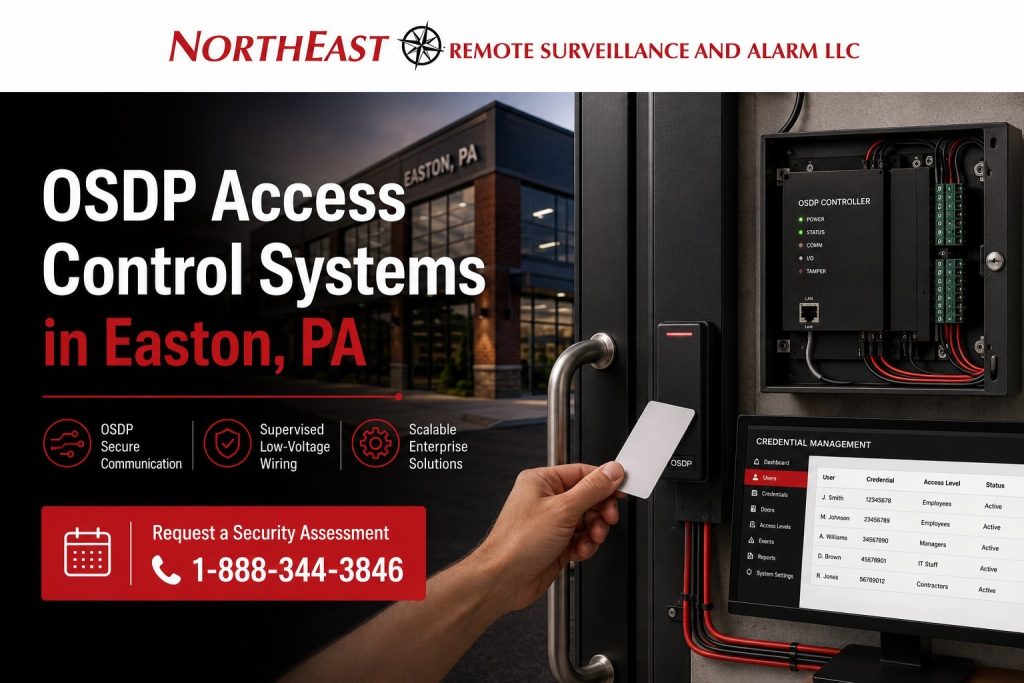
Use OSDP where the complete access system supports it
First, confirm that the controller, reader, firmware, and access software support the required OSDP features. Next, inspect the cable type, topology, distance, grounding, shielding, and device power against the equipment instructions. Then configure the reader addresses and bus settings, then document each door’s Secure Channel, supervision, and fallback behavior during commissioning.
OSDP supports two-way communication between the controller and reader, including supervision and commands.
Secure Channel provides encrypted communication when correctly configured on compatible devices.
Verify that it is active; an OSDP-capable reader or a successful credential read alone does not demonstrate encrypted operation.
For the protocol’s capabilities, review the Security Industry Association’s OSDP overview.
What the assessment covers
- Controller, reader, firmware, credential, and software compatibility.
- RS-485 cable, topology, distance, termination, grounding, shielding, and power.
- Device addresses, communication speed, bus loading, and supervised connection status.
- Secure Channel support, key setup, commissioning method, and service procedures.
- Door operation, credential reads, LEDs, sounder, keypad, tamper, and event reporting.
However, the service team should not assume that an existing reader cable meets every OSDP need. A mixed system may require a phased change, gateway hardware, or a short-term interface. Testing at each door confirms whether the selected design works with the installed path and site conditions.
Test the Reader Connection
Back up the current access-control configuration and record the existing door settings before converting a planned zone. Test allowed and denied credentials, door status, request to exit, and alarms. Verify supported reader supervision, tamper reporting, communication-loss detection, and recovery. Finally, record results and unresolved faults, then label the wiring. Update the controller, reader, address, and Secure Channel records for authorized service staff.
Return to Easton access control systems for related readers, credentials, door hardware, and management options.
For a coordinated property plan, see Easton unified security systems.
Request an Easton assessment
NERSA can review your Easton property’s readers, controllers, and wiring to plan an appropriate OSDP access control upgrade.
Request a security assessment.
Compliance, Codes & Project Standards
NERSA plans commercial and industrial security work with applicable code, documentation, inspection and authority-having-jurisdiction requirements in mind. Requirements vary by system, property and jurisdiction. These resources support project planning; they do not establish legal compliance, certification or AHJ approval.
Related guidance: Regulatory compliance & inspection readiness · Access control & door hardware standards · NFPA 101 & egress planning · ADA access-control planning