Warehouse and logistics security along Route 33 in Easton, PA should be planned around truck entrances, employee traffic, loading docks, trailer movement, parking areas, shipping and receiving operations, restricted rooms, exterior approaches, and after-hours exposure.
Northeast Remote Surveillance and Alarm, LLC designs, installs, monitors, upgrades, and supports commercial security systems for Easton warehouses, distribution centers, logistics facilities, fulfillment operations, freight terminals, flex-industrial buildings, and mixed office-warehouse properties connected to the Route 33 market.
This page is a focused Easton warehouse-and-logistics spindle beneath Easton Warehouse Security Systems. It addresses the local operating conditions created by Route 33-related freight movement, truck traffic, employee shifts, loading activity, vehicle access, trailer exposure, and reduced after-hours staffing.
For broader citywide planning across video surveillance, access control, intrusion alarms, fire alarm systems, monitoring, intercoms, infrastructure, and unified security, visit Commercial and Industrial Security Systems in Easton, PA.
For corridor-wide planning beyond Easton, visit Lehigh Valley Route 33 Industrial Corridor Security Systems.
Request a Route 33 Warehouse Security Assessment in Easton or call 1-888-344-3846.
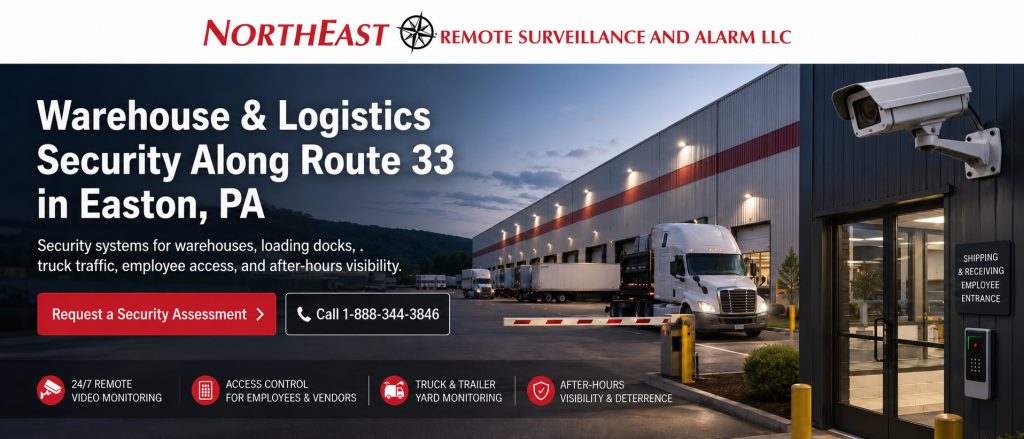
Security Planning for Route 33 Warehouse Properties in Easton
Warehouse and logistics properties near Route 33 often operate differently from smaller commercial buildings. Vehicle movement may begin before normal office hours, continue through several shifts, and create activity around truck entrances, employee doors, loading areas, service lanes, parking lots, side approaches, and rear sections of the property.
A strong security design should account for how the site actually operates:
- Where tractor-trailers and delivery vehicles enter
- How drivers are directed to loading positions
- Where employees park and enter the building
- How vendors and contractors access the site
- Where trailers are staged or stored
- How freight moves through shipping and receiving
- Which doors remain active during different shifts
- Which rooms and warehouse sections require restricted access
- What areas remain exposed after normal operations slow down
- How management reviews incidents involving people, vehicles, freight, or equipment
The objective is not simply to install more cameras, readers, or alarm devices. The objective is to create a coordinated system around vehicle flow, employee access, freight movement, building protection, incident documentation, and after-hours response.
Find the Right Easton Route 33 Security Resource
Use the NERSA resource that most closely matches the property’s primary warehouse, vehicle, dock, monitoring, or system-management need.
Easton Warehouse Security Systems
Use the primary warehouse sub-hub for complete planning across loading docks, yards, employee access, intrusion alarms, fire alarm systems, LPR, monitoring, perimeter security, and warehouse infrastructure.
Commercial Video Surveillance Systems in Easton, PA
Use this sub-hub when camera placement, recording, retention, analytics, remote access, nighttime visibility, and recorded-event review are the main project concerns.
Loading Dock Security Systems in Easton, PA
Use this focused page for dock doors, trailer positions, shipping lanes, receiving areas, staged freight, drivers, forklifts, and dock-side personnel movement.
License Plate Recognition Camera Systems in Easton, PA
Use this resource when searchable plate records, truck-entrance documentation, gate-lane capture, employee vehicles, or after-hours vehicle activity are the main requirements.
Commercial Access Control Systems in Easton, PA
Use this Easton sub-hub for controlled employee doors, warehouse transitions, restricted rooms, credentials, schedules, audit trails, gates, and long-term user administration.
Commercial and Industrial Intrusion Alarm Systems in Easton, PA
Use this page when overhead doors, exterior openings, interior detection, partitions, users, monitoring communication, or after-hours intrusion protection are the primary concerns.
Remote Video Monitoring in Easton, PA
Use this page when reviewed camera alerts, after-hours verification, live audio warnings where appropriate, responsible-party notification, and documented response procedures are needed.
Cargo Theft Prevention Systems in Easton, PA
Use this focused resource when staged freight, trailer activity, pickup verification, loading records, unauthorized movement, and cargo exposure are the central security concerns.
Easton Security System Upgrades, Retrofits, and Takeovers
Use the upgrades sub-hub when existing cameras, recorders, alarms, access control, monitoring paths, door hardware, cabling, or network systems no longer match the property.
Truck Entrances, Drive Lanes, and Vehicle Approaches
Truck entrances and vehicle approaches are among the most important security areas at Route 33 warehouse and logistics properties. These lanes may carry tractor-trailers, delivery vehicles, employee vehicles, vendors, contractors, maintenance providers, and visitors throughout the day and after normal business hours.
A vehicle-entry security plan may need to document:
- Which vehicle entered or exited
- Which lane or gate was used
- When the vehicle arrived and departed
- Whether the vehicle was expected
- Which trailer or delivery was associated with the visit
- Whether the vehicle proceeded to the correct area
- What occurred before or after a gate or driveway event
- Whether unusual activity occurred after hours
General overview cameras may show traffic flow but may not provide enough detail for consistent license plate capture or driver review. A layered design may combine broad vehicle-context cameras with focused entrance, driver, gate, and LPR views.
License Plate Recognition at Route 33 Properties
License plate recognition should be designed around the actual lane rather than the nearest available mounting point.
LPR planning should account for:
- Vehicle speed
- Lane width
- Inbound and outbound direction
- Camera angle
- Mounting height
- Distance from the plate
- Headlights and nighttime conditions
- Plate reflectivity
- Truck and passenger-vehicle differences
- Search, export, and retention requirements
An overview camera and an LPR camera perform different jobs. The overview camera provides context around the vehicle and surrounding activity. The LPR camera provides focused plate documentation where conditions allow.
For plate-specific planning, visit License Plate Recognition Camera Systems in Easton, PA.
Employee Parking and Shift Entrances
Route 33 warehouse and logistics facilities may operate several shifts, use temporary labor, and experience employee arrivals and departures when the office is closed or lightly staffed.
Employee parking and entrance planning may involve:
- Parking-lot camera coverage
- Pedestrian routes between vehicles and the building
- Employee entrance cameras
- Card, fob, mobile, or PIN-based access
- Shift-specific access schedules
- Temporary worker credentials
- Door-position monitoring
- Forced-door and held-open events
- After-hours access review
- Credential onboarding and offboarding
Access-control records can identify which credential was presented, which door was involved, and when the event occurred. A related camera view may provide additional context about who physically used the entrance.
Employee entrances should remain practical for normal warehouse operations while maintaining appropriate control and required emergency egress.
Loading Docks, Shipping, and Receiving Operations
Loading docks combine open overhead doors, trailer movement, drivers, employees, vendors, forklifts, staged freight, shipping paperwork, changing lighting, and after-hours exposure in one concentrated operating area.
Security planning may need to document:
- Trailer arrival and departure
- Trailer position at the dock
- Overhead-door activity
- Shipping and receiving movement
- Staged freight
- Driver and vendor activity
- Forklift movement near dock positions
- Employee movement
- Damage claims
- Shortages and disputed deliveries
- Activity outside approved schedules
Dock camera placement should account for open-door glare, trailer shadows, blocked views, dock numbering, equipment movement, lighting, ceiling height, and changing staging layouts.
A useful dock design may combine broad views of the shipping area with tighter views of specific doors, trailer interfaces, personnel entrances, and freight-transfer points.
For dock-focused planning, visit Loading Dock Security Systems in Easton, PA.
Trailer Staging, Truck Courts, and Exterior Yard Exposure
Many warehouse and logistics facilities connected to Route 33 have trailer staging, truck courts, rear drives, drop lots, exterior equipment, containers, or stored materials that remain exposed when the building itself is secured.
Yard security may need to account for:
- Trailer rows
- Loaded and empty trailers
- Truck-court movement
- Gate approaches
- Fence lines
- Rear service drives
- Exterior equipment
- Containers and outdoor storage
- Blind areas between trailers
- Overnight vehicle activity
- Lighting and weather conditions
Wide cameras may provide general yard awareness, while focused views may be needed at gates, trailer-row entrances, exterior storage areas, fence-line approaches, or repeat trouble spots.
Large exterior areas may also require fiber, wireless bridges, remote PoE switches, outdoor enclosures, surge protection, backup power, and network planning to extend dependable coverage beyond the main building.
Interior Warehouse and Inventory-Area Security
Route 33 warehouse security is not limited to exterior cameras and truck traffic. Interior warehouse operations may include inventory areas, shipping offices, returns rooms, tool cribs, maintenance spaces, dispatch areas, server rooms, supervisor offices, controlled storage, and office-to-warehouse transitions.
Interior security planning may support:
- Inventory-transfer review
- Restricted-room access
- Shipping-office control
- Returns and damaged-goods areas
- Tool and equipment accountability
- Office-to-warehouse separation
- Maintenance and utility-room control
- Incident review around operational choke points
Not every aisle requires identical camera coverage. The design should prioritize entrances, transition points, inventory movement, restricted areas, and locations where management may need a reliable record after an event.
Access Control for Route 33 Warehouse Operations
Warehouse access control should be organized around users, doors, schedules, and operational responsibility.
Common access-control priorities include:
- Employee entrances
- Office-to-warehouse doors
- Shipping and dispatch offices
- Dock-adjacent personnel doors
- Inventory rooms
- Tool cribs and parts storage
- Maintenance rooms
- Server and communications rooms
- Tenant or department separation
- Detached warehouse buildings
Permissions may need to be assigned according to department, job role, shift, building, door, or schedule. Temporary employees, vendors, contractors, and maintenance personnel may require time-limited or area-specific access rather than unrestricted credentials.
Controlled doors must preserve required egress, fire-door operation, accessible use, panic-hardware function, emergency release, and other approved life-safety behavior.
For deeper door and credential planning, visit Commercial Access Control Systems in Easton, PA.
Intrusion Alarm Protection for Warehouse Openings
Warehouses may require intrusion detection around openings and interior areas that become vulnerable when the facility is closed or only partially occupied.
Alarm planning may include:
- Overhead and roll-up door contacts
- Employee entrance contacts
- Dock-adjacent personnel doors
- Interior motion detection
- Restricted-room detection
- Office and warehouse partitions
- Detached-building protection
- Individual user codes
- Shift and holiday schedules
- IP or cellular communication
- Video verification
- Monitoring and response instructions
Alarm partitions may allow office sections, warehouse areas, tenant spaces, or detached buildings to be armed independently when other parts of the property remain active.
Device selection should account for ceiling height, airflow, temperature changes, machinery, forklifts, pests, vibration, and approved after-hours activity.
For alarm-specific planning, visit Commercial and Industrial Intrusion Alarm Systems in Easton, PA.
After-Hours Monitoring and Event Response
Route 33 warehouse properties may remain active outside normal office hours because of overnight shipments, early arrivals, late pickups, shift changes, cleaning personnel, maintenance work, parked trailers, and exterior vehicle movement.
An after-hours security plan may combine:
- Exterior and dock cameras
- AI-assisted event alerts
- Remote video monitoring
- Intrusion alarm signals
- Video verification
- Gate and vehicle documentation
- Responsible-party notification
- Live audio warnings where appropriate
- Written escalation instructions
- Recorded event documentation
Remote monitoring should be designed around useful camera views, usable nighttime lighting, stable network communication, tested analytics, accurate operating schedules, and clear response instructions.
Monitoring should not be represented as a guarantee that every event will be identified, prevented, or stopped.
For focused event-response planning, visit Remote Video Monitoring in Easton, PA.
Cargo Theft Prevention and Freight Accountability
Warehouse and logistics properties may need stronger documentation around staged freight, trailer movement, pickups, deliveries, receiving activity, inventory transfer, and after-hours access.
Security systems may support freight accountability by helping document:
- Which vehicle or trailer arrived
- Which dock position was used
- When loading or unloading occurred
- Who accessed a shipping or storage area
- What freight was staged near a dock
- Whether a pickup matched the expected schedule
- What happened before or after a shortage was discovered
- Whether unauthorized activity occurred around trailers or stored product
Video, LPR, access control, alarm events, shipping records, employee statements, and physical evidence may all be relevant during an investigation. No single system should be treated as complete proof of why an event occurred.
For deeper freight-loss planning, visit Cargo Theft Prevention Systems in Easton, PA.
Video Recording, Retention, and Evidence Review
A camera system provides limited value when footage is overwritten before an incident is discovered or when users cannot locate and export the correct event.
Recording design should account for:
- Camera count
- Resolution and frame rate
- Continuous or event-based recording
- Warehouse activity levels
- Truck and trailer movement
- Investigation and reporting timelines
- Video-export requirements
- Available storage
- Future camera expansion
Clear camera names, synchronized timestamps, logical camera groups, controlled user permissions, dependable playback, and documented export procedures can make incident review substantially easier.
Authorized users should understand who may view, search, export, or administer recorded video.
Network and Low-Voltage Infrastructure
Warehouse security depends on the infrastructure connecting cameras, readers, controllers, recorders, alarm communicators, monitoring equipment, and remote devices.
Supporting infrastructure may include:
- Cat6 or Cat6A structured cabling
- Fiber-optic backbones
- Building-to-building fiber
- PoE switches
- Remote network cabinets
- Wireless bridges
- Outdoor-rated enclosures
- Equipment racks and patch panels
- UPS backup
- Surge-protection coordination
- Network segmentation
- Bandwidth and uplink planning
- Cable testing and labeling
- System and network documentation
A switch may have enough physical ports but lack the PoE capacity required for all connected devices. A recorder may support the camera count while lacking sufficient storage or playback performance. A wireless bridge may show connectivity while remaining unstable for dependable video transmission.
Infrastructure should be sized around current requirements and reasonable future expansion.
Security-System Upgrades for Route 33 Warehouse Properties
Many Easton warehouse and logistics properties already have cameras, access control, intrusion alarms, monitoring, or network infrastructure, but the existing system may no longer match the building or the operation.
Common warning signs include:
- Blind spots at truck or employee entrances
- Poor dock and rear-building visibility
- Unusable nighttime video
- Limited recording retention
- Failed or intermittent cameras
- Outdated DVR or NVR equipment
- Unreliable remote access
- Shared keys, alarm codes, cards, or fobs
- Former users who remain active
- Unsupported alarm panels or communicators
- Inaccurate zone or camera names
- Weak network switching or PoE capacity
- Damaged or undocumented cabling
- No practical expansion path
An upgrade may include:
- Correcting camera placement
- Improving truck and gate coverage
- Adding LPR
- Improving dock and trailer views
- Replacing or expanding recording equipment
- Adding AI-assisted event searches
- Improving access control and user administration
- Adding alarm zones or partitions
- Modernizing alarm communication
- Adding remote video monitoring
- Correcting network, fiber, wireless, or PoE infrastructure
- Improving documentation and system naming
The best upgrade is not automatically a complete replacement. Existing cameras, cabling, readers, door hardware, alarm devices, switches, recorders, or infrastructure may sometimes be retained when their condition, compatibility, supportability, cybersecurity, testing, and performance support the new design.
For broader modernization planning, visit Easton Security System Upgrades, Retrofits, and Takeovers.
Security for Multi-Tenant and Flex-Industrial Properties
Some Route 33 properties combine warehouse units, offices, shared roads, common parking, separate tenants, rear loading areas, and multiple business schedules.
These properties may require clear separation between:
- Common exterior cameras
- Tenant-specific camera access
- Shared vehicle entrances
- Tenant doors and credentials
- Common and tenant alarm partitions
- Property-management responsibilities
- Monitoring contacts
- Shared loading or parking areas
The operating plan should define who controls common systems, who may administer tenant users, who receives events, who may export video, and how credentials and permissions are removed after tenant or employee changes.
Compliance-Aware Warehouse Security Planning
Warehouse security systems can support visibility, access accountability, incident documentation, and after-hours awareness. They do not make a property compliant with every OSHA, NFPA, building-code, insurance, contractual, or workplace requirement.
Security planning should not interfere with:
- Required emergency egress
- Fire-rated openings
- Fire alarm devices and interfaces
- Sprinkler equipment
- Forklift and equipment clearances
- Emergency signs and lighting
- Accessible routes
- Required employee procedures
- Loading-dock and overhead-door operation
- Safety equipment and workplace controls
Security cameras, access control, alarms, and monitoring supplement—but do not replace—training, supervision, safety procedures, emergency planning, equipment maintenance, hazard controls, or required life-safety systems.
Why Route 33 Warehouse Properties Choose NERSA
- Commercial and industrial systems only
- Warehouse and logistics security experience
- Easton and Route 33 market familiarity
- Truck, dock, yard, employee, and freight-focused planning
- Video surveillance, LPR, access control, alarms, and monitoring
- New installations, expansions, upgrades, and takeovers
- Network, fiber, wireless, PoE, and infrastructure planning
- Testing, training, documentation, and long-term support
- Small warehouse through large distribution-facility capability
Northeast Remote Surveillance and Alarm, LLC plans warehouse security around how people, vehicles, freight, equipment, doors, parking areas, loading operations, and after-hours activity move through the property.
Easton Route 33 Warehouse Security Case Study
For a local example of camera and access-control improvements at a warehouse and flex-industrial property connected to the Route 33 logistics market, review the Easton Route 33 Warehouse Security Camera and Access Control Upgrade Case Study.
The case study demonstrates how front entrances, employee doors, parking areas, warehouse-side activity, operational transition points, remote viewing, and controlled access can be reviewed as parts of one commercial security environment.
Request a Route 33 Warehouse Security Assessment in Easton
A warehouse and logistics security project should begin with the property rather than a predetermined equipment list.
An Easton Route 33 security assessment may review:
- Truck entrances and vehicle lanes
- Employee parking and staff entrances
- Loading docks and shipping operations
- Trailer staging and truck courts
- Gates and exterior approaches
- Warehouse interiors and inventory areas
- Office-to-warehouse transitions
- Restricted rooms and support spaces
- Existing camera placement and image quality
- LPR and vehicle-documentation opportunities
- Access-control users, schedules, and doors
- Alarm zones, partitions, and communication paths
- Remote monitoring and response procedures
- Video retention and evidence-export requirements
- Cabling, fiber, wireless, switching, PoE, and bandwidth
- Existing-system supportability
- Documentation and future expansion
The objective is to identify where the property needs stronger visibility, tighter access control, more useful vehicle and freight documentation, dependable after-hours awareness, and a clearer long-term security structure.
Request an Easton Route 33 Warehouse and Logistics Security Assessment or call 1-888-344-3846.
Frequently Asked Questions About Route 33 Warehouse Security in Easton, PA
What is this Route 33 warehouse and logistics page for?
This page is a focused Easton warehouse-security spindle for properties affected by Route 33-related truck traffic, freight movement, loading operations, employee activity, vehicle access, trailer exposure, and after-hours risk.
How is this page different from Easton Warehouse Security Systems?
Easton Warehouse Security Systems is the broader warehouse sub-hub. This page focuses more narrowly on Easton warehouse and logistics properties whose operations are influenced by Route 33 traffic, freight movement, truck entrances, and corridor-oriented activity.
How is this page different from the Route 33 corridor hub?
The Lehigh Valley Route 33 Industrial Corridor Security Systems page covers the broader regional corridor. This page is limited to warehouse and logistics properties in the Easton market.
What areas should a Route 33 warehouse secure first?
Common priorities include truck entrances, employee doors, loading docks, overhead doors, parking areas, shipping offices, trailer staging, gates, warehouse transitions, restricted rooms, and rear or side approaches.
Do Route 33 warehouses need license plate recognition?
Not every property needs LPR. It may be useful when management requires searchable vehicle records at truck entrances, gates, employee parking entrances, service drives, or other controlled vehicle lanes.
Can cameras document loading and receiving disputes?
Properly positioned cameras may help review trailer positions, dock-door activity, freight movement, drivers, employees, staged product, shortages, damage claims, and related shipping or receiving activity.
Can offices and warehouse areas use separate alarm partitions?
Yes. Compatible commercial alarm systems may allow offices, warehouse sections, tenant spaces, restricted rooms, and detached buildings to be armed and managed independently.
Can access control manage different employee shifts?
Yes. Access permissions may be assigned according to employee, department, door, shift, schedule, job role, building, or operational need.
Can remote video monitoring help after hours?
Remote video monitoring may support reviewed alerts, visual verification, live audio warnings where appropriate, authorized notification, and documented escalation around docks, yards, gates, parking areas, and exterior trouble spots.
Can warehouse security help reduce cargo-theft exposure?
Security systems may improve vehicle, trailer, dock, freight, access, and after-hours documentation. They do not guarantee that cargo theft will be prevented, but they can strengthen accountability, review, and response.
Can an existing Route 33 warehouse security system be upgraded?
Yes. NERSA can evaluate existing cameras, recorders, access control, alarms, monitoring paths, door hardware, cabling, switches, networks, and documentation to determine what may be retained, repaired, expanded, modernized, or replaced.
Can NERSA support both small warehouses and large distribution facilities?
Yes. NERSA supports qualifying projects ranging from smaller mixed office-warehouse buildings and storage properties to logistics facilities, distribution centers, fulfillment operations, freight terminals, and multi-building industrial sites.
Does NERSA install residential security systems?
No. Northeast Remote Surveillance and Alarm, LLC focuses on commercial, industrial, warehouse, logistics, manufacturing, office, healthcare, municipal, institutional, contractor, multi-tenant, and other non-residential properties.