
Fire alarm elevator recall integration connects the commercial fire alarm system with elevator recall functions so elevator equipment can respond properly during fire alarm conditions where required.

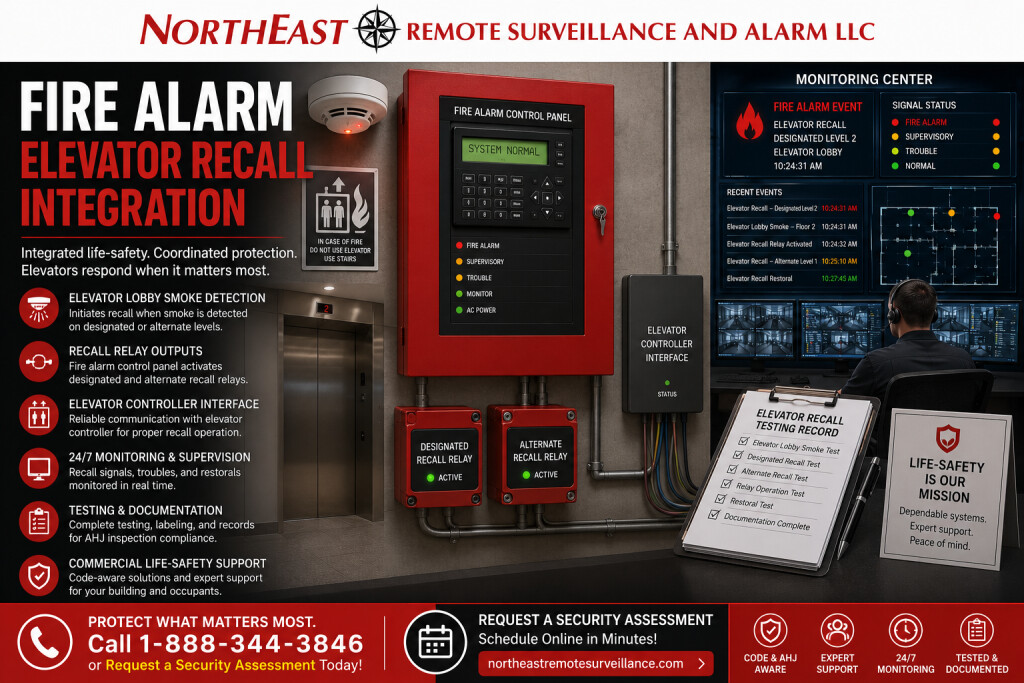
Northeast Remote Surveillance and Alarm, LLC helps commercial and industrial facilities coordinate fire alarm control panels, smoke detector inputs, relay modules, elevator controller interfaces, monitoring records, testing documentation, and AHJ-aware life-safety planning.
For the related system responsibilities, review Fire Alarm Monitoring and Supervision alongside Commercial & Industrial Fire Alarm Installation and Life Safety.
Commercial Fire Alarm Elevator Recall Integration
Elevators are not standalone security devices.
In many commercial buildings, the fire alarm system must interface with elevator equipment so elevator recall can occur when specific fire alarm initiating devices activate. This may involve smoke detectors, heat detectors, fire alarm control modules, monitor modules, recall relays, elevator controller inputs, annunciation, documentation, testing, and coordination with the elevator contractor and AHJ.
Elevator recall integration must be planned carefully because it involves life safety, fire alarm operation, elevator control, building code requirements, and inspection acceptance.
What Is Elevator Recall?
Elevator recall is a life-safety function that moves elevator cars to a designated recall level or alternate recall level during certain fire alarm conditions.
The exact recall sequence depends on the building, elevator equipment, fire alarm design, adopted code, elevator code requirements, detector locations, AHJ interpretation, and elevator contractor coordination.
In practical terms, the fire alarm system may provide signals to the elevator controller when specific initiating devices activate. The elevator controller then performs the required elevator recall function according to its design and programming.
Why Fire Alarm Elevator Recall Matters
Elevator recall helps prevent elevators from remaining available for normal public use during certain fire alarm conditions.
A properly coordinated elevator recall interface can help:
- Support required elevator recall operation.
- Coordinate elevator lobby, machine room, control room, or hoistway detection where applicable.
- Provide fire alarm relay outputs to the elevator controller.
- Support designated and alternate recall logic where required.
- Improve inspection and acceptance readiness.
- Reduce coordination problems between fire alarm and elevator contractors.
- Improve documentation for future service and testing.
- Support long-term building life-safety management.
The goal is not just to install detectors near elevators. The goal is to make sure the fire alarm system and elevator equipment are coordinated correctly.
Fire Alarm and Elevator Contractor Coordination
Fire alarm elevator recall projects require coordination.
NERSA can support the fire alarm and low-voltage side of the integration, including fire alarm devices, control modules, relay outputs, monitoring points, signal descriptions, documentation, and testing support. The elevator contractor is responsible for elevator equipment, elevator controller wiring requirements, elevator programming, and elevator-side acceptance where applicable.
A clean project may require coordination between:
- Building owner
- Facility manager
- Fire alarm contractor
- Elevator contractor
- Electrical contractor where required
- Monitoring provider
- Engineer where required
- Authority Having Jurisdiction
- Inspection or testing personnel
Elevator recall should not be treated like a generic alarm output. It is a coordinated life-safety interface.
Existing Elevator Recall System Review
Before adding, correcting, or upgrading elevator recall integration, NERSA reviews the existing fire alarm and elevator interface conditions.
The review may include:
- Fire alarm control panel
- Elevator lobby smoke detectors
- Elevator machine room or control room detection where applicable
- Hoistway or shaft detection where applicable
- Heat detectors where applicable
- Fire alarm control modules
- Relay module locations
- Elevator controller interface points
- Existing recall wiring
- Existing sequence of operations
- Annunciator display descriptions
- Monitoring account information
- Trouble conditions
- Documentation records
- Prior inspection notes
- AHJ concerns
- Future upgrade needs
This review helps determine whether the existing system needs documentation cleanup, relay correction, detector review, communicator support, testing support, or a broader fire alarm modernization plan.
Smoke Detector Inputs for Elevator Recall
Smoke detectors are commonly involved in elevator recall integration.
Depending on the building and elevator design, smoke detection may be required in elevator lobbies, machine rooms, control rooms, elevator hoistways, or other elevator-related areas. The exact device locations and requirements must follow the approved design, applicable code, elevator requirements, and AHJ direction.
Smoke detector planning may include:
- Detector location review
- Device type review
- Addressable point identification
- Alarm input mapping
- Designated recall logic
- Alternate recall logic
- Annunciator description
- Testing documentation
- AHJ coordination
The detector description should be clear enough for service, monitoring, inspection, and future troubleshooting.
Elevator Lobby Detection
Elevator lobby smoke detectors are often part of recall planning.
A lobby detector may initiate recall depending on which floor or area is involved. The system must distinguish between different elevator lobby detector inputs when required by the approved sequence of operations.
Elevator lobby detection review may include:
- Floor-by-floor detector identification
- Designated level detector review
- Alternate recall level detector review
- Addressable point naming
- Control module mapping
- Annunciator display review
- Documentation and testing records
Clear labeling and programming matter because vague point names can create inspection and service problems.
Elevator Machine Room and Control Room Detection
Elevator machine rooms, control rooms, or control spaces may require specific fire alarm detection or interface planning depending on the elevator design and applicable requirements.
These devices may affect elevator recall, shutdown, shunt trip coordination, or supervisory documentation where applicable.
Planning may include:
- Smoke detector review
- Heat detector review where applicable
- Relay interface review
- Elevator controller input review
- Shunt trip coordination where applicable
- Monitoring point descriptions
- Testing procedures
- AHJ coordination
- Elevator contractor coordination
These areas should be reviewed carefully before any fire alarm or elevator interface work is modified.
Hoistway or Shaft Detection
Some elevator systems may include hoistway or shaft detection depending on the building, elevator type, applicable requirements, and AHJ direction.
Hoistway detection should be reviewed carefully because access, testing, device placement, and elevator coordination can be more complex than standard room detection.
Review may include:
- Detector location
- Access requirements
- Device type
- Point description
- Recall or interface sequence
- Testing coordination
- Elevator contractor involvement
- AHJ review
NERSA does not assume every elevator requires the same detection layout. The approved design and AHJ requirements determine what is needed.
Fire Alarm Relay Modules and Elevator Controller Interfaces
Fire alarm elevator recall integration often uses control modules or relay modules to provide signals to the elevator controller.
The fire alarm system may provide dry contacts or relay outputs that the elevator controller uses to perform recall or related elevator functions. The elevator contractor must confirm the required input type, connection points, and elevator-side programming.
Relay interface review may include:
- Control module location
- Relay function
- Wiring pathway
- Elevator controller input requirements
- Designated recall output
- Alternate recall output
- Firefighter service interface where applicable
- Supervisory or trouble monitoring where applicable
- Labeling
- Documentation
- Testing
Relay outputs should be clearly identified so future service providers understand what each module controls.
Designated and Alternate Recall
Commercial elevator recall may involve designated recall and alternate recall functions.
The designated recall level is typically the primary level where elevators are recalled during certain fire alarm conditions. An alternate recall level may be used when the fire alarm condition is at or near the designated level, depending on the elevator sequence and applicable requirements.
Planning may include:
- Designated recall floor review
- Alternate recall floor review
- Detector-to-recall mapping
- Elevator controller input review
- Fire alarm relay output review
- Testing of recall operation
- Documentation of the approved sequence
The exact sequence must match the approved system design and AHJ expectations.
Shunt Trip and Heat Detector Coordination
Some elevator systems may involve shunt trip or power shutdown coordination where applicable.
This is a high-coordination area because it may involve fire alarm detection, elevator equipment, electrical power, sprinkler conditions, heat detectors, relays, supervision, and AHJ acceptance.
NERSA approaches shunt trip coordination carefully and does not treat it as a generic output.
Planning may involve:
- Elevator contractor coordination
- Electrical contractor coordination where required
- Heat detector review where applicable
- Fire alarm relay review
- Control module review
- Power shutdown interface review
- AHJ requirements
- Testing and documentation
Not every elevator installation has the same shunt trip requirements. The approved design and AHJ direction control the final approach.
Elevator Recall Monitoring and Annunciation
Elevator recall integration should be clearly displayed and documented where the system design requires it.
The fire alarm panel, remote annunciator, monitoring account, and service documentation should use clear descriptions for elevator-related devices and outputs.
Examples of useful descriptions may include:
- Elevator Lobby Smoke — Floor 1
- Elevator Lobby Smoke — Floor 2
- Elevator Machine Room Smoke
- Elevator Control Room Smoke
- Elevator Recall Relay
- Elevator Alternate Recall Relay
- Elevator Heat Detector where applicable
- Elevator Equipment Room Trouble where applicable
Clear descriptions help during inspection, service, testing, and emergency response.
Fire Alarm Monitoring Path
Elevator-related fire alarm signals are only useful if the monitoring path is reliable.
If the fire alarm communicator is outdated, disconnected, still using old phone lines, or not properly tested, elevator-related alarm and trouble events may not be transmitted as expected.
Communicator review may include:
- Existing communicator type
- Phone-line dependence
- Cellular communicator options
- IP communicator options
- Dual-path options where applicable
- Panel compatibility
- Monitoring account programming
- Signal testing
- Communication trouble review
- Backup power
- Documentation
For dedicated communicator planning, see Fire Alarm Communicator Upgrades.
Elevator Recall and Monitoring Account Review
Monitoring account information should describe fire alarm and elevator-related signals clearly where applicable.
NERSA can help review:
- Site name
- Site address
- Monitoring account information
- Emergency contacts
- Call list order
- Elevator-related point descriptions
- Alarm signal descriptions
- Trouble signal descriptions
- Supervisory signal descriptions where applicable
- Restoral descriptions
- Signal test records
- Monitoring center receipt confirmation
For dedicated account cleanup planning, see Fire Alarm Monitoring Account Review.
Elevator Recall and Fire Alarm Inspection Readiness
Elevator recall integration is often a major part of inspection and acceptance testing.
Inspection readiness may involve documentation, sequence of operations, device records, relay locations, elevator contractor coordination, signal testing, recall testing, fire alarm panel display review, and AHJ witness testing where required.
NERSA helps support fire alarm inspection readiness by reviewing:
- Device addresses
- Detector descriptions
- Relay module descriptions
- Control output functions
- Elevator interface notes
- Monitoring records
- Signal testing documentation
- Trouble conditions
- As-built notes where available
- AHJ punch list items
For related planning, see Fire Alarm Inspection Readiness.
Testing and Verification
Elevator recall integration must be tested carefully.
Testing should be coordinated with facility staff, the elevator contractor, the fire alarm provider, the monitoring center, and AHJ or inspection personnel where required.
Testing may include:
- Elevator lobby smoke detector testing
- Machine room or control room detector testing where applicable
- Hoistway detector testing where applicable
- Recall relay activation
- Designated recall testing
- Alternate recall testing
- Fire alarm panel display review
- Monitoring signal verification where applicable
- Restoral testing
- Documentation of results
Testing should not be improvised. It should follow the approved sequence and required safety procedures.
AHJ and Code-Aware Planning
Fire alarm elevator recall integration must be handled with code awareness.
The Authority Having Jurisdiction has final authority over fire alarm approval, inspection, and acceptance. Elevator recall requirements may involve adopted building code, fire alarm code, elevator code, local amendments, manufacturer requirements, elevator contractor requirements, and AHJ interpretation.
NERSA plans elevator recall integration with attention to:
- AHJ expectations
- Approved drawings
- Fire alarm design documents
- Elevator contractor requirements
- Fire alarm panel programming
- Relay module operation
- Device descriptions
- Signal reporting
- Monitoring records
- Inspection readiness
- Long-term serviceability
For broader fire alarm code planning, see NFPA 72 Fire Alarm Standards for Commercial Buildings.
Elevator Recall vs. Elevator Service
The guidance below addresses the connection between the fire alarm system and elevator recall.
It is not an elevator service page, elevator repair page, elevator inspection page, elevator modernization page, or elevator controller programming guide. Elevator contractors are responsible for elevator equipment and elevator-side work.
NERSA’s role is focused on the fire alarm and life-safety integration side, including fire alarm initiating devices, relays, control modules, monitoring support, documentation, and testing coordination.
Elevator Recall for Commercial Buildings
Elevator recall integration is common in many commercial and institutional buildings, including:
- Office buildings
- Multi-tenant commercial buildings
- Healthcare offices
- Schools and education facilities
- Municipal buildings
- Industrial buildings with elevators
- Warehouses with elevator equipment
- Mixed-use commercial properties
- Professional buildings
- Institutional properties
Each building should be reviewed based on its elevator equipment, fire alarm system, approved design, monitoring requirements, and AHJ expectations.
Elevator Recall for Multi-Tenant Buildings
Multi-tenant buildings need especially clear elevator recall documentation.
If the fire alarm panel displays vague elevator-related points, property managers and service providers may struggle during testing, inspection, or troubleshooting. Clear point names and relay descriptions help identify which detector, floor, recall output, or elevator-related condition is involved.
Multi-tenant planning may include:
- Floor-by-floor point naming
- Elevator lobby detector descriptions
- Machine room or control room descriptions
- Relay output documentation
- Tenant coordination where needed
- Property manager contact review
- Monitoring account cleanup
- Testing documentation
Elevator Recall for Healthcare and Institutional Facilities
Healthcare, municipal, school, and institutional properties often require careful coordination because occupant safety, documentation, inspection, and operational continuity matter.
These facilities may need:
- Clear elevator recall sequence documentation
- Coordinated testing windows
- Facility leadership communication
- Monitoring account review
- Elevator contractor scheduling
- AHJ involvement
- Clean records for future inspection
- Long-term service planning
Elevator recall integration should be handled as a life-safety system function, not a basic low-voltage add-on.
Before and After
| Before Elevator Recall Review | After Elevator Recall Review |
|---|---|
| Elevator recall sequence was unclear | Recall function and fire alarm interface can be reviewed |
| Detector descriptions were vague | Elevator-related points can be named more clearly |
| Relay modules were not documented | Recall relays and control outputs can be identified |
| Elevator contractor coordination was missing | Fire alarm and elevator-side work can be coordinated |
| Monitoring descriptions were incomplete | Monitoring account records can be reviewed |
| Testing records were limited | Recall testing and signal verification can be documented |
| AHJ concerns were unresolved | Inspection readiness can be improved |
| Owner had uncertainty | Clearer long-term elevator recall support path |
Related Planning
Coordinate elevator recall work with the elevator contractor, responsible fire alarm professionals, required testing, and the local authority.
Why Businesses Choose NERSA for Elevator Recall Integration Support
Northeast Remote Surveillance and Alarm, LLC focuses on commercial, industrial, institutional, and business and facility security and life-safety systems.
Fire alarm elevator recall integration requires more than adding a relay. It requires understanding fire alarm panels, initiating devices, recall sequences, monitoring paths, elevator contractor coordination, signal descriptions, AHJ expectations, testing, and documentation.
NERSA helps commercial facilities coordinate elevator recall integration so the fire alarm system can support required building life-safety functions properly.
When to Request Elevator Recall Integration Review
A commercial facility should request elevator recall integration review if:
- The building has elevators connected to the fire alarm system.
- Elevator recall testing has failed or is unclear.
- Elevator-related detector descriptions are vague.
- Relay modules are not documented.
- The fire alarm panel is being upgraded.
- The elevator controller is being upgraded.
- The building is preparing for inspection.
- AHJ comments mention elevator recall.
- Monitoring account descriptions are incomplete.
- The building is changing tenants, ownership, or use.
- The owner wants clearer life-safety documentation.
Fire Alarm Elevator Recall Integration Checklist
Before reviewing elevator recall integration, evaluate:
- Fire alarm control panel
- Elevator equipment locations
- Elevator lobby smoke detectors
- Machine room or control room detection where applicable
- Hoistway or shaft detection where applicable
- Heat detectors where applicable
- Recall relay modules
- Control module locations
- Elevator controller interface points
- Designated recall sequence
- Alternate recall sequence
- Shunt trip coordination where applicable
- Monitoring account information
- Point descriptions
- Fire alarm communicator
- Signal testing records
- Elevator contractor requirements
- AHJ requirements
- Documentation
- Future upgrade needs
Request Fire Alarm Elevator Recall Integration Support
NERSA can support an elevator recall integration review for your commercial property. The review may cover fire alarm relays, smoke detector inputs, monitoring records, testing support, and documentation.
Frequently Asked Questions About Fire Alarm Elevator Recall Integration
What is fire alarm elevator recall integration?
Fire alarm elevator recall integration connects the fire alarm system to elevator recall functions so elevators can respond properly during specific fire alarm conditions where required by the approved design and AHJ requirements.
Does the fire alarm system control the elevator?
The fire alarm system typically provides signals or relay outputs to the elevator controller. The elevator controller performs the elevator-side recall function according to its design and programming.
Who works on the elevator controller?
Elevator-side work is handled by the elevator contractor. NERSA supports the fire alarm side of the interface, including initiating devices, control modules, relay outputs, monitoring records, documentation, and testing coordination.
What devices are involved in elevator recall?
Devices may include elevator lobby smoke detectors, machine room or control room detectors, hoistway detectors where applicable, heat detectors where applicable, fire alarm relay modules, monitor modules, and elevator controller interfaces.
What is designated recall?
Designated recall is the primary elevator recall level used during certain fire alarm conditions, depending on the approved elevator recall sequence and building requirements.
What is alternate recall?
Alternate recall is a secondary recall level used when the fire alarm condition affects the designated recall level or when required by the approved elevator recall sequence.
Is shunt trip always required?
No. Shunt trip requirements depend on the building, elevator equipment, sprinkler protection, code requirements, and AHJ direction. It must be reviewed carefully with the elevator contractor and applicable project team.
Can NERSA help with elevator recall testing?
Yes. NERSA can support fire alarm-side testing, signal verification, relay operation, monitoring documentation, and coordination with the elevator contractor and AHJ where applicable.
Does elevator recall need AHJ approval?
Yes. The Authority Having Jurisdiction has final authority over fire alarm approval, inspection, and acceptance. Elevator recall integration should be reviewed and tested according to the approved design and local requirements.
How do we start an elevator recall integration review?
Call 1-888-344-3846 or use Request a Security Assessment.
NERSA can review the fire alarm panel, elevator-related devices, relay modules, monitoring path, documentation, and testing needs before recommending the right path.
Compliance, Codes & Project Standards
NERSA plans commercial and industrial security work with applicable code, documentation, inspection and authority-having-jurisdiction requirements in mind. Requirements vary by system, property and jurisdiction. These resources support project planning; they do not establish legal compliance, certification or AHJ approval.
Related guidance: Regulatory compliance & inspection readiness · NERSA project standards · Documentation, testing & inspection readiness