Industrial parks need security systems that protect more than one door, one camera view, or one building. Northeast Remote Surveillance and Alarm, LLC helps industrial parks, warehouse campuses, logistics properties, manufacturing sites, contractor yards, and multi-tenant commercial properties upgrade video surveillance, access control, gate security, perimeter coverage, and remote monitoring around real operating conditions. This case study explains how an industrial park security upgrade can improve visibility, accountability, tenant support, after-hours protection, and long-term property management.
For related planning, visit Case Studies by Northeast Remote Surveillance and Alarm, LLC, Commercial Video Surveillance Systems, and Commercial & Industrial Access Control Systems.
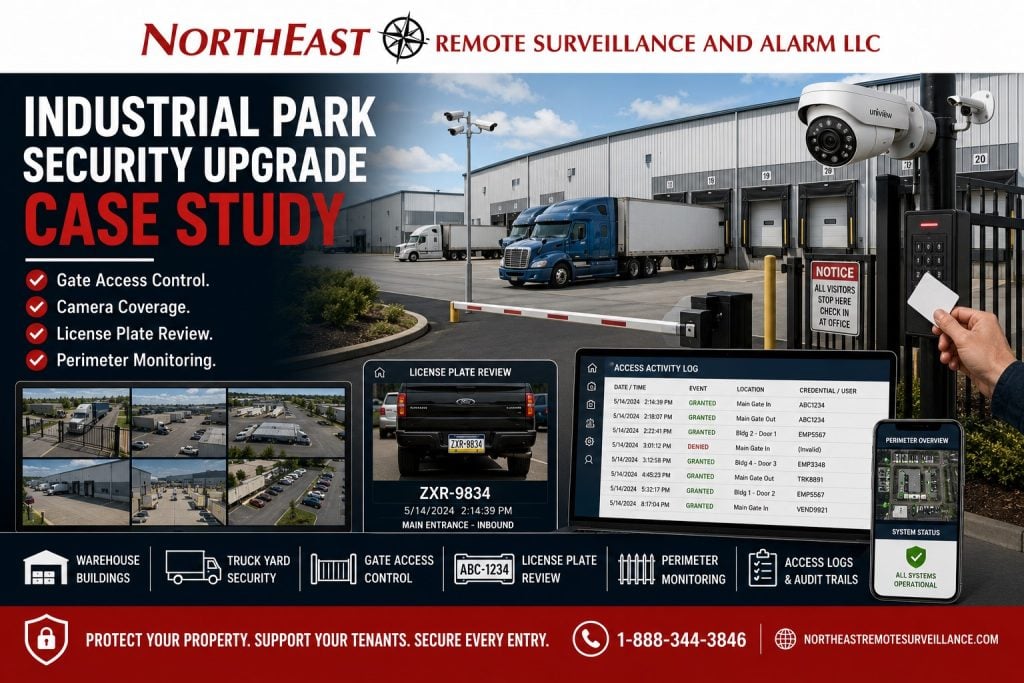
Project Snapshot
| Project Area | Details |
|---|---|
| Facility Type | Industrial park / warehouse campus / multi-building commercial property |
| Primary Concern | Limited perimeter visibility, uncontrolled vehicle movement, older cameras, weak after-hours review, and disconnected security systems |
| Existing Condition | Mixed camera coverage, limited access control, limited license plate review, and inconsistent visibility across tenant and common areas |
| Upgrade Focus | Security cameras, gate access control, perimeter monitoring, license plate review, truck yard visibility, access logs, and remote review |
| Main Goal | Improve industrial park security without disrupting tenants, deliveries, staff, vendors, or daily logistics operations |
| System Approach | Commercial-grade security upgrade designed around traffic flow, tenant spaces, exterior areas, gates, loading zones, and after-hours activity |
| Result | Stronger visibility, better entry control, improved incident review, better after-hours accountability, and a more scalable security platform |
The Problem: The Industrial Park Needed Better Coverage and Better Control
The property had multiple buildings, tenant spaces, vehicle routes, parking areas, loading areas, exterior doors, and after-hours activity. The existing security system was not giving property management enough usable visibility or control.
The industrial park had several common problems:
- Older cameras did not cover the property consistently.
- Some camera views were too wide, too dark, or too low-quality for strong review.
- Vehicle entry and exit activity was not documented clearly.
- Loading docks and truck movement areas needed better visibility.
- Exterior doors and tenant entrances needed stronger accountability.
- After-hours activity was harder to verify.
- Gate activity, access logs, and video review were not tied together effectively.
- The property needed a system that could grow as tenants, traffic, and security needs changed.
The goal was not to install random cameras across the site. The goal was to build a security system around how the industrial park actually operates.
Why Industrial Park Security Is Different
Industrial parks are different from standard office buildings.
They often include large exterior areas, multiple tenants, long drive lanes, shared entrances, employee parking, delivery traffic, vendor access, truck yards, loading docks, trailer storage, maintenance areas, utility areas, and after-hours movement. Security coverage must account for distance, lighting, network pathways, building separation, tenant boundaries, and the need for reliable review after an incident.
A strong industrial park security upgrade should bring together:
- Perimeter cameras
- Building-mounted cameras
- Parking lot cameras
- Loading dock cameras
- Truck yard camera views
- Gate access control
- License plate review
- Access logs
- Remote video review
- After-hours monitoring options
- Network infrastructure
- User permissions
- Documentation
- Long-term service support
One camera at the front of the property is not enough. One keypad at a gate is not enough. The strongest result comes from connecting the security layers into a practical property-wide plan.
Existing System Challenges
The industrial park had several limitations that needed to be corrected.
Older Cameras Had Limited Review Value
Some existing cameras were not positioned for useful review. Others lacked the image quality, lighting performance, angle, or recording reliability needed to support investigations.
A camera system is only valuable if it can help answer real questions:
- Who entered the property?
- What vehicle was involved?
- Which direction did the vehicle travel?
- What happened near the loading dock?
- Did activity happen after hours?
- Was a gate, door, trailer, or exterior area involved?
- Can the footage be searched and exported efficiently?
The previous system did not answer those questions consistently enough.
Vehicle Activity Was Not Documented Clearly
Industrial parks rely on constant vehicle movement. Employees, vendors, delivery vehicles, contractors, box trucks, tractor-trailers, maintenance crews, and visitors may all move through the property.
Without strong entrance, exit, and license plate review, property management may struggle to identify vehicles involved in theft, damage, dumping, after-hours access, unauthorized parking, or tenant disputes.
Shared Areas Needed Better Visibility
Industrial parks often include common areas that are not owned by one tenant but still affect every tenant.
These areas may include:
- Main entrances
- Internal drive lanes
- Shared parking lots
- Loading areas
- Dumpster locations
- Utility areas
- Exterior stairways
- Walkways
- Gate areas
- Trailer parking areas
- Building corners
- Rear service roads
When these areas are not covered properly, property management may not have the information needed to respond to incidents.
Access Control Was Too Limited
The property needed better control over selected gates, tenant doors, staff-only areas, and shared access points. Physical keys, open gates, unmanaged codes, and disconnected systems can create avoidable risk.
Access control can help industrial park owners manage who can enter selected areas, when they can enter, and what activity was recorded.
After-Hours Activity Was Harder to Verify
Many industrial properties look quiet after hours, but that is when theft, dumping, trespassing, vandalism, vehicle damage, trailer activity, and unauthorized access often become harder to manage.
The property needed better tools to review and respond to after-hours activity.
Upgrade Objectives
Northeast Remote Surveillance and Alarm, LLC planned the upgrade around industrial park operations.
The main objectives were:
- Improve camera coverage at entrances, exits, parking areas, loading zones, and shared exterior areas.
- Improve vehicle review and license plate visibility where appropriate.
- Strengthen gate and controlled-area access.
- Improve visibility around tenant entrances and shared doors.
- Support access logs and administrative review.
- Improve after-hours incident review.
- Reduce blind spots around high-risk exterior areas.
- Build a scalable system for future buildings, cameras, gates, and tenants.
- Support remote review by authorized users.
- Improve documentation for property management and service support.
Recommended Solution
NERSA recommended a commercial-grade industrial park security upgrade combining video surveillance, access control, gate security planning, license plate review, and remote review capability.
The system was designed around the actual movement of people and vehicles across the property.
The upgrade focused on:
- Security camera placement at priority views.
- Gate and entrance review.
- License plate capture planning where appropriate.
- Access control for selected gates and doors.
- Perimeter and exterior area visibility.
- Truck yard and loading dock review.
- Parking lot and tenant area coverage.
- Recording and remote access configuration.
- User permission setup.
- Documentation and training.
The result was a system designed for industrial property management, not a generic camera installation.
Scope of Work
The industrial park security upgrade included a complete planning and installation process.
The project scope included:
- Site walkthrough and security assessment.
- Review of existing cameras, gates, doors, network paths, power, and recording equipment.
- Identification of high-priority camera locations.
- Review of entrance and exit points.
- Review of vehicle routes, truck traffic, and delivery areas.
- Review of lighting conditions and camera mounting options.
- Camera upgrade or replacement in selected areas.
- Gate access control planning where applicable.
- Access control reader, keypad, credential, or intercom planning where applicable.
- License plate review planning at selected vehicle points.
- Network and recording equipment review.
- Remote viewing configuration for authorized users.
- Access log and event review planning.
- Testing of camera views, recording, and remote review.
- Documentation and system handoff.
- Recommendations for future expansion.
Camera System Upgrade
The camera upgrade focused on useful coverage, not just camera count.
Industrial park cameras must be selected and placed carefully. Wide exterior areas, long distances, moving vehicles, poor lighting, weather exposure, and mixed tenant activity can make camera design more complex than a standard commercial office.
The upgraded camera plan supported review of areas such as:
- Main vehicle entrances
- Exit lanes
- Gate areas
- Truck routes
- Loading docks
- Trailer parking areas
- Employee parking lots
- Visitor parking areas
- Tenant entrances
- Exterior doors
- Rear service roads
- Dumpster and dumping areas
- Building corners
- Shared walkways
- Perimeter fence lines
- Utility and maintenance areas
The goal was to create camera views that could support real investigation, not just provide a general overview.
Gate Access Control Upgrade
Gate security is one of the most important layers in an industrial park.
Depending on the property, gate access control may include card readers, keypads, mobile credentials, intercoms, vehicle detection, gate operators, access schedules, tenant permissions, and remote management.
A properly planned gate access control system can help property management:
- Control vehicle entry.
- Limit after-hours access.
- Assign access by user or tenant.
- Remove old users quickly.
- Review gate activity.
- Support vendor and maintenance access.
- Reduce unmanaged gate codes.
- Improve accountability at property entrances.
Gate security must be designed around traffic flow, safety, emergency access, tenant operations, and long-term serviceability.
License Plate Review
Vehicle review is critical for industrial parks.
License plate recognition or license plate review cameras can help property management investigate incidents involving vehicles, deliveries, theft, dumping, damage, unauthorized parking, and after-hours activity.
License plate camera planning must consider:
- Camera angle
- Vehicle speed
- Lane width
- Mounting height
- Lighting
- Headlight glare
- Entrance and exit direction
- Recording quality
- Search and export needs
A general parking lot camera is not the same as a properly planned license plate review camera. NERSA evaluates the site before recommending where license plate review will be most useful.
Truck Yard and Loading Dock Visibility
Truck yards and loading docks are high-value security areas.
These areas often involve trailers, freight, equipment, dock doors, drivers, vendor activity, and after-hours movement. Poor visibility can create problems for property managers and tenants when incidents occur.
The upgraded system helped improve review of:
- Trailer movement
- Dock door activity
- Truck arrivals and departures
- After-hours vehicles
- Loading area disputes
- Property damage
- Unauthorized access
- Suspicious activity near freight areas
For related warehouse planning, see Warehouse Security Camera Upgrade Case Study.
Perimeter and Exterior Area Monitoring
Industrial parks need strong perimeter awareness.
The system was planned to improve visibility around exterior areas where incidents are likely to occur but may not be visible from offices or tenant suites.
Important perimeter areas may include:
- Rear building lines
- Fence lines
- Dark corners
- Service roads
- Exterior storage areas
- Utility areas
- Remote parking areas
- Trailer storage zones
- Shared drive lanes
- Open lots
- Property entrances
A well-planned perimeter camera layout helps property management review activity before it becomes a bigger issue.
Access Logs and Audit Trails
Access logs help property management understand activity at controlled gates and doors.
Depending on the system configuration, access logs may show:
- Who used a credential
- Which gate or door was accessed
- When access occurred
- Whether access was granted or denied
- Whether activity happened after hours
- Whether a gate or door was held open
- Whether a forced-door condition occurred
Access logs become more valuable when reviewed with camera footage. The log shows the event. The camera helps show what happened.
Video and Access Control Working Together
The strongest part of the upgrade was the connection between access control and video review.
When gate events, door events, and camera views are planned together, property management can better review:
- Vehicle entry events
- Tenant access activity
- Denied access attempts
- After-hours gate use
- Held-open gates or doors
- Unauthorized vehicle movement
- Visitor or vendor entry
- Incidents near loading areas
- Activity near tenant spaces
Disconnected systems make investigations slower. Integrated planning makes review clearer.
For broader integration planning, see Commercial & Enterprise Unified / Integrated Security Systems.
Remote Video Review
Industrial park managers often need to review activity without being physically on site.
Remote video review can help authorized users check cameras, review incidents, verify activity, export clips, and support tenant concerns. This is especially useful for multi-building properties, after-hours incidents, and property managers responsible for more than one site.
Remote access must be configured with proper user permissions, strong account management, and a clear understanding of who is allowed to view or export footage.
After-Hours Security
After-hours security was a major focus of the upgrade.
Industrial parks may experience after-hours risks such as:
- Trespassing
- Dumping
- Vandalism
- Fuel theft
- Equipment theft
- Trailer theft
- Copper or material theft
- Unauthorized parking
- Vehicle damage
- Door tampering
- Gate misuse
- Suspicious activity near tenant spaces
The upgraded system improved the property’s ability to review and document after-hours activity.
Network and Infrastructure Planning
Industrial park security often requires more infrastructure planning than a single-building installation.
Large properties may need network switches, fiber links, wireless bridges, equipment cabinets, surge protection, UPS backup, weather-rated enclosures, trenching coordination, conduit planning, and structured cable pathways.
NERSA evaluates infrastructure before recommending equipment. A camera system is only as strong as the network, power, mounting, and recording design supporting it.
Before and After
| Before Upgrade | After Upgrade |
|---|---|
| Mixed camera coverage with blind spots | Improved camera coverage at priority areas |
| Limited vehicle review | Better entrance, exit, and license plate review planning |
| Unclear after-hours activity | Stronger after-hours review and documentation |
| Gate or door activity was difficult to audit | Access logs support review of selected controlled areas |
| Disconnected systems | Video and access control can support each other |
| Limited remote review | Authorized users can review cameras and incidents more efficiently |
| Harder tenant support | Better documentation for property management and tenant concerns |
| Reactive security management | More structured industrial park security operations |
Results
The industrial park gained a stronger, more manageable security system.
The upgrade helped deliver:
- Better visibility across priority areas.
- Stronger camera coverage at entrances, exits, parking areas, and loading zones.
- Better review of vehicle activity.
- Improved gate and access control planning.
- Access logs for selected gates or doors.
- Better after-hours accountability.
- More useful video review.
- Stronger support for tenant concerns.
- Improved documentation for incidents.
- A scalable platform for future expansion.
The result was not just a camera upgrade. It was a better property-wide security management system.
Why This Project Was a Good Fit for NERSA
Northeast Remote Surveillance and Alarm, LLC focuses on commercial, industrial, institutional, and non-residential security systems.
Industrial parks need a security provider that understands exterior cameras, access control, gate systems, truck traffic, warehouse activity, network infrastructure, tenant needs, remote review, after-hours risk, and long-term service support.
NERSA designs security systems around the way the property actually operates.
For broader industrial planning, see Industries We Serve.
What This Case Study Is and Is Not
This page is an industrial park security upgrade case study.
It is not a residential security page. It is not a single-camera product page. It is not a general alarm-only page. It is not a fire alarm design page. It is not a generic office security article.
This page focuses on industrial park security: cameras, access control, gate security, perimeter visibility, loading areas, truck yards, license plate review, tenant access, remote review, after-hours accountability, and long-term support.
Lessons From This Case Study
This industrial park security upgrade shows several important lessons:
- Industrial parks need property-wide planning, not random camera placement.
- Vehicle review is one of the most important security layers.
- Gate access control is stronger when paired with camera review.
- Loading docks and truck yards require dedicated visibility.
- Access logs become more useful when connected to video review.
- Remote viewing helps property managers respond faster.
- After-hours activity must be planned for directly.
- Network infrastructure can determine whether the system performs reliably.
- Tenant needs should be considered during system design.
- A scalable system is better than a short-term patch.
When an Industrial Park Should Consider a Security Upgrade
An industrial park should consider a security upgrade if:
- Camera coverage has blind spots.
- Existing footage is unclear or hard to search.
- Gate activity is not well documented.
- Vehicle entry and exit activity is difficult to review.
- License plate review is needed.
- Loading docks or truck yards have security concerns.
- Tenants report theft, dumping, damage, or unauthorized access.
- After-hours activity is difficult to verify.
- Physical keys or shared gate codes are hard to manage.
- Multiple buildings or tenants need better security coordination.
- Property management needs better remote review.
- The current system cannot scale.
Industrial Park Security Upgrade Planning Checklist
Before upgrading an industrial park security system, property owners should evaluate:
- Main entrances and exits
- Vehicle lanes
- Gate locations
- Truck routes
- Loading docks
- Trailer parking areas
- Tenant entrances
- Shared parking lots
- Rear service roads
- Perimeter fence lines
- Exterior storage areas
- Lighting conditions
- Camera mounting locations
- Network pathways
- Power availability
- Recording retention needs
- Remote review needs
- User permissions
- Access logs
- Tenant requirements
- Future expansion plans
Request an Industrial Park Security Assessment
If your industrial park, warehouse campus, logistics property, manufacturing site, contractor yard, or multi-tenant commercial property needs better cameras, gate access control, license plate review, perimeter monitoring, remote video review, or after-hours security support, Northeast Remote Surveillance and Alarm, LLC can help.
Call 1-888-344-3846 or use Request a Security Assessment to schedule an industrial park security upgrade review.
Frequently Asked Questions About Industrial Park Security Upgrades
What is an industrial park security upgrade?
An industrial park security upgrade improves protection across a multi-building commercial or industrial property. It may include security cameras, access control, gate security, license plate review, perimeter monitoring, remote video review, access logs, and tenant-area coverage.
Why do industrial parks need more than basic cameras?
Industrial parks have large exterior areas, truck traffic, tenant spaces, loading docks, parking lots, gates, and after-hours activity. Basic cameras often miss the areas where incidents occur or fail to provide the detail needed for strong review.
Can access control help manage industrial park gates?
Yes. Gate access control can help property management control who enters the site, limit after-hours access, remove old users, assign tenant permissions, and review gate activity.
Is license plate recognition useful for industrial parks?
Yes. License plate review can help document vehicle activity at entrances, exits, truck yards, and parking areas. It is especially useful for theft investigations, dumping, vehicle damage, unauthorized parking, and after-hours activity.
What areas should industrial park cameras cover?
Important camera areas may include entrances, exits, gate areas, truck routes, loading docks, trailer parking, tenant entrances, employee parking, visitor parking, rear service roads, dumpster areas, utility areas, and perimeter fence lines.
Can industrial park managers review cameras remotely?
Yes. Remote video review can allow authorized users to check cameras, search recordings, export clips, and respond to incidents without being physically on site. Proper user permissions and account security should be configured.
How do access logs help industrial property managers?
Access logs can show who used a credential, which gate or door was accessed, when access occurred, and whether access was granted or denied. When paired with video, access logs give property managers stronger incident review.
Can NERSA upgrade older industrial park camera systems?
Yes. NERSA can evaluate older cameras, weak image quality, poor camera placement, outdated recorders, limited remote access, poor retention, network issues, and blind spots before recommending an upgrade plan.
Does every industrial park need gate access control?
Not every site needs gate access control, but many industrial parks benefit from controlled vehicle access, especially when there is after-hours traffic, tenant movement, truck activity, equipment storage, trailer parking, or repeated unauthorized access.
How do we start an industrial park security upgrade?
Call 1-888-344-3846 or use Request a Security Assessment. NERSA can review entrances, gates, cameras, truck routes, tenant areas, loading docks, parking areas, network infrastructure, and long-term support needs before recommending a system.