
Contractor-yard video surveillance in the Lehigh Valley should be designed around vehicle gates, fleet parking, tools, equipment, trailers, exterior materials, detached buildings, fence lines, employee entrances, and after-hours exposure—not around a generic camera package.

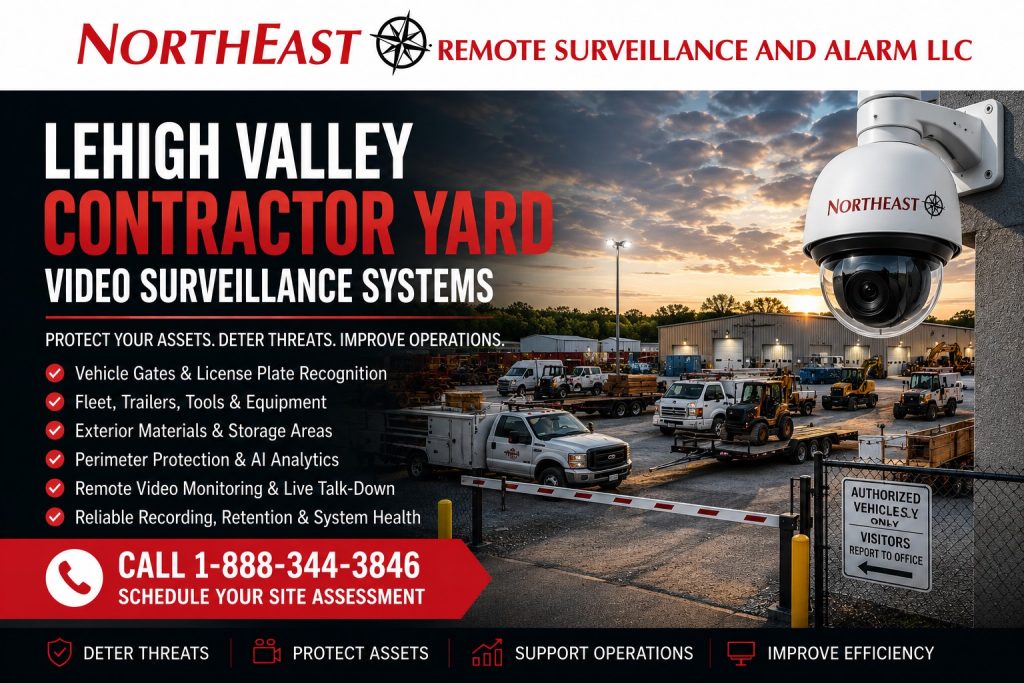
Electrical contractors, mechanical contractors, construction companies, excavation firms, paving operations, landscaping businesses, service fleets, utility contractors, equipment companies, and material-storage properties often operate differently from conventional offices, warehouses, or retail businesses.
A contractor yard may contain:
- Work trucks
- Service vans
- Trailers
- Heavy equipment
- Portable tools
- Building materials
- Fueling areas
- Outdoor storage
- Maintenance buildings
- Offices and shops
- Employee parking
- Vehicle gates
- Fence lines
- Remote sections with limited power or network access
Northeast Remote Surveillance and Alarm, LLC designs, installs, upgrades, integrates, monitors and supports contractor-yard camera systems. We serve Allentown, Bethlehem, Easton, Lehigh County and Northampton County, including properties along Route 22, Route 33 and I-78.
NERSA plans contractor-yard camera systems around:
- Vehicle and pedestrian gates
- Fleet entrances and exits
- Tools, equipment, and material storage
- Trailer parking
- Service and maintenance buildings
- Employee and contractor entrances
- Fueling and equipment areas
- Fence lines and perimeter exposure
- Yard lighting and nighttime visibility
- License plate capture
- AI-supported perimeter analytics
- Local, cloud, or hybrid recording
- Secure remote viewing
- Remote video monitoring
- Live audio talk-down
- Camera and recorder health
- Fiber, wireless, cellular, and network infrastructure
- Existing-system upgrades
- Multi-location administration
- Long-term service and lifecycle planning
A few cameras overlooking an open lot do not establish complete yard coverage. Plan each view to give authorized personnel useful evidence when reviewing theft, trespassing, vehicle incidents, equipment loss, or material discrepancies. The same footage may help clarify gate concerns, contractor issues, property-damage claims, and after-hours alarms.
Call 1-888-344-3846 to schedule a Lehigh Valley contractor-yard video surveillance assessment.
For regional camera planning across commercial and industrial properties, visit Lehigh Valley Commercial Video Surveillance Systems.
For complete contractor-yard protection involving cameras, access control, intrusion alarms, gates, monitoring, intercoms, and supporting infrastructure, continue to Lehigh Valley Contractor Yard Security Systems.
For NERSA’s primary sitewide camera-system resource, visit Commercial and Industrial Video Surveillance Systems.
Contractor-Yard Cameras Should Follow the Operation
Contractor properties are active environments where employees, subcontractors, vendors, customers, vehicles, trailers, tools, equipment, and materials may enter or leave throughout the day.
Before cameras are selected, the business should identify:
- Where vehicles enter and exit
- Where employees park
- Where workers report
- Where trailers are staged
- Where tools and equipment are stored
- Which materials remain outdoors
- Where fueling or maintenance occurs
- Which buildings contain offices or inventory
- Which areas are used after hours
- Where fence lines are vulnerable
- Which locations lack power or network connectivity
- Which incidents require identification-level detail
- Whether license plates must be captured
- How long recordings should remain available
- Who needs remote access
- Whether active after-hours monitoring is needed
- Whether additional yards or facilities may be added
A single wide-angle camera may show activity across the property while failing to capture enough detail to identify a person, vehicle, trailer, piece of equipment, or movement through a gate.
A stronger contractor-yard camera design may combine:
- Wide-area overview cameras
- Focused vehicle-gate cameras
- Dedicated pedestrian-entrance views
- Fleet and trailer-row cameras
- Tool and equipment-storage coverage
- Material-yard cameras
- Fueling-area surveillance
- Shop and office entrance cameras
- Fence-line views
- License plate recognition
- AI-supported perimeter detection
- Wireless or cellular cameras
- Remote-monitoring cameras
- Audio speakers for approved live talk-down
Each camera should have a clearly documented purpose.
Vehicle Gates and Yard Entrances
The vehicle entrance is often one of the most important camera positions at a contractor property.
Gate-area planning may need to document:
- Employee vehicles
- Fleet vehicles
- Service trucks
- Trailers
- Vendors
- Deliveries
- Subcontractors
- Visitors
- Vehicles entering after hours
- Gate opening and closing
- Direction of travel
A useful gate-camera plan may include:
- A general entrance overview
- A focused driver-side view
- A dedicated license plate camera
- A camera showing the gate operator
- A camera covering adjacent pedestrian access
- An intercom or visitor-entry view
General overview cameras and license plate cameras serve different purposes.
A broad camera may show traffic flow and vehicle type, while reliable plate capture usually requires controlled camera angle, distance, mounting height, lighting, lane width, and vehicle speed.
For complete vehicle-entry planning involving operators, credentials, intercoms, safety equipment, and emergency access, visit Commercial and Industrial Access Control Systems.
Fleet Vehicle and Trailer Surveillance
Contractor yards may contain:
- Service vans
- Pickup trucks
- Bucket trucks
- Dump trucks
- Utility vehicles
- Equipment trailers
- Enclosed trailers
- Flatbed trailers
- Specialty vehicles
- Rental equipment
Camera coverage may help document:
- Vehicle arrival and departure
- Trailer movement
- Equipment loading
- After-hours access
- Vehicle damage
- Fuel theft
- Unauthorized use
- Activity around parked assets
- Contractor or vendor movement
Fleet cameras should be planned around actual parking patterns.
A yard may look open during the assessment but become densely packed with trucks and trailers overnight. Camera positions should account for:
- Vehicle height
- Trailer rows
- Seasonal fleet changes
- Large equipment
- Obstructed sightlines
- Lighting
- Snow or weather conditions
- Future fleet expansion
An elevated overview may provide general context, while focused views may be required at vehicle lanes, trailer rows, fueling points, or equipment-transfer areas.
Tools, Equipment, and Material Storage
Contractor operations may store high-value assets outdoors or in lightly staffed buildings.
These may include:
- Power tools
- Hand tools
- Cable and wire
- Copper
- HVAC equipment
- Pipe and fittings
- Construction materials
- Landscaping equipment
- Generators
- Compressors
- Welders
- Skid steers
- Excavators
- Lifts
- Specialty machinery
- Customer-owned equipment
Camera planning may focus on:
- Tool cages
- Storage containers
- Equipment rows
- Material racks
- Warehouse or shop entrances
- Loading areas
- Checkout locations
- Detached storage buildings
- Exterior inventory
- Restricted areas
A distant yard overview may not provide useful evidence at a specific tool cage, storage container, equipment row, or transfer point.
Focused cameras should be considered where the business needs stronger detail for:
- Asset movement
- Employee checkout
- Equipment loading
- Material delivery
- Inventory disputes
- Unauthorized entry
- After-hours activity
Fence Lines and Perimeter Exposure
Contractor yards commonly have long fence lines, wooded boundaries, neighboring properties, railroad edges, road frontage, or remote sections that are difficult to supervise.
Perimeter planning may involve:
- Fence corners
- Rear boundaries
- Gaps between buildings
- Gates
- Exterior storage near the perimeter
- Dark areas
- Frequently breached locations
- Remote equipment
- Adjacent public access
- Wooded or uneven terrain
Potential camera technologies may include:
- Fixed perimeter cameras
- Pan-tilt-zoom cameras
- Low-light cameras
- Thermal cameras for selected applications
- AI-supported intrusion analytics
- Wireless or cellular cameras
- Solar-powered systems where properly engineered
- Remote video monitoring
- Live audio speakers
Cameras should not be selected solely because they advertise long range.
Effective perimeter surveillance depends on:
- Subject size in the image
- Camera angle
- Lighting
- Environmental conditions
- Vegetation
- Weather
- Mounting stability
- Network communication
- Power
- Detection-zone configuration
- Defined response procedures
Trees, vegetation, flags, shadows, precipitation, insects, headlights, and animals can affect exterior analytics.
Shops, Offices, and Detached Buildings
Contractor properties may include:
- Main offices
- Dispatch offices
- Shops
- Maintenance buildings
- Parts rooms
- Tool rooms
- Storage buildings
- Training areas
- Detached garages
- Remote utility buildings
Camera coverage may be useful at:
- Main office entrances
- Employee entrances
- Shop doors
- Overhead doors
- Tool-room entrances
- Parts counters
- Service bays
- Detached-building entrances
- Office-to-yard transitions
These views may provide context for:
- Employee entry
- Contractor access
- Door alarms
- Tool and material movement
- After-hours access
- Shop activity
- Reported incidents near an opening
When doors use electronic access control, compatible systems may associate selected credential and door events with nearby video.
For ongoing credential administration, controller-health awareness, door-status oversight, and lifecycle support, visit Managed Access Control Systems and System Health Monitoring.
Fueling and Maintenance Areas
Some contractor yards maintain on-site fueling, service, repair, or equipment-washing areas.
Camera planning may help document:
- Fueling activity
- Vehicle positioning
- Employee use
- Vendor access
- Equipment maintenance
- Property damage
- Unauthorized activity
- After-hours use
The camera location should provide useful operational context without being exposed unnecessarily to impact, vibration, water, chemicals, or obstruction.
Potential concerns include:
- Strong glare
- Vehicle headlights
- Large trucks blocking views
- Equipment movement
- Weather
- Steam or spray
- Nighttime lighting
- Hazardous or restricted locations
Equipment selection and installation should reflect the actual environment.
Video surveillance does not replace fuel-management controls, employee procedures, environmental safeguards, fire protection, or other required systems.
Employee Parking and Pedestrian Approaches
Employee parking and walking routes may affect:
- Worker safety
- Vehicle-damage claims
- Theft investigations
- Shift-change activity
- Employee arrival and departure
- After-hours awareness
- General property documentation
Camera planning should review:
- Vehicle paths
- Pedestrian walkways
- Building entrances
- Side and rear parking
- Accessible parking
- Lighting
- Blind spots
- Gate approaches
- Shop and office entrances
- Nighttime image quality
A wide parking overview may show general activity while failing to identify the person, vehicle, or exact sequence involved in an incident.
Some properties benefit from:
- Wide parking-lot views
- Focused entrance cameras
- Vehicle-lane cameras
- Pedestrian-approach cameras
- LPR at selected entry points
For dedicated exterior-camera planning, visit Lehigh Valley Parking Lot Security Cameras.
License Plate Recognition for Contractor Yards
License plate recognition may help document vehicles entering or leaving selected lanes.
Potential applications include:
- Main yard entrances
- Employee parking gates
- Contractor entrances
- Vendor lanes
- Delivery approaches
- Fleet exits
- Restricted vehicle areas
Reliable plate capture depends on:
- Vehicle speed
- Lane width
- Camera angle
- Mounting height
- Direction of travel
- Lighting
- Headlight glare
- Plate size in the image
- Dedicated camera settings
A standard surveillance camera may capture a plate occasionally without providing reliable, searchable LPR results.
The business should determine whether the goal is:
- General vehicle documentation
- Searchable plate records
- Selected plate alerts
- Delivery verification
- Gate support
- Incident investigation
AI Video Analytics and Smart Search
AI-supported video may help authorized users find selected activity faster and reduce unnecessary alerts from routine movement.
Depending on the platform and configuration, analytics may assist with:
- Person detection
- Vehicle classification
- Line crossing
- Perimeter intrusion
- Loitering
- Direction of travel
- Activity within selected areas
- After-hours movement
- Object appearance or removal
- Faster recorded-video search
AI should not replace proper camera placement.
Analytics perform best when:
- Camera views are stable
- Subjects are large enough in the image
- Lighting is suitable
- Detection zones are configured correctly
- Vegetation is controlled
- Network communication is dependable
- Recording is functioning
- The analytic matches the business objective
Exterior contractor yards can present difficult analytic conditions because of:
- Moving trees and vegetation
- Weather
- Animals
- Headlights
- Equipment movement
- Shadows
- Flags or tarps
- Dust
- Steam
- Rapid lighting changes
The system should be tested against real site conditions rather than assumed to perform perfectly from manufacturer specifications.
Remote Video Monitoring and Live Talk-Down
Contractor yards are strong candidates for remote video monitoring because many have valuable outdoor assets and limited staffing after hours.
Monitoring may be appropriate for:
- Vehicle gates
- Fence lines
- Equipment rows
- Material storage
- Trailer parking
- Fueling areas
- Shop entrances
- Detached buildings
- Exterior yards
- Repeat trespassing areas
A properly defined service may include:
- Analytics-generated events
- Monitoring-operator review
- Video verification
- Live audio warnings
- Customer notification
- Escalation under approved procedures
Remote video monitoring is different from allowing an owner to view cameras through a phone.
A monitored program requires:
- Selected cameras
- Defined schedules
- Appropriate analytics
- Current contact information
- Written escalation procedures
- Suitable speaker placement
- Clear authority for live intervention
- Reliable system communication
Local, Cloud, and Hybrid Recording
Contractor-yard video can be recorded and managed through on-premises, cloud-managed, or hybrid platforms.
On-Premises Recording
Local recording may be appropriate for:
- Larger camera counts
- Longer retention
- High recording bandwidth
- Local storage control
- Limited internet capacity
- Existing network infrastructure
On-premises systems still require:
- Recorder or server maintenance
- Hard-drive monitoring
- Secure remote access
- User administration
- Software support
- Cybersecurity
- Backup planning
- Lifecycle management
Cloud-Managed Video
Cloud-managed systems may provide:
- Remote administration
- Central user management
- Mobile access
- Multi-location visibility
- Device-health information
- Easier expansion
- Subscription-based services
The customer should understand:
- Recurring costs
- Internet requirements
- Retention limits
- Primary account ownership
- Data export
- Outage behavior
- Local recording capabilities
- Long-term platform support
Hybrid Video Surveillance
Hybrid systems may combine local recording with cloud-based:
- Administration
- Remote viewing
- Health alerts
- Event management
- Analytics
- Selected backup services
- Multi-site dashboards
The correct architecture depends on camera count, video retention, internet reliability, cybersecurity, internal resources, remote access, subscriptions, and long-term operating cost.
Recording and Video Retention
A contractor-yard camera system provides limited value if footage was never recorded correctly or has already been overwritten.
Actual retention depends on:
- Number of cameras
- Resolution
- Frame rate
- Compression
- Scene activity
- Recording schedules
- Continuous or event-based recording
- Storage capacity
- Audio
- Analytic metadata
- Added cameras
- Failed or degraded drives
A recorder designed for a specific retention period may no longer provide that retention after cameras are added or recording quality changes.
Retention planning should consider:
- Delayed discovery of stolen tools or materials
- Vehicle-damage claims
- Customer or contractor disputes
- Equipment investigations
- Employee incidents
- Insurance expectations
- Evidence exports
- Internal reporting procedures
The oldest available footage should be checked rather than estimated only from storage settings.
A business that typically discovers inventory loss several weeks later should not assume a short recording period will meet its investigative needs.
Managed Camera and Recorder Health Monitoring
Contractor-yard camera systems can fail quietly.
A camera may remain powered but stop recording. A wireless bridge may become unstable. A recorder may appear online while storage becomes degraded. A remote yard may stop communicating without anyone noticing.
Compatible health-monitoring services may help identify:
- Offline cameras
- Repeated camera disconnections
- Recording interruptions
- Recorder failures
- Storage trouble
- Degraded drives
- Reduced retention
- Network communication loss
- Wireless-link failures
- Cloud gateway problems
- Licensing issues
- Time-synchronization problems
- Sites that stop reporting
Health monitoring does not guarantee uninterrupted operation and does not replace physical inspection.
It improves awareness of technical conditions that might otherwise remain hidden until footage is needed.
For broader technical monitoring across cameras, access control, alarms, networks, servers, and power systems, visit Commercial Security System Health Monitoring.
Preventive Maintenance and Physical Camera Inspection
Remote health information cannot identify every physical condition.
Scheduled maintenance may include:
- Cleaning lenses
- Removing insects and spiderwebs
- Verifying camera views
- Checking focus
- Inspecting mounts
- Reviewing nighttime image quality
- Checking enclosures
- Testing recording
- Reviewing actual retention
- Confirming system time
- Testing remote access
- Reviewing user accounts
- Inspecting recorder condition
- Checking UPS and backup power
- Testing wireless links
- Updating documentation
Contractor yards change frequently.
New trailers, storage containers, material piles, vehicles, fencing, signs, vegetation, temporary structures, or equipment may block views that were useful when installed.
Critical cameras should be reviewed periodically to confirm they still support their original purpose.
Wireless, Cellular, Fiber, and Network Infrastructure
Contractor yards often contain areas where conventional building cabling is difficult or impractical.
Potential connectivity options may include:
- Cat6 or Cat6A cabling
- Fiber-optic links
- Point-to-point wireless bridges
- Point-to-multipoint wireless
- Cellular communication
- Local edge recording
- Solar power where properly engineered
- PoE switches
- Remote enclosures
- UPS equipment
- Backup batteries
- Surge protection
- Network segmentation
- Secure remote access
Many apparent camera failures originate from infrastructure problems such as:
- Damaged cabling
- Failed PoE ports
- Insufficient bandwidth
- Weak wireless links
- Misaligned bridges
- Power interruptions
- Poor battery performance
- Cellular communication loss
- Water intrusion
- Inadequate enclosures
- Surge damage
- Undocumented network changes
Wireless, cellular, and solar solutions should not be used casually.
The design should account for:
- Distance
- Line of sight
- Bandwidth
- Interference
- Weather
- Power consumption
- Battery capacity
- Solar exposure
- Seasonal conditions
- Recording needs
- Maintenance access
- Communication redundancy
The network and power architecture should be planned as part of the security system.
Integration With Access Control, Gates, and Intrusion Alarms
Contractor-yard cameras may provide context for:
- Gate openings
- Credential activity
- Access denied
- Forced doors
- Doors held open
- Intrusion alarms
- Fence-line activity
- Shop entrances
- After-hours access
- Visitor releases
- Contractor movement
Compatible integration may allow authorized users to move from a gate, door, or alarm event to relevant footage more efficiently.
Integration should solve a practical operating need and should not interfere with required gate safety, emergency access, egress, fire alarm functions, or other life-safety systems.
For broader coordination among cameras, access control, intrusion alarms, intercoms, monitoring, and reporting, visit Unified and Integrated Commercial Security Systems.
Multi-Location Contractor-Yard Management
Contractors with several branches, yards, shops, or material-storage properties may inherit:
- Different camera manufacturers
- Separate recorders
- Inconsistent camera names
- Different retention periods
- Shared passwords
- Unclear account ownership
- Unsupported software
- Separate mobile applications
- Missing documentation
- Different service providers
A coordinated management program may establish:
- Central user administration
- Location-specific permissions
- Standard camera naming
- Camera and recorder inventories
- Retention standards
- Health reporting
- Service-ticket tracking
- Preventive maintenance
- Recurring-failure analysis
- Platform-migration planning
- Lifecycle priorities
Every yard does not need immediate replacement.
Supportable systems may remain in service while the organization develops a phased standardization plan.
For multi-location administration, service coordination, reporting, documentation, and lifecycle planning, visit Multi-Site Security System Management.
Contractor-Yard Video Surveillance Upgrades and Takeovers
A contractor property may require modernization because of:
- Poor image quality
- Weak nighttime performance
- Offline cameras
- Failed recorders
- Insufficient storage
- Short retention
- Difficult footage retrieval
- Insecure remote access
- Installer-owned accounts
- Unsupported software
- Poor camera positioning
- Weak wireless communication
- Inadequate network infrastructure
- Limited expansion capacity
An assessment may determine what can be:
- Retained
- Repositioned
- Reconfigured
- Repaired
- Expanded
- Integrated
- Migrated
- Replaced in phases
A successful takeover should leave the customer with:
- Customer-controlled accounts
- Documented camera locations
- Clear camera names
- Verified recording
- Known retention
- Secure user access
- Supportable infrastructure
- Defined service procedures
- A practical modernization plan
Existing equipment does not need to be replaced merely because another provider installed it.
It may remain when it is compatible, dependable, secure, accessible, serviceable, and appropriate for the completed system.
Contractor-Yard Video From Small Shops to Regional Fleets
A smaller contractor shop may require:
- Office and shop entrance cameras
- Tool-storage coverage
- Fleet parking views
- Vehicle-gate visibility
- Local recording
- Secure remote access
A larger yard may require:
- Multiple gate cameras
- Trailer-row coverage
- Equipment and material surveillance
- Fence-line cameras
- Fueling-area views
- LPR
- Wireless infrastructure
- AI perimeter detection
- Remote monitoring
- Managed camera health
A regional contractor with several locations may require:
- Centralized users
- Location-specific permissions
- Standard camera names
- Consistent retention
- Multi-site dashboards
- Health reporting
- Service coordination
- Documented platform standards
- Lifecycle planning
The system should address current risks without preventing future vehicles, equipment, cameras, buildings, or locations from being added.
The NERSA Contractor-Yard Video Surveillance Process
Property and Operations Review
NERSA reviews:
- Property layout
- Vehicle entrances
- Employee movement
- Fleet parking
- Trailer storage
- Tools and equipment
- Exterior materials
- Shops and offices
- Fence lines
- Lighting
- Existing cameras
- Known incidents
- After-hours exposure
Camera-Purpose Planning
Each proposed camera receives a defined objective, such as:
- Yard overview
- Gate documentation
- License plate capture
- Fleet-area coverage
- Trailer surveillance
- Tool-storage review
- Equipment monitoring
- Shop-entrance identification
- Fence-line detection
- Alarm verification
Recording and Retention Planning
The design may evaluate:
- Camera count
- Resolution
- Frame rate
- Compression
- Recording architecture
- Storage capacity
- Actual retention
- Expansion needs
- Evidence-export requirements
Infrastructure Review
Planning may include:
- Cabling
- Fiber
- Wireless links
- Cellular communication
- Solar power where appropriate
- PoE switching
- Bandwidth
- Backup power
- Network security
- Remote enclosures
- Equipment locations
Installation and Configuration
Approved systems are configured around:
- Camera views
- Camera names
- Recording requirements
- User permissions
- Remote access
- Analytics
- Monitoring
- Included integrations
Testing and Commissioning
Testing may include:
- Live-image verification
- Recording checks
- Playback
- Search
- Video export
- Retention verification
- Remote access
- User permissions
- LPR operation where included
- Analytic events
- Health-monitoring functions
- Included integrations
Training and Documentation
Authorized users may receive instruction on:
- Live viewing
- Recorded-video search
- Video export
- Mobile access
- User administration
- Incident review
- Monitoring procedures
- Requesting service
Project documentation may identify:
- Camera names
- Camera locations
- Recorder information
- Storage
- Expected retention
- User roles
- Network requirements
- Primary accounts
- Monitoring scope
- Service information
Frequently Asked Questions About Contractor-Yard Video Surveillance
What is a contractor-yard video-surveillance system?
It is a commercial camera, recording, storage, viewing, analytics, and management system designed for gates, fleet vehicles, trailers, tools, equipment, materials, shops, offices, fence lines, parking areas, and exterior property activity.
Where should contractor-yard cameras be installed?
Common priorities include vehicle entrances, pedestrian gates, fleet parking, trailer rows, equipment storage, tool cages, material areas, shops, offices, fueling areas, fence lines, detached buildings, and exterior approaches.
Can one camera cover an entire contractor yard?
It may provide a general overview, but it is unlikely to provide useful detail across every gate, vehicle, trailer, tool area, fence line, and building. Most yards need several cameras with different purposes.
Can cameras identify license plates?
Dedicated LPR cameras may capture plates at selected lanes when angle, distance, speed, lighting, and mounting position are properly controlled. Standard overview cameras should not be assumed to provide reliable plate capture.
Can cameras protect tools and equipment?
Cameras may deter some activity and provide useful evidence, but they do not physically prevent theft. Stronger protection may combine video with gates, access control, intrusion detection, lighting, monitoring, and operating procedures.
Is remote viewing the same as active monitoring?
No. Remote viewing allows authorized users to access cameras. Remote video monitoring is a separate service involving selected cameras, alert rules, schedules, trained operators, and defined response procedures.
Can monitoring operators speak to trespassers?
Compatible monitored systems may support live audio warnings when speakers, cameras, analytics, schedules, and response procedures are properly configured.
Are wireless cameras suitable for large yards?
Wireless links can support cameras where cabling is impractical, but the design must consider distance, line of sight, interference, bandwidth, weather, power, maintenance, and recording needs.
Can solar-powered cameras be used?
Possibly. Solar systems must be engineered around camera load, communication, battery capacity, seasonal sunlight, weather, recording method, and required availability.
Can NERSA monitor camera and recorder health?
Compatible systems may provide health information for cameras, recorders, storage, networks, wireless links, cloud gateways, licensing, and other supported conditions through Managed Video Surveillance and Camera System Health Monitoring.
Can cameras integrate with gates and access control?
Compatible platforms may associate gate or door events with nearby footage and help authorized users review credential activity, forced openings, visitor releases, and after-hours access.
Should a contractor yard use local or cloud recording?
The correct architecture depends on camera count, retention, bandwidth, internet reliability, remote access, cybersecurity, subscription preferences, and multi-location requirements.
Can existing contractor-yard cameras be upgraded?
Possibly. NERSA can evaluate cameras, mounts, views, cabling, wireless links, recorders, storage, software, accounts, remote access, and infrastructure to determine what may be retained, repaired, expanded, migrated, or replaced.
Can several contractor yards be managed from one platform?
Compatible systems may support centralized users, location-specific permissions, standard naming, health reporting, retention standards, multi-site viewing, and coordinated service.
Does NERSA install single-family home camera systems?
No. Northeast Remote Surveillance and Alarm, LLC focuses on commercial, industrial, contractor, fleet, warehouse, manufacturing, logistics, institutional, municipal, healthcare, educational, and multi-site properties.
Request a Lehigh Valley Contractor-Yard Video Surveillance Assessment
NERSA can evaluate:
- Vehicle gates
- Pedestrian entrances
- Fleet parking
- Trailer rows
- Tools and equipment
- Exterior materials
- Shops and offices
- Detached buildings
- Fueling areas
- Maintenance areas
- Fence lines
- Exterior approaches
- Existing cameras
- Yard lighting
- Required image detail
- License plate requirements
- Recording
- Storage
- Retention
- Remote access
- User permissions
- Account ownership
- AI analytics
- Cabling
- Fiber
- Wireless communication
- Cellular connectivity
- Remote monitoring
- Live talk-down
- Camera-health capabilities
- Future expansion
Call Northeast Remote Surveillance and Alarm at 1-888-344-3846 to schedule a Lehigh Valley contractor-yard video surveillance assessment.
For regional camera planning, return to Lehigh Valley Commercial Video Surveillance Systems.
For complete contractor-yard protection, continue to Lehigh Valley Contractor Yard Security Systems.
Plan Your Next Security Improvement
Tell NERSA about your commercial facility, existing systems, and project priorities. We can help you plan an installation, evaluate an upgrade, or coordinate security across multiple locations.
Compliance, Codes & Project Standards
NERSA plans commercial and industrial security work with applicable code, documentation, inspection and authority-having-jurisdiction requirements in mind. Requirements vary by system, property and jurisdiction. These resources support project planning; they do not establish legal compliance, certification or AHJ approval.
Related guidance: Regulatory compliance & inspection readiness · Video surveillance compliance · NERSA project standards