
Estimate license plate recognition system costs around vehicle lanes, capture conditions, equipment placement, software, retention, and required integrations.

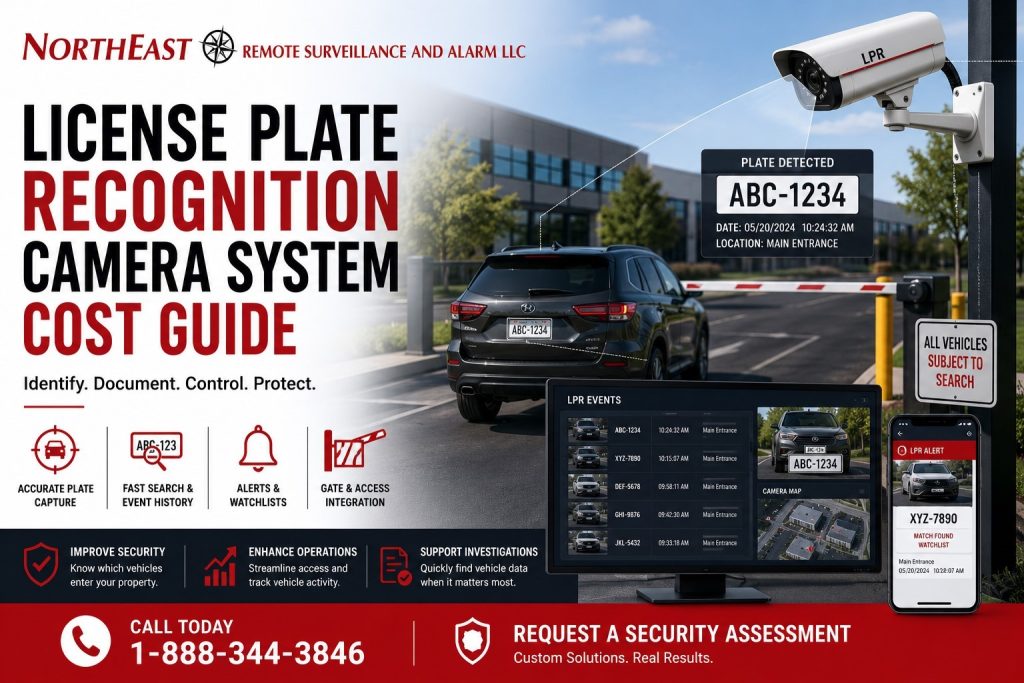
This guide helps commercial and industrial buyers understand what drives LPR camera cost and how to plan a system that captures usable plate data instead of just general vehicle footage.
For the broader pricing structure, start with Commercial & Industrial Security System Costs, Comparisons & Buyer Guides.
License plate recognition camera system cost guide graphic showing a commercial entrance, vehicle lane, LPR camera, captured license plate, vehicle alert software, gate access integration, and Northeast Remote Surveillance and Alarm, LLC branding.
License Plate Recognition Camera System Cost Guide for Planning
License plate recognition, often called LPR, is different from a standard security camera. A regular camera may show that a vehicle entered the property. An LPR camera is designed to capture the plate clearly enough for review, search, alerting, or integration with a larger security process.
Cost depends on how the system will be used. A small commercial parking entrance has different requirements than a warehouse truck gate, logistics yard, gated industrial property, municipal facility, or multi-lane vehicle entrance.
A strong LPR system starts with the vehicle path. Camera placement, lane width, vehicle speed, mounting angle, lighting, capture distance, and software configuration all affect whether the system can reliably read plates.
What Changes License Plate Recognition Camera Cost
LPR cost is not based only on the camera. The full system design matters.
Major cost drivers include:
- camera count
- number of vehicle lanes
- single-lane or multi-lane coverage
- vehicle speed
- capture distance
- camera angle
- mounting height
- nighttime lighting
- infrared performance
- network availability
- power availability
- software licensing
- cloud or on-site recording
- retention period
- plate search features
- watchlist or alert rules
- gate access integration
- monitoring integration
- installation conditions
- conduit or trenching requirements
A controlled gate lane is usually easier to design than an open driveway, wide parking entrance, truck court, or high-speed vehicle approach. The more uncontrolled the vehicle path is, the more planning is needed.
LPR Cameras vs Standard Security Cameras
A standard security camera is usually designed for general viewing. It may show people, vehicles, entrances, parking areas, or activity around the property.
An LPR camera is designed for a more specific job: capturing license plates under real operating conditions.
For broader camera system planning, use Commercial and Industrial Video Surveillance Systems.
The difference matters because plates are difficult to capture when vehicles are moving, headlights are pointed at the camera, lighting changes throughout the day, or the camera angle is too wide. A camera that looks good for general video may still fail to capture plates consistently.
Lane Design, Camera Placement, and Capture Quality
The most important part of an LPR project is the lane design. The camera needs a clean view of the plate at the right distance, angle, and speed.
Good LPR planning considers:
- where vehicles enter
- where vehicles exit
- whether traffic stops or rolls through
- how fast vehicles move
- whether the lane is controlled
- how wide the vehicle path is
- whether trucks and passenger vehicles use the same lane
- where headlights point at night
- where the camera can be mounted
- how the camera will be powered and networked
A properly planned LPR system should create a repeatable capture point. The goal is to make vehicles pass through a defined area where the camera has the best chance to capture the plate clearly.
License Plate Recognition Camera System Cost Guide for Commercial and Industrial Properties
License plate recognition is useful for properties where vehicle activity matters.
Common applications include:
- commercial parking lots
- warehouse entrances
- truck gates
- logistics yards
- contractor yards
- manufacturing facilities
- distribution centers
- employee parking areas
- visitor entrances
- gated commercial properties
- equipment yards
- municipal sites
- multi-building campuses
- shared commercial properties
These environments often need better documentation of vehicle activity. LPR can help identify when a vehicle entered, when it left, which plate was captured, and whether the vehicle is associated with an authorized list, watchlist, investigation, delivery, employee, vendor, or visitor process.
License Plates as Vehicle Credentials
In some applications, a license plate can function like a vehicle credential. This can be useful for gated entrances, employee parking areas, authorized vendor lanes, vehicle yards, tenant parking, or restricted commercial property access.
An LPR-supported access process may allow the system to compare plates against an approved list and support gate control or alerting. This does not eliminate the need for proper gate safety, access control planning, intercoms, credentials, or manual override procedures, but it can improve vehicle-level accountability.
The system should be planned carefully. Vehicle credentials need clean plate data, accurate lists, user management, reliable network support, and a clear process for adding, removing, or changing authorized vehicles.
Software, Search, and Alert Features
The software platform can change the cost of an LPR system. Some systems are built mainly for recording and search. Others support watchlists, alerts, vehicle history, multi-site search, gate integration, notifications, or remote monitoring workflows.
Important software questions include:
- Can users search plates quickly?
- Can partial plates be searched?
- Can events be filtered by time and location?
- Can plates be associated with approved or restricted lists?
- Can the system alert on specific vehicles?
- Can reports be exported when needed?
- Can multiple sites be managed together?
- Can the system integrate with gates or access control?
- How long is plate data retained?
- Who is allowed to access the data?
A cheaper camera without the right software may not solve the buyer’s real problem. The value of LPR often comes from search, alerting, event history, and integration.
One-Time Installation Costs vs Ongoing LPR Costs
LPR projects may include both one-time installation costs and ongoing software or service costs.
One-time costs may include LPR cameras, mounts, poles, brackets, conduit, cabling, network equipment, power supplies, recording equipment, software setup, gate integration, configuration, testing, and training.
Ongoing costs may include software licensing, cloud access, plate database features, analytics licensing, remote access, monitoring service, maintenance, system health checks, firmware updates, and technical support.
A proper budget should include both. A system with a low upfront cost can become more expensive if it produces unreliable reads, requires frequent adjustment, lacks search features, or cannot support the property as it expands.
LPR and Remote Monitoring
License plate recognition can support remote monitoring when vehicle activity needs to be verified or documented. This may apply to after-hours vehicle movement, truck yard activity, gated entrances, restricted parking, or repeated unauthorized vehicle activity.
For monitored response planning, use Remote Video Monitoring and Live Talk-Down Cost Guide.
LPR should not be treated as a replacement for monitored video, access control, gate safety, or response procedures. It works best as part of a defined process where vehicle events are captured, reviewed, searched, alerted on, or escalated based on the site’s operating requirements.
LPR for Truck Yards, Warehouses, and Logistics Facilities
Truck yards and logistics properties often have more demanding LPR requirements than standard office parking lots. Trucks may have different plate positions, trailers may block views, vehicles may enter at different angles, and activity may happen early, late, or overnight.
A logistics-focused LPR design should consider:
- truck entrances
- trailer movement
- dock approaches
- employee parking
- vendor vehicles
- delivery windows
- yard circulation
- gatehouse procedures
- after-hours vehicle activity
- lighting around entry and exit lanes
- whether both tractors and trailers need documentation
The goal is to create useful vehicle documentation without creating a system that is too complicated for daily operations.
Privacy, Data Access, and Retention Planning
LPR systems collect vehicle-identifying information, so planning should include privacy, data access, retention, and internal-use expectations. Businesses should define who can access plate data, how long records are retained, when searches are appropriate, and how LPR information supports legitimate commercial security needs.
Retention should match the business purpose. Some properties may need short-term event review. Others may need longer retention for investigations, access history, vehicle accountability, or incident documentation.
NERSA does not treat LPR as a replacement for written policies, management procedures, law enforcement, gate safety, or broader security planning. LPR should support visibility, accountability, and documentation within a controlled commercial process.
When LPR Is Worth the Cost
License plate recognition is worth evaluating when vehicle identity matters more than general vehicle visibility.
It may be especially useful when a property has:
- vehicle theft concerns
- after-hours vehicle activity
- unauthorized parking
- truck yard movement
- employee parking access
- contractor or vendor traffic
- gated entrances
- restricted vehicle areas
- repeat trespassing vehicles
- logistics documentation needs
- multi-tenant parking issues
- incident investigations involving vehicles
LPR does not need to be installed everywhere. The strongest designs place LPR at the points where vehicles naturally slow down, stop, enter, exit, or pass through a controlled area.
Why Businesses Choose Northeast Remote Surveillance and Alarm, LLC
Northeast Remote Surveillance and Alarm, LLC designs license plate recognition systems around real vehicle movement, not generic camera placement. The goal is to capture usable plate data, support reliable review, and create a system that matches the property’s security and operating needs.
NERSA helps businesses evaluate lane layout, camera placement, lighting, mounting options, software requirements, network conditions, gate integration, monitoring potential, and long-term support.
The right LPR system should help the business identify vehicles, search events faster, support access decisions, and improve vehicle-related documentation.
Request a License Plate Recognition Camera Assessment
If your business is comparing LPR cameras, vehicle access control, gate integration, parking lot documentation, truck yard monitoring, vehicle alerts, or license plate search software, Northeast Remote Surveillance and Alarm, LLC can help.
A site-specific assessment can review vehicle entrances, exit lanes, lighting, camera locations, mounting conditions, network availability, software needs, retention requirements, gate integration, and long-term support requirements.
Call 1-888-344-3846 or Request a Security Assessment.
Frequently Asked Questions About License Plate Recognition Camera System Costs
What is a license plate recognition camera system?
A license plate recognition camera system uses specialized cameras and software to capture, read, search, and document license plates as vehicles enter, exit, or move through a property.
What affects the cost of an LPR camera system?
Cost is affected by lane count, camera count, vehicle speed, capture distance, camera placement, lighting, software licensing, retention requirements, network availability, mounting conditions, gate integration, and monitoring needs.
Can a regular security camera read license plates?
Sometimes, but standard cameras are usually not reliable for license plate capture. LPR cameras are designed for plate visibility, glare control, nighttime capture, and vehicle movement conditions that standard cameras may not handle well.
Where should LPR cameras be installed?
LPR cameras should be installed where vehicles naturally slow down, stop, enter, exit, or pass through a defined lane. Common locations include gates, parking entrances, warehouse driveways, truck yards, and controlled vehicle access points.
Can license plates be used as credentials?
Yes. In some commercial applications, license plates can support vehicle credentialing for gates, parking areas, approved vehicle lists, vendor access, or restricted vehicle areas. The system should be planned with proper access rules, management procedures, and backup options.
Does LPR work at night?
LPR can work at night when the camera, infrared capability, angle, lighting, and capture distance are properly designed. Nighttime plate capture is one reason LPR cameras should not be planned like standard security cameras.
Can LPR integrate with gates?
Yes. LPR can support gate access workflows when paired with the right software, access rules, gate equipment, safety devices, and response procedures. Gate integration should be planned carefully so access control and vehicle safety remain reliable.
Is LPR useful for warehouses and logistics facilities?
Yes. LPR can help warehouses, truck yards, logistics facilities, and distribution centers document vehicle activity, review entries and exits, support investigations, manage authorized vehicles, and improve accountability around exterior traffic.
What is the best way to budget for an LPR system?
The best way to budget is to review the vehicle lanes, traffic patterns, lighting, camera locations, network conditions, software needs, retention requirements, gate integration, and whether the system needs alerting, monitoring, or multi-site management.