
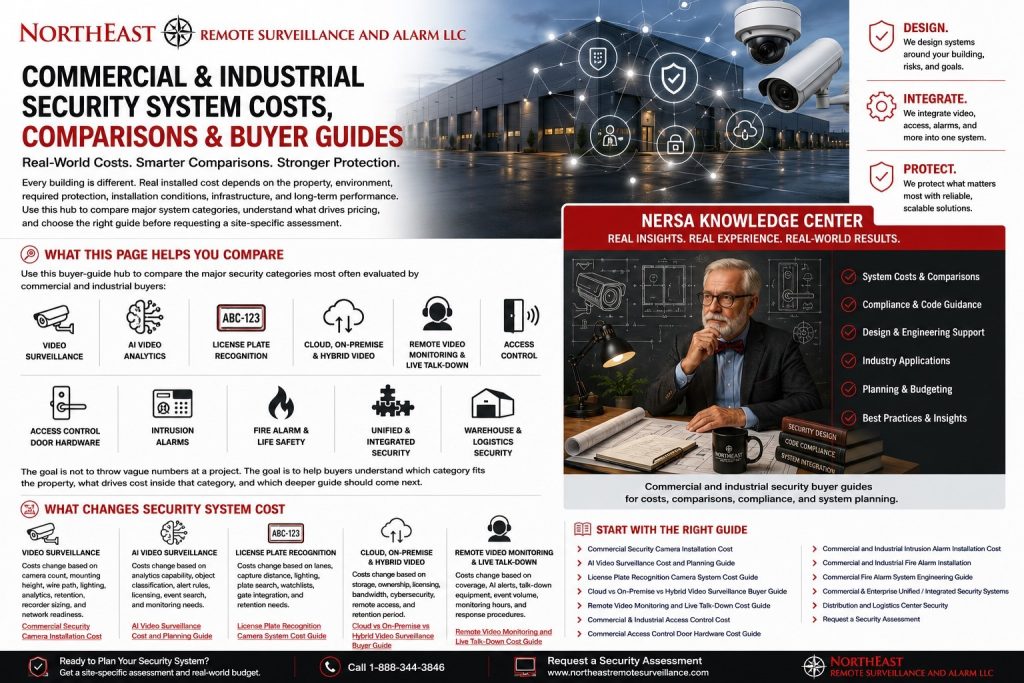
Compare commercial security costs, system choices and planning considerations using the focused guides below.

Compare equivalent project scopes
Use a cost guide to understand the parts of a project before comparing proposals. A device count alone does not describe installation access, cabling, power, recording, configuration, training, or support. Begin with the operational result required, then identify the components and services necessary to deliver it.
The comparison guides address different decisions: recording or management approaches, monitoring arrangements, and the treatment of existing equipment. Choose the comparison tied to the actual limitation rather than assuming one technology is the best fit for every property.
Ask what is included and what continues after installation
Separate one-time work from any ongoing licenses, storage, connectivity, monitoring, or support included in the proposed arrangement. Confirm ownership and administrative access, the basis for future expansion, and what happens when a service arrangement changes. Those details should be established from the specific proposal.
For a retrofit, identify equipment to retain and the compatibility checks behind that decision. Ask how acceptance will demonstrate the agreed result, such as usable evidence retrieval or correct door operation. Comparing the same scope and handover obligations makes the guides more useful than an isolated headline price.
Video and Monitoring Costs
Camera Installation Cost — Review the factors that shape a commercial camera project budget.
AI Video Surveillance Cost — Review analytics, licensing and implementation cost considerations.
License Plate Recognition Cost — Plan for cameras, capture conditions, software and infrastructure.
Cloud, On-Premise or Hybrid Video — Compare recording and management approaches.
Remote Monitoring and Live Talk-Down Cost — Review installation and recurring monitoring considerations.
Access Control and Alarm Costs
Access Control Cost — Review controlled-door, credential and administration cost drivers.
Door Hardware Cost — Compare hardware and installation requirements at controlled openings.
Intercom Installation Cost — Compare entrance stations, answering users, door-release work and ongoing charges before choosing a proposal.
Intrusion Alarm Installation Cost — Review detection, communication and installation budget factors.
Fire Alarm Installation Cost — Compare design, equipment, installation, testing and ongoing service costs before requesting a proposal.
Compare Systems Before You Buy
Choose the decision you are working through, then compare proposals with the same installation and support requirements.
- Commercial integrator versus DIY security — compare installation, administration and support responsibilities.
- Commercial camera purchasing considerations — review camera selection and procurement questions.
- Wireless versus hardwired access control — compare installation constraints and ongoing maintenance.
- Monitored alarms versus local-only alarms — understand who receives an event and how a response begins.
- Door hardware retrofit versus replacement — compare the options for an existing controlled entrance.
- When a security retrofit can save money — review what must be checked before retaining existing equipment.
Related System Planning
Fire Alarm and Life Safety Systems — Review service options for a commercial fire alarm project.
Fire Alarm Engineering Guide — Review system design and coordination considerations.
Unified Security Systems — Consider how connected systems affect the overall project.
Distribution and Logistics Security — Explore facility-specific requirements for logistics properties.
Commercial Security Knowledge Center — Explore additional technical and planning guides.
Frequently Asked Questions
Why can commercial security quotes differ for the same device count?
The same device count can represent different installation scopes. Compare coverage requirements, cabling, power, door hardware, recording, configuration, commissioning, training, and support. Confirm retained-equipment assumptions and exclusions before treating two prices as equivalent.
Which recurring security costs should a buyer ask about?
Ask whether the proposal includes ongoing licenses, cloud storage, connectivity, monitoring, or support charges. Separate those costs from one-time installation work and confirm renewal terms, administrative ownership, expansion costs, and what happens when the service arrangement changes.
How should a business choose between an upgrade and replacement?
Begin with the limitation the current system cannot resolve, then compare selective improvements with replacement on the same required outcome. Assess existing equipment and account access before assuming everything must change. Use the relevant cost and comparison guides to prepare questions for a site-specific proposal.
Plan Your Security Budget
Request a Security Assessment to review site conditions and establish project priorities.
Compliance, Codes & Project Standards
NERSA plans commercial and industrial security work with applicable code, documentation, inspection and authority-having-jurisdiction requirements in mind. Requirements vary by system, property and jurisdiction. These resources support project planning; they do not establish legal compliance, certification or AHJ approval.
Related guidance: Regulatory compliance & inspection readiness · NERSA project standards · Documentation, testing & inspection readiness