My Security Company Is Recommending a Magnetic Lock: What Pennsylvania Building Owners Should Know

A security company has recommended installing a magnetic lock, commonly called a maglock, on my building door. A maglock may be an appropriate solution, but it should not be treated as a simple substitution for a conventional lock. Because a maglock can prevent a door from opening in the direction of egress, its release devices, wiring, fire-alarm connections and power-failure behavior become part of the building’s life-safety system.

Before approving the proposal, I would want the security company to identify the exact Pennsylvania Uniform Construction Code provision under which the door will operate, confirm whether a permit is required and obtain approval from the municipal Building Code Official or other Authority Having Jurisdiction, commonly called the AHJ.

NERSA—Northeast Remote Surveillance and Alarm—appropriately describes commercial access control as more than card readers and credentials. Its materials identify electric strikes, magnetic locks, electrified locksets, panic hardware, door controls and life-safety coordination as parts of the overall door system. NERSA also notes that the proper hardware choice depends on the door’s function, occupancy, fire-alarm strategy and local code interpretation. (Access Control Installer)

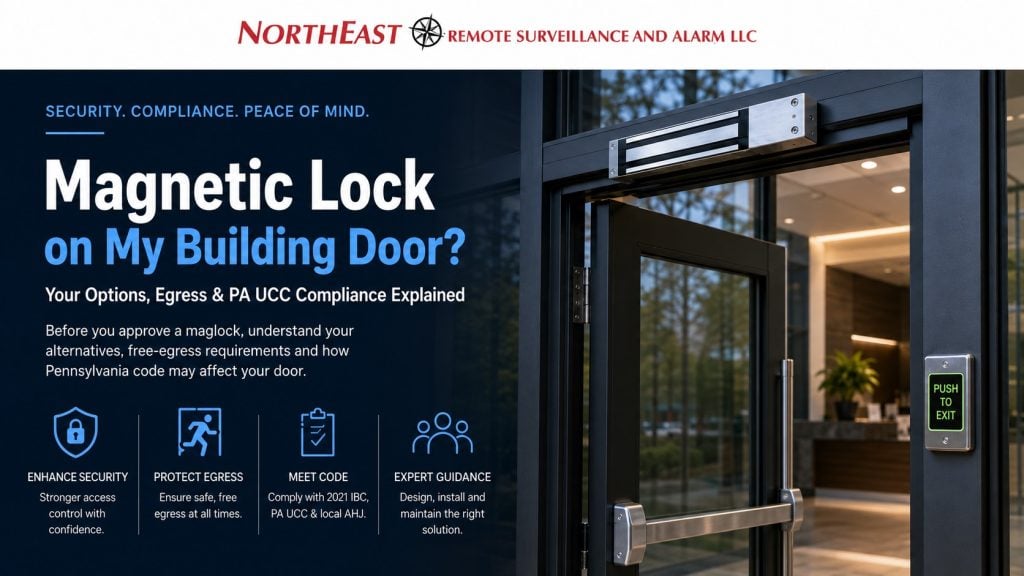
Northeast Remote Surveillance and Alarm banner about magnetic-lock options and PA UCC compliance, showing a commercial glass door with a maglock, panic bar, and push-to-exit button.

Not and accurate Installation, a door like this should almost always use a push-bar motorization upgrade and power transfer hinge

The central issue is egress, not the card reader

An exterior card reader generally controls who may enter a building. Building-code concerns arise primarily from what a person must do to exit.

The 2021 International Building Code establishes the basic rule that an egress door must be readily openable from the egress side without a key, special knowledge or unusual effort, unless the door qualifies under a specific exception or special locking arrangement. (ICC Codes)

For example:

  • A card reader outside combined with an electric strike and a freely operating inside lever may not restrict egress at all.
  • A maglock that physically holds the door closed does restrict egress until electricity to the magnet is interrupted.
  • A “request-to-exit” motion sensor, push button, panic bar, fire alarm and loss-of-power function are not interchangeable. The required combination depends on the code section selected for the installation.

That is why a proposal stating only “install card reader and maglock” is incomplete. It should include a door-hardware schedule, sequence of operation, wiring diagram, fire-alarm interface, power-supply arrangement, product listings and the applicable code section.

Which building code currently applies in Pennsylvania?

As of July 2026, Pennsylvania’s most recent UCC triennial update has been effective since January 1, 2026. Pennsylvania has incorporated specified portions of the 2021 International Building Code, including Chapter 10, Means of Egress. (Pennsylvania.gov)

For an existing building, an alteration generally must comply through either Chapter 34 of the 2021 IBC or the 2021 International Existing Building Code, depending on the compliance method used for the project. (Pennsylvania Code & Bulletin)

A maglock installation should generally be treated as permit-related work unless the local Building Code Official determines otherwise. Pennsylvania regulations require a commercial-building permit for covered alterations and for installing or altering a regulated electrical system. The regulations also state that a change to a required means of egress is not an “ordinary repair.” (Pennsylvania Code & Bulletin)

Permit documents may have to show:

  • The location and configuration of the means of egress.
  • The building’s occupancy classifications and occupant loads.
  • Door hardware and release functions.
  • Fire-protection interfaces.
  • Enough detail to demonstrate UCC compliance.

Pennsylvania expressly requires commercial permit documents to describe the means of egress in sufficient detail, and it authorizes the Building Code Official to request additional documents when needed. (Pennsylvania Code & Bulletin)

Most Pennsylvania municipalities enforce the UCC locally, either through municipal staff or a certified third-party agency. Local amendments and separately adopted fire-code requirements may also apply, particularly in municipalities such as Philadelphia. (Pennsylvania.gov)

The two common code paths for an ordinary maglock

The security company should identify one clear release arrangement rather than combining unrelated parts from different sections.

Option 1: Release through door-mounted hardware — IBC Section 1010.2.11

Under this arrangement, a lever, panic bar, touch-sense bar or other obvious hardware mounted on the door leaf releases the maglock.

The principal requirements include:

  • The releasing hardware is attached to the door leaf and has an obvious method of operation.
  • It can be operated with one hand.
  • Operating the hardware directly interrupts electrical power to the lock.
  • The door unlocks immediately.
  • Loss of power to the locking system unlocks the door.
  • When panic or fire-exit hardware is required, operating that hardware also releases the electric lock.
  • The locking-system units are listed to UL 294.

This arrangement is permitted for means-of-egress doors in occupancies other than Group H when all applicable conditions are satisfied. (ICC Codes)

The word directly is important. A door-mounted switch that sends a software request to a controller, which then decides whether to release the lock, may not provide the required direct power interruption. The submitted wiring diagram should show how operation of the door hardware physically interrupts the maglock circuit.

This can be a clean solution because the occupant performs a familiar action—pressing a panic bar, pushing a door-mounted release bar or operating a lever—and the door opens immediately.

Option 2: Sensor release — IBC Section 1010.2.12

This is the arrangement many people picture when discussing a lobby or storefront maglock. A motion sensor on the egress side detects someone approaching and unlocks the door.

A compliant design generally requires all of the following:

  • An egress-side sensor that detects an approaching occupant and unlocks the door.
  • Unlocking upon loss of power to the sensor.
  • Unlocking upon loss of power to the lock or locking system.
  • A separate manual unlocking device within 5 feet of the secured door.
  • The manual device mounted between 40 and 48 inches above the floor.
  • Clear “PUSH TO EXIT” identification.
  • Direct interruption of power to the electric lock, independent of the access-control electronics.
  • The manual release holding the door unlocked for at least 30 seconds.
  • Automatic unlocking upon fire-alarm activation, where a fire alarm is provided.
  • Automatic unlocking upon activation of the applicable sprinkler or fire-detection system, where provided.
  • Emergency lighting on the egress side.
  • UL 294-listed locking-system units.

This section also excludes Group H occupancies. (ICC Codes)

A few frequent mistakes are worth emphasizing:

The motion sensor is not optional. A push-to-exit button by itself does not create the sensor-release arrangement.

The push button is not merely a software input. It must directly interrupt power to the lock independently of the other access-control electronics.

Fire-alarm release is not the normal daily exit method. Occupants must be able to leave during ordinary operations without waiting for an alarm condition.

Sensor coverage matters. The door must release when a person approaches from the egress side, including someone moving slowly or using a mobility device. Placement should also minimize unintended releases caused by ordinary movement near the door.

Option 3: Delayed egress — IBC Section 1010.2.13

Delayed egress is a separate and more restrictive arrangement. It intentionally keeps the door locked for a limited period after someone attempts to exit. Under the standard arrangement, release occurs within 15 seconds; a delay of up to 30 seconds requires AHJ approval.

Delayed-egress systems are subject to occupancy restrictions and additional safeguards involving sprinklers or approved detection, audible notification, signage, emergency release, power failure and system listing. They are commonly considered where theft prevention, elopement or a similar operational concern justifies a brief delay. (ICC Codes)

A contractor should not describe a normal maglock as “delayed egress” unless the entire delayed-egress arrangement is designed, listed, documented and approved for that purpose.

How the maglock could affect other door requirements

Panic and fire-exit hardware

A maglock does not eliminate an existing requirement for panic or fire-exit hardware. When panic hardware is required, the proposed locking arrangement must comply with the panic-hardware provisions as well as the applicable electrical-locking section.

Under the door-hardware-release method, operating the panic or fire-exit hardware must release the electric lock. (ICC Codes)

Therefore, adding a small push button beside a door that is required to have panic hardware is not necessarily an acceptable substitute for proper release through the exit device.

Fire-rated doors

A magnetic lock is not a positive latch. Fire doors generally must be latching and self-closing or automatic-closing in accordance with their approved assembly. (ICC Codes)

If the opening is fire-rated:

  • The existing label on the door and frame must be identified.
  • The door must continue to latch positively when closed.
  • New hardware, drilling and field modifications must be permitted by the assembly’s listing.
  • The closer, latch, hinges, strike and other components must continue to function as a complete fire-door assembly.
  • The maglock cannot be used as a substitute for the required latch.

This is one reason an electrified mortise lock, fire-rated electric strike or electrified fire-exit device may be more appropriate than a maglock on certain rated openings.

Accessibility

Door hardware must remain accessible. Federal ADA standards generally place operable door-hardware components between 34 and 48 inches above the finished floor and require operation without tight grasping, pinching or twisting of the wrist. (Access Board)

The sensor-release section’s manual push-to-exit device has its own 40-to-48-inch mounting requirement. The final layout must also preserve door maneuvering clearances, usable clear width, opening force requirements and an accessible path to the release device.

Pennsylvania currently directs enforcement to the applicable 2018 accessibility requirements because enforcement of the 2021 accessibility updates was enjoined; the non-accessibility provisions of the UCC were not affected. (Pennsylvania.gov)

Power supplies and backup power

A conventional maglock uses electricity to hold the door locked and releases when power to the magnet is removed. This is generally described as fail-safe operation.

That behavior is helpful for life safety, but it creates an operational security issue: a power or component failure may leave the door unlocked. A battery-backed power supply may improve continuity, but it cannot be wired in a way that defeats the required direct-release functions or the approved loss-of-power sequence.

The proposal should therefore explain separately:

  1. What happens when normal building power fails.
  2. What happens when the access-control panel fails.
  3. What happens when the egress sensor loses power.
  4. What happens when the fire alarm activates.
  5. What happens when the sprinkler or detection system activates.
  6. What happens when the push-to-exit device or panic hardware is operated.
  7. Whether the door automatically relocks and under what conditions.

NERSA’s practical guidance distinguishes fail-safe and fail-secure hardware and emphasizes that the selection must account for life-safety and free-egress requirements rather than security alone. (Northeast Remote Surveillance)

What are the alternatives to a magnetic lock?

For a conventional wood, aluminum or hollow-metal door that already has a latch, there may be less complicated ways to control entry while preserving ordinary mechanical egress.

AlternativeHow it worksEgress and operational considerations
Electric strikeThe powered strike in the frame releases the existing latch after a valid credential.The inside lever or panic bar can usually continue to provide mechanical free egress. A properly selected fail-secure strike may keep the exterior secure during a power failure, but fire-rating and listing requirements must be verified. (Northeast Remote Surveillance)
Electrified mortise or cylindrical locksetThe locking function is controlled within the lock body rather than at the frame.It can provide credential-controlled entry while retaining mechanical exit through the inside lever. It generally requires a listed power-transfer method between the frame and door. (Northeast Remote Surveillance)
Electrified trim on existing panic hardwareThe outside lever or trim is electrically enabled while the panic bar remains mechanically operable.This is often a strong option for doors already required to have panic hardware because the exit bar continues to provide familiar free egress. NERSA identifies electrified trim and panic-hardware upgrades as standard access-control options. (Northeast Remote Surveillance)
Electric latch retraction or electrified exit deviceThe exit device’s latch is electrically controlled or retracted for authorized entry and scheduled unlocking.The push bar remains the normal means of egress. Product selection must match the door, frame and any fire rating.
Mechanical lock with controlled key systemA conventional key or restricted-keyway cylinder controls entry.It avoids electronic release dependencies but provides less flexible credential management, auditing and immediate revocation.
Standalone electronic lock with mechanical free egressA keypad, wireless credential reader or smart lock is incorporated into a lockset.Appropriate models allow the inside lever to retract the latch mechanically. The complete hardware still must meet accessibility, egress and fire-door requirements.
Alarmed exit with door monitoringThe door remains freely openable, but unauthorized use activates a local alarm or sends a security notification.This is useful when the real concern is detecting unauthorized exit rather than physically preventing it. It avoids intentionally restraining ordinary egress.
Door-position switch, camera and intercomThe system monitors held-open doors, forced entry and visitor requests without changing the exit hardware.It can address operational security while leaving the existing means of egress intact.
Delayed-egress hardwareThe door releases after the code-permitted delay and sounds an alarm.Appropriate only where the operational need justifies a delayed exit and all occupancy, detection, signage, power and AHJ conditions are satisfied. (I Dig Hardware)

Industry guidance from BHMA also distinguishes ordinary access-controlled doors—where the exterior credential controls entry but the inside hardware always allows free egress—from special locking arrangements that electrically restrict egress. (Builders Hardware)

When a maglock may still be the practical choice

A maglock can make sense when:

  • The door is frameless glass or otherwise difficult to prepare for a conventional latch.
  • Existing door or frame conditions make an electric strike impractical.
  • The opening geometry favors a surface-mounted magnetic lock.
  • A properly designed door-hardware-release or sensor-release system can be installed without compromising required panic hardware, fire ratings or accessibility.
  • The owner accepts that the lock is generally fail-safe and understands the security implications of power or equipment failure.

NERSA’s own guidance recognizes that maglocks can be code compliant when equipped with the correct release methods, egress devices, alarm coordination, signage and AHJ approval. (Northeast Remote Surveillance)

For an ordinary latched commercial door, however, it is reasonable to request pricing for an electric strike, electrified lockset or electrified panic trim before accepting a maglock. Those alternatives frequently control entry without making the access-control electronics responsible for ordinary egress. That is a practical design preference rather than a universal code rule; the best choice depends on the actual opening and building conditions. (Northeast Remote Surveillance)

Questions I would require the security company to answer

Before authorizing the work, I would request written answers to the following:

  1. What is the building’s occupancy classification and occupant load?
  2. Is this door a required exit, exit-access door, accessible entrance or part of an accessible route?
  3. Which exact 2021 IBC section will govern the locking arrangement—1010.2.11, 1010.2.12, 1010.2.13 or another provision?
  4. Is the door or frame fire-rated? If so, how will positive latching and the listed fire-door assembly be maintained?
  5. Is panic or fire-exit hardware required? If so, how does operating it release the lock?
  6. For a door-hardware-release system, does the door-mounted hardware directly interrupt power to the magnet?
  7. For a sensor-release system, where are the sensor, independent push-to-exit button and emergency lighting located?
  8. How are the fire alarm, sprinkler system and fire-detection system interfaced with the lock?
  9. What happens during each type of power failure, including failure of the controller, sensor, lock power supply and building power?
  10. Are the locking-system units listed to UL 294, and are all door components approved for the door’s construction and rating?
  11. Who is obtaining the building or electrical permit and submitting the egress drawings?
  12. Will the municipal Building Code Official and fire-code official, where applicable, inspect and acceptance-test the completed system?
  13. Who will test the sensor, push button, panic hardware, alarm interface and power-failure release after installation and during future maintenance?

A vague statement that “the fire alarm will unlock it” is not an adequate answer. The normal means of egress must work every day, independently of an emergency alarm.

For a typical commercial building door, I would use this order of evaluation:

First, determine the door’s occupancy, occupant load, exit function, fire rating and existing hardware.

Second, ask whether entry can be controlled while retaining mechanical free egress. If so, evaluate an electric strike, electrified lockset or electrified panic trim.

Third, use a maglock only when the opening conditions or security design make it the better solution and the installer can identify a complete, code-compliant release arrangement.

Fourth, submit the design to the local Building Code Official before ordering equipment. This is particularly important because Pennsylvania treats means-of-egress changes and regulated electrical alterations as matters subject to UCC review. (Pennsylvania Code & Bulletin)

Bottom line

A magnetic lock is not automatically prohibited by the Pennsylvania UCC, but neither is it automatically acceptable because it is “fail-safe” or connected to the fire alarm. Its legality depends on the complete door assembly, the building occupancy, the door’s role in the means of egress, the selected 2021 IBC release provision, required panic hardware, fire rating, accessibility and local AHJ approval.

For many conventional commercial doors, an electric strike, electrified lockset or electrified panic trim may offer a simpler balance of controlled entry and mechanical free egress. A maglock may still be appropriate for glass doors and difficult retrofits, but it requires careful design, permitting, inspection and ongoing testing.

The final determination should come from the municipal Building Code Official or other AHJ based on drawings for the actual building and door—not solely from a security-company sales proposal.

Reference materials

  • Pennsylvania Department of Labor & Industry — Uniform Construction Code and January 1, 2026 update: official information on the current statewide UCC. (Pennsylvania.gov)
  • 34 Pa. Code Chapter 403: Pennsylvania’s adoption of the 2021 IBC, existing-building provisions, permit requirements and construction-document rules. (Pennsylvania Code & Bulletin)
  • 2021 IBC Section 1010.2.11: door-hardware release of electrically locked egress doors. (ICC Codes)
  • 2021 IBC Section 1010.2.12: sensor release of electrically locked egress doors. (ICC Codes)
  • 2021 IBC Section 1010.2.13: delayed-egress locking systems. (ICC Codes)
  • NERSA — Access Control Trim and Strike Hardware: discussion of electric strikes, electrified hardware, maglocks, free egress and AHJ considerations. (Northeast Remote Surveillance)
  • NERSA — Access Control Door Hardware Retrofits: practical alternatives including electrified locksets and mortise locks. (Northeast Remote Surveillance)
  • BHMA — Access Control Systems Clarification: distinction between ordinary free-egress access control and special locking arrangements. (Builders Hardware)
  • U.S. Access Board — ADA Accessibility Standards: accessible door-hardware height and operability requirements. (Access Board)

This post provides general Pennsylvania building-code information and is not a permit decision, legal opinion or substitute for a site-specific review by the responsible design professional and local AHJ.

Scroll to Top
1-888-344-3846