NERSA plans commercial and industrial security systems around the facility, existing equipment, integration needs, and support responsibilities.
Manufacturer-specific capabilities, authorizations, and service commitments must be confirmed in the project scope.
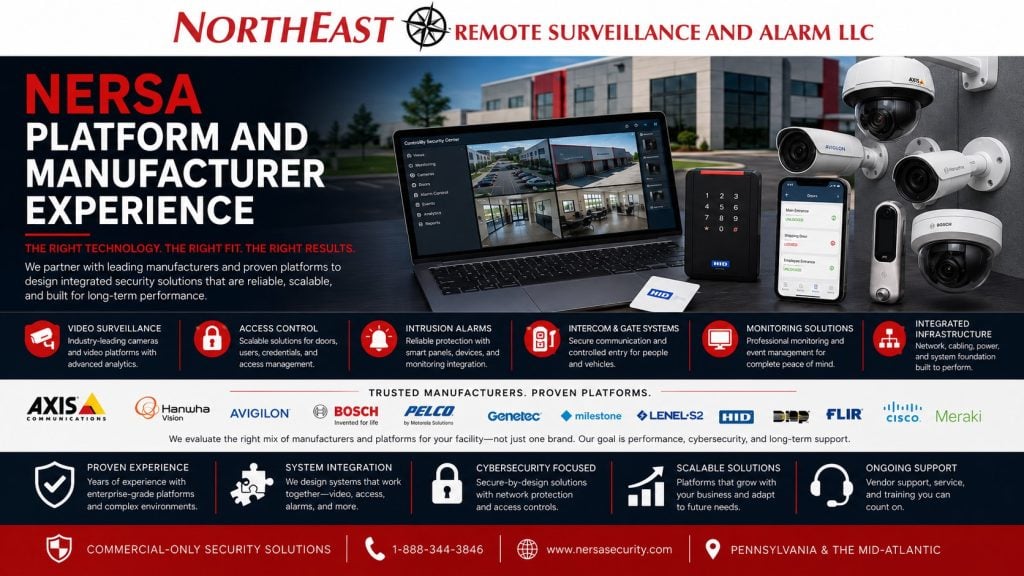
This resource explains how NERSA evaluates manufacturer fit, platform compatibility, cybersecurity posture, serviceability, integration potential, and long-term support for business and professionally managed properties.
For company background, commercial-only focus, and trust positioning, start with About Northeast Remote Surveillance and Alarm, LLC.
Platform Experience Matters in Commercial Security
Commercial security systems are not just individual devices mounted on a wall, ceiling, gate, or pole. A camera, access control reader, alarm panel, intercom, video platform, monitoring path, and network switch all become part of a larger operating environment.
That is why platform and manufacturer experience matters. A commercial security provider should understand how products behave in real buildings, how systems integrate, how software is managed, how devices are supported, and how future expansion affects the original design.
NERSA does not approach manufacturer selection as a brand popularity contest. The right platform depends on the property, the risk, the infrastructure, the budget, the long-term support requirement, and the operational outcome the customer needs.
Manufacturer Selection Should Fit the Property
Platform-specific planning resources include Verkada installation considerations and Ajax hybrid commercial systems.
Compare the relevant architecture, account ownership, and support requirements against the facility’s needs.
Different facilities need different systems. A warehouse with loading docks, truck courts, and trailer areas may need a different platform strategy than a medical office, school, municipal building, contractor yard, or manufacturing plant.
NERSA evaluates manufacturer fit around practical conditions such as:
- Property size
- Camera count
- Door count
- Alarm coverage
- Gate and intercom requirements
- Indoor and outdoor conditions
- Lighting conditions
- Network infrastructure
- Remote viewing needs
- Video retention requirements
- User management needs
- Cybersecurity expectations
- Integration requirements
- Long-term supportability
- Future expansion plans
The goal is to match the platform to the property instead of forcing the property into a one-size-fits-all product line.
Camera and Video Surveillance Manufacturer Experience
Commercial video surveillance can involve many types of cameras, recorders, video management systems, cloud platforms, analytics, storage designs, and network conditions. Manufacturer experience matters because camera performance depends on more than resolution.
NERSA may evaluate video surveillance manufacturers and platforms based on:
- Indoor and outdoor camera options
- Low-light performance
- Lens selection
- Mounting conditions
- Edge analytics
- AI object detection
- License plate recognition needs
- Thermal or perimeter detection options
- Video management software compatibility
- Cloud, on-premise, or hybrid recording
- Cybersecurity features
- Firmware and update practices
- System health monitoring
- Multi-site scalability
- Long-term support
Compare video products by their demonstrated coverage, image quality, supported recording platform, firmware lifecycle, and warranty. Product names in the independent directory do not establish NERSA authorization or brand-specific service capability.
The important point is not the logo on the camera. The important point is whether the system produces usable footage, supports the business, protects the network, and remains serviceable after installation.
Video Management System Experience
A video management system is the software environment that helps users view, record, search, manage, and review video. In larger commercial and industrial environments, the video management system can be just as important as the cameras themselves.
NERSA may evaluate VMS platforms around:
- Ease of use
- Search and playback
- Multi-camera review
- User permissions
- Remote access
- Multi-site management
- Analytics compatibility
- Access control integration
- Alarm event integration
- Storage and retention planning
- System health reporting
- Cybersecurity controls
- Long-term licensing and support
Document the VMS edition, supported device list, integration versions, licenses, and support provider. Test the actual combination before accepting compatibility claims.
A strong VMS decision helps the customer manage footage faster, investigate incidents more clearly, and avoid being trapped in a system that cannot grow.
Access Control Platform Experience
Access control platforms manage who can enter a door, gate, restricted room, office suite, warehouse area, or secured zone. In commercial environments, access control is not just about unlocking a door. It is about user management, schedules, permissions, events, reporting, and accountability.
NERSA may evaluate access control platforms around:
- Door count
- User count
- Credential type
- Cloud or server-based management
- Mobile credential options
- Multi-site needs
- Audit history
- Door schedules
- Access groups
- Elevator or gate needs
- Visitor and vendor access
- Integration with video
- Integration with intercoms
- Life-safety and egress coordination
- Serviceability and expansion
Record the proposed controllers, readers, credentials, door interfaces, software version, and licenses. Confirm supported combinations and the provider responsible for programming and maintenance.
The right access control platform should make the facility easier to manage, not harder. It should support the customer’s real access workflow and provide a clear path for future doors, users, and credentials.
Alarm and Intrusion Platform Experience
Commercial intrusion alarm systems must match the way the property operates. A warehouse, office, school, medical facility, municipal building, contractor yard, truck yard, or industrial plant may each need different alarm zones, schedules, users, monitoring paths, and device types.
NERSA may evaluate alarm platforms around:
- Building layout
- Door and overhead door protection
- Motion detection needs
- Glass-break detection needs
- Wireless and hardwired device options
- User code management
- Alarm partitions
- Opening and closing schedules
- Monitoring communication paths
- Video verification potential
- Service history
- Expansion capability
- Long-term reliability
Verify the panel, communicator, detection devices, monitoring arrangement, and service responsibilities for the specific property. A familiar manufacturer name does not establish compatibility.
A strong alarm platform should be understandable for users, dependable for the property, and supportable over time.
Intercom, Gate, and Visitor Entry Experience
Intercoms, gate systems, call boxes, and visitor entry systems are important where people or vehicles need to be verified before access is granted. These systems are common at warehouses, contractor yards, truck yards, schools, municipal sites, offices, industrial parks, and gated commercial properties.
NERSA may evaluate intercom and gate-related platforms around:
- Door entry communication
- Vehicle gate communication
- Visitor verification
- Remote release needs
- Video intercom capability
- Mobile answering
- Tenant or department call routing
- Integration with access control
- Integration with cameras
- Weather and vandal resistance
- Gate operator compatibility
- Emergency access considerations
- Long-term supportability
Evaluate call routing, answering devices, release permissions, outdoor ratings, and interfaces to the door or gate equipment. Identify who supports each part of the installation.
The goal is controlled entry with clear communication, not a disconnected buzzer system that creates confusion.
Unified Platform Experience
Many commercial properties need cameras, access control, alarms, gates, intercoms, monitoring, and analytics to work together. This is where manufacturer and platform selection becomes especially important.
NERSA evaluates unified security design around:
- Whether systems can share useful event information
- Whether video can support access events
- Whether alarm events can be verified
- Whether gates and intercoms can be connected to user workflows
- Whether managers can operate the system without confusion
- Whether user permissions are clean
- Whether system health can be monitored
- Whether future expansion is realistic
- Whether the platform can be supported long term
For a deeper explanation of how NERSA designs systems that work together, use How NERSA Designs Unified Security Systems.
Cybersecurity and Manufacturer Selection
Modern security systems are networked systems. Cameras, recorders, access control panels, cloud dashboards, mobile apps, intercoms, alarm communicators, and remote access tools all create cybersecurity considerations.
NERSA may review manufacturer and platform decisions around:
- User permissions
- Role-based access
- Firmware practices
- Remote access methods
- Network segmentation
- Cloud account security
- Multi-factor authentication options
- Encryption support
- Device management
- Audit logging
- Vendor support history
- Lifecycle and update expectations
A low-cost device can become expensive if it creates cybersecurity risk, support problems, weak documentation, or replacement pressure. Manufacturer selection should consider the full lifecycle, not just the purchase price.
NDAA, Compliance, and Procurement Awareness
Some commercial, municipal, institutional, and enterprise buyers may have procurement requirements that affect manufacturer selection.
That can include cybersecurity expectations, NDAA-aware product selection, internal IT standards, insurance requirements, documentation expectations, or facility-specific compliance concerns.
When comparing enterprise proposals, use security procurement and bid-evaluation planning to organize requirements and evidence.
NERSA does not treat every project as if the same manufacturer list applies. The platform strategy should reflect the buyer’s risk level, facility type, procurement requirements, and long-term support needs.
This is especially important for schools, municipalities, healthcare-related facilities, industrial properties, logistics operations, multi-site organizations, and customers with stronger IT governance.
Open-Platform Versus Single-Ecosystem Design
Some properties benefit from a single manufacturer ecosystem. Others benefit from an open-platform design where cameras, access control, alarms, analytics, intercoms, and infrastructure can be selected from compatible manufacturers.
A single-ecosystem design may help simplify support when one platform covers most of the required functions.
An open-platform design may be stronger when the customer needs best-fit devices, specialized analytics, advanced VMS features, or compatibility with existing equipment.
NERSA evaluates both approaches based on the property. The goal is a system that works, can be supported, and can grow.
Supportability Comes Before Brand Hype
A manufacturer may have strong marketing, but that does not automatically make it the right fit for every facility. NERSA looks at whether the product or platform can be installed properly, configured securely, supported efficiently, documented clearly, and expanded over time.
Supportability includes:
- Availability of replacement parts
- Vendor documentation
- Service access
- Platform stability
- Software updates
- Licensing clarity
- Installation requirements
- Installer familiarity
- Customer usability
- Long-term expansion path
- Integration maturity
- Support response expectations
A security system should not become a dead-end because the wrong product was selected at the beginning.
Existing System Review and Migration Planning
Many businesses already have security systems in place. They may have older cameras, legacy alarm panels, disconnected access control, outdated recorders, unsupported software, unknown user lists, weak documentation, or systems installed by multiple vendors over time.
NERSA can review existing systems and help determine whether the right path is:
- Continue supporting the existing platform
- Replace only failing components
- Upgrade the recorder or VMS
- Add cameras to a usable system
- Migrate access control in phases
- Replace an outdated alarm panel
- Improve monitoring communication
- Standardize naming and documentation
- Build a phased path toward unified security
- Replace unsupported or risky equipment
For project planning, installation standards, testing, and handoff expectations, use NERSA Project Delivery Standards .
Manufacturer Experience Does Not Mean One Brand for Every Job
NERSA’s platform and manufacturer experience is valuable because it supports better judgment. A warehouse may need one type of camera ecosystem. A medical office may need another. A municipal building may have stricter procurement expectations. A truck yard may need better perimeter, gate, and LPR planning. A school may need stronger visitor entry and access control coordination.
No single manufacturer automatically solves every commercial security problem.
The right question is not “Which brand is best?”
The better question is:
Which platform best fits the facility, risk, infrastructure, cybersecurity expectations, user workflow, and long-term support plan?
What Customers Should Expect From Platform Guidance
Commercial customers should expect clear manufacturer and platform guidance before committing to a system. The decision should be explained in practical business terms, not buried in technical jargon.
NERSA helps customers understand:
- Why a platform is being recommended
- What the system is expected to do
- How it supports the property’s risk profile
- What systems it may integrate with
- What infrastructure is required
- What future expansion may look like
- What support considerations apply
- What limitations should be understood up front
That clarity helps customers make better long-term decisions.
Best-Fit Properties for Platform and Manufacturer Planning
Platform and manufacturer planning is especially important for:
- Warehouses
- Distribution centers
- Logistics facilities
- Manufacturing plants
- Office buildings
- Schools
- Municipal buildings
- Healthcare-related facilities
- Contractor yards
- Truck yards
- Industrial parks
- Multi-tenant commercial buildings
- Multi-site organizations
- Facilities replacing outdated systems
- Properties with mixed or disconnected security systems
The more complex the property, the more important the platform decision becomes.
Request Platform and Manufacturer Guidance
Choosing the right security platform is not just a technical decision. It affects system usability, cybersecurity, serviceability, integration, documentation, future expansion, and long-term cost of ownership.
Northeast Remote Surveillance and Alarm, LLC helps commercial and industrial clients evaluate cameras, access control, alarms, monitoring, gates, intercoms, analytics, and infrastructure through practical platform and manufacturer experience.
To review your facility, compare system options, or plan a future-ready security platform, call 1-888-344-3846 or use Request a Security Assessment to schedule the next step.
Frequently Asked Questions About NERSA Platform and Manufacturer Experience
What does platform and manufacturer experience mean?
Platform and manufacturer experience means understanding how different cameras, access control systems, alarm panels, video management systems, intercoms, gates, monitoring tools, and infrastructure products perform in real commercial and industrial environments.
Does NERSA use one manufacturer for every project?
No. NERSA evaluates the property, risk level, infrastructure, cybersecurity expectations, integration needs, support requirements, and future expansion plan before recommending a platform or manufacturer approach.
What camera manufacturers may be considered for commercial projects?
The independent Security Technologies & Platforms directory lists product families for comparison.
Inclusion does not establish a NERSA partnership, certification, authorization, or installation commitment.
What video management platforms may be considered?
Choose a VMS against the required camera integrations, search workflows, retention, user permissions, and support model. Confirm the exact edition and device support before purchase.
What access control platforms may be considered?
Compare platforms against the door schedule, credential requirements, offline operation, administrator roles, and supported hardware. Confirm who will configure and maintain the selected system.
What alarm platforms may be considered?
Compare alarm platforms against the required zones, communications, monitoring response, operating schedules, and maintenance arrangements. Confirm equipment and provider eligibility directly.
Why should manufacturer selection consider cybersecurity?
Modern security systems connect to networks, cloud services, mobile apps, remote access tools, and user accounts. Manufacturer selection should consider permissions, firmware, remote access, encryption, account security, and long-term device management.
Can NERSA help replace a mixed or outdated system?
Yes. NERSA can review existing cameras, access control, alarms, intercoms, monitoring paths, and infrastructure to determine whether the system should be supported, upgraded, integrated, migrated, or replaced in phases.
Does NERSA design unified systems with multiple manufacturers?
Yes. When appropriate, NERSA can design systems where compatible cameras, access control, alarms, monitoring, intercoms, gates, analytics, and infrastructure work together in a supportable architecture.
How does a business start platform planning with NERSA?
The best starting point is a commercial security assessment. NERSA can review the facility, evaluate existing systems, discuss operational goals, identify infrastructure needs, and recommend a platform strategy based on the property’s real conditions.
Compliance, Codes & Project Standards
NERSA plans commercial and industrial security work with applicable code, documentation, inspection and authority-having-jurisdiction requirements in mind. Requirements vary by system, property and jurisdiction. These resources support project planning; they do not establish legal compliance, certification or AHJ approval.
Related guidance: Regulatory compliance & inspection readiness · Manufacturing compliance planning · NERSA project standards