
Parking lot security cameras help commercial and industrial properties document vehicle movement, pedestrian activity, exterior approaches, employee parking areas, visitor spaces, side entrances, and after-hours events.

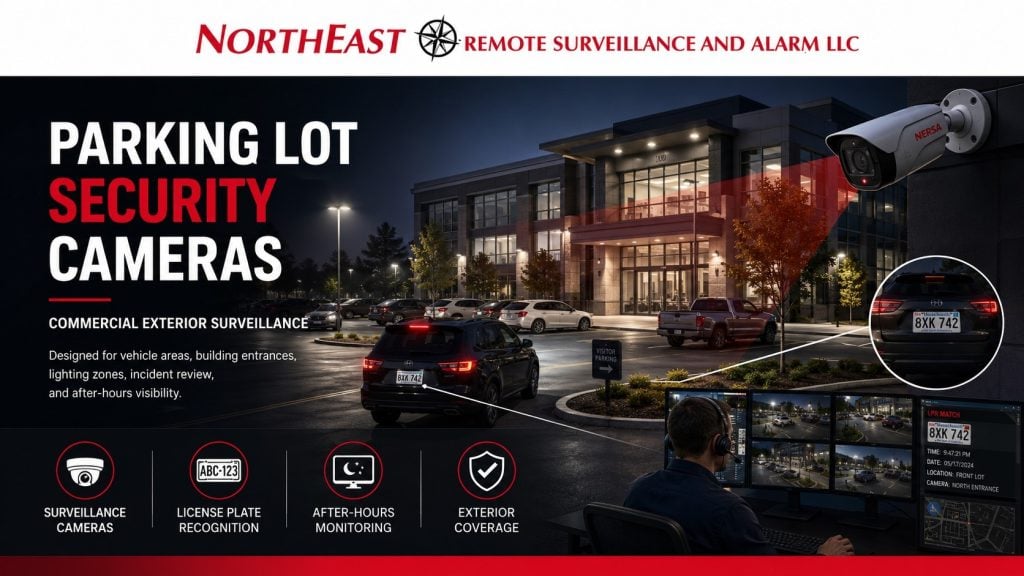
Camera planning considers exterior visibility, lighting conditions, mounting locations, recording quality, vehicle documentation, and incident review.
For broader camera system design, start with Commercial and Industrial Video Surveillance Systems.
Security Planning for Commercial Parking Lots
Parking lots are often one of the most active and exposed areas of a commercial property. Employees, visitors, vendors, contractors, delivery drivers, service vehicles, fleet vehicles, and unauthorized vehicles may all move through the same exterior space at different times of day.
A parking lot camera system should be planned around how the property actually operates. The right design depends on entrances, exits, lighting, building layout, vehicle paths, pedestrian routes, parking patterns, blind spots, camera mounting options, and the type of incidents the business needs to review.
Parking lot security camera planning should account for:
- Employee parking areas
- Visitor parking spaces
- Side and rear entrances
- Building approaches
- Vehicle entry and exit points
- Drive lanes and traffic flow
- Delivery areas
- Dumpster areas
- Walkways and pedestrian paths
- Lighting levels
- Blind spots
- After-hours activity
- Weather exposure
- Camera mounting height
- Recording retention
- Remote access needs
- Evidence quality requirements
The goal is not simply to cover the parking lot with wide camera views. The goal is to create useful visibility that helps the business understand what happened, where it happened, when it happened, and what evidence is available.
Why Parking Lots Need Dedicated Camera Planning
Parking lots are different from interior spaces. They involve changing daylight, vehicle headlights, weather, glare, shadows, wide areas, moving vehicles, and activity that may occur far from the building.
A camera that looks good during the day may not provide usable review at night. A camera that shows a full parking lot may not capture the detail needed to identify a vehicle, document a person, review a collision, or confirm activity near an entrance.
Common parking lot camera problems include:
- Cameras mounted too high for useful detail
- Views that are too wide to identify activity
- Poor nighttime image quality
- Headlight glare
- Blind spots behind parked vehicles
- Weak coverage of side entrances
- Poor visibility at dumpsters or rear doors
- No dedicated entry or exit view
- No usable vehicle documentation
- Inadequate recording retention
- No remote access for incident review
- Weak network or power infrastructure
A properly planned parking lot camera system should balance overview coverage with focused views of high-value areas.
Camera Coverage for Vehicle Areas
Parking lot cameras should be placed to document the areas where activity matters most.
Depending on the property, this may include employee parking, visitor parking, fleet parking, delivery lanes, vehicle entrances, building entrances, exterior walkways, and areas with repeated incidents.
For medical properties with shared parking and building approaches, see Lehigh Valley healthcare parking and exterior security.
A strong design may use different camera views for different purposes. Overview cameras help show general movement and event timelines. Focused cameras help document entrances, vehicle paths, and activity near doors or problem areas.
Camera placement should consider:
- Where vehicles enter and leave
- Where employees park
- Where visitors walk
- Where incidents have occurred before
- Which areas are hidden from the building
- Where lighting is strongest or weakest
- How parked vehicles may block views
- Whether cameras can be mounted on the building, poles, light poles, or exterior structures
- How far the camera is from the activity being recorded
For parking lots connected to gates or vehicle entrances, continue to License Plate Recognition Camera Systems.
Building Entrances and Exterior Approaches
Parking lot security should not stop at vehicle spaces. Many incidents connect the parking lot to the building entrance, employee door, side entrance, rear door, receiving area, or service entrance.
Camera planning should document how people and vehicles move from the exterior lot toward the building. This is especially important for employee entrances, public entrances, visitor access points, after-hours doors, and areas where staff may open or close the building.
Entrance and approach coverage may include:
- Main public entrances
- Employee entrances
- Side doors
- Rear doors
- Service doors
- Walkways
- Vestibules
- Loading-area approaches
- Exterior stairways
- Accessible routes
- Visitor paths
- After-hours access points
These views help connect vehicle activity, pedestrian movement, and building access into one clear incident timeline.
After-Hours Parking Lot Monitoring
Many parking lot incidents occur after normal business hours. Problems may include trespassing, loitering, vandalism, theft from vehicles, suspicious vehicles, unauthorized gatherings, dumping, repeated nuisance activity, or activity near building entrances.
Remote video monitoring can help businesses review exterior activity when the property is closed or lightly staffed. Depending on the property and system design, monitoring may support alert verification, operator response, live talk-down, escalation procedures, and documentation of events.
For active exterior review, alert verification, and after-hours response support, use Remote Video Monitoring.
Nighttime Visibility and Lighting Conditions
Lighting is one of the most important factors in parking lot camera performance. A camera system should be planned around real nighttime conditions, not only daytime views.
Parking lots may include dark corners, bright building lights, uneven pole lighting, vehicle headlights, shadows, reflective surfaces, rain, fog, snow, and glare. These conditions can affect whether video is useful when an incident needs to be reviewed.
Nighttime planning should review:
- Existing pole lighting
- Building-mounted lighting
- Dark corners
- Shadowed walkways
- Headlight glare
- Camera direction
- Reflective surfaces
- Weather conditions
- Color-at-night requirements
- Infrared performance
- Exposure settings
- Image clarity at distance
Better lighting and better camera placement often work together. The best result comes from reviewing the parking lot as a full exterior environment instead of selecting cameras based only on specifications.
License Plate Recognition and Vehicle Documentation
Some parking lots need more than general video coverage. Businesses may need vehicle records for entrance lanes, service drives, employee parking entrances, visitor lanes, gate areas, or recurring vehicle activity.
License plate recognition can support investigations, vehicle accountability, entry and exit review, and recurring vehicle documentation. However, LPR should be planned separately from general parking lot surveillance because plate capture requires the correct distance, angle, lane focus, lighting control, and camera selection.
A general overview camera may show a vehicle but fail to capture a readable plate. A dedicated LPR camera should be aimed and positioned specifically for vehicle documentation.
Parking Lot Alarm and Security Integration
Parking lot cameras can become more useful when they are integrated with other security systems. Depending on the property, parking lot coverage may support alarms, access control, remote monitoring, intercoms, gates, lighting coordination, and incident response procedures.
Integrated planning may include:
- Camera views tied to exterior alarm events
- Gate cameras tied to access activity
- LPR views tied to vehicle entry
- Intercom views at gate or visitor lanes
- Monitoring alerts from defined exterior zones
- Camera bookmarks for incident review
- Alarm verification using nearby camera views
- Remote access for managers or security staff
For properties with broader system needs, parking lot cameras should be planned as part of the full commercial security environment rather than a standalone camera add-on.
Infrastructure for Exterior Camera Systems
Exterior parking lot cameras depend on reliable infrastructure. Cameras may need cabling, PoE switches, wireless bridges, fiber, network paths, weather-rated enclosures, surge protection, power, recording equipment, and serviceable mounting locations.
Parking lot camera infrastructure should be realistic about distances, mounting points, cable routes, trenching limitations, pole availability, network access, and future expansion.
Common infrastructure questions include:
- Can cameras be mounted on the building?
- Are light poles available for camera mounting?
- Is power available where cameras are needed?
- Is fiber required for longer distances?
- Is a wireless bridge practical?
- Are pathways available for cabling?
- Is there enough network capacity?
- Is recording retention adequate?
- Is surge protection needed?
- Can the system be serviced safely?
- Can future cameras be added?
For cabling, PoE switching, fiber, wireless links, equipment racks, and security network planning, continue to Commercial Low Voltage and Network Infrastructure Services.
What a Parking Lot Camera Assessment Should Review
A parking lot camera assessment should review the full exterior environment. The assessment should not only count cameras. It should look at how the property operates, where risk exists, where people and vehicles move, where incidents occur, and what video must show after an event.
A practical assessment should review:
- Parking lot layout
- Vehicle entrances and exits
- Employee parking
- Visitor parking
- Fleet areas
- Walkways and pedestrian paths
- Main entrances
- Side and rear entrances
- Dumpster areas
- Delivery areas
- Lighting conditions
- Existing camera views
- Blind spots
- Mounting options
- Network and power availability
- Recording retention
- Remote access needs
- Monitoring expectations
- Incident review requirements
- Future expansion needs
The result should be a camera plan that supports usable evidence, not just visible equipment.
Compliance and Safety Awareness
Parking lot security cameras should be planned with awareness of property operations, emergency access, lighting conditions, accessible routes, workplace safety, privacy-sensitive areas, and building entry procedures.
Security cameras do not replace safety programs, lighting maintenance, access policies, emergency procedures, parking rules, or workplace training. They can, however, support documentation, incident review, alarm verification, vehicle accountability, and safer operational awareness.
Camera placement should avoid creating confusion around emergency access, accessible paths, required exits, or areas where privacy expectations may apply. The system should support the property’s operations without creating unnecessary risk or operational problems.
Why Businesses Choose Northeast Remote Surveillance and Alarm, LLC
Northeast Remote Surveillance and Alarm, LLC designs commercial and industrial security systems around real operating conditions, not generic residential-style camera packages.
Parking lots require practical planning because they involve large exterior areas, changing light, moving vehicles, pedestrian activity, weather exposure, and after-hours risk. NERSA helps businesses design parking lot camera systems that support visibility, evidence quality, remote access, monitoring, and long-term service.
NERSA helps businesses review:
- Parking lot coverage
- Vehicle movement
- Entrance visibility
- Lighting conditions
- Camera placement
- Nighttime image quality
- License plate documentation
- After-hours monitoring
- Infrastructure requirements
- Recording retention
- Incident review needs
- Long-term support
The objective is a parking lot camera system that gives decision-makers clearer visibility into exterior activity and more useful video when an event needs to be reviewed.
Frequently Asked Questions About Parking Lot Security Cameras
What are parking lot security cameras?
Parking lot security cameras are exterior surveillance cameras used to document vehicle areas, building approaches, entrances, walkways, parking spaces, delivery areas, and after-hours activity around commercial and industrial properties.
Why do parking lots need dedicated camera planning?
Parking lots need dedicated planning because they involve wide exterior areas, moving vehicles, changing light, weather, glare, shadows, and activity that may happen far from the building. A camera layout that works indoors may not provide useful exterior evidence.
What cameras work best for parking lots?
The best camera depends on the parking lot layout, distance, lighting, mounting options, and review goals. Many properties need a mix of overview cameras, focused entrance cameras, nighttime-capable cameras, and dedicated vehicle documentation views.
Can parking lot cameras capture license plates?
Some parking lot cameras may capture plates under the right conditions, but reliable plate capture usually requires a dedicated license plate recognition camera. LPR cameras need proper angle, distance, lighting control, lane focus, and placement.
Should parking lot cameras be monitored after hours?
After-hours monitoring can be useful when a property has repeated exterior activity, vehicle issues, trespassing, loitering, vandalism, theft, dumping, or exposed parking areas. Monitoring can support alert verification, operator response, and better documentation.
How many cameras does a commercial parking lot need?
The number of cameras depends on the size of the lot, entrances, exits, building layout, lighting, blind spots, vehicle paths, and the level of detail required. The goal is not simply more cameras; the goal is useful coverage.
Can cameras be mounted on parking lot light poles?
Yes, cameras can sometimes be mounted on light poles, but the design must consider power, network connectivity, mounting height, service access, pole condition, camera angle, and whether trenching, fiber, or wireless links are needed.
What should be reviewed before installing parking lot cameras?
A proper review should include parking layout, vehicle flow, entrances, exits, walkways, lighting, blind spots, camera mounting options, network access, power availability, recording retention, remote access, and incident review needs.
How do local property conditions affect parking lot cameras?
Traffic patterns, nearby activity, available lighting, parking layout, and site access influence camera placement and recording requirements.
How does Northeast Remote Surveillance and Alarm, LLC design parking lot camera systems?
NERSA starts by reviewing daily operations, people and vehicle movement, gaps in visibility and after-hours activity. We identify which incidents need review and what infrastructure is available. These findings guide camera placement, recording, monitoring and vehicle records.
Request a Parking Lot Security Camera Assessment
NERSA can assess cameras for employee and visitor parking, fleet areas, and building exteriors. The review can address incident documentation, license plate capture, remote monitoring, and visibility after hours.
Call 1-888-344-3846 or use Request a Security Assessment to review your parking layout, vehicle movement, entrances, lighting, camera views, blind spots, recording needs, monitoring expectations, infrastructure conditions, and long-term security goals.
Compliance, Codes & Project Standards
NERSA plans commercial and industrial security work with applicable code, documentation, inspection and authority-having-jurisdiction requirements in mind. Requirements vary by system, property and jurisdiction. These resources support project planning; they do not establish legal compliance, certification or AHJ approval.
Related guidance: Regulatory compliance & inspection readiness · Video surveillance compliance · NERSA project standards