
Plan Lehigh Valley healthcare exterior security around patient and staff parking, pedestrian routes, service entrances, lighting conditions, and incident review.

Request a Lehigh Valley Healthcare Parking & Exterior Security Assessment
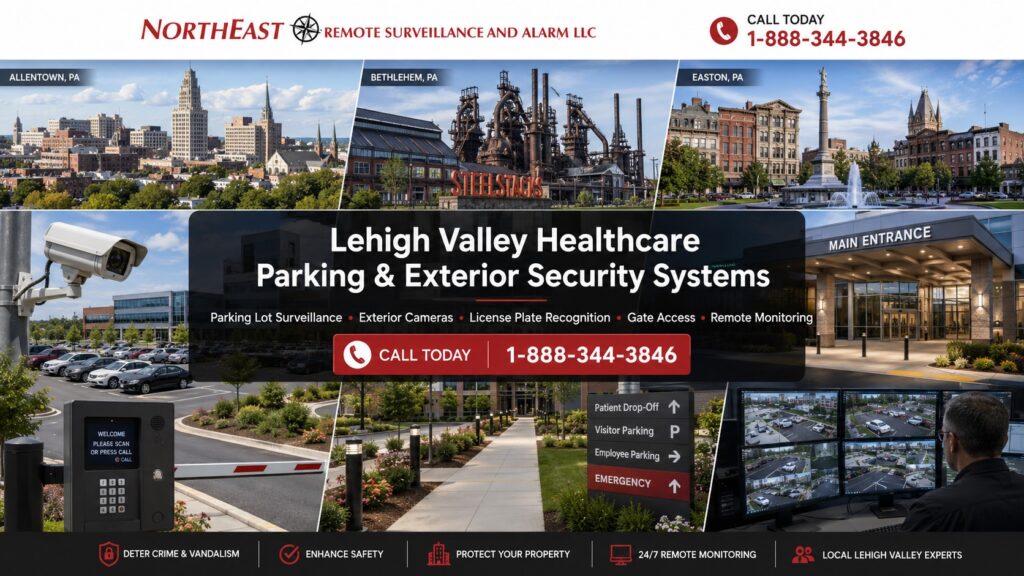
People arrive at and leave healthcare properties throughout the day and night. The security plan should cover parking areas, pedestrian approaches, exterior entrances, garages, service roads and loading areas. Account for patients, staff, visitors, vendors, contractors and service personnel.
Northeast Remote Surveillance and Alarm, LLC (NERSA) designs, installs, upgrades and supports healthcare parking and exterior security systems throughout Allentown, Bethlehem, Easton, Lehigh County, Northampton County and the surrounding Lehigh Valley.
Healthcare exterior-security systems may include:
- parking-lot video surveillance;
- parking-garage cameras;
- exterior building cameras;
- license-plate recognition;
- vehicle gate access control;
- pedestrian gate access;
- video intercoms;
- remote gate release;
- employee parking access;
- entrance monitoring;
- loading-area cameras;
- perimeter detection;
- remote video monitoring;
- exterior intrusion detection;
- access-control integration.
For broader healthcare-security planning, visit Lehigh Valley Healthcare Security Systems.
Commercial and institutional systems only.
Call NERSA: 1-888-344-3846
Healthcare Parking and Exterior Security Starts with the Property
A healthcare exterior-security plan should not begin by simply placing cameras around a building.
It should begin with how people and vehicles actually move through the property.
NERSA evaluates:
- where employees park;
- where patients and visitors park;
- how people travel from parking areas to entrances;
- which entrances operate after hours;
- how deliveries enter the property;
- where contractors and vendors arrive;
- which areas have limited natural visibility;
- which locations operate during reduced staffing;
- how emergency vehicles move through the property;
- how exterior incidents are currently reviewed or monitored.
The goal is to create useful visibility, controlled movement and reliable response, not simply increase device count.
Healthcare Parking Lot Video Surveillance
Parking-area camera systems should be designed around specific objectives.
Potential coverage may include:
- employee parking;
- visitor parking;
- pedestrian approaches;
- drive aisles;
- building entrances;
- remote parking sections;
- loading areas;
- service roads;
- exterior equipment.
A camera may be intended to:
- identify a person;
- observe vehicle movement;
- document an incident;
- monitor a building approach;
- provide situational awareness;
- support alarm verification.
One camera cannot necessarily accomplish every objective.
NERSA evaluates:
- distance;
- field of view;
- mounting height;
- lighting;
- resolution;
- obstructions;
- nighttime conditions;
- network connectivity;
- recording retention.
For camera-system design beyond healthcare parking and exterior areas, review the regional video-surveillance guide.
Employee Parking Security
Healthcare staff may arrive or leave during:
- early-morning shifts;
- evening shifts;
- overnight shifts;
- weekends;
- holidays;
- reduced-staffing periods.
Employee parking security may involve:
- camera coverage;
- controlled vehicle entrances;
- pedestrian access control;
- entrance visibility;
- intercom communication;
- remote video monitoring;
- after-hours procedures.
Security planning should consider the entire route from the employee’s vehicle to the controlled staff entrance.
A camera covering parked vehicles but not the pedestrian path to the building can leave an important visibility gap.
Patient and Visitor Parking
Patient and visitor parking should balance security with accessibility.
Planning may consider:
- entrance visibility;
- pedestrian approaches;
- accessible parking areas;
- visitor drop-off;
- after-hours access;
- emergency entrances;
- exterior cameras;
- wayfinding areas.
Security measures should support normal healthcare operations without creating unnecessary barriers for legitimate patients and visitors.
Parking Garage Security
Healthcare parking garages can create different security challenges than open surface lots.
Important areas may include:
- vehicle entrances;
- pedestrian entrances;
- elevators;
- stairwells;
- ramps;
- payment areas;
- individual parking levels;
- emergency exits;
- connecting corridors.
Security may incorporate:
- video surveillance;
- access-controlled employee areas;
- intercoms;
- emergency communication;
- license-plate recognition;
- remote monitoring.
Camera design should account for changing light conditions between outdoor approaches and enclosed garage areas.
License-Plate Recognition for Healthcare Properties
License-plate recognition may be useful where healthcare organizations need improved vehicle identification at defined entrances or exits.
Potential applications include:
- employee parking;
- controlled garages;
- service entrances;
- healthcare campuses;
- restricted vehicle entrances;
- after-hours vehicle access.
Reliable LPR requires dedicated planning around:
- camera angle;
- vehicle speed;
- lane width;
- lighting;
- mounting position;
- plate distance;
- resolution.
A general overview camera should not automatically be expected to provide dependable plate capture.
Where plate identification is required, LPR should be treated as a dedicated system objective.
Healthcare Vehicle Gate Access Control
Some healthcare properties need to restrict vehicle access to areas such as:
- employee parking;
- service areas;
- secured campuses;
- loading areas;
- maintenance areas;
- restricted exterior lots.
Gate access may incorporate:
- card readers;
- mobile credentials;
- keypads;
- intercoms;
- remote release;
- license-plate recognition;
- vehicle detection;
- gate operators;
- cameras.
Gate access should be incorporated into the larger healthcare security architecture rather than managed as an isolated device.
Healthcare Pedestrian Gate Access
Healthcare campuses may include:
- fenced areas;
- secured courtyards;
- employee-only walkways;
- controlled service entrances.
Pedestrian gate systems may use:
- credentials;
- intercoms;
- electric locking hardware;
- position monitoring;
- cameras.
Planning should account for:
- emergency egress;
- accessibility;
- gate hardware;
- weather exposure;
- closing and latching;
- power;
- emergency operation.
A controlled pedestrian gate should receive the same planning attention as a controlled building door.
Exterior Video Intercom Systems
Exterior intercoms can support communication at:
- parking gates;
- garage entrances;
- service entrances;
- loading areas;
- after-hours entrances;
- remote buildings.
Systems may provide:
- audio communication;
- video verification;
- remote release;
- centralized answering;
- call routing.
For detailed healthcare entrance planning, visit Lehigh Valley Healthcare Visitor Entry Systems.
Healthcare Entrance Surveillance
The transition between exterior space and the building interior is often one of the most important points in a healthcare security design.
Entrance surveillance may help document:
- visitor arrival;
- employee entry;
- after-hours activity;
- vendor access;
- vehicle drop-off activity.
Camera placement should consider:
- identification requirements;
- lighting;
- entrance glass;
- door movement;
- exterior glare;
- mounting height.
Where identification is required, the camera should be positioned to produce identification-quality imagery rather than simply a wide overview.
Loading Dock and Receiving Security
Healthcare facilities may receive:
- medical supplies;
- pharmaceuticals;
- equipment;
- food;
- linens;
- contractors;
- maintenance deliveries.
Loading and receiving areas can provide access into parts of the facility that are otherwise restricted.
Security may include:
- cameras;
- controlled personnel doors;
- video intercoms;
- door-position monitoring;
- scheduled vendor access;
- after-hours alarms;
- access-controlled interior doors.
The objective is to support legitimate receiving operations without creating uncontrolled access deeper into the healthcare facility.
Remote Video Monitoring for Healthcare Exterior Areas
Some healthcare properties may benefit from remote video monitoring during selected periods.
Potential applications include:
- parking areas;
- remote lots;
- loading areas;
- exterior equipment;
- service entrances;
- after-hours facilities.
Remote monitoring may combine:
- cameras;
- analytics;
- event rules;
- operator review;
- documented escalation procedures;
- audio talk-down where appropriate.
Remote monitoring should be designed around clearly defined events.
It should not be expected to replace every local security procedure.
Video Analytics for Exterior Healthcare Security
Video analytics can help identify selected events such as:
- movement in restricted areas;
- after-hours activity;
- vehicle presence;
- line crossing;
- loitering where supported.
Analytics should be configured around actual property conditions.
Poorly configured rules can create nuisance events from:
- weather;
- shadows;
- vegetation;
- headlights;
- normal pedestrian activity;
- expected vehicle movement.
Analytics should solve a defined security problem rather than be enabled simply because the feature exists.
Exterior Intrusion Detection
Some healthcare properties may require security detection outside the building itself.
Applications may include:
- fenced areas;
- exterior equipment;
- remote buildings;
- service areas;
- restricted outdoor zones.
Potential technologies can include:
- outdoor motion detection;
- beam detection;
- gate contacts;
- perimeter detection;
- video analytics.
Outdoor detection must account for environmental conditions.
Weather, vegetation, animals and normal property activity can affect system performance.
Exterior Panic and Duress
Some healthcare exterior areas may require staff-accessible emergency signaling.
Potential locations can include:
- parking booths;
- security stations;
- exterior reception areas;
- controlled gates;
- remote employee work areas.
For detailed emergency-signaling planning, visit Lehigh Valley Healthcare Panic & Duress Systems.
Behavioral Healthcare Exterior Security
Behavioral-health facilities may have additional exterior-security requirements involving:
- patient drop-off;
- visitor arrival;
- employee parking;
- controlled courtyards;
- exterior staff entrances;
- after-hours access;
- emergency signaling.
Exterior-security design should support these operating requirements without duplicating the broader behavioral-health security page.
Pharmacy and Medication Delivery Areas
Healthcare exterior-security planning can also affect medication and pharmacy operations.
Medication deliveries may pass through:
- loading docks;
- service entrances;
- secured receiving areas;
- controlled corridors;
- pharmacy entrances.
The delivery route should be evaluated as part of the property’s complete security environment.
Medical Office Building Parking Security
Medical office buildings may contain:
- patient parking;
- employee parking;
- common entrances;
- tenant entrances;
- after-hours entrances;
- garages;
- exterior walkways.
Security planning should reflect the relationship between shared property areas and individual medical tenants.
The broader medical-office service covers the wider facility, while this guide focuses on parking and exterior areas, while This service remains focused on the exterior environment.
Healthcare Campus Exterior Security
Large healthcare campuses may include:
- multiple buildings;
- parking garages;
- surface lots;
- service roads;
- pedestrian paths;
- loading facilities;
- satellite buildings;
- restricted exterior areas.
A campus-wide exterior-security design may support:
- centralized video management;
- consistent camera naming;
- common retention standards;
- centralized access control;
- shared alarm monitoring;
- unified administration.
For broader multi-building planning, visit Lehigh Valley Healthcare Campus Security Systems.
Lighting and Camera Performance
Exterior camera performance depends heavily on available lighting.
Planning should consider:
- parking-lot lighting;
- entrance lighting;
- vehicle headlights;
- shadow areas;
- seasonal changes;
- nighttime conditions.
Infrared capability can improve performance in some conditions, but it does not solve every lighting problem.
Good exterior surveillance design may require coordination between:
- camera selection;
- camera placement;
- lighting;
- mounting;
- scene objectives.
Camera Mounting and Exterior Infrastructure
Exterior cameras may be mounted on:
- buildings;
- poles;
- parking-lot poles;
- parapets;
- garages;
- exterior structures.
System infrastructure may require:
- Ethernet;
- fiber;
- PoE;
- wireless bridges;
- surge protection;
- weather-resistant enclosures;
- UPS backup.
Long exterior distances may require fiber or wireless network design rather than standard copper Ethernet.
Fiber and Wireless Connections
Large healthcare properties may have parking areas or remote buildings beyond practical copper-Ethernet distances.
Connectivity may involve:
- fiber;
- managed switches;
- point-to-point wireless bridges;
- dedicated network pathways.
Network architecture should be evaluated before final equipment placement.
A useful camera location provides little value if reliable connectivity cannot be established.
Existing Exterior Security System Upgrades
Healthcare organizations may already have:
- older cameras;
- analog surveillance systems;
- unsupported recorders;
- outdated gate controls;
- aging intercoms;
- legacy wiring;
- parking cameras with poor image quality.
NERSA can evaluate whether existing infrastructure should be:
- retained;
- repaired;
- repositioned;
- integrated;
- upgraded;
- replaced.
The decision should consider:
- image quality;
- supportability;
- cybersecurity;
- equipment condition;
- network capability;
- future expansion.
New Healthcare Construction and Exterior Planning
Exterior security should be considered early during:
- new facility construction;
- campus expansion;
- parking-lot construction;
- parking-garage projects;
- new entrances;
- loading-area redesign;
- property renovations.
Early planning can establish:
- camera poles;
- underground conduit;
- fiber pathways;
- network cabinets;
- gate infrastructure;
- intercom locations;
- access-control equipment;
- power requirements.
Exterior infrastructure becomes significantly more difficult to add after paving, landscaping and construction are complete.
Healthcare Parking & Exterior Security Assessment
A healthcare exterior-security assessment should evaluate the entire property before equipment is selected.
Vehicle Flow
Where vehicles enter, exit, park and circulate.
Pedestrian Flow
How employees, patients and visitors travel between parking areas and entrances.
Critical Entrances
Which doors and approaches require stronger visibility or control.
Existing Cameras
Whether installed cameras provide useful overview and identification coverage.
Lighting
How the property performs after dark.
Remote Areas
Which parking areas, loading locations or remote buildings have limited natural visibility.
Network Infrastructure
How cameras, intercoms and access systems can be reliably connected.
Monitoring
Whether selected exterior events require active monitoring.
Expansion
Whether future parking areas, buildings or entrances need to be supported.
The result should become a practical exterior-security plan rather than simply a camera-count proposal.
Plan Healthcare Parking & Exterior Security in the Lehigh Valley
NERSA can assess exterior security at your healthcare property. We review parking lots, garages, vehicle access, license plate recognition, intercoms, loading areas, and remote video monitoring. The assessment can also identify options for modernizing existing equipment.
The goal is to protect the complete exterior path—from property entrance to parking area, pedestrian approach and building entry—without creating a collection of disconnected security devices.
Northeast Remote Surveillance and Alarm, LLC
Commercial & Institutional Security Systems
Allentown • Bethlehem • Easton • Lehigh County • Northampton County
Call 1-888-344-3846
Request a Lehigh Valley Healthcare Parking & Exterior Security Assessment
Compliance, Codes & Project Standards
NERSA plans commercial and industrial security work with applicable code, documentation, inspection and authority-having-jurisdiction requirements in mind. Requirements vary by system, property and jurisdiction. These resources support project planning; they do not establish legal compliance, certification or AHJ approval.
Related guidance: Regulatory compliance & inspection readiness · Healthcare security compliance · NERSA project standards