
Phased security upgrades help businesses modernize existing cameras, access control, intrusion alarms, monitoring, intercoms, gate control, low-voltage infrastructure, and network-connected security equipment in planned stages instead of replacing everything at once.

review phased security upgrade options for your commercial property
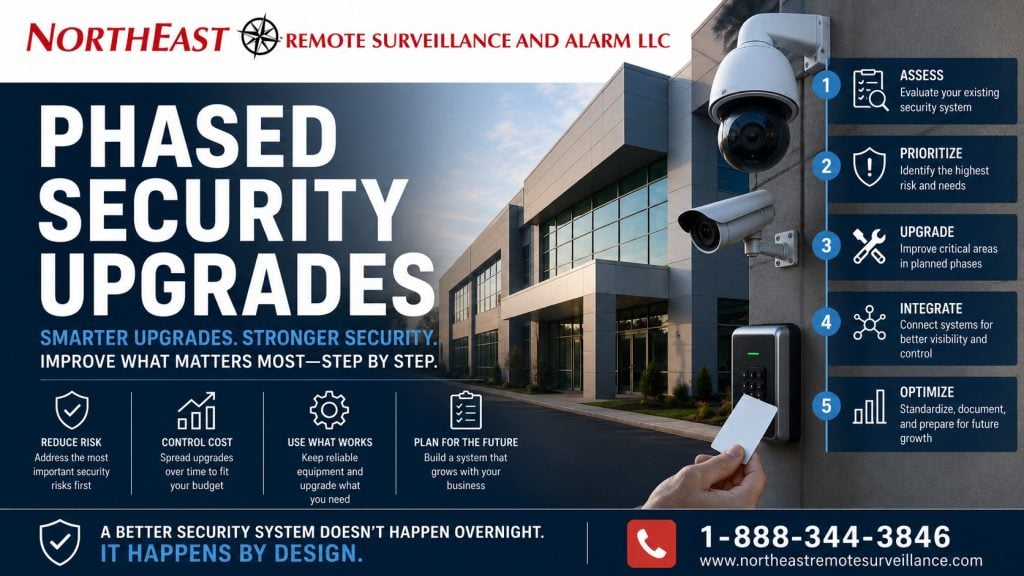
Northeast Remote Surveillance and Alarm, LLC helps offices, warehouses, industrial buildings, logistics properties, medical offices, schools, municipal facilities, contractor yards, retail spaces, small businesses, growing companies, multi-site operators, and large commercial environments improve security systems step by step.
For related system planning, explore Commercial Security System Retrofits.
Many businesses know their security system needs improvement, but the right answer is not always a full immediate replacement. A warehouse may need better cameras now, access control next quarter, alarm communication upgrades later, and monitoring improvements after the system foundation is cleaned up. NERSA helps businesses prioritize upgrades in a practical order so the most important risks are addressed first while usable equipment remains in service when appropriate.
Plan security upgrades in phases based on risk, budget, system condition, operational needs and long-term expansion.
Why Phased Security Upgrades Matter
A phased security upgrade gives a business a practical path forward when the existing system is outdated, disconnected, unreliable, or no longer aligned with how the property operates. Instead of forcing one large replacement project, phased upgrades allow the business to improve the most important parts of the system first.
This approach is especially useful for warehouses, industrial buildings, logistics properties, schools, municipal facilities, medical offices, contractor yards, retail spaces, office buildings, and multi-building commercial properties. Each site may have different priorities, including camera coverage, alarm reliability, employee access, loading dock visibility, gate control, remote access, monitoring workflows, or communication infrastructure.
NERSA helps businesses build phased upgrade plans that protect current investment while moving the property toward a cleaner, stronger, easier-to-manage security platform.
Common Reasons Businesses Choose Phased Upgrades
Businesses may choose phased security upgrades when the existing system still has usable equipment but also has clear weaknesses. A business may have working cameras but poor remote access. It may have a functioning alarm system but outdated phone-line communication. It may have access control on some doors but not on employee entrances, storage rooms, or warehouse areas. It may have monitoring in place but weak video verification or outdated contact procedures.
Phased upgrades can help a business expand or move into an existing building. They can also support property takeovers, acquisitions, added staff and increased warehouse activity. Other reasons include better after-hours security and planned technology improvements.
The goal is to avoid random one-off upgrades and create a clear plan that builds toward the right final system.
Phase One: Review the Existing Security System
A strong phased upgrade begins with a full review of the existing system. NERSA evaluates cameras, recorders, access control doors, intrusion alarm devices, keypads, panels, communicators, monitoring workflows, intercoms, gates, low-voltage cabling, network paths, PoE switches, wireless bridges, user permissions, and system documentation.
This review helps identify what is working, what is failing, what is outdated, what can remain, and what should be upgraded first. Without this step, businesses often spend money on visible devices while ignoring the infrastructure or communication problems causing the system to fail.
Phase Two: Correct the Highest-Risk Security Gaps
After the system review, the next phase is usually correcting the highest-risk gaps. These may include blind spots, failed cameras, unreliable alarm communication, unsecured employee entrances, loading dock coverage gaps, weak perimeter detection, poor gate visibility, outdated monitoring contacts, or doors that are not properly controlled.
For some businesses, the first priority may be camera coverage. For others, it may be alarm reliability, access control cleanup, or monitoring improvements. NERSA prioritizes upgrades based on the property’s actual risk, not a one-size-fits-all package.
Phase Three: Stabilize Communication Infrastructure
Many security problems come from weak infrastructure. Cameras may go offline because of poor PoE switching. Alarm systems may fail because of outdated communication paths. Access control may become unreliable because of poor network or power design. Wireless bridge links may be unstable between buildings, yards, gates, or remote areas.
Phased security upgrades often include communication infrastructure improvements such as PoE switch upgrades, cabling cleanup, wireless bridge correction, alarm communicator replacement, network path review, power supply correction, labeling, rack organization, and remote access cleanup.
A stronger infrastructure foundation helps every future upgrade perform better.
Phase Four: Upgrade Cameras and Video Coverage
Camera upgrades are often a major part of phased security improvements. Businesses may need better image quality, improved night views, longer retention, better remote access, AI-ready camera placement, stronger loading dock coverage, parking lot visibility, or better coverage of employee entrances and high-risk areas.
A phased camera upgrade may begin with the highest-risk areas first, such as entrances, parking lots, warehouse doors, loading docks, gates, yards, production areas, or cash-handling spaces. Additional cameras can be added later as the property’s needs and budget allow.
Phase Five: Improve Access Control
Access control upgrades help businesses manage who can enter buildings, doors, offices, storage areas, warehouse spaces, employee entrances, tenant areas, restricted rooms, and gates. In a phased plan, access control may start with the highest-value or highest-risk doors before expanding across the property.
A phased access control plan may include reader upgrades, controller replacement, door hardware correction, credential cleanup, mobile credential planning, user permission cleanup, door schedule improvements, and future door expansion.
Phase Six: Upgrade Intrusion Alarms and Monitoring
Intrusion alarm upgrades help businesses improve after-hours protection, alarm communication, zone organization, keypad operation, sensor coverage, user code management, and monitoring reliability. In a phased plan, alarm improvements may start with communication path upgrades, keypad replacement, high-priority door contacts, motion detection review, or monitoring contact cleanup.
NERSA helps businesses preserve usable alarm devices when practical while upgrading the parts that create reliability problems, false alarms, communication failures, or operational confusion.
Phase Seven: Integrate Systems for Better Event Review
Once the major systems are more stable, the next phase may be integration. A business may need cameras, access control, alarms, intercoms, gate control, and monitoring workflows to work together more clearly.
Integration upgrades can help managers understand what happened during an event, which door was used, what camera covered the area, whether an alarm was triggered, and how the event should be reviewed. This is especially useful for warehouses, logistics sites, schools, municipal facilities, industrial buildings, and multi-site operations.
The goal is not to create unnecessary complexity. The goal is to make the existing security environment easier to manage and easier to understand.
Phase Eight: Standardize Users, Documentation, and Future Expansion
The final phase of a strong upgrade plan is standardization. This may include camera naming, door naming, alarm zone naming, user permissions, monitoring contacts, access groups, system documentation, service records, and future upgrade standards.
Good documentation helps owners, facility managers, IT teams, security staff, and service technicians understand the system faster. It also makes future additions cleaner because the business is no longer guessing how the system was built.
When Phased Upgrades Are Better Than Full Replacement
Phased upgrades may suit a system with equipment worth keeping. Check the wiring, cameras, door hardware, alarm devices and mounting locations. If these remain useful, you may be able to improve the infrastructure without replacing the whole system.
This approach can help reduce waste, control cost, prevent unnecessary disruption, and allow the business to improve security in an organized sequence. It also gives growing businesses a way to match security improvements to operational priorities.
When Full Replacement May Still Be Needed
Some systems are too outdated, unsupported, unreliable, undocumented, or poorly installed to justify continued patching. In those cases, NERSA may recommend a full replacement or a phased replacement where the old system is retired over time.
Full replacement may be appropriate when equipment is unsupported, wiring is damaged, or communication paths are unreliable. Other reasons include obsolete cameras or alarm panels, access-control software that cannot be serviced, or a system that cannot meet the business’s long-term needs.
A phased plan can still help by showing which parts should be replaced first and how the final system should be built.
Built for Commercial and Industrial Properties
Phased security upgrades suit warehouses, industrial sites, logistics properties, manufacturing facilities and offices. They also serve medical offices, schools, municipal buildings, contractor yards and retail spaces. Plans can include parking, gates and multi-tenant commercial buildings.
NERSA supports small businesses, growing businesses, warehouses, industrial facilities, schools, municipal buildings, multi-site operations, and large commercial security environments. Each phased upgrade plan is built around the property’s current system, risk level, operating schedule, budget priorities, and long-term growth.
Coordinating Related Upgrades
Coordinate the project sequence with camera, access-control, alarm, communication, intercom, gate and monitoring upgrades, including any shared infrastructure or multi-site standards.
A planned sequence helps each improvement support the intended long-term system.
Frequently Asked Questions
What are phased security upgrades?
Phased security upgrades are planned improvements made in stages so a business can modernize cameras, access control, alarms, monitoring, intercoms, gate control, communication infrastructure, and security workflows over time.
Do phased upgrades mean we keep old equipment forever?
No. Phased upgrades help determine what can remain for now, what should be upgraded immediately, and what should be replaced later. The goal is practical modernization, not keeping outdated equipment longer than it should stay in service.
Can NERSA upgrade one part of the system first?
Yes. NERSA can help businesses begin with the highest-priority need, such as camera coverage, alarm communication, access control doors, remote access, monitoring workflows, gate control, or infrastructure cleanup.
Are phased upgrades better than replacing the whole system?
Sometimes. If the existing system has usable parts, phased upgrades can protect the current investment while improving reliability. If the system is too outdated or unreliable, NERSA may recommend full replacement or phased replacement.
Can phased upgrades support future expansion?
Yes. A good phased upgrade plan should make future additions easier. NERSA plans for additional cameras, doors, alarm points, monitoring features, intercoms, gates, network equipment, and system expansion when appropriate.
Is this only for large facilities?
No. NERSA supports small businesses, growing businesses, warehouses, industrial facilities, schools, municipal buildings, multi-site operations, and large commercial security environments. Phased upgrades can be useful for a single small business location or a larger multi-building property.
Request Phased Security Upgrade Support
For related planning, explore Commercial Security System Upgrades, Retrofits and Takeovers.
Call Northeast Remote Surveillance and Alarm, LLC at 1-888-344-3846 to review phased security upgrade options for your commercial property.
Compliance, Codes & Project Standards
NERSA plans commercial and industrial security work with applicable code, documentation, inspection and authority-having-jurisdiction requirements in mind. Requirements vary by system, property and jurisdiction. These resources support project planning; they do not establish legal compliance, certification or AHJ approval.
Related guidance: Regulatory compliance & inspection readiness · NERSA project standards · Documentation, testing & inspection readiness