
Commercial keypad systems let Philadelphia businesses manage PIN entry at selected doors.

request a commercial security assessment
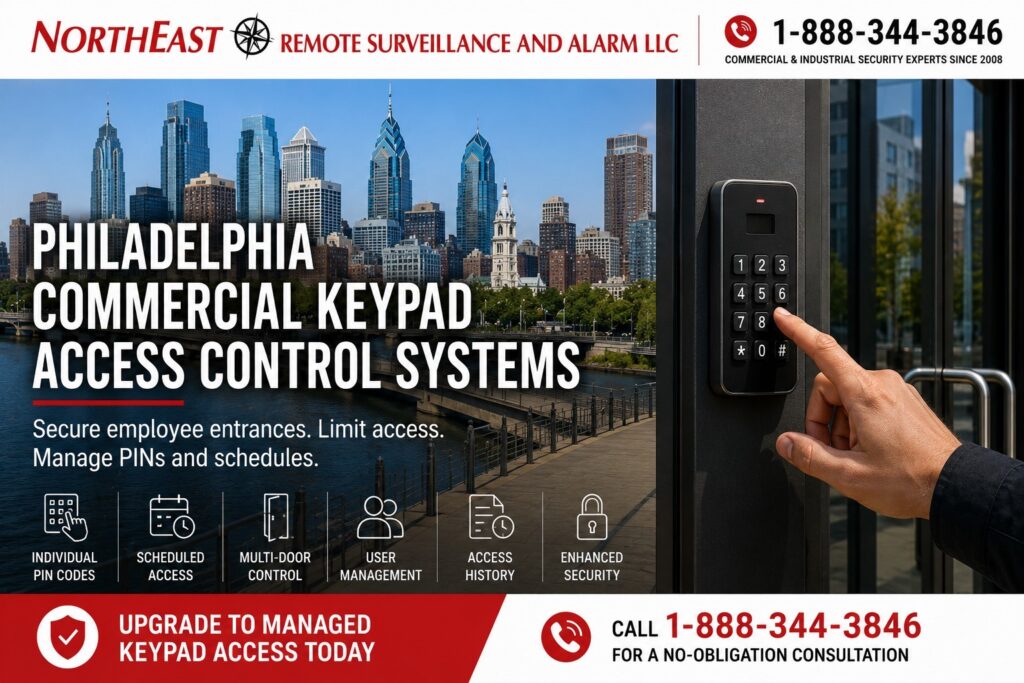
They may suit employee entrances, restricted rooms, tenant spaces and service doors where a physical credential is unnecessary or impractical.
Northeast Remote Surveillance and Alarm, LLC designs, installs, upgrades and supports commercial keypad access in Philadelphia. We serve qualifying offices, industrial sites, warehouses, healthcare facilities, shared buildings, institutions and contractor properties. Other business and professionally managed properties may also qualify.
This guide covers commercial PIN and keypad-based access control in Philadelphia.
For complete city-level planning involving readers, credentials, controllers, door hardware, industry applications, and broader system architecture, visit Philadelphia Commercial Access Control Systems.
Commercial Keypad Access Is More Than a Shared Door Code
A basic keypad can allow someone to enter a number and unlock a door.
Commercial access control should go further.
Where the platform supports individually assigned PINs, the system can provide administrators with better control over:
- Who has a code
- Which door the code operates
- When the code is valid
- When access expires
- Whether a former user’s PIN remains active
- Which access events are associated with a particular user
The objective is to avoid turning an electronic keypad into the equivalent of a mechanical key hidden under the mat.
A commercial keypad should be administered as part of the facility’s access-control system.
Individual PINs Instead of Shared Codes
One of the biggest weaknesses of keypad entry is the uncontrolled shared code.
If fifty employees use the same PIN, the business may know that the code was entered but not which employee used it.
Shared codes can also become difficult to control when:
- Employees leave
- Contractors finish projects
- Codes are given to unauthorized people
- Former users remember the PIN
- Different shifts require different access
- The same code is used for years
Where the access-control platform permits it, individually assigned PINs provide much stronger administration.
A business can disable one user’s PIN without changing access for everyone else.
Employee Keypad Access
Commercial keypads may be appropriate for selected employee entrances where PIN entry matches the operating environment.
Employee access can potentially be organized according to:
- Individual user
- Department
- Shift
- Door
- Schedule
- Building
- Access group
For example, a day-shift employee can receive a PIN that operates an approved entrance during the user’s scheduled hours.
A supervisor may receive broader access.
A maintenance technician may receive a different schedule.
The keypad becomes part of the same managed permission structure rather than simply accepting one building-wide number.
PIN Access for Restricted Interior Rooms
Keypads can also be useful on selected interior spaces where the business wants controlled access without issuing another physical key.
Possible applications may include:
- IT rooms
- Records rooms
- Tool rooms
- Parts storage
- Management offices
- Staff-only rooms
- Supply rooms
- Equipment spaces
- Controlled storage
The decision should be based on the actual security and administrative requirement.
Not every restricted room needs a keypad.
The strongest design identifies the openings where managed PIN access provides meaningful value.
Temporary PINs for Contractors and Service Personnel
Philadelphia commercial properties frequently use contractors, vendors, technicians, cleaners, maintenance personnel, and temporary workers.
A temporary PIN may be appropriate where the installed platform supports limited-duration access.
Temporary access can potentially be restricted by:
- Door
- Schedule
- Start date
- Expiration date
- Assignment
When the work ends, the user’s access should be removed.
Temporary codes should not become permanent shared contractor codes that remain active indefinitely.
A clearly managed temporary-user process preserves the value of the system.
Scheduled Keypad Access
A valid PIN does not necessarily need to work twenty-four hours a day.
Commercial systems can use access schedules to limit when authorized PINs operate.
Schedules may be appropriate for:
- Day-shift employees
- Evening staff
- Overnight personnel
- Cleaning crews
- Contractors
- Maintenance
- Weekend personnel
This allows the system to support legitimate operations without giving every user unrestricted after-hours entry.
Schedules should reflect the facility’s actual requirements rather than being created arbitrarily.
Keypad Access for After-Hours Entrances
After-hours access is one of the situations where good PIN administration becomes particularly important.
A Philadelphia office, warehouse, industrial property, or managed commercial building may need selected personnel to enter outside normal business hours.
Authorized users can potentially receive:
- Approved entrance
- Specific schedule
- Individual PIN
- Restricted interior permissions
Users without a legitimate after-hours requirement can remain limited to normal operating periods.
This provides a clearer access strategy than leaving one shared building code active at all times.
Keypad Readers Versus Standalone Keypads
Not every electronic keypad is the same.
A standalone keypad may control one opening locally.
A commercial access-control keypad reader may connect to a centralized controller and management platform.
A centrally managed system can provide advantages such as:
- User administration
- Door schedules
- Individual PIN management
- Central credential removal
- Event records
- Multi-door operation
- Remote administration where supported
The appropriate approach depends on the scale of the facility and how much administration the business requires.
A one-door restricted interior room may have different requirements from a multi-door commercial building with hundreds of users.
Multi-Door Keypad Access Control
PIN access does not have to be limited to one door.
Compatible commercial systems may manage keypad entry across multiple controlled openings.
A user might be permitted to access:
- Employee entrance
- Assigned department
- Required restricted room
while remaining denied at other keypad-controlled doors.
This allows facilities to maintain one managed user structure instead of maintaining unrelated door codes throughout the property.
Multi-door administration becomes especially valuable as employee populations and access requirements grow.
Multi-Building Keypad Systems
Commercial properties with multiple buildings may also use centrally managed PIN permissions where supported by the access-control platform.
An employee can receive access only to the buildings required for the job.
Maintenance personnel may receive broader permissions.
A contractor may receive one building for a limited period.
Management may receive appropriate multi-building access.
The objective is to manage permissions intentionally rather than using the same universal code at every property entrance.
PIN Management When Employees Leave
Employee offboarding is critical with keypad systems.
A PIN belonging to a former employee should not remain active simply because the person no longer has a physical badge to return.
A managed access-control platform can allow administrators to disable an individual user.
This is one reason individual PINs are preferable to shared codes.
With a shared code, removing one former employee’s knowledge of the number may require changing the code for everyone.
With individually administered PINs, one user can be disabled without disrupting the entire workforce.
Lost Credentials and Keypad Backup
Some commercial properties may consider keypad entry as an alternative access method within a larger access-control system.
That does not mean a keypad should automatically become a universal bypass for lost cards or phones.
Backup entry methods should be deliberately defined.
An unrestricted shared backup PIN can undermine the accountability gained from individually managed credentials.
Where a system uses multiple access methods, each method should be administered according to the facility’s security requirements.
Card Plus PIN and Multi-Factor Door Entry
Some commercial applications may require more than one authentication factor at selected openings.
A compatible reader may support a credential plus PIN workflow.
For example, the user may need:
- An authorized credential
- The correct personal PIN
This may be considered for selected higher-control applications where the platform and facility requirements justify it.
However, card-plus-PIN should not be installed everywhere simply because the feature is available.
The additional step affects user workflow and should solve a defined security requirement.
For alternatives to PIN entry, use the Philadelphia keycard, fob and mobile-credential guide to compare issuance, removal and migration requirements.
Protecting PIN Privacy
Individual PINs only provide meaningful accountability when they remain individual.
Businesses should discourage:
- Sharing PINs
- Writing codes near the door
- Posting codes in common areas
- Reusing one code for multiple employees
- Giving permanent employee codes to vendors
- Keeping former users active
Administrators should also have a defined method for handling forgotten or compromised PINs.
A compromised individual PIN can be changed without requiring every other authorized user to receive a new code.
Keypad Location and Commercial Use
The keypad is part of a controlled physical opening.
Placement should consider:
- User approach
- Door swing
- Weather exposure
- Visibility
- Wall or mullion construction
- Potential physical damage
- Cable pathway
- Daily traffic
- Serviceability
- Appropriate mounting conditions
Exterior commercial applications may require equipment suited to environmental exposure and expected use.
Industrial and warehouse locations may also need consideration for carts, equipment, rough handling, dust, and other operating conditions.
The reader should be selected and installed around the actual environment.
Keypad Access Still Depends on Door Hardware
A correct PIN does not secure the building by itself.
The controlled opening may also include:
- Access controller
- Electric strike
- Electrified lock
- Exit hardware
- Door-position contact
- Request-to-exit device
- Power supply
- Door closer
- Supporting wiring
The keypad can authorize entry while the physical door still fails to close or latch.
Commercial access control therefore requires the entire opening to operate properly.
This service covers the PIN-entry and keypad-management side of the system rather than complete door-hardware engineering.
Door Monitoring With Keypad Access
Door-position monitoring can provide useful information beyond the PIN transaction itself.
A system may be able to identify:
- PIN accepted
- Door opened
- Door held open
- Door forced
- Door closed
This distinction matters.
Knowing that an authorized code was entered does not automatically prove that the door returned to a secure condition afterward.
Door monitoring should be included where the information provides operational value.
Existing Keypad System Upgrades
Older Philadelphia commercial properties may already have keypad-controlled doors.
Existing systems may have problems such as:
- One shared code for everyone
- Former employees still knowing the code
- Unsupported equipment
- Worn keypads
- Unclear programming
- No user records
- Limited scheduling
- No centralized administration
- Failing locking hardware
- Poor documentation
An upgrade may involve replacing the keypad, integrating the door into a managed access-control platform, correcting the locking hardware, or changing the user-administration process.
Complete replacement should not be assumed until the existing installation has been evaluated.
Moving From Shared Codes to Individual Users
A common keypad upgrade is moving away from one universal PIN.
A planned migration can include:
- Identifying authorized users
- Establishing individual accounts
- Creating appropriate access groups
- Assigning schedules
- Programming unique PINs
- Testing each access level
- Removing the old shared code
The goal is not simply to create more numbers.
The goal is to make the keypad part of a controlled user-management process.
Keypad Access for Multi-Tenant Properties
A multi-tenant building may use keypad access at selected doors, but shared building codes require careful administration.
Where supported, users should be separated by tenant or responsibility.
Property management may control:
- Main entrances
- Common areas
- Building-service doors
while tenants receive appropriate access to their assigned spaces.
A tenant should not automatically know a universal code that provides access to unrelated tenant areas.
The exact design depends on the property’s management structure and installed platform.
Keypad Access for Commercial and Industrial Facilities
Keypads can serve many business and professionally managed environments when PIN access fits the workflow.
Applications can include:
- Offices
- Warehouses
- Industrial properties
- Manufacturing facilities
- Medical offices
- Multi-tenant buildings
- Contractor facilities
- Institutional properties
Choose keypad access according to the opening, user workflow, and level of accountability your facility requires.
NERSA can assess whether PIN entry or another credential method is the better fit for each location.
This service covers the keypad and PIN-entry method used at commercial doors throughout Philadelphia.
Egress and Compliance Boundaries
A keypad typically controls entry.
The controlled opening must still maintain its required exit operation.
Certain locking arrangements, doors, or building conditions may require additional review involving egress, accessibility, emergency release, fire-rated openings, or other compliance considerations.
Coordinate these requirements with the appropriate design professional and authority having jurisdiction before selecting or changing door hardware.
The keypad should be selected as part of an appropriate controlled-opening design rather than being treated as an independent lock.
Service Scope
The service focuses on:
commercial keypad and PIN-based door access control in Philadelphia.
Keypad system planning and support can include:
- Commercial keypad readers
- Individual PINs
- PIN issuance
- PIN removal
- Temporary PINs
- Scheduled keypad access
- After-hours PIN access
- Multi-door keypad systems
- Multi-building PIN administration
- Shared-code replacement
- PIN audits
- Card-plus-PIN only as a supporting authentication option
Choosing between PINs, keycards, fobs, and mobile credentials?
Explore Philadelphia commercial access control services to plan credentials, doors, and related security requirements around your facility.
Why Philadelphia Businesses Choose NERSA
Northeast Remote Surveillance and Alarm, LLC has focused on commercial and industrial electronic security since 2008.
Commercial keypad access requires more than mounting a number pad beside a door.
The system should account for:
- Individual users
- PIN administration
- Employee turnover
- Contractors
- Schedules
- Restricted areas
- Door permissions
- Existing hardware
- Physical door operation
- Long-term management
NERSA designs keypad access around how the commercial property actually operates.
Request a Philadelphia Keypad Access Control Assessment
NERSA can review employee PINs, shared door codes and scheduled keypad access at your Philadelphia property. We can also assess temporary contractor codes, PIN management across doors and upgrades to older keypad systems.
Call 1-888-344-3846 or request a commercial security assessment to review your controlled doors, users, existing keypads, access schedules, hardware, and administration requirements.
Frequently Asked Questions
What is commercial keypad access control?
Commercial keypad access control allows authorized users to enter a PIN at a controlled door. Managed systems can associate PINs with individual users, schedules, doors, and permissions.
Is an individual PIN better than one shared building code?
Where accountability matters, individual PINs are generally easier to manage because one user’s access can be changed or disabled without changing the code for every other authorized user.
Can keypad access be limited by schedule?
Yes. Compatible access-control systems can restrict individual users to approved days and times.
Can contractors receive temporary PINs?
Yes. Where the installed system supports it, contractor or temporary-user access can be limited by door, schedule, and expiration period.
Can one PIN work at several approved doors?
Compatible centrally managed systems can assign a user access to multiple keypad-controlled doors while denying that user access to other openings.
Can an employee’s PIN be disabled when the person leaves?
Yes. Individually managed users can be disabled without necessarily changing access for every other employee.
Can a keypad require both a card and PIN?
Some compatible access-control readers can support credential-plus-PIN authentication where the facility has a defined need for an additional authentication step.
Can an old shared-code keypad be upgraded?
Often, yes. The existing keypad, controller, door hardware, wiring, and user requirements should be evaluated to determine whether the door can be moved to a more manageable commercial access-control platform.
Does keypad access still need proper electric locking hardware?
Yes. The keypad authorizes entry, but the lock, strike, exit hardware, door contact, power, and physical opening must still operate correctly.
How does a Philadelphia commercial keypad project begin?
The project begins by identifying the controlled doors, user groups, PIN requirements, schedules, temporary-user needs, existing hardware, and administration responsibilities. NERSA can then design the keypad access solution around those requirements.
Compliance, Codes & Project Standards
NERSA plans commercial and industrial security work with applicable code, documentation, inspection and authority-having-jurisdiction requirements in mind. Requirements vary by system, property and jurisdiction. These resources support project planning; they do not establish legal compliance, certification or AHJ approval.
Related guidance: Regulatory compliance & inspection readiness · Access control & door hardware standards · NFPA 101 & egress planning · ADA access-control planning