
Manufacturing and industrial access control systems in Philadelphia should control who enters the facility, which production or restricted areas each user can access, and when those permissions apply without creating unnecessary obstacles for normal plant operations.

request a commercial security assessment
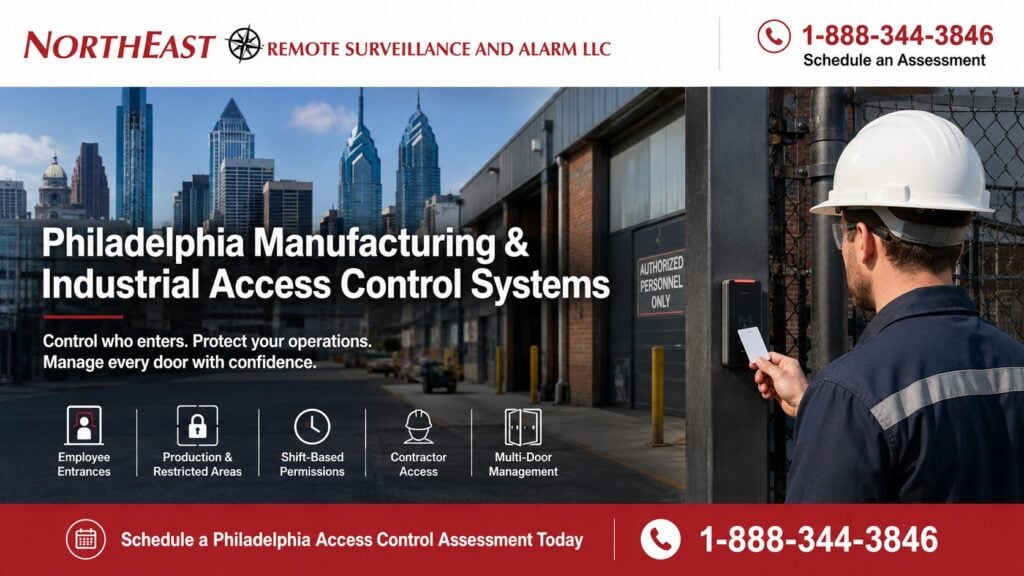
Northeast Remote Surveillance and Alarm, LLC designs, installs, upgrades, and supports commercial access control systems for Philadelphia manufacturing plants, industrial buildings, fabrication facilities, production properties, contractor operations, and related business and professionally managed facilities.
NERSA provides access control for manufacturing and industrial properties in Philadelphia.
For broader city-level planning involving offices, warehouses, healthcare properties, multi-tenant buildings, credentials, gates, and other commercial applications, visit Philadelphia Commercial Access Control Systems.
Access Control Built Around Manufacturing Operations
Manufacturing facilities operate differently from conventional office buildings.
Employees may arrive across multiple shifts. Production personnel may need different permissions from maintenance teams. Contractors may require temporary access. Management, engineering, IT, shipping, and production staff may each need different controlled areas.
The access-control system should reflect those operational differences.
A Philadelphia industrial facility may need controlled access at employee entrances, production-support areas, tool rooms, parts storage, engineering spaces, IT rooms, maintenance areas, shipping offices, contractor entrances, and other restricted interior openings.
The objective is not to electronically control every door.
The objective is to control the openings where individual permissions, access schedules, and better accountability create meaningful operational or security value.
Employee Entrances and Shift-Based Access
Manufacturing plants frequently operate beyond a standard daytime schedule.
First shift, second shift, third shift, weekend production, maintenance periods, and temporary operating schedules can create very different access requirements.
An electronic access-control system can provide permissions based on the employee’s actual schedule rather than simply allowing every credential to operate around the clock.
A production employee may be authorized during an assigned shift.
A maintenance supervisor may require broader hours.
A plant manager may need approved after-hours access.
A contractor may receive access only during the scheduled project window.
When employees change shifts or responsibilities, their permissions can be updated without rekeying affected doors.
This is especially valuable in facilities where staffing changes regularly or different departments operate on different schedules.
Production Areas and Restricted Process Spaces
Not every person who can enter an industrial facility should have access to every production or support area.
Some spaces may require additional restriction because of equipment, inventory, operational responsibility, proprietary processes, or management requirements.
Access permissions can be separated according to the user’s role.
A general employee credential may permit entry through the assigned employee entrance while providing no access to engineering, IT, maintenance, controlled inventory, or other restricted areas.
Supervisors and department managers can receive different permissions when their responsibilities require broader access.
This type of separation creates clearer accountability without forcing the facility to operate multiple unrelated access-control systems.
Tool Rooms, Parts Storage, and Controlled Inventory
Tool rooms, parts areas, maintenance storage, and controlled inventory can become important access-control points in manufacturing facilities.
Physical keys and shared codes provide limited accountability when many employees need access at different times.
Individual credentials can provide a clearer record of authorized entry while allowing the facility to change permissions without replacing mechanical keys throughout the operation.
These areas may be appropriate for tighter permission groups than general production spaces.
For example, access might be limited to maintenance personnel, supervisors, designated production employees, or other authorized users.
The access-control system should reflect actual job responsibilities rather than giving every employee unnecessary access to sensitive support areas.
Maintenance and Engineering Access
Maintenance and engineering personnel frequently need broader facility access than general production employees.
They may need to enter mechanical rooms, electrical areas, equipment spaces, production-support rooms, engineering offices, tool storage, or other controlled areas.
Those permissions should still be managed deliberately.
Access control can allow the facility to provide broader access to appropriate maintenance or engineering groups without issuing uncontrolled master keys or giving every employee the same permissions.
Schedules can also be configured around planned maintenance periods or other approved operating requirements.
Contractor and Vendor Access
Manufacturing properties regularly use outside contractors, service companies, equipment technicians, vendors, and specialized trades.
Those individuals may need legitimate access without receiving the same privileges as permanent employees.
Contractor access can be structured around the specific work being performed.
A temporary credential may be limited by door, schedule, building, or expiration date.
When the project ends, the credential can be deactivated without changing access for employees or other approved users.
This is generally more manageable than distributing physical keys or permanent shared access codes to outside personnel.
Shipping and Receiving Office Access
Manufacturing facilities may also have shipping offices, receiving areas, material-control spaces, and office-to-production transitions that require controlled entry.
These openings can experience regular interaction between plant employees and outside drivers, carriers, vendors, or contractors.
The access-control design should establish who is permitted to move from public or receiving areas into employee-only portions of the facility.
An outside driver who needs access to a receiving office should not automatically receive unrestricted entry to production or administrative areas.
Controlled transitions can help maintain that separation.
Door-Held-Open and Forced-Door Monitoring
Industrial security depends on more than knowing whether a credential was accepted.
A controlled door can still create a problem if it remains propped open or fails to return to a secure position after use.
Door-position monitoring can provide information about doors that remain open beyond the expected period or open without an associated authorized access event.
Repeated held-open conditions may indicate employee convenience habits, high traffic, damaged hardware, poor door alignment, closer problems, or an operational process that needs to be reconsidered.
Forced-door events can also provide facility managers with useful information when an opening behaves unexpectedly.
The value of these events depends on properly installed door contacts, reliable physical door operation, and appropriate access-control programming.
Access Permissions by Department and Job Role
Large manufacturing facilities can become difficult to manage when every employee is programmed individually door by door.
Role-based permissions can simplify administration.
A facility may establish groups for production, maintenance, engineering, management, IT, shipping, receiving, contractors, or other appropriate responsibilities.
Each group can receive the doors and schedules appropriate for that role.
When an employee changes departments, the administrator can update the user’s permission group rather than manually changing every individual door.
This also makes future access reviews easier.
Employee Changes and Credential Removal
Manufacturing businesses need a reliable process for adding and removing users.
Employee turnover, role changes, temporary staffing, contractors, terminations, lost credentials, and department transfers can all affect access permissions.
Electronic credentials allow an authorized administrator to deactivate one user’s access without changing permissions for the rest of the workforce.
That does not eliminate the need for good administrative procedures.
The facility should still maintain clear responsibility for issuing credentials, disabling former users, reviewing inactive accounts, and limiting unnecessary access.
Good credential management is part of the access-control system.
Multi-Building Industrial Properties
Some Philadelphia industrial operations occupy more than one building or contain several operational structures on the same property.
A scalable access-control system can help manage users across those buildings while maintaining different permission levels.
An employee may need access to one production building.
A maintenance supervisor may require several buildings.
Management or IT personnel may need different areas.
The system should allow legitimate movement without automatically giving every credential unrestricted campus access.
Common door naming, user roles, schedules, and administrative standards also make larger installations easier to manage over time.
Existing Manufacturing Access Control Systems
Philadelphia industrial properties may already have readers, door controllers, electric strikes, access cards, wiring, power supplies, or software from a previous security provider or an older installation.
Existing equipment should be evaluated before deciding that everything must be replaced.
A takeover or upgrade may involve correcting unsupported controllers, aging credential technology, unreliable readers, failed locks, poor door naming, inactive users, incomplete documentation, or systems that can no longer expand with the facility.
Where existing components remain compatible, reliable, and supportable, selective reuse may be appropriate.
Where they create operational or service problems, replacement or phased modernization may be the better approach.
The Physical Controlled Door Matters
Manufacturing access control is not just a software or credential project.
The physical opening must operate correctly.
The door, frame, electric locking hardware, exit device, closer, request-to-exit equipment, door contact, power supply, and associated wiring all affect reliability.
A reader cannot correct a door that fails to close.
Software cannot compensate for a damaged exit device.
A valid credential does not provide meaningful security if the opening fails to relatch afterward.
High-use industrial doors should therefore be evaluated as complete controlled openings.
Access Control and Required Egress
Electronic access should control entry without improperly interfering with required occupant exit.
Some industrial openings may require additional review because of locking hardware, emergency release, fire-rated conditions, exit devices, or other inspection-sensitive requirements.
Access-control planning does not replace required life-safety, fire-door, accessibility, fire-alarm, or authority review.
Those subjects require separate review by the appropriate qualified professionals and authorities.
For manufacturing access control, the key boundary is straightforward: security permissions should control authorized entry while the physical opening continues to support its required building function.
Common Manufacturing Access-Control Problems
NERSA can evaluate common access problems at industrial facilities. These include active credentials for former employees, shared badges or codes, and users with more access than their roles require. Other concerns include broad after-hours permissions, contractors with permanent access, and restricted rooms without role-based controls. We also review propped doors, missing door-held-open reports, unreliable forced-door events, and older equipment that is difficult to manage or service.
These conditions are often caused by system design, administrative procedures, or physical door problems rather than simply by the type of credential being used.
NERSA’s Manufacturing Access Control Process
A manufacturing access-control project begins with understanding the operation.
NERSA reviews employee entrances, departments, shifts, restricted areas, contractors, existing doors, current equipment, administrative responsibilities, and known security or operational problems.
The facility can then identify which openings actually require control and which employee groups need access to them.
Readers, controllers, locking hardware, door contacts, request-to-exit devices, power, schedules, and management software are selected around those requirements.
Permissions and schedules are programmed around the approved operating structure, and controlled openings are functionally tested before turnover.
The goal is a system that facility personnel can continue to administer after installation.
Manufacturing Access Control Scope
This service covers employee entrances, production-area permissions, maintenance and engineering access, tool and parts rooms, contractor credentials, shift-based schedules, restricted industrial spaces, and day-to-day access administration.
Video surveillance, intrusion alarms, vehicle gates, and broader citywide access-control needs can be coordinated through the appropriate NERSA service resource.
Request a Philadelphia Manufacturing Access Control Assessment
Does your Philadelphia manufacturing plant need better control of employee entrances or restricted production areas? NERSA can review shift schedules, contractor credentials, tool-room access, and maintenance access. We can also assess upgrades to your existing access-control system.
Call 1-888-344-3846 or request a commercial security assessment to review your controlled openings, users, shifts, existing equipment, and access-management requirements.
Frequently Asked Questions
What is manufacturing access control?
Manufacturing access control manages which employees, contractors, supervisors, and other authorized users can enter selected doors or restricted areas and when those permissions are valid.
Can access permissions follow manufacturing shifts?
Yes. Access-control schedules can be configured around first, second, third, weekend, maintenance, or other approved operating periods.
Should every manufacturing employee have the same access?
No. Permissions can be separated according to department, job role, shift, building, or operational responsibility.
Can tool rooms and parts areas have separate permissions?
Yes. Tool rooms, parts storage, maintenance areas, controlled inventory, and other restricted spaces can use more limited access groups than general employee areas.
How should contractors receive access?
Contractors can receive individual credentials limited to the doors, schedules, and project periods appropriate for their work. Temporary credentials can be deactivated when the assignment ends.
Can shipping and receiving offices use access control?
Yes. Controlled entrances can help separate employee-only areas from driver, vendor, carrier, and contractor activity around shipping or receiving operations.
Can an existing manufacturing access-control system be upgraded?
Often, yes. Existing readers, controllers, locking hardware, wiring, credentials, and software can be evaluated to determine what remains supportable and what should be corrected or replaced.
Can one system control several industrial buildings?
Many commercial access-control platforms can manage multiple buildings when appropriately designed. Different employees can receive permissions only for the buildings and areas they require.
Does manufacturing access control include door monitoring?
It can. Door-position contacts can support held-open and forced-door reporting when those functions are appropriate for the controlled opening.
How does a Philadelphia manufacturing access-control project begin?
The project begins by identifying employee groups, operating shifts, controlled entrances, restricted areas, contractor requirements, existing doors, current equipment, and administrative responsibilities. NERSA can then design the access-control system around those actual operating conditions.