
Plan Philadelphia warehouse access control around employee entrances, shipping offices, restricted storage, shift schedules, and logistics operations.

Request a Philadelphia Access Control Assessment
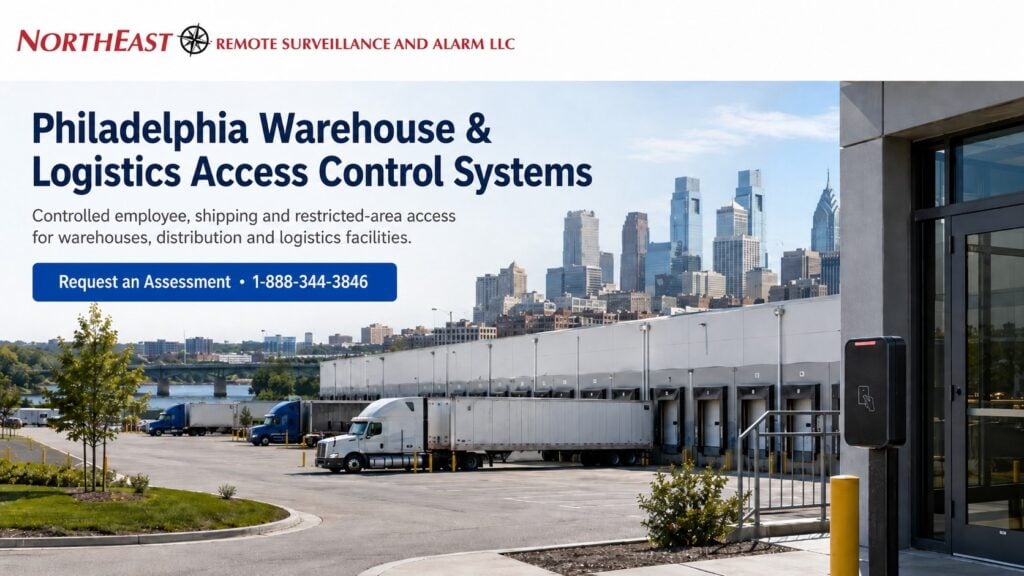
Northeast Remote Surveillance and Alarm, LLC designs and installs commercial access-control systems for qualifying warehouses, distribution facilities, logistics operations and freight-handling properties throughout Philadelphia.
Commercial and Industrial Systems Only • Warehouses • Distribution • Logistics • Controlled Doors • Employee Credentials
For broader Philadelphia access-control planning, visit Commercial Access Control Installation in Philadelphia.
Warehouse access control in Philadelphia should be designed around the movement of employees, supervisors, contractors, drivers and authorized visitors through a working logistics facility.
A warehouse may contain offices, shipping departments, receiving areas, inventory rooms, IT spaces, maintenance areas and restricted operational zones that should not all have the same access permissions.
The purpose of warehouse access control is not to electronically lock every door.
The purpose is to identify the openings where individually managed credentials and clearly defined permissions improve control over the facility.
Employee Entrances
Employee entrances are often among the first openings considered for warehouse access control.
Individually assigned credentials can allow administrators to manage who may enter and when.
Permissions may be organized around:
- Employee
- Department
- Shift
- Building
- Door
- Job responsibility
- Contractor status
- Time schedule
A first-shift warehouse employee may require different permissions from a maintenance supervisor, shipping manager or overnight contractor.
The access-control system should reflect those differences.
Shipping and Receiving Offices
Shipping and receiving offices frequently act as transition points between administrative areas and active warehouse operations.
These doors may require controlled access because they can provide entry into:
- Inventory areas
- Shipping records
- Receiving operations
- Warehouse floors
- Equipment areas
- Restricted storage
The access strategy should account for employees who need regular entry as well as drivers, vendors or contractors who should not receive unrestricted building access.
Office-to-Warehouse Doors
A door separating an office environment from the warehouse floor can become an important internal control point.
Office employees may not require unrestricted warehouse access.
Warehouse employees may not require unrestricted access to administrative offices.
Access control can help establish the appropriate boundary while still allowing authorized personnel to move between departments.
Restricted Inventory and Equipment Areas
Some warehouses contain inventory, tools, equipment or records that require greater access control than the general warehouse floor.
Potential controlled areas may include:
- High-value inventory
- Tool rooms
- Parts rooms
- IT rooms
- Network closets
- Records rooms
- Maintenance storage
- Controlled materials
- Specialized equipment areas
Credential permissions should be based on legitimate operational requirements.
Shift-Based Access
Warehouses often operate beyond conventional office hours.
The access-control system may therefore need to account for:
- First shift
- Second shift
- Third shift
- Weekend crews
- Cleaning personnel
- Maintenance personnel
- Temporary labor
- Contractors
- After-hours management
Access schedules should match actual operating procedures.
A credential that is appropriate during an employee’s normal shift does not necessarily need to provide unrestricted entry at every hour of the day.
Contractor and Vendor Credentials
Warehouse properties regularly receive maintenance personnel, equipment technicians, vendors and other contractors.
Where appropriate, temporary or limited credentials may be used instead of providing unrestricted permanent access.
Contractor permissions may be limited according to:
- Specific door
- Building
- Time period
- Schedule
- Assignment
- Required work area
Temporary access should have a defined process for issuance and removal.
The Controlled Warehouse Door
Every warehouse door should be evaluated individually.
A controlled opening may involve:
- Credential reader
- Access controller
- Electrified locking hardware
- Door-position monitoring
- Request-to-exit device
- Power supply
- Battery backup
- Door closer
- Exit hardware
- Appropriate wiring
Warehouse doors can experience heavy use.
Door condition, traffic volume and existing hardware therefore matter as much as the credential technology.
Electronic access control cannot correct a door that does not close, latch or mechanically operate correctly.
After-Hours Door Management
After-hours activity can create different access requirements from normal daytime operation.
Employees may need access to one entrance while other doors remain restricted.
Supervisors or emergency personnel may require broader permissions.
Cleaning crews or contractors may require limited access during specific periods.
An access-control design should establish these permissions deliberately rather than allowing every credential to work everywhere.
Warehouse Access Control and Video
Compatible video systems may provide camera context around selected warehouse-door events.
Examples may include:
- Rejected credentials
- Forced doors
- Held-open doors
- After-hours entry
- Contractor access
- Shipping-office activity
Video should support the access-control workflow rather than replace properly designed door control.
Existing Warehouse Access-Control Systems
A warehouse may already contain readers, controllers, locks, cabling or credentials from a previous tenant or installer.
NERSA can evaluate existing equipment before complete replacement is recommended.
The appropriate approach may include:
- Repair
- Reprogramming
- Credential cleanup
- Reader replacement
- Controller replacement
- Selective door upgrades
- Provider takeover
- Phased modernization
Reusable infrastructure should be retained when its condition, compatibility and design support the new system requirements.
Request a Philadelphia Warehouse Access-Control Assessment
A warehouse access-control assessment may review:
- Employee entrances
- Shipping and receiving doors
- Office-to-warehouse transitions
- Restricted inventory
- Shift schedules
- Contractor access
- Existing door hardware
- Existing controllers and readers
- Emergency operation
- Expansion requirements
Request a Philadelphia Access Control Assessment.
Frequently Asked Questions
Can access control manage different warehouse shifts?
Yes. Compatible systems may provide credential schedules based on employee role, shift, door and operating requirements.
Can warehouse contractors receive temporary credentials?
Yes. Compatible platforms may support credentials with limited schedules or door permissions.
Can access control restrict office-to-warehouse doors?
Yes. Controlled internal doors may be used to separate administrative areas from warehouse operations.
Can existing warehouse readers and wiring be reused?
Possibly. Existing equipment should be evaluated for condition, compatibility and suitability before replacement decisions are made.
Does every warehouse door need access control?
No. Controlled openings should be selected where individually managed permissions provide meaningful operational or security value.