
Upgrade an existing commercial fire alarm communicator or replace an aging telephone-line reporting path at a warehouse, manufacturing plant, office, institutional building, multi-tenant property or other commercial facility in Reading, Pennsylvania.

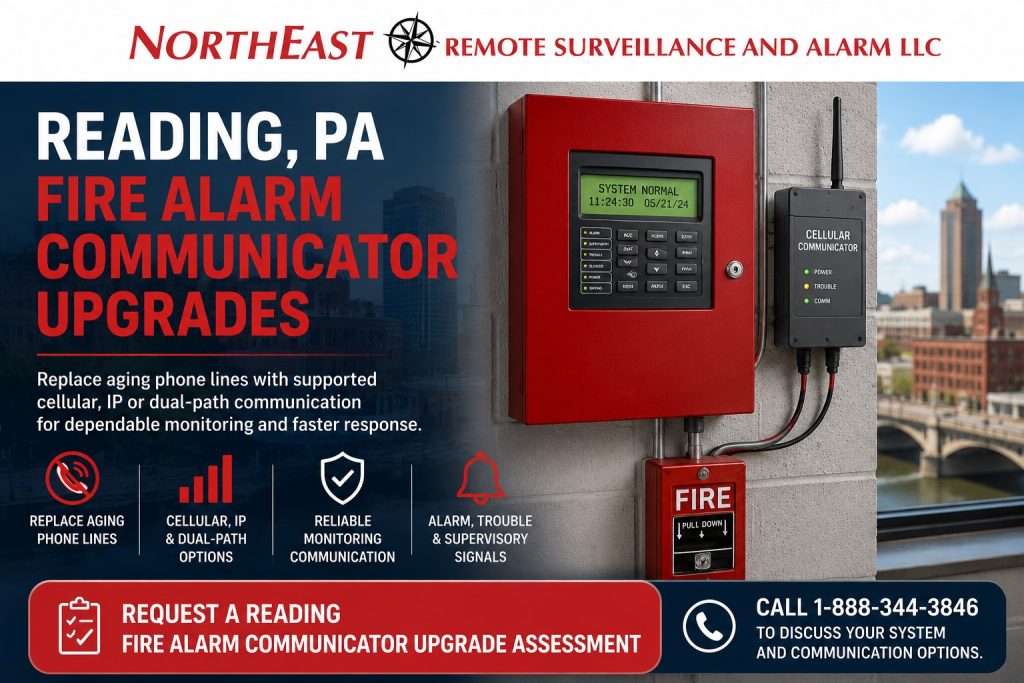
This focused fire alarm page supports NERSA’s Reading Commercial Security System Upgrades, Retrofits and Takeovers page.
It is intended for existing commercial fire alarm systems that require a more dependable and supportable method of transmitting alarm, supervisory, trouble and system-status signals to the designated monitoring center.
A fire alarm control panel does not necessarily need to be replaced simply because its original telephone-line communication path has become expensive, unreliable, unsupported or scheduled for removal. When the existing panel remains accessible, compatible and supportable, a communicator upgrade may modernize signal transmission while retaining usable detection, notification and control equipment.
Northeast Remote Surveillance and Alarm, LLC evaluates the existing fire alarm panel, communicator, telephone-line dependencies, cellular or network availability, power, batteries, monitoring account, event descriptions and available documentation before recommending a communication-path upgrade.
The objective is not merely to attach a cellular device to a fire alarm panel. The objective is to establish a properly planned, documented and supportable communication path that transmits the intended fire alarm events and can be maintained over time.
Commercial and industrial systems only • Existing fire alarm systems • Communicator replacement • Legacy phone-line modernization • Cellular and IP communication • Dual-path planning • Monitoring transitions • Signal verification • Documentation • Small businesses through enterprise facilities
Project availability and design depend on the property and its installed fire alarm equipment. Review ownership, programming access, manufacturer support and communication services. Monitoring requirements, adopted rules, AHJ expectations, existing records and long-term service needs also matter.
Modernize the Communication Path Without Automatically Replacing the Fire Alarm System
A commercial fire alarm system contains several related functions.
The fire alarm control panel receives information from initiating devices and system modules. Notification appliances alert building occupants when programmed conditions occur. The communicator transmits designated events to the monitoring center.
A problem with one component does not automatically mean the entire fire alarm system has failed.
The existing panel, initiating devices, notification appliances, wiring and control functions may remain usable while the communication path becomes difficult to support because of:
- Removed telephone lines
- Rising telephone-service costs
- Telephone-line failure
- Incompatible telephone emulation
- Aging cellular equipment
- Weak cellular performance
- Unreliable network service
- Provider-controlled communication hardware
- Inactive communication accounts
- Repeated communication troubles
- Unsupported communication technology
- A change in monitoring provider
A proper communicator assessment separates communication-path problems from unrelated panel, device or notification-system deficiencies.
For broader technical planning, review NERSA’s Fire Alarm Communicator Upgrades resource.
When a Reading Property Should Consider a Communicator Upgrade
The Fire Alarm System Still Uses Traditional Telephone Lines
Many existing commercial fire alarm systems were originally configured to report through one or more conventional telephone lines.
A property may need communication modernization when:
- Telephone service is being discontinued
- The existing lines have become expensive
- The building is changing telephone providers
- Analog service is being replaced
- The panel reports repeated line troubles
- Nobody can identify which lines serve the fire alarm system
- The current arrangement is poorly documented
- Telephone-service changes are planned during renovation
The existing communication path should not be disconnected before the fire alarm arrangement is identified and the replacement path is installed, programmed and tested through the approved project process.
The Existing Cellular Communicator Is Aging or Unsupported
Cellular communication equipment may require replacement even when the fire alarm control panel remains operational.
A communicator should be reviewed when:
- The model is no longer supported
- Its cellular technology is obsolete
- Replacement parts are unavailable
- Signal strength is inconsistent
- Communication failures occur repeatedly
- The associated service account cannot be transferred
- The previous provider owns or controls the device
- The communicator cannot report the intended panel events
- The monitoring platform no longer supports it
A compatible replacement communicator may allow the existing fire alarm panel to remain in service when the panel is otherwise supportable.
The Building Is Changing Monitoring Providers
A monitoring transition usually requires more than opening a new account.
The project may involve:
- Customer authorization
- Equipment-ownership review
- Fire alarm panel programming
- Communicator replacement or re-enrollment
- Monitoring-account creation
- Signal-format verification
- Event-description cleanup
- Emergency-contact updates
- Dispatch-procedure review
- Alarm, supervisory and trouble testing
- Coordination with the former provider
The old communication arrangement should remain active until the replacement path has been verified according to the approved transition plan.
The Fire Alarm Panel Shows Communication Trouble
A communication-related trouble condition may involve:
- Telephone-line failure
- Cellular communication failure
- Network interruption
- Missing communicator supervision
- Account-programming problems
- Incorrect receiver information
- Weak cellular service
- Antenna-placement problems
- Loss of communicator power
- Low backup battery
- Damaged wiring
- Failed communication hardware
- Monitoring-platform incompatibility
The cause should be identified before equipment is replaced.
A disconnected telephone line requires a different correction than a failed communicator, incorrect account setting or damaged panel connection.
The Communicator Is Controlled by a Previous Provider
A building owner or new tenant may inherit a communicator without receiving:
- Programming information
- Account credentials
- Monitoring documentation
- Equipment-ownership records
- Emergency-contact lists
- Service history
- Cellular-account information
- Signal descriptions
- Test records
- Cancellation procedures
NERSA can evaluate the available equipment and documentation to determine whether the communicator can be retained, transferred, reprogrammed or replaced.
The Property Is Being Renovated or Reconfigured
Renovation, tenant work or a change in building operation may affect the fire alarm communication path.
The review may need to account for:
- A relocated fire alarm panel
- New sprinkler monitoring points
- Additional buildings
- Tenant separation
- New network infrastructure
- Telephone-line removal
- Changed emergency contacts
- New ownership or management
- Updated monitoring responsibilities
- Panel or communicator replacement
Communicator work should be coordinated with the complete approved fire alarm scope rather than treated as an isolated telephone or network change.
What a Reading Fire Alarm Communicator Upgrade May Include
A communicator upgrade may include:
- Identifying the existing fire alarm panel
- Documenting the installed communicator
- Confirming the current monitoring path
- Identifying telephone-line dependencies
- Reviewing cellular-service availability
- Reviewing available network connectivity
- Confirming panel and communicator compatibility
- Determining equipment ownership
- Reviewing authorized programming access
- Replacing unsupported communication hardware
- Installing a compatible communicator
- Reviewing power and battery requirements
- Establishing or transferring the monitoring account
- Correcting event descriptions
- Updating emergency contacts
- Sending applicable test signals
- Confirming signal receipt
- Documenting the completed communication path
The proposal should explain what equipment will remain, what will be replaced and what limitations or dependencies will continue.
Communicator Upgrade or Complete Fire Alarm Replacement?
A communicator problem should not automatically be converted into a complete fire alarm replacement.
Communicator-Only Upgrade
A focused communicator upgrade may be appropriate when:
- The fire alarm panel remains supported
- Authorized programming access is available
- The panel operates properly
- The panel can provide the intended reportable events
- Compatible communication equipment is available
- Existing power can support the new equipment
- The monitoring arrangement can be established
- No unrelated condition requires immediate panel replacement
This scope focuses on communication and monitoring-path modernization.
Panel and Communicator Upgrade
Both components may require replacement when:
- The fire alarm panel is unsupported
- Programming access cannot be obtained
- Compatible communicators are unavailable
- The panel cannot report the required events
- Replacement parts are unavailable
- The panel repeatedly fails
- Existing capacity is inadequate
- The equipment lacks a practical long-term support path
The proposal should distinguish panel work from communicator-only work.
Broader Fire Alarm Replacement
Complete replacement may be appropriate when the overall system is obsolete, damaged, unreliable, unsupported or incompatible with the property’s approved requirements.
That broader project belongs under the appropriate fire alarm upgrade or installation page. This Reading resource remains focused on existing communication paths and communicator modernization.
Cellular Fire Alarm Communication
A cellular fire alarm communicator uses an available cellular network to transmit supported events to the monitoring platform.
Planning may include:
- Fire alarm panel compatibility
- Communicator compatibility
- Available cellular carriers
- Signal strength
- Antenna location
- Building construction
- Equipment-room location
- Power requirements
- Battery backup
- Panel connection
- Communication supervision
- Monitoring-platform support
- Account ownership
- Recurring communication service
Metal buildings, interior utility rooms, below-grade locations and other building conditions may affect cellular performance.
Signal conditions should be evaluated at the proposed communicator or antenna location rather than assumed from ordinary mobile-phone performance elsewhere on the property.
IP Fire Alarm Communication
An IP communicator uses an approved network connection to transmit supported system events.
Planning may involve:
- Panel and communicator compatibility
- Customer IT approval
- Network ownership
- Available network connections
- Firewall coordination
- Addressing requirements
- Internet-service availability
- Backup power for network equipment
- Communication supervision
- Cybersecurity requirements
- Monitoring-platform compatibility
- Responsibilities during network changes
The communicator should not depend on an undocumented network connection that can be disconnected during ordinary IT work without appropriate coordination.
The customer should know which network components affect fire alarm communication and who is responsible for maintaining them.
Dual-Path Fire Alarm Communication
A dual-path arrangement uses two supported communication methods or routes when required or selected for the project.
A supported design may combine:
- Cellular and IP communication
- Multiple cellular paths where available
- Another manufacturer-supported communication arrangement
The appropriate configuration depends on the panel, communicator, monitoring platform, available services and approved project requirements.
Two communication paths do not provide meaningful resilience when both depend on the same unsupported power source, temporary network equipment or undocumented infrastructure.
The complete communication architecture should be evaluated as one system.
Reportable Events Should Be Identified and Verified
A communicator upgrade should identify the events the fire alarm system is intended to transmit.
Depending on the installed system and monitoring arrangement, reportable events may include:
- General fire alarm
- Individual initiating-device alarms
- Sprinkler waterflow
- Valve supervisory conditions
- Fire pump conditions
- Duct detector activation
- Manual pull-station activation
- Smoke detector activation
- Communication trouble
- AC power failure
- Battery trouble
- Device or circuit trouble
- Panel trouble
- Supervisory events
- Signal restoration
- Scheduled test signals
Event descriptions should help the monitoring center and authorized property representatives understand what occurred.
Generic descriptions such as “Zone 3” or “Module 5” may provide limited value when more specific reporting is available.
More useful descriptions may identify:
- Main sprinkler waterflow
- Warehouse valve supervisory
- First-floor east smoke detector
- Rooftop-unit duct detector
- Fire pump running
- North-building fire alarm
- Second-floor circuit trouble
The detail available depends on the panel, communicator, reporting format and monitoring arrangement.
Monitoring Account and Contact Review
Communicator modernization should include a review of the associated monitoring account.
The property representative should confirm:
- Legal business name
- Correct property address
- Building or suite information
- Authorized representatives
- Primary and alternate contacts
- Verification information
- Emergency instructions
- Signal descriptions
- Testing procedures
- Account ownership
- Service responsibilities
- Contact-update procedures
Outdated information may prevent the monitoring center from reaching the appropriate property representative during an alarm, supervisory or trouble event.
For broader information about fire alarm event transmission, monitoring responsibilities and system supervision, review Fire Alarm Monitoring and Supervision.
Sprinkler-Related Signals
Many commercial fire alarm systems receive information from sprinkler monitoring devices.
Connected events may include:
- Waterflow
- Valve supervisory conditions
- Fire pump status
- Low-air conditions
- Other sprinkler-related supervisory points
A communicator upgrade does not replace sprinkler inspection, installation or mechanical repair.
The communicator project should verify that the fire alarm control panel receives the intended connected conditions and transmits the programmed events to the monitoring center.
Coordination may involve:
- Property management
- Fire alarm contractor
- Sprinkler contractor
- Monitoring provider
- Customer representatives
- IT personnel
- The applicable AHJ
Responsibilities should be established before testing or system changes begin.
Power Supplies and Backup Batteries
A fire alarm communicator depends on appropriate power.
The review may examine:
- Required voltage
- Current demand
- Power-source compatibility
- Existing panel capacity
- Separate power supplies
- Battery charging
- Battery condition
- Battery capacity
- Equipment supervision
- AC power-failure reporting
- Enclosure condition
A communicator should not be added to an existing power source without reviewing the available capacity.
Existing batteries should be evaluated rather than assumed to remain usable because they are physically present.
Network and IT Coordination
An IP or network-dependent communication path may require coordination with the customer’s IT department or managed service provider.
The project should identify:
- Who owns the network
- Who approves the connection
- Which equipment supports the communicator
- Who controls addressing and firewall settings
- Whether remote access is permitted
- What backup power supports the network
- How network changes will be communicated
- Who responds to a communication failure
- What documentation will be retained
Fire alarm communication should not be installed on an unknown port, temporary connection or undocumented network segment.
What Existing Equipment May Be Retained?
Existing equipment may remain when it is:
- Customer-owned
- Accessible
- Operational
- Supported
- Compatible
- Properly installed
- Adequately powered
- Testable
- Documented
- Appropriate for continued service
Potentially reusable equipment may include:
- Fire alarm control panel
- Panel enclosure
- Initiating devices
- Notification appliances
- Monitor modules
- Control modules
- Wiring
- Power supplies
- Serviceable batteries
- Existing communication pathways
- Approved network infrastructure
Reuse should be based on inspection, compatibility and testing rather than equipment age alone.
When Communication Equipment Should Be Replaced
Replacement may be appropriate when a communicator is:
- Unsupported
- Obsolete
- Provider-owned
- Locked to an unavailable account
- Physically damaged
- Repeatedly failing
- Incompatible with the fire alarm panel
- Incompatible with the monitoring platform
- Dependent on discontinued technology
- Unable to transmit the intended events
- Improperly powered
- Missing necessary supervision
- More costly to maintain than replace
The proposal should explain why the installed communicator cannot remain.
Reading Properties That May Need Communicator Upgrades
Warehouses and Distribution Centers
Warehouse projects may involve:
- Large sprinklered areas
- Multiple waterflow zones
- Valve supervisory conditions
- Fire pumps
- Separate office and warehouse sections
- Detached buildings
- Telephone-line removal
- Cellular signal challenges
- Multi-shift emergency contacts
- Monitoring-account cleanup
Manufacturing and Industrial Facilities
Industrial projects may require coordination around:
- Production schedules
- Process equipment
- Fire pumps
- Multiple buildings
- Existing network restrictions
- Controlled shutdown periods
- Plant emergency procedures
- Maintenance personnel
- Approved testing windows
Installation and testing may need to be phased to avoid unnecessary operational disruption.
Offices and Multi-Tenant Buildings
Office and multi-tenant properties may require review of:
- Common fire alarm systems
- Tenant responsibilities
- Property-management contacts
- Multiple suites
- Central monitoring accounts
- Telephone-service changes
- Network ownership
- After-hours contacts
- Panel and communicator access
Monitoring and communication-account ownership should remain clear when tenants, owners or property managers change.
Healthcare, Educational and Institutional Properties
These facilities may require planning around:
- Occupied areas
- Staff notification
- Emergency procedures
- Restricted equipment rooms
- Multiple buildings
- IT policies
- Approved testing periods
- Monitoring contacts
- Documentation
- AHJ coordination
Small Commercial Properties
A smaller Reading office, shop, medical practice, restaurant, contractor facility or commercial building may have a less complex system, but it still requires dependable communication, correct event transmission and documented account ownership.
NERSA evaluates qualifying projects ranging from focused small-business communicator replacements to multi-building and enterprise communication upgrades.
The NERSA Reading Fire Alarm Communicator Upgrade Process
1. Identify the Communication Problem
NERSA begins by determining why the existing communication path requires attention.
The concern may involve:
- Telephone-line removal
- Recurring trouble conditions
- Unsupported cellular equipment
- A monitoring-provider change
- Poor documentation
- Unreliable transmission
- Provider-controlled equipment
- A broader fire alarm upgrade
2. Inspect the Existing Equipment
The assessment may review:
- Fire alarm control panel
- Existing communicator
- Telephone-line connections
- Cellular equipment
- Network connections
- Power supplies
- Backup batteries
- Programming access
- Monitoring information
- Available documentation
3. Confirm Ownership, Compatibility and Requirements
NERSA evaluates:
- Customer authorization
- Equipment ownership
- Panel compatibility
- Communicator options
- Available communication services
- Monitoring compatibility
- Existing account limitations
- Coordination requirements
- Long-term serviceability
4. Develop the Upgrade Scope
The scope should identify:
- Equipment being retained
- Equipment being replaced
- Selected communication path
- Monitoring responsibilities
- Programming requirements
- Power requirements
- Network requirements
- Event descriptions
- Testing procedures
- Documentation
- Known exclusions
- Recurring service requirements
5. Install and Program the Communicator
The approved communicator is installed, connected and programmed according to the selected equipment and project requirements.
Work may include:
- Communicator mounting
- Panel connections
- Antenna placement
- Network connection
- Power connection
- Battery backup
- Account enrollment
- Event programming
- Communication supervision
6. Test Event Transmission
Testing may include applicable:
- Alarm events
- Supervisory events
- Trouble events
- Restorations
- Communication failures
- Power-failure events
- Scheduled tests
- Individual point descriptions
Testing should confirm that applicable events are received and identified correctly by the designated monitoring center.
7. Update Documentation
Documentation may identify:
- Fire alarm panel
- Communicator model
- Communication method
- Equipment location
- Account ownership
- Monitoring contacts
- Event descriptions
- Power source
- Network dependencies
- Known limitations
- Test results
- Service responsibilities
8. Train Authorized Representatives
Authorized customer representatives should understand:
- What equipment was changed
- Who owns the monitoring account
- How to report a trouble condition
- How to place the system on test
- Who may update emergency contacts
- Who controls the network connection
- How to request service
- What recurring communication services apply
Communicator Upgrade Limitations
A project may be limited by:
- Unsupported fire alarm panels
- Missing programming access
- Proprietary equipment
- Unknown equipment ownership
- Provider-controlled communicators
- Non-transferable accounts
- Weak cellular service
- Customer IT restrictions
- Unavailable network connectivity
- Inadequate power
- Failed batteries
- Damaged wiring
- Missing documentation
- Incorrect event descriptions
- Unresolved panel troubles
- Unavailable replacement equipment
- Hidden building conditions
- Permitting or engineering requirements
- AHJ requirements
- No practical support path
These conditions should be identified before the existing communication arrangement is disconnected.
Why Reading Businesses Use NERSA for Communicator Upgrades
A commercial fire alarm communicator upgrade requires more than replacing a telephone line with a cellular device.
It requires an understanding of:
- Fire alarm panel compatibility
- Communicator technology
- Monitoring accounts
- Alarm, supervisory and trouble events
- Cellular coverage
- Network dependencies
- Power and battery requirements
- Equipment ownership
- System documentation
- Testing coordination
- AHJ expectations
- Long-term supportability
Northeast Remote Surveillance and Alarm, LLC focuses on commercial, industrial, institutional, municipal, healthcare, educational, warehouse, manufacturing, logistics and multi-site properties.
NERSA evaluates the panel, communicator and monitoring arrangement as one operating environment and develops a practical path from an aging or poorly documented communication method to a supportable system.
Request a Reading Fire Alarm Communicator Upgrade Assessment
A Reading fire alarm communicator assessment can help determine whether the appropriate path is telephone-line replacement, cellular modernization, IP communication, dual-path communication, communicator replacement, monitoring transfer or a broader fire alarm panel upgrade.
The assessment may review:
- Existing fire alarm panel
- Installed communicator
- Telephone-line dependencies
- Cellular communication
- IP communication
- Dual-path options
- Panel compatibility
- Programming access
- Equipment ownership
- Power supplies
- Backup batteries
- Event descriptions
- Alarm, supervisory and trouble events
- Monitoring account
- Emergency contacts
- Network requirements
- Existing documentation
- Known communication troubles
- Long-term support requirements
Frequently Asked Questions About Reading Fire Alarm Communicator Upgrades
What is a fire alarm communicator?
A fire alarm communicator transmits programmed alarm, supervisory, trouble and system-status events from the fire alarm control system to its designated monitoring platform.
Does replacing the communicator require replacing the fire alarm panel?
Not always. A serviceable panel may remain when it is accessible, supported and compatible with an appropriate communicator.
Can an old telephone-line fire alarm system be upgraded to cellular communication?
Possibly. The panel, interface, monitoring requirements, cellular availability and project requirements must be evaluated.
Can NERSA upgrade a communicator installed by another provider?
NERSA can evaluate qualifying customer-authorized commercial systems to determine whether the communicator can be transferred, reprogrammed, retained or replaced.
What happens when the previous provider owns the communicator?
Provider-owned equipment may need to be returned, disconnected or replaced. Equipment ownership and account responsibilities should be established before the monitoring arrangement changes.
Can the communicator use the customer’s internet connection?
Some supported configurations may use an IP connection. Compatibility, network reliability, IT approval, backup power and monitoring support must be reviewed.
What is dual-path fire alarm communication?
Dual-path communication uses two supported communication methods or routes, such as cellular and IP, when required or selected for the approved project.
Can the old telephone lines be disconnected immediately?
The existing path should remain until the replacement communicator has been installed, programmed, tested and confirmed operational under the approved transition process.
Will a communicator upgrade correct every fire alarm trouble condition?
No. A communicator upgrade addresses communication and event transmission. Panel, device, notification, wiring, battery and other system troubles may require separate work.
Can an existing cellular communicator be reused?
Possibly. Reuse depends on ownership, manufacturer support, cellular technology, compatibility, account transferability, physical condition and monitoring-platform support.
Does the communicator report sprinkler waterflow and valve supervisory conditions?
It may transmit those events when the connected devices are properly interfaced and programmed through the fire alarm system.
Does NERSA install or repair sprinkler piping?
This resource concerns fire alarm communication. Mechanical sprinkler work requires the appropriate qualified sprinkler contractor.
Can the monitoring provider be changed during the upgrade?
Yes, when customer authorization, compatible equipment, account enrollment, programming and complete event testing support the transition.
What information should be gathered before the assessment?
Useful information includes the panel manufacturer and model, existing communicator, monitoring provider, telephone-service information, recent trouble conditions, account records, inspection reports and available system documentation.
Does NERSA support both small commercial properties and enterprise facilities?
Yes. NERSA evaluates qualifying communicator upgrades for smaller offices and businesses as well as warehouses, manufacturing plants, institutional properties and multi-building facilities.
Does this guide cover routine fire alarm testing and inspection?
No. This guide covers communication-path and communicator modernization. Routine inspection, testing and broader fire alarm compliance services remain separate service needs.
How does a Reading business begin a communicator upgrade?
Call 1-888-344-3846 or submit the NERSA assessment request.
NERSA can review the installed panel, communication equipment, monitoring arrangement and known trouble conditions before recommending the appropriate upgrade.
Compliance, Codes & Project Standards
NERSA plans commercial and industrial security work with applicable code, documentation, inspection and authority-having-jurisdiction requirements in mind. Requirements vary by system, property and jurisdiction. These resources support project planning; they do not establish legal compliance, certification or AHJ approval.
Related guidance: Regulatory compliance & inspection readiness · Fire alarm inspection readiness · NFPA 72 fire-alarm planning